
West Virginia Outdoor Recreation Surges to $9.1 Billion Economic Impact and 61,000 Jobs
West Virginia's outdoor recreation economy generated $9.1 billion in visitor spending, $1.1 billion in tax revenue, and supported 61,000 jobs.

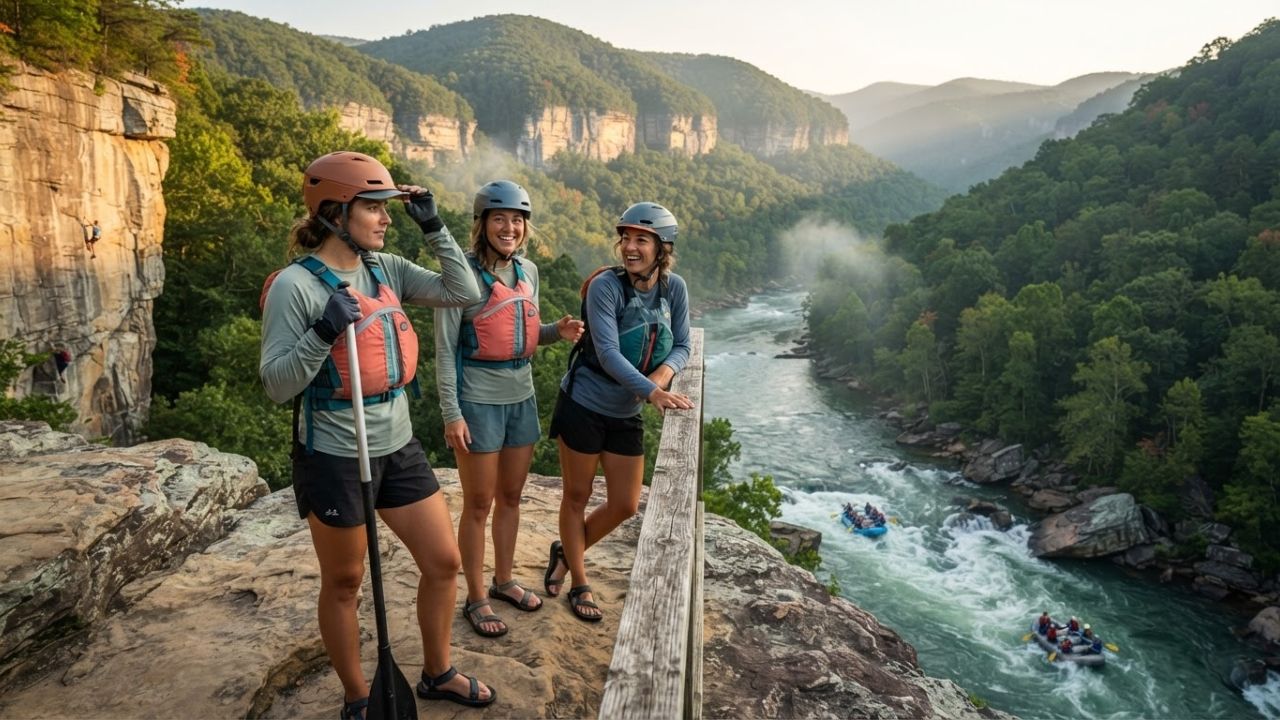
Image generated by AI
West Virginia’s high-intensity outdoor recreation sector has grown into a $9.1 billion economic engine, sustaining 61,000 jobs and generating $1.1 billion in state and local tax revenue across mountain communities.
[CHARLESTON, W.Va.] — Official economic performance reports from the West Virginia Department of Tourism and federal land agencies confirm that adventure tourism and outdoor recreation generated $9.1 billion in direct visitor spending. Powered by 77.2 million annual visitor arrivals, the sector supports 61,000 jobs—representing nearly 7% of total state employment—and generates $2.2 billion in direct labor income. Tax revenues derived from outdoor recreation save the average West Virginia household approximately $859 per year in local tax relief while funding public infrastructure across former industrial coalfield regions.
New River Gorge and Gauley River Whitewater Catalysts
High-intensity river rafting serves as the primary catalyst for West Virginia’s recreation market, drawing hundreds of thousands of paddlers annually.
The New River Gorge National Park & Preserve, managed under the authority of the U.S. National Park Service, registered 1,958,440 visits during the latest reporting period. Commercial outfitter permits strictly regulate access to Class III to V rapids along the Lower Gorge to balance passenger safety with river conservation.
Further north, the Gauley River National Recreation Area hosts "Gauley Season," a six-weekend autumn window following Labor Day driven by scheduled water releases from Summersville Dam managed by the U.S. Army Corps of Engineers. Extreme paddlers navigate Class V+ rapids including Insignificant, Pillow Rock, and Sweet’s Falls, bringing 40,000 to 60,000 technical kayakers into local mountain communities annually.
West Virginia Whitewater Metrics:
├── New River Gorge Annual Visits: 1,958,440 registered visits (NPS)
├── Gauley Season Kayaker Volume: 40,000 to 60,000 technical paddlers across 6 autumn weekends
└── Water Release Control: Summersville Dam managed by U.S. Army Corps of Engineers
Technical Rock Climbing at Seneca Rocks and Meadow River Gorge
Alpine climbing and vertical mountaineering form a major structural pillar of the state's outdoor profile, attracting elite athletes to quartzite and sandstone formations.
Seneca Rocks, situated within the 921,000-acre Monongahela National Forest and monitored by the U.S. Forest Service, features a 900-foot quartzite fin rising above the North Fork River. The formation attracts global traditional climbers attempting multi-pitch vertical routes.
Concurrently, the Endless Wall and Meadow River Gorge offer more than 3,000 established climbing routes in Nuttall sandstone. Combined, these vertical assets contribute to the 1.3 million outdoor enthusiasts who visit the Monongahela National Forest annually.
Climbing & Forest Infrastructure:
├── Monongahela National Forest Scale: 921,000 protected acres | 1.3 Million annual visitors
├── Seneca Rocks Height: 900-foot quartzite fin above North Fork River
└── Endless Wall & Meadow River Routes: 3,000+ established Nuttall sandstone climbing routes
Subterranean Karst Exploration in Organ Cave and Lost World Caverns
Beneath the surface, West Virginia contains an extensive subterranean network documented by the U.S. Geological Survey and the West Virginia Geological and Economic Survey.
Featuring more than 4,000 surveyed caves, the state possesses one of North America's densest concentrations of karst topography. Organ Cave System and Lost World Caverns represent primary destinations for technical speleology, where wild cavers navigate vertical shafts and narrow rock fissures.
Federal and state management guidelines govern cavern access to protect fragile speleothems and hibernating bat populations, channeling research and adventure travel into isolated rural counties.
Hatfield-McCoy Trail System Coalfield Economic Revitalization
Motorized off-road recreation has transformed former industrial coal mining corridors into world-class off-highway vehicle (OHV) trail networks.
The Hatfield-McCoy Trail System incorporates over 1,000,000 acres of public and private land managed by a regional public authority partnering with 300+ landowners. The network issues over 115,000 trail permits annually, with more than 80% purchased by out-of-state visitors.
Out-of-state utility terrain vehicle (UTV) riders generate over $80 million in direct annual non-local spending and $68 million in direct economic impact, revitalizing lodging, dining, and machine maintenance businesses across southern coalfield towns.
Hatfield-McCoy Trail Network Economics:
├── Total Land Scale: 1,000,000+ acres across public & 300+ private land holdings
├── Annual Permits Issued: 115,000+ permits (80%+ out-of-state buyers)
└── Direct Financial Impact: $80M+ non-local spending | $68M direct economic impact
Comprehensive Economic and Tax Breakdown
The table below outlines the macroeconomic metrics, visitor volumes, employment data, and tax distribution generated by West Virginia's outdoor recreation sector.
| Economic / Operational Indicator | Measured Value / Statistic | Operational Scope & Impact |
|---|---|---|
| Total Visitor Volume | 77.2 Million (Up to 80M peak) | Statewide leisure & adventure arrivals |
| Direct Visitor Spending | $9.1 Billion ($6.6B baseline) | Outfitter, lodging, dining & gear purchases |
| Total Employment Impact | 61,000 Jobs (1 in 15 statewide) | ~7% of total West Virginia employment |
| Labor Income Generation | $2.2 Billion | Direct guide, ranger & hospitality payroll |
| State & Local Tax Revenues | $1.1 Billion ($619M state/local) | Infrastructure, emergency services & public schools |
| Household Tax Savings | $859 per household annually | Direct local tax offset for residents |
| Winter Alpine Visitors | 18.5 Million visitors | Snowshoe Mountain & Timberline resort surge |
| BEA National GDP Baseline | 2.4% US GDP ($696.7 Billion) | High state recreation dependency |
State GDP Contribution and BEA Macroeconomic Analysis
Macroeconomic data published by the U.S. Bureau of Economic Analysis (BEA) highlights outdoor recreation as a primary engine of West Virginia’s Gross Domestic Product.
While outdoor recreation accounts for 2.4% of total U.S. GDP ($696.7 billion nationally), West Virginia ranks among the most recreation-dependent state economies in the Eastern United States.
Retaining $619 million of the $1.1 billion total tax revenue stream allows municipal bodies to fund emergency response networks, road maintenance, and public services without increasing local property or income taxes on residents.
Why This Matters for Paddlers, Off-Roaders, and Mountain Communities
Analyzing West Virginia's $9.1 billion outdoor recreation economy highlights key practical benefits for travelers and residents:
- For Whitewater & Climbing Enthusiasts: Controlled water releases at Summersville Dam and U.S. Forest Service preservation at Seneca Rocks guarantee world-class Class V rapids and multi-pitch climbing routes.
- For Off-Road UTV Riders: The 1,000,000-acre Hatfield-McCoy Trail System offers over 115,000 annual permit holders access to interconnected coalfield trails supported by local service hubs.
- For West Virginia Residents: A robust outdoor economy sustains 61,000 jobs, generates $2.2 billion in labor income, and provides $859 in annual household tax relief through non-resident visitor spending.
Related Travel Guides
Disclaimer
This article is for informational and educational purposes only. It does not constitute legal, financial, or professional advice. While we strive to provide accurate and up-to-date information, travel policies, regulations, and conditions change rapidly. Always verify information with official sources before making travel decisions. Nomad Lawyer makes no representations about the accuracy, reliability, completeness, or suitability of the information provided. Readers should consult qualified professionals for advice specific to their circumstances. The views expressed in this article are those of the author and do not necessarily reflect the views of Nomad Lawyer.
Raushan Kumar
Founder & Lead Developer
Full-stack developer with 11+ years of experience and a passionate traveller. Raushan built Nomad Lawyer from the ground up with a vision to create the best travel and law experience on the web.
Learn more about our team →