
Vietnam Blue Economy Revolution: Marine Protected Areas, Coastal Co-Management, and Eco-Tourism Expansion to 2030
Vietnam reshapes tropical travel by expanding its marine protected sanctuary network to 442,230 hectares, handing reef restoration and eco-tourism co-management to coastal villagers.

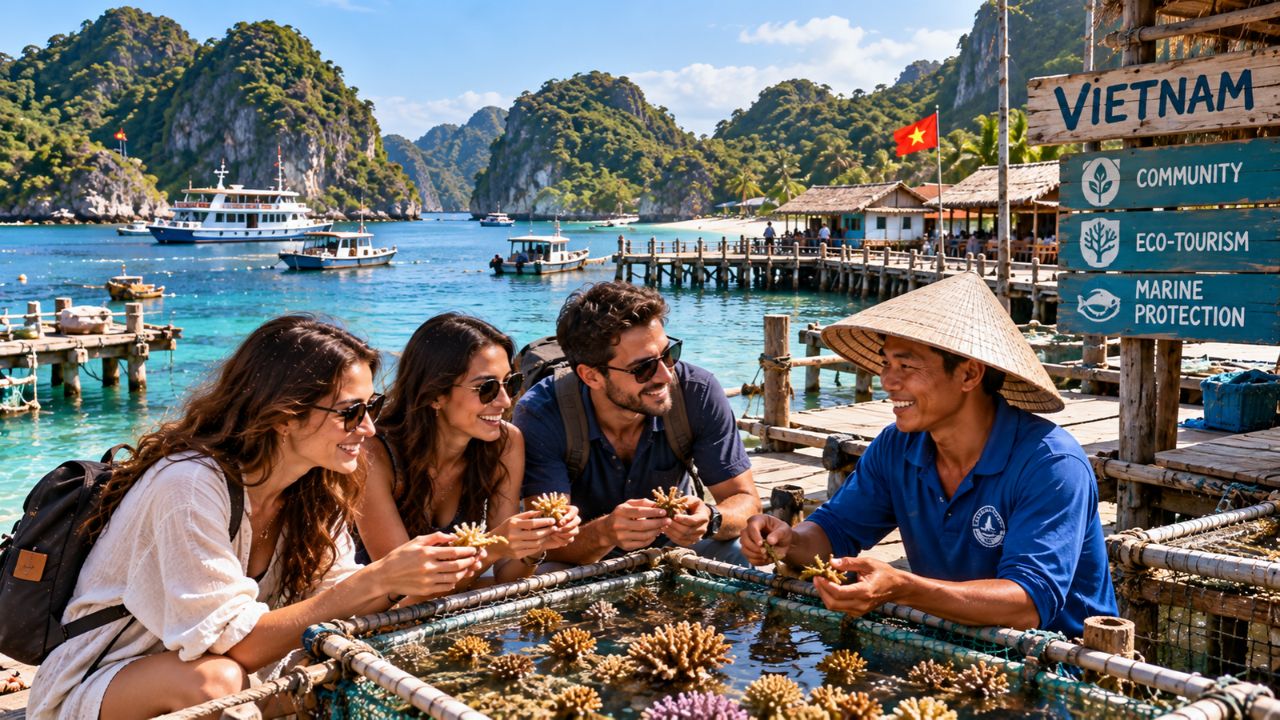
Executing a strategic pivot away from high-density coastal concrete construction, Vietnam is restructuring its 3,260-kilometer shoreline and one-million-square-kilometer Exclusive Economic Zone by transferring operational stewardship of fragile marine sanctuaries directly to coastal fishing communities. Anchored by national legislative mandates aiming to expand the country's Marine Protected Area (MPA) network from less than 0.2 percent to at least 6 percent of national waters—encompassing more than 442,230 hectares across 27 operational sanctuaries by 2030—this blue economy transition replaces destructive commercial harvesting with community-led eco-tourism, coral nursery cultivation, and sea turtle conservation. Across island archipelagos from Ha Long Bay to the Con Dao islands, traditional fishers are becoming salaried environmental wardens, certified dive guides, and sustainable hospitality hosts.
Supervised at the ministerial level by the Cục Du lịch Quốc gia Việt Nam alongside the Bộ Nông nghiệp và Phát triển Nông thôn, this decentralized conservation model aligns ecological rehabilitation with national macroeconomic targets. Under Resolution No. 36-NQ/TW and Decision No. 147/QD-TTg, the central government projects the marine economy to generate 10 to 12 percent of gross domestic product by 2030, contributing toward an overarching travel revenue target of $130 billion to $135 billion. By establishing statutory co-management rights, Vietnam ensures that international visitor expenditures flow directly into local village cooperatives rather than off-island commercial conglomerates.
Legislative Blueprints: Marine Spatial Planning and Community Co-Management Mandates
The legal architecture underpinning Vietnam's maritime realignment rests on three foundational policy frameworks designed to eliminate regulatory overlap and grant coastal residents enforceable management authority:
- Resolution No. 36-NQ/TW (Marine Economy Strategy to 2030, Vision to 2045): Defines the marine sector as an economic pillar while mandating that all commercial activities comply with strict carrying-capacity thresholds and habitat regeneration protocols.
- Resolution No. 139/2024/QH15 (National Marine Spatial Planning): Establishes clear legal boundaries across territorial waters, partitioning marine environments into strictly preserved core ecological zones, regulated buffer sectors, and controlled eco-tourism corridors.
- Decision No. 1117/QD-TTg and the Law on Fisheries: Grants coastal co-management associations statutory authority to regulate local fisheries, monitor coral reefs, and manage community tourism concessions in partnership with provincial administrative departments.
These frameworks directly resolve historical jurisdictional conflicts. In regions such as Khanh Hoa, Quang Nam, and Quang Ninh provinces, local marine management boards previously lacked statutory powers to deter unauthorized commercial trawlers. Under updated co-management structures, community patrol units conduct joint maritime enforcement operations alongside the Cục Kiểm ngư Việt Nam and the national Border Guard, closing enforcement gaps across remote island perimeters.
Island Sanctuaries in Action: Cham Islands, Ly Son, and Con Dao
The operational success of Vietnam's marine conservation transition is anchored by localized initiatives across key island destinations, where direct community action has produced rapid biological recovery:
Cham Islands (Quang Nam Province): Zero-Plastic Discipline and Co-Management
Positioned off the coast of Hoi An, the Cham Islands Marine Protected Area serves as Southeast Asia’s benchmark for community-enforced conservation. Island authorities and local village committees enacted an absolute ban on single-use plastic bags and disposable packaging, achieving a documented reduction in municipal solid waste exceeding 70 percent.
Local fishers patrol marine boundaries to prevent illegal blast and cyanide fishing, protect sandy nesting beaches for endangered sea turtles, and guide educational snorkeling excursions. Island admissions incorporate eco-fees ranging from 10,000 to 20,000 VND per visitor, which are retained locally to fund daily beach cleanups, material sorting facilities, and village cooperative healthcare initiatives.
Ly Son Island and Nha Trang Bay: Coral Nurseries and Species Rehabilitation
In Ly Son Island (Quang Ngai Province) and the Hon Mun sanctuary within Nha Trang Bay (Khanh Hoa Province), former extractive fishermen work alongside marine biologists to manage extensive coral nursery farms. Nha Trang Bay shelters extraordinary biological diversity, housing more than 350 species of hard corals, 250 species of reef fish, 122 crustacean varieties, and 112 mollusc species.
Villagers cultivate, fragment, and transplant thousands of nursery-grown coral colonies annually onto degraded reef flats. Documented biological monitoring confirms that protected core zones achieve measurable increases in coral canopy cover and fish biomass within two to four years of community enforcement, generating biological spillover that naturally replenishes adjacent communal fishing grounds.
Con Dao Archipelago: Endangered Sea Turtle Protection
In Con Dao National Park (Ba Ria – Vung Tau Province), community volunteers and park rangers manage Vietnam’s most successful marine reptile nursery network. Nightly beach patrols monitor nesting green sea turtles, safely relocating clutches threatened by high tides or predators into controlled incubation hatcheries. The program hatches and releases between 100,000 and 150,000 green sea turtle hatchlings annually into the East Sea, recording an exceptional survival hatch rate exceeding 80 percent.
The following data table breaks down operational zones, conservation targets, and community tourism mechanisms across Vietnam’s primary marine protected areas:
| Marine Protected Sanctuary | Coastal Province & Jurisdiction | Protected Area & Ecological Focus | Community Co-Management Mechanism | Key Wildlife & Habitat Metrics | Visitor Access & Eco-Fee Regulations |
|---|---|---|---|---|---|
| Cham Islands MPA | Quang Nam (Hoi An Maritime Zone) | Coral reefs, seagrass beds, sea turtle nesting beaches | Strict village co-management; paid community ranger patrols | Single-use plastic ban cuts waste by >70%; coral cover recovery | Controlled day-boat quotas; 10,000–20,000 VND local conservation fee |
| Nha Trang Bay (Hon Mun) | Khanh Hoa (South-Central Coast) | Shallow fringing reefs, deep-water benthic habitats | Fishers retrained as divemasters and coral nursery operators | Shelters 350+ coral species, 250 reef fish, 122 crustacean types | Core sanctuary closed to anchoring; regulated electric boat tours |
| Ly Son Marine Reserve | Quang Ngai (Offshore Volcanic Island) | Volcanic underwater topography, shallow reef flats | Fisher cooperatives manage low-impact coastal boat circuits | Community coral nursery fragments transplanted across damaged flats | Small-group snorkeling permits; strict catch-and-release zoning |
| Bai Tu Long National Park | Quang Ninh (Northern Coastal Basin) | Karst limestone islands, tidal mangrove forests | Island households guide non-motorized sea kayak routes | Mangrove roots store 3–5x more blue carbon than rainforests | Large cruise ships excluded; low-impact homestays prioritized |
| Cat Ba Biosphere Reserve | Haiphong (Lan Ha Bay Maritime Zone) | Marine karst lagoons, coastal aquaculture bays | Floating educational centers, eco-aquaculture cooperatives | Solar-powered passenger tenders replace diesel engine craft | Zoned navigation channels; mandatory solid waste collection |
| Con Dao National Park | Ba Ria – Vung Tau (Southern Archipelago) | Pristine marine corridors, sandy turtle beaches | Ranger-volunteer teams manage sea turtle hatcheries | 100,000–150,000 sea turtle hatchlings released annually (>80% survival) | Regulated night turtle encounters; strict coastal lighting controls |
Blue Carbon Dynamics: Mangrove Conservation and Climate Resilience
Beyond fringing coral reefs, Vietnam’s blue economy strategy places heavy emphasis on protecting extensive coastal mangrove wetlands across Bai Tu Long National Park (Quang Ninh Province), Xuan Thuy National Park (Nam Dinh Province), and the Can Gio Biosphere Reserve.
From a global climate perspective, coastal mangrove ecosystems represent critical blue carbon sinks, sequestering between three and five times more carbon dioxide per hectare than mature terrestrial tropical rainforests. By preserving dense mangrove root systems, Vietnam accelerates progress toward its statutory net-zero carbon emissions target by 2050.
Concurrently, intact mangrove wetlands serve as essential natural breakwaters. During the Northwest Pacific typhoon season, dense mangrove forests absorb wave energy and storm surges, shielding low-lying coastal villages and aquaculture ponds from catastrophic erosion. Non-motorized community kayak tours and elevated timber boardwalk circuits allow eco-tourists to explore these wetland nurseries without damaging fragile sediment layers or disturbing juvenile fish, crab, and shrimp populations.
Expert Analysis: Livelihood Transitions, Blue Economy Capital, and Enforcement Mechanics
The long-term viability of Vietnam’s community marine stewardship hinges on sustaining viable economic returns for coastal households making the transition away from commercial net-fishing.
In pilot zones such as Nha Trang Bay, the introduction of formal co-management structures triggered an immediate shift in local employment patterns, lowering male workforce dependency on commercial fishing from 79.8 percent to 76.0 percent within early trial phases. However, sustaining this economic transition requires long-term capital investment. While international development grants from organizations like the United Nations Development Programme (UNDP) and the Global Environment Facility (GEF) funded initial vocational training and boat retrofits, provincial authorities are institutionalizing autonomous municipal conservation funds. By retaining tourist entry receipts and commercial concession fees directly within island districts, local boards secure stable funding for patrol boat fuel, diving equipment maintenance, and competitive warden salaries.
From an aviation and regional travel logistics perspective, improved international connectivity directly supports high-value eco-tourism. Direct flights into regional gateways—including Da Nang International Airport (DAD) for the Cham Islands, Cam Ranh International Airport (CXR) for Nha Trang, and Van Don International Airport (VDO) for Bai Tu Long—enable international travelers to bypass congested urban centers and reach coastal sanctuaries efficiently.
The strategic challenge moving toward 2030 will be maintaining carrying-capacity discipline as international arrivals approach the target of 45 million to 50 million foreign visitors. If visitor numbers overwhelm island freshwater supplies, sewage treatment networks, or shallow reef flats, ecological gains could rapidly erode. Strict enforcement of marine spatial zoning under Resolution No. 139/2024/QH15—limiting daily boat entries, capping passenger numbers on fragile reefs, and enforcing no-anchoring mooring buoys—will remain the critical determinant of whether Vietnam's blue economy revolution achieves permanent equilibrium.
Key Takeaways
- National Marine Sanctuary Expansion: Vietnam is expanding its Marine Protected Area network from under 0.2% to at least 6% of national territorial waters, safeguarding over 442,230 hectares across 27 operational MPAs by 2030.
- Statutory Co-Management Rights: Frameworks under Resolution No. 36-NQ/TW and Decision No. 1117/QD-TTg legally empower coastal villagers to manage marine buffer zones and operate community eco-tours.
- Reef and Species Rehabilitation: Former net-fishermen manage coral nurseries in Ly Son and Nha Trang Bay, while Con Dao volunteers hatch and release 100,000 to 150,000 sea turtle hatchlings annually with an 80%+ survival rate.
- Circular Waste Elimination: The Cham Islands plastic ban has eliminated more than 70% of municipal solid waste, funded by local 10,000 to 20,000 VND eco-fees retained directly within the island cooperative.
- Blue Carbon Sequestration: Preserving coastal mangrove forests in Bai Tu Long and Can Gio protects vital fish nurseries and sequesters 3 to 5 times more carbon per hectare than terrestrial tropical rainforests.
FAQ: Vietnam Marine Protection & Eco-Tourism 2026
What is Resolution No. 36-NQ/TW and how does it affect Vietnam travel?
Resolution No. 36-NQ/TW is Vietnam’s national master strategy for developing a sustainable marine blue economy by 2030, prioritizing low-impact community eco-tourism over mass coastal construction and commercial exploitation.
How does the community co-management model work in Vietnamese Marine Protected Areas?
Local coastal residents form statutory associations with legal rights to regulate fishing, operate guided boat and kayak tours, conduct coral restoration, and collect visitor eco-fees that fund village infrastructure and reef patrols.
Are plastic bags permitted when visiting the Cham Islands?
No. The Cham Islands enforce an absolute ban on single-use plastic bags and disposable packaging. Visitors are inspected at departure piers in Hoi An and provided with reusable canvas bags or paper alternatives.
How do mangrove kayak tours contribute to climate resilience in Vietnam?
Mangrove forests store three to five times more carbon per hectare than rainforests while acting as physical storm barriers against ocean surges, creating sustainable tour revenues without disturbing vital fish breeding grounds.
By entrusting the future of its turquoise bays to the hands that once cast nets across them, Vietnam demonstrates that lasting ocean conservation happens when local communities become the proud guardians of their own coastal waters.
Related Travel Guides
Disclaimer
This article is for informational and educational purposes only. It does not constitute legal, financial, or professional advice. While we strive to provide accurate and up-to-date information, travel policies, regulations, and conditions change rapidly. Always verify information with official sources before making travel decisions. Nomad Lawyer makes no representations about the accuracy, reliability, completeness, or suitability of the information provided. Readers should consult qualified professionals for advice specific to their circumstances. The views expressed in this article are those of the author and do not necessarily reflect the views of Nomad Lawyer.
Kunal K Choudhary
Co-Founder & Contributor
A passionate traveller and tech enthusiast. Kunal contributes to the vision and growth of Nomad Lawyer, bringing fresh perspectives and driving the community forward.
Learn more about our team →