
Venice Airport Issues Safety Warning After Travelers Force Emergency Exits
Italian officials heighten enforcement at Venice Marco Polo Airport after eight passengers opened emergency exits to access the tarmac during the summer.

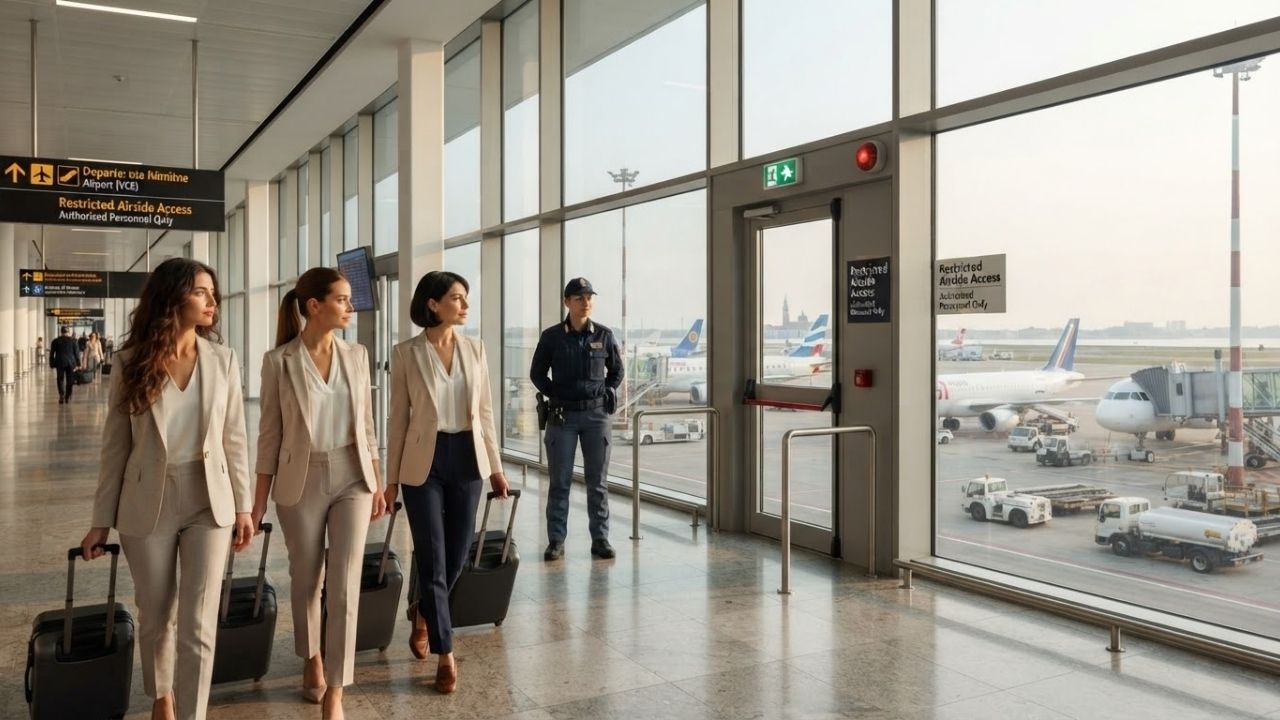
Image generated by AI
Italian authorities have issued an urgent travel warning for Venice Marco Polo Airport following a series of security breaches where eight travelers opened alarmed emergency exits to access the restricted airfield.
High-Cost Violations on the Tarmac
The safety warning follows multiple incidents during the summer of 2026, most notably involving two travelers who missed their boarding gate for a flight to Santorini. Despite seeing the aircraft parked outside, gate access remained closed. Instead of contacting airline ground staff, the pair forced open an alarmed emergency exit door and ran onto the active apron.
Border Police intercepted the passengers before they reached the plane. Each passenger received an administrative penalty of €2,064, resulting in a combined fine of €4,128, while the flight departed without them.
Entering an active apron exposes pedestrians to severe physical danger, including moving ground equipment, baggage tractors, and jet engine blast. Unauthorized entries also divert police personnel from other security operations and trigger terminal-wide alerts.
Scale of the Summer Security Crackdown
Between early June and late August 2026, Border Police registered eight incidents where travelers forced open alarmed exits at Venice’s primary international gateway. The summer enforcement campaign resulted in a total of 27 administrative penalties with a combined value of approximately €63,000.
Venice Marco Polo Airport Security Violation Statistics (Summer 2026)
| Security Violation / Event | Reported Occurrences / Value | Impact on Passengers and Operations |
|---|---|---|
| Forced Emergency Exits | 8 incidents | Triggers alarms, airside security sweeps, and flight delays |
| Total Summer Penalties | 27 penalties | Covers passenger access breaches and carrier document failures |
| Total Value of Fines | About €63,000 | Illustrates the severe financial costs of rules violations |
| Santorini Flight Incident Fine | €2,064 per person | Levied on two passengers who entered the apron after gate closure |
| Smoking / Vaping Breaches | Multiple violations | Incidents of entering controlled areas to use electronic cigarettes |
Approximately half of the 27 penalties were issued to airlines for document compliance failures. These included transport issues such as carrying passengers with expired passports, invalid identification cards, or lacking Schengen entry visas. Smoking and vaping inside the terminal were also targeted, highlighted by a case where an arriving traveler forced an internal door to enter the apron to vape while waiting for baggage.
Regulatory Framework and Apron Dangers
The European Union Aviation Safety Agency (EASA) classifies unauthorized airfield entry and the presence of unauthorized persons on the apron as major aerodrome security occurrences. Airport aprons are highly controlled operational spaces where pedestrian movements must be managed through designated, supervised transit routes.
Possessing a valid ticket or boarding pass does not grant independent access to runways, taxiways, or aircraft stands. Once boarding is officially closed, passengers must remain within public passenger zones and contact the carrier's customer service representatives to arrange rebooking.
Cultural Tourism Context and Infrastructure Growth
Venice Marco Polo Airport serves as a key gateway to northern Italy's Veneto region, supporting city breaks, cruise line departures, and business travel. The importance of secure operations matches Italy's growing tourism scale. ISTAT's preliminary 2024 estimates recorded 129.3 million tourist arrivals and 458.4 million accommodation nights, with non-resident travelers generating over half of the accommodation nights in the fourth quarter.
To accommodate this volume, the airport is executing a long-term development plan extending to 2037. The program includes 116,300 square meters of terminal extensions, 45 new boarding gates, 9,200 square meters of commercial space, and a direct rail link to integrate the airport into the national railway network. As the terminal grows to support 15 million annual passengers by 2030 and 20 million by 2037, passenger awareness regarding security boundaries and safety rules becomes essential.
Destination Specialist Local Insider Tips
To help travelers navigate Venice Marco Polo Airport safely, local destination specialists recommend the following insider tips:
- Track Boarding Deadlines Carefully: Gate closure normally occurs 15 to 20 minutes before the scheduled departure. Always monitor terminal screens rather than relying solely on boarding pass times.
- Use the Airport Water Bus (Alilaguna): For a scenic and low-impact connection to Venice center, take the Alilaguna water boat directly from the airport dock to support the local maritime transit economy.
- Inspect Schengen Entry Papers: For non-EU citizens, ensure your passport is valid for at least three months beyond your intended stay and carry proof of travel insurance and accommodation.
- Utilize Approved Smoking Zones: Smoking and vaping are strictly prohibited inside the terminal. Use only designated outdoor smoking cabins to avoid triggering security alarms.
- Allow Extra Time during Peak Summer: VCE is a highly seasonal airport; traveling through security and passport control during the July-August weekend rush requires arriving at least three hours before long-haul flights.
Future Outlook
No official changes to the penalty structure or airport access rules have been introduced following the summer security reports. Travelers are advised to follow airport signs, respect boarding gates, and consult with airline staff when delays or missed connections affect their journey.
Related Travel Guides
Disclaimer
This article is for informational and educational purposes only. It does not constitute legal, financial, or professional advice. While we strive to provide accurate and up-to-date information, travel policies, regulations, and conditions change rapidly. Always verify information with official sources before making travel decisions. Nomad Lawyer makes no representations about the accuracy, reliability, completeness, or suitability of the information provided. Readers should consult qualified professionals for advice specific to their circumstances. The views expressed in this article are those of the author and do not necessarily reflect the views of Nomad Lawyer.
Preeti Gunjan
Contributor & Community Manager
A passionate traveller and community builder. Preeti helps grow the Nomad Lawyer community, fostering engagement and bringing the reader experience to life.
Learn more about our team →