
Vancouver International Airport Faces 117 Delays and 8 Total Cancellations as Air Canada, Jazz, WestJet, and Lufthansa Operations Face Transatlantic, Transborder, and Regional Network Stalls Impacting Canada, the United States, Europe and Asia Pacific
Vancouver International Airport faces 117 delays and 8 cancellations as Air Canada, Jazz, WestJet, and Lufthansa operati

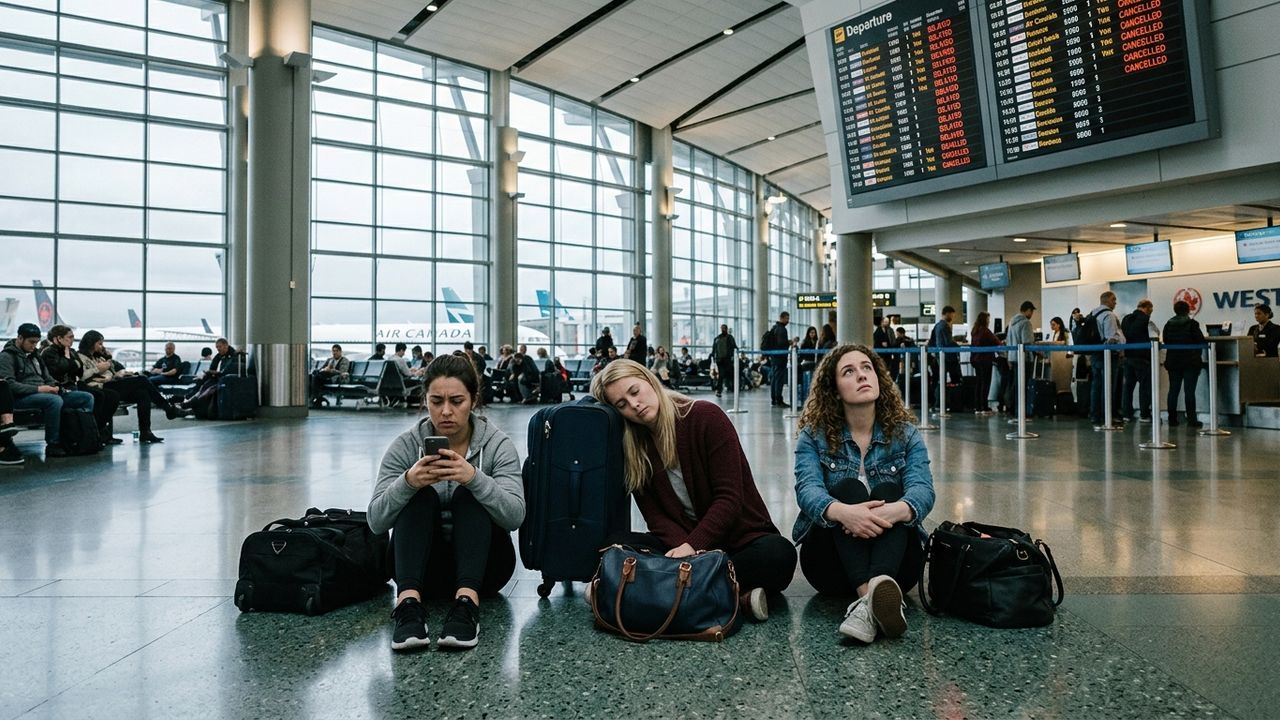
Image generated by AI
Vancouver International Airport Logs 117 Delays and 8 Cancellations as Air Canada, Jazz, WestJet, and Lufthansa Face Transatlantic, Transborder, and Regional Network Disruptions Across Canada, the United States, Europe, and Asia Pacific
[Richmond, BC, June 28, 2026] — Vancouver International Airport (YVR) is grappling with 117 delayed flights and 8 total cancellations as a combination of severe weather and technical malfunctions paralyzes operations across transatlantic, transborder, and regional networks. Air Canada, Jazz, WestJet, and Lufthansa are among the carriers hardest hit, with disruptions cascading through routes connecting Canada, the United States, Europe, and the Asia Pacific region. Terminal gates are overflowing as travelers confront blank departure boards and rapidly shifting schedules.
The crisis unfolded early in the day when heavy weather choked local runways, causing regional grids to collapse. International long-haul flights subsequently fell victim to cascading crew shortages across oceanic corridors. The ripple effect moved swiftly through major travel arteries, leaving passengers stranded and airlines scrambling to recover.
Weather and Technical Failures Trigger YVR Operational Collapse
Industry sources indicate that a convergence of adverse meteorological conditions and system-level technical glitches created what observers are calling a perfect storm at Vancouver International Airport. The twin pressures struck simultaneously — severe weather reduced runway throughput while internal system failures hampered coordination across airline operations desks.
Regional and domestic carriers absorbed the highest volume of disruptions by raw count. However, several elite international airlines posted the most damaging percentage-based failure rates, signaling that the crisis was not confined to short-haul routes alone. Flight tracking data confirms that the disruption cut across three distinct layers: domestic regional networks within British Columbia, major transborder routes into the United States, and long-haul international corridors spanning Europe, Asia, and the South Pacific.
Jazz and Air Canada Dominate Regional Disruption Volume
Jazz, operating under the Air Canada Express banner, emerged as the single largest source of disruptions by volume. The regional carrier logged 5 cancellations — representing a 4% cancellation rate — alongside 28 delays, translating to a 25% delay rate across its scheduled departures and arrivals.
Air Canada, Jazz's parent company, recorded 15 delays, accounting for a 12% delay rate across its operations at YVR. Air Canada Rouge contributed an additional 10 delays, pushing its delay rate to 22%. WestJet and its regional subsidiary, WestJet Encore, combined for a significant operational headache: WestJet racked up 11 delays (13%), while WestJet Encore added 6 delays (20%). Neither WestJet brand reported any cancellations, offering a small measure of relief within an otherwise chaotic day.
Pacific Coastal Airlines also struggled substantially, registering 1 cancellation (2%) and 11 delays (23%), further compounding the regional network's difficulties.
Lufthansa, Japan Airlines, and KLM Suffer Severe International Delay Rates
The international carrier performance data reveals a stark picture. Lufthansa experienced what industry observers described as a near-total operational collapse at YVR, posting 2 cancellations — a staggering 50% cancellation rate — paired with 1 delay (25%).
Japan Airlines and KLM each recorded a 100% delay rate, with every one of their scheduled flights held up. Both carriers saw two flights delayed apiece. Several other international airlines faced a coin-flip scenario, ending the day with a flat 50% delay rate: All Nippon Airways (2 delays), British Airways (3 delays), Condor (1 delay), Edelweiss Air AG (1 delay), Fiji Airways (1 delay), and Turkish Airlines (1 delay).
The data underscores how the disruption penetrated deep into long-haul networks, affecting carriers based across Europe, Asia, and the South Pacific.
British Columbia Regional Routes Bear the Brunt of Inbound Delays
The short-hop regional network across British Columbia was devastated on both inbound and outbound legs. Inbound flights to Vancouver from Castlegar (YCG), Cranbrook (YXC), and Penticton (YYF) each registered a 100% delay rate, with one flight affected per route.
Kelowna (YLW) stood out as a major inbound trouble spot, recording 7 delays representing a 41% delay rate. Inbound cancellations struck Terrace (YXT) with 1 cancellation (16%) and 2 delays (33%), CFB Comox (YQQ) with 1 cancellation (16%) and 1 delay (16%), and Victoria (YYJ) with 1 cancellation (5%) and 4 delays (22%).
Additional inbound delays affected flights from Fort St. John (2 delays, 66%), Prince George (2 delays, 25%), Whitehorse (1 delay, 25%), Sandspit (1 delay, 50%), Port Hardy (1 delay, 50%), Masset (1 delay, 25%), and Trail (1 delay, 50%).
Outbound Regional Departures from YVR Mirror Inbound Chaos
Outbound regional flights leaving Vancouver reflected the same operational dysfunction. Departures to Castlegar (YCG) and Sandspit (YZP) were completely stalled at a 100% delay rate, with one flight affected on each route.
Outbound flights to Kelowna (YLW) suffered 6 delays (42%), while Victoria (YYJ) lost another flight to cancellation (7%) alongside 1 delay (7%). Edmonton (YEG) was hit hard on departures with 1 cancellation (4%) and 3 delays (13%).
Other outbound Canadian destinations experiencing delays included Calgary (4 delays, 11%), Toronto Pearson (4 delays, 13%), Campbell River (1 delay, 33%), Hamilton (1 delay, 33%), Halifax (1 delay, 100%), CFB Comox (1 delay, 20%), Regina (1 delay, 25%), Winnipeg (1 delay, 14%), Saskatoon (1 delay, 25%), Fort St. John (1 delay, 33%), Prince George (1 delay, 14%), Smithers (1 delay, 50%), Penticton (1 delay, 50%), Port Hardy (1 delay, 50%), Masset (1 delay, 25%), Trail (1 delay, 50%), and Bella Bella (1 delay, 33%).
Transborder US Routes from Vancouver Face Significant Delay Clusters
Inbound traffic from the United States into Vancouver experienced notable disruptions. Seattle-Tacoma (SEA) was heavily impacted with 6 delays (35%), while inbound flights from Dallas-Fort Worth (DFW) showed 2 delays (66%). Inbound routes from Los Angeles (1 delay, 12%), Portland (1 delay, 20%), and San Francisco (1 delay, 10%) also reported delays.
Outbound transborder flights from Vancouver to Seattle saw 3 delays (17%). Routes to Nashville (BNA) and Detroit (DTW) were hit with an absolute 100% delay rate, with one flight affected on each route. Additional outbound delays touched Chicago O'Hare (1 delay, 20%), Portland (1 delay, 20%), and San Francisco (1 delay, 10%).
European and Transoceanic Corridors Report Uniform Delay Patterns
European routes exhibited the most uniform disruption patterns of the day. Inbound flights to Vancouver from Munich (MUC), London Gatwick (LGW), Amsterdam (AMS), and Istanbul (IST) all registered a 100% delay rate, with one flight affected per route.
Frankfurt (FRA) emerged as a global bottleneck, suffering 1 cancellation (33%) and 1 delay (33%) on inbound routes. The German hub replicated that exact disruption profile on outbound departures from YVR — 1 cancellation (33%) and 1 delay (33%) — making it one of the few destinations affected symmetrically in both directions.
Affected Airlines Summary
| Airline | Cancellations | Cancellation Rate | Delays | Delay Rate |
|---|---|---|---|---|
| Jazz (Air Canada Express) | 5 | 4% | 28 | 25% |
| Air Canada | 0 | 0% | 15 | 12% |
| Air Canada Rouge | 0 | 0% | 10 | 22% |
| WestJet | 0 | 0% | 11 | 13% |
| WestJet Encore | 0 | 0% | 6 | 20% |
| Pacific Coastal Airlines | 1 | 2% | 11 | 23% |
| Lufthansa | 2 | 50% | 1 | 25% |
| Japan Airlines | 0 | 0% | 2 | 100% |
| KLM | 0 | 0% | 2 | 100% |
| All Nippon Airways | 0 | 0% | 2 | 50% |
| British Airways | 0 | 0% | 3 | 50% |
| Condor | 0 | 0% | 1 | 50% |
| Edelweiss Air AG | 0 | 0% | 1 | 50% |
| Fiji Airways | 0 | 0% | 1 | 50% |
| Turkish Airlines | 0 | 0% | 1 | 50% |
Impact Analysis: Cascading Failures Expose YVR Network Vulnerabilities
The disruption data reveals that Vancouver International Airport's operational fragility stems from its heavy reliance on regional feeder networks. When short-haul routes across British Columbia collapsed under weather pressure, the effects propagated upward into transborder and transatlantic corridors. Crews scheduled to operate long-haul international flights were delayed on incoming regional legs, creating a cascading shortage that left carriers like Lufthansa unable to maintain scheduled departures.
The symmetric disruption pattern at Frankfurt — identical cancellation and delay rates in both directions — illustrates how a single bottleneck can paralyze bidirectional traffic. Meanwhile, the 100% delay rates posted by Japan Airlines and KLM demonstrate that even carriers with minimal daily frequency at YVR were not insulated from the systemic breakdown.
For passengers, the financial and logistical consequences are immediate. Those affected by cancellations on routes like Terrace, CFB Comox, and Victoria face rebooking delays that could extend into subsequent days as airlines work through backlogs. Transborder travelers heading to Nashville and Detroit experienced total delay coverage, meaning no passenger on those routes escaped disruption.
What Affected Passengers Should Do Now
Travelers whose plans have been upended by the YVR gridlock are advised to take several proactive steps:
Monitor Flight Statuses Digitally: Passengers should not proceed to Vancouver International Airport without first checking their airline's mobile application or the YVR website. Tarmac ripple effects are causing flight statuses to change rapidly, and arriving at the terminal without confirmation risks extended waits in overcrowded gate areas.
Understand Passenger Rights Under APPR: Canada's Air Passenger Protection Regulations provide entitlements when delays or cancellations fall within an airline's control. Staffing shortages and scheduling errors — which heavily impacted regional carriers like Jazz — typically qualify. Affected passengers may be entitled to standard compensation, complimentary food and drink vouchers, or overnight hotel accommodations depending on the length and cause of the disruption.
Use Alternative Customer Service Channels: Physical customer service lines at YVR gates are likely to be overwhelmed. Passengers should contact their airline via international customer service phone lines or through official social media support accounts, which frequently offer faster response times during domestic airport crises.
Why This Matters: Systemic Risk at a Pacific Gateway
The events at Vancouver International Airport expose a structural vulnerability in one of Canada's primary aviation gateways. YVR functions as a critical node connecting British Columbia's regional network to transborder US corridors and transoceanic routes spanning Europe, Asia, and the South Pacific. When that node falters, the impact radiates across multiple continents within hours.
The data shows that no category of carrier was spared. Regional operators like Jazz and Pacific Coastal Airlines suffered the highest disruption volumes. Legacy carriers like Air Canada and WestJet posted double-digit delay rates. Elite international airlines including Lufthansa, Japan Airlines, KLM, and British Airways experienced percentage-based failure rates that would be considered unacceptable under normal operating conditions.
The convergence of weather and technical failures at a single hub demonstrates how dependent global aviation remains on the uninterrupted function of individual airports. For an industry still recovering from post-pandemic staffing challenges, the YVR disruption serves as a reminder that operational resilience at major gateways requires investment in both infrastructure and crew contingency planning. As climate-driven weather events become more frequent and technology systems grow more complex, the risk of multi-layered failures at critical hubs will only increase — making the lessons from this day at Vancouver International Airport relevant far beyond British Columbia.
Related Travel Guides
Disclaimer
This article is for informational and educational purposes only. It does not constitute legal, financial, or professional advice. While we strive to provide accurate and up-to-date information, travel policies, regulations, and conditions change rapidly. Always verify information with official sources before making travel decisions. Nomad Lawyer makes no representations about the accuracy, reliability, completeness, or suitability of the information provided. Readers should consult qualified professionals for advice specific to their circumstances. The views expressed in this article are those of the author and do not necessarily reflect the views of Nomad Lawyer.
Raushan Kumar
Founder & Lead Developer
Full-stack developer with 11+ years of experience and a passionate traveller. Raushan built Nomad Lawyer from the ground up with a vision to create the best travel and law experience on the web.
Learn more about our team →