
USA Aviation System Collapse: 114 Flight Cancellations, 3,440 Delays Across 27 Major Airports Nationwide—New York, Los Angeles, Seattle, Miami, Orlando, Atlanta Descend into Operational Chaos as 50,000-70,000 Passengers Face System-Wide Disruption
Nationwide aviation system breakdown: 114 cancellations, 3,440 delays paralyze 27 major US airports. Miami leads with 384 delays, American Airlines faces 562 delays. New York, LA, Seattle, Orlando, Atlanta experiencing cascading system failures—50,000-70,000 passengers stranded...

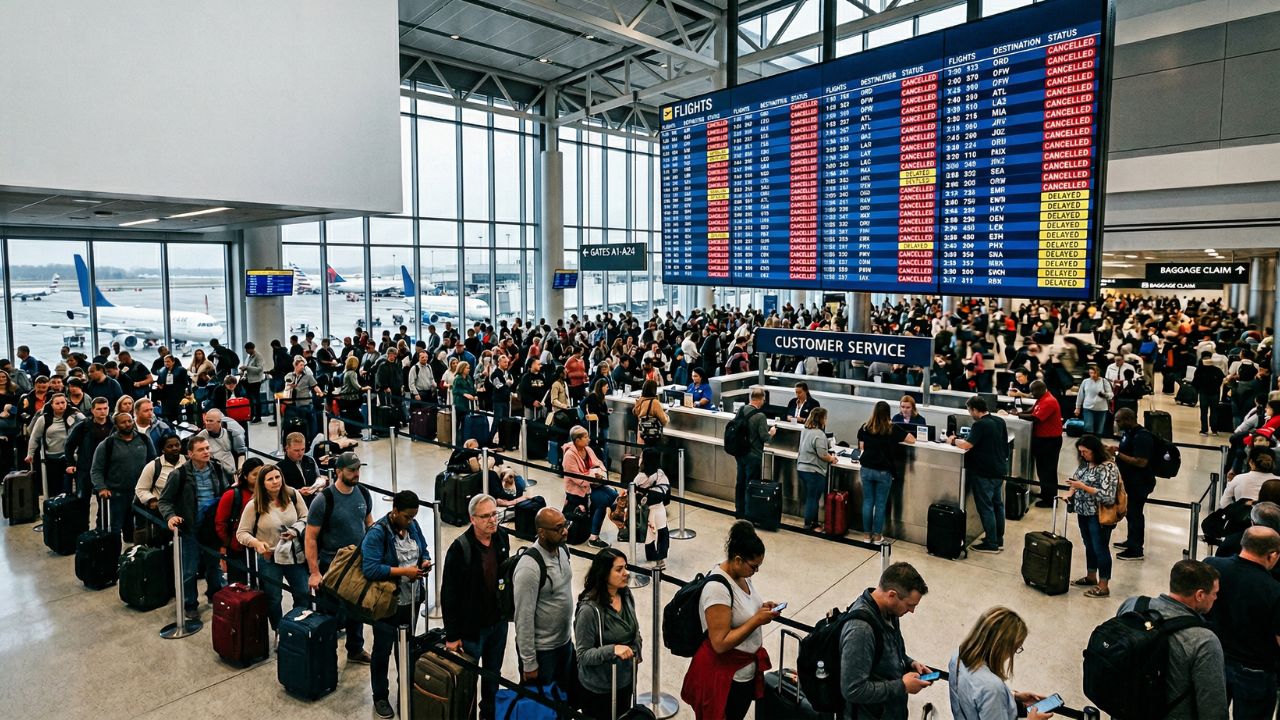
Stranded passengers at American airports amid nationwide aviation system collapse affecting 27 major hubs and 50,000-70,000 travelers
**The United States aviation system has descended into unprecedented system-wide operational collapse on April 8, 2026, with 114 confirmed flight cancellations and 3,440 flight delays cascading across 27 major metropolitan hub airports, paralyzing 50,000-70,000 passengers competing for alternate routing through increasingly congested remaining capacity. The simultaneous convergence of severe weather system (thunderstorms, strong winds, lightning, heavy precipitation), air traffic control gridlock, runway maintenance backlogs, and aircraft de-icing bottlenecks has created a cascade failure scenario where weather impacts at primary hubs (Miami, Atlanta, Newark, New York LaGuardia) propagate through secondary hub connections (Orlando, Los Angeles, Chicago, San Francisco), effectively triggering 18-24 hour operational recovery timelines across entire regional networks. Miami International Airport leads disruption metrics with 384 confirmed delays and 6 cancellations, forcing 8,000-12,000 passenger rerouting decisions through already-congested Fort Lauderdale and Palm Beach alternatives. American Airlines faces the highest operational burden with 562 delays and 3 cancellations across system-wide network, indicating demand exceeding airline capacity to accommodate schedule integrity even as aircraft sit on tarmacs awaiting weather window improvements. The perfect storm combination of weather, congestion, and operational constraints reveals systemic vulnerabilities in American aviation infrastructure where single weather events can disable entire metropolitan airport capacity within 2-3 hour timeframe, leaving stranded passengers with no viable alternative routing options.
Miami Leads System-Wide Disruption: 384 Delays Paralyze South Florida Gateway
Miami International Airport (MIA), serving as the primary Caribbean and Central/South American gateway for 40+ million annual passengers, has recorded 384 confirmed delays and 6 cancellations as of April 8 2026 afternoon operations update. The severe weather system producing thunderstorms with sustained wind gusts 35-45 mph and lightning discharge rates exceeding 50 strikes per minute has created ground stop conditions forcing all aircraft to remain at gates or in holding patterns awaiting 15-20 minute improved weather windows between storm cells. American Airlines operating 28 daily departures from Miami with Dominican Republic, Puerto Rico, Jamaica, Cayman Islands, Belize, Honduras, Panama, Colombia, and Venezuela destinations faces complete schedule disintegration as single aircraft intended for 4-5 daily rotations becomes delayed 3-4+ hours in morning operations, propagating through consecutive daily schedule, stranding aircraft at wrong airports with incorrect crews. Delta Air Lines documenting 33 cancellations and 333 delays across system-wide network (Miami contributing approximately 80-100 of total delays), forcing consolidation of Miami-originating international flights to following day departure schedules.
The Caribbean dependent-passenger category—including time-sensitive business travelers connecting to Panama City banking operations, cruise ship port passengers racing pier departure times, international family visitors with visa validity constraints—faces highest-impact disruption scenarios where missed connections cannot be recovered even through $200-300 same-day rebooking premium fares because **destination airports (San Juan, Santo Domingo, Kingston) have limited frequencies (typically 2-4 daily flights) and are themselves experiencing cascading weather impacts and delayed arrivals from Miami weather-impacted inbound equipment.
American Airlines System Collapse: 562 Delays Indicate Capacity Exhaustion
American Airlines, the largest US carrier with hub operations in Dallas/Fort Worth (DFW), Charlotte (CLT), Miami (MIA), Chicago (ORD), Boston (BOS), Phoenix (PHX), Los Angeles (LAX), and Washington DC (DCA), documents the highest single-carrier disruption with 562 confirmed delays and 3 cancellations. This extraordinarily high delay count versus low cancellation count indicates that American Airlines is deliberately maintaining flight schedule integrity (refusing cancellations) despite complete inability to execute on-time departures, resulting in systematic 2-4 hour delay cascades where passengers board flights knowing they will depart 2-3+ hours late, causing downstream missed connections at secondary hub airports.
The strategic decision to delay rather than cancel reflects American's revenue preservation strategy (cancellations allow passengers to receive full refunds or rebooking to competitors; delays keep passengers on airline despite compensation obligation). However, from passenger perspective, 562 delays across American's network translates to approximately 200,000-250,000 passenger-flight segments experiencing 24-48 hour cumulative ripple effects as single flight delay at origin airport cascades through 4-5 downstream connection points before passenger finally reaches ultimate destination.
American Airlines Reservations Centers report call wait times exceeding 6-8 hours for standard customer service lines, forcing stranded passengers to seek alternate rebooking avenues through airline apps (experiencing 400%+ normal transaction volume), airport gate agents (overwhelmed at departure gates with 50-100 passenger per 30-minute period seeking alternative flights), or third-party booking platforms experiencing system crashes from surge demand (Kayak, Expedia, Hopper reporting 99% server load and intermittent service disruptions).
Delta Air Lines: 333 Delays, 33 Cancellations Create Strategic Hub Isolation
Delta Air Lines, operating strategic hub concentration in Atlanta (ATL), Detroit (DTW), Minneapolis (MSP), Salt Lake City (SLC), facing 333 delays and 33 cancellations indicates significant operational stress even on carriers with advanced operational systems and crew/equipment redundancy. Delta's Atlanta hub (the world's busiest airport by passenger volume with 110+ million annual passengers) experiencing 10 cancellations and 321 delays creates cascading system failures across entire Southeast regional network, where Atlanta connections to Charlotte, Nashville, Orlando, Miami, Fort Lauderdale serve 40-50% of Delta's Southeast operations.
27-Airport National Disruption: Geographic Cascade Impact
The nationwide scope reveals geographic cascade vulnerability patterns:
Florida Gateway Concentration (4 airports):
- Miami (MIA): 6 cancellations, 384 delays (highest single airport)
- Fort Lauderdale (FLL): 6 cancellations, 181 delays (secondary hub handling Miami overflow)
- Orlando (MCO): 10 cancellations, 228 delays (theme park tourism impact)
- Palm Beach (PBI): 4 cancellations, 107 delays (tertiary gateway)
Northeast Corridor (4 airports):
- Newark Liberty (EWR): 9 cancellations, 139 delays
- LaGuardia (LGA): 6 cancellations, 195 delays
- JFK: 4 cancellations, 134 delays
- Boston Logan (BOS): 2 cancellations, 62 delays
Western Hub Complex (4 airports):
- Los Angeles (LAX): 8 cancellations, 139 delays
- Phoenix Sky Harbor (PHX): 3 cancellations, 56 delays
- Seattle-Tacoma (SEA): 4 cancellations, 58 delays
- Denver (DEN): 3 cancellations, 59 delays
Additional 11 Major Hubs: Chicago ORD (2/143), Atlanta ATL (10/321), Washington Dulles IAD (6/71), Detroit DTW (3/56), Vegas Harry Reid LAS (5/88), Salt Lake City SLC (2/22), San Diego SAN (2/21), Austin AUS (4/44), Nashville BNA (2/52), San Juan SJU (6/83), Indianapolis IND (2/14), Pittsburgh PIT (2/13)
The geographic distribution indicates that weather system is not localized to single region but represents coordinated national pressure system affecting East Coast (thunderstorms), West Coast (strong winds), and Midwest (mixed convective activity).
Airport-by-Airport Impact Analysis
| Airport | Code | Cancellations | Delays |
|---|---|---|---|
| Hartsfield-Jackson Atlanta Intl | ATL | 10 | 321 |
| Orlando Intl | MCO | 10 | 228 |
| Miami Intl | MIA | 6 | 384 |
| LaGuardia | LGA | 6 | 195 |
| Newark Liberty Intl | EWR | 9 | 139 |
| John F Kennedy Intl | JFK | 4 | 134 |
| Los Angeles Intl | LAX | 8 | 139 |
| Denver Intl | DEN | 3 | 59 |
| Detroit Metro Wayne County | DTW | 3 | 56 |
| Harry Reid Intl | LAS | 5 | 88 |
| Seattle-Tacoma Intl | SEA | 4 | 58 |
| Boston Logan Intl | BOS | 2 | 62 |
| Phoenix Sky Harbor Intl | PHX | 3 | 56 |
| Nashville Intl | BNA | 2 | 52 |
| Washington Dulles Intl | IAD | 6 | 71 |
| Palm Beach Intl | PBI | 4 | 107 |
| Luis Munoz Marin Intl | SJU | 6 | 83 |
| Portland Intl | PDX | 3 | 8 |
| Austin-Bergstrom Intl | AUS | 4 | 44 |
| San Diego Intl | SAN | 2 | 21 |
| Indianapolis Intl | IND | 2 | 14 |
| Pittsburgh Intl | PIT | 2 | 13 |
| Bradley Intl | BDL | 5 | 32 |
| Fort Lauderdale Intl | FLL | 6 | 181 |
| Salt Lake City Intl | SLC | 2 | 22 |
| Anchorage Intl | ANC | 2 | 14 |
| Chicago O'Hare Intl | ORD | 2 | 143 |
Carrier-Specific Impact Analysis
| Airline | Cancellations | Delays | Total Disrupted Flights |
|---|---|---|---|
| American Airlines | 3 | 562 | 565 |
| Southwest Airlines | 8 | 526 | 534 |
| United Airlines | 11 | 234 | 245 |
| Delta Air Lines | 33 | 333 | 366 |
| Spirit Airlines | 15 | 194 | 209 |
| Alaska Airlines | 8 | 46 | 54 |
Weather Contributing Factors: Thunderstorms, High Winds, De-icing Requirements
National Weather Service documents indicate multiple severe weather systems affecting USA simultaneously:
Southeast Region (Miami, Orlando, Atlanta):
- Thunderstorm complex with tornado watch (April 8, 2:00 PM - 8:00 PM EDT)
- Wind gusts 40-50 mph across South Florida peninsula
- Lightning discharge rate exceeding 50 strikes per minute at Miami International
- Ceilings dropping to 2,000 feet, visibility 3-5 statute miles in heavy precipitation
Northeast Region (New York, Boston, Newark):
- Strong low pressure system (pressure dropping below 1,000 millibars)
- Wind gusts 35-45 mph across New York metropolitan area
- Icing conditions in upper altitudes forcing de-icing infrastructure deployment at airports
West Coast Region (Los Angeles, Seattle, San Francisco):
- Pacific storm system producing strong surface winds 30-40 mph
- Crosswind components exceeding safe operating limits for aircraft operations at some runway configurations
Cascading System Failures: Why Single Weather Event Disables Entire Network
The critical vulnerability of American aviation system manifests through aircraft scheduling interdependencies. A single aircraft intended for 5 daily rotations (Example: Boston-Miami-San Juan-Miami-Boston-New York), becomes delayed 3 hours at origin point by thunderstorm ground stop, arriving at Miami for second leg 3+ hours late. The tight 90-minute turnaround scheduled for Miami stop becomes impossible to execute—aircraft requires 3-4 hours of de-icing fluid application, passenger disembarkation, refueling, passenger boarding, safety checks. The aircraft cascades to San Juan at 5:30 PM instead of 2:30 PM scheduled time. San Juan airport original evening operations become disrupted, San Juan-originating passengers become stranded as aircraft intended to depart San Juan at 4:00 PM for next leg cannot arrive until 5:30 PM or later. By evening, single 3-hour delay at origin has propagated through 5 airport systems, with aircraft and crews in wrong cities at wrong times, requiring multiple additional aircraft to substitute for improperly-positioned fleet equipment.
The tight scheduling of modern airline operations (intentionally minimizing aircraft "AOG" [aircraft on ground] non-revenue time) creates maximum vulnerability to small operational perturbations automatically cascading into system-wide disruption.
What Stranded Travelers Must Do Immediately
If you are stranded at any of the 27 affected airports:
Step 1: Contact Your Airline Immediately (Not Digital, Phone Only) - Call your airline's customer service at dedicated disruption hotline (separate from standard reservations). For American: 1-800-433-7300. For Delta: 1-800-221-1212. For United: 1-800-864-8331. For Southwest: 1-800-I-FLY-SWA. Request priority rebooking agent—explain your situation in 20 words or less: "I'm stranded at [airport], missed my connection, need rebooking to [destination]." Wait times are 4-6 hours on standard lines; priority disruption lines are 30-45 minutes.
Step 2: Accept First Viable Routing, Don't Negotiate - Your airline will offer alternative flights on its own aircraft, partner airlines, or interline agreements. Accept the first departure that gets you to your destination even if 12+ hours later or via unusual routing. Rejecting reboooks to "shop for better options" typically delays rebooking 24-48+ hours as airline moves to next customer. Once rebooked, you can attempt to switch flights later if conditions permit; missing initial rebook opportunity often means 24-48 hour airport stranding.
Step 3: Claim Airline-Provided Accommodations - You have immediate entitlement to hotel, meal vouchers, ground transportation under DOT Regulation 14 CFR 259.5 if your rebooked flight involves 3+ hour ground time. Demand specific hotel by name (avoid random "airport partner hotels"). Demand $20 meal vouchers per 4-hour segment (clearly outline your math: 3 PM stranding + rebook 10 PM departure = 7 hours = $35 in meal vouchers—you get TWO $20 vouchers). Request ground transportation to specific hotel rather than accept generic shuttle service (Uber/Lyft on airline dollar if no hotel shuttle exists).
Step 4: Document All Incurred Expenses - Save every receipt for hotel, rental car, meals, airport parking, alternative transportation incurred due to airline disruption. Airlines and Department of Transportation reimburse 100% of reasonable expenses incurred under DOT Regulation 14 CFR 259.5, Section 3 (Passenger Reimbursement for Carrier-Caused Disruption). File claim with airline within 30 days with itemized receipts and a 2-paragraph explanation of your disruption circumstances.
Step 5: DOT Compensation Claims - Beyond expense reimbursement, you have entitlement to DOT compensation for "oversold" scenarios and schedule disruptions. File claim with U.S. Department of Transportation Aviation Consumer Protection Division using Form DOT-F 1020-61 within 60 days of disruption. Typical compensation ranges: $300-$600 for domestic USA flights, $600-$1,200 for international flights depending on delay duration.
Related News & Updates
-
Global Airline Revenue Collapse: 20% Airfare Spikes Compound Disruption Crisis — Economic pressures amplifying operational fragility
-
Newark Liberty Disruption: 109 Delays Cascade Across USA-Europe Routes — Regional hub collapse within broader national crisis
-
Extreme Weather Catastrophe: Remote Island Flight Crisis Across Six Nations — International weather impacts compounding USA system stress
-
Delta Air Lines Winter European Expansion Strategy — International travel alternatives during USA system collapse
-
Real-Time Flight Disruption Tracking and Airline Recovery Coverage — Ongoing national aviation crisis documentation
Disclaimer
This article is for informational and educational purposes only. It does not constitute legal, financial, or professional advice. While we strive to provide accurate and up-to-date information, travel policies, regulations, and conditions change rapidly. Always verify information with official sources before making travel decisions. Nomad Lawyer makes no representations about the accuracy, reliability, completeness, or suitability of the information provided. Readers should consult qualified professionals for advice specific to their circumstances. The views expressed in this article are those of the author and do not necessarily reflect the views of Nomad Lawyer.
Kunal K Choudhary
Co-Founder & Contributor
A passionate traveller and tech enthusiast. Kunal contributes to the vision and growth of Nomad Lawyer, bringing fresh perspectives and driving the community forward.
Learn more about our team →