
Why US Navy F/A-18 Hornets Land at Extreme Nose-Up Angles During Carrier Operations
The dramatic high-angle carrier landings of legacy F/A-18 Hornets aren't theatrical—they're physics. Here's why the Navy designed jets to approach with such extreme nose-up attitudes.

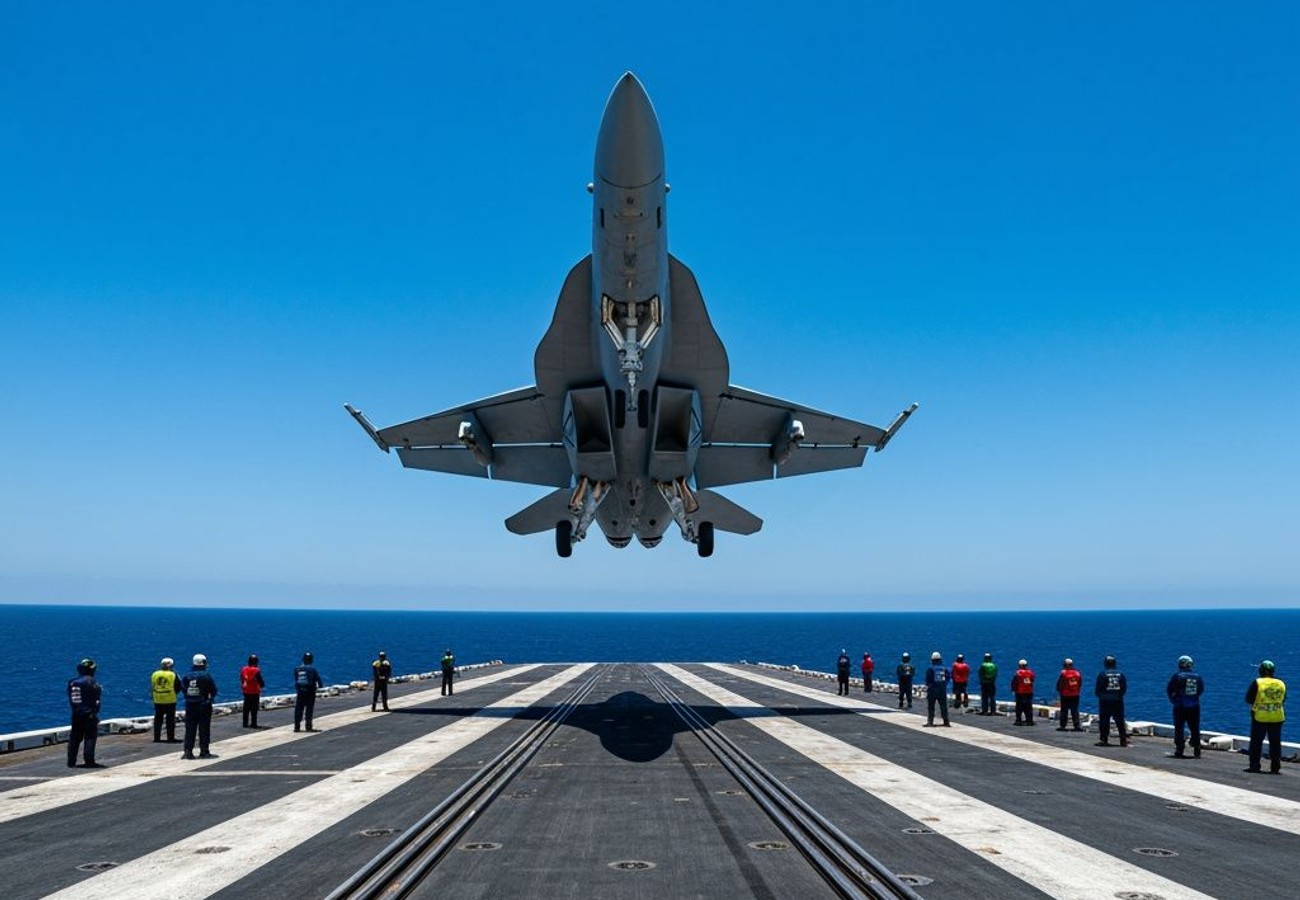
Image generated by AI
The Dramatic Descent That Looks Like Controlled Chaos
Watch a US Navy F/A-18 Hornet approach an aircraft carrier and you'll witness something that appears genuinely alarming: the jet pitches its nose skyward at an extreme angle, descending steeply toward a flight deck that seems impossibly short. It looks like the pilot is fighting for control. They're not.
This dramatic maneuver is one of aviation's most misunderstood phenomena. The extreme nose-up attitude—technically called "angle of attack" (AoA)—is deliberate, engineered, and absolutely necessary. Understanding why reveals the brutal physics of landing on a floating runway.
Landing On Water Is Fundamentally Different
Carrier-based aviation exists in a different universe than conventional air operations. When an F/A-18 Super Hornet or legacy Hornet pilot touches down on a carrier deck, they immediately jam the throttles to 100%. This isn't aggression—it's survival insurance.
If the tailhook misses the arresting wires, the jet needs enough power to take off again before tumbling into the ocean. There is no go-around. There is no second chance. This reality shapes every aspect of how these aircraft are designed.
Reddit: "Carrier landings aren't landings—they're controlled crashes where everything has to work the first time." — r/aviation
The comparison isn't hyperbole. The US Navy has repeatedly described these operations as "controlled crashes," and the aircraft are engineered accordingly. Carrier-based fighters receive structural reinforcement, heavy-duty landing gear, and saltwater-resistant components that land-based variants don't need.
Angle of Attack: The Physics That Makes It Look Extreme
Here's the core reason for the dramatic nose-up attitude: the F/A-18 requires approximately 8° angle of attack and a 3.5° glide slope to reliably snag the arresting wires. This steep descent rate is called "Slam" in Navy terminology.
The angle of attack serves multiple critical functions simultaneously. First, it ensures the tailhook—mounted low on the fuselage—will catch one of the arresting wires strung across the deck. Missing is catastrophic. When Russia's Admiral Khusanov carrier experienced arresting wire failures in 2016, aircraft tumbled into the sea. Modern US carriers carry multiple wires; F/A-18s typically snag the #3 wire.
Second, the high AoA allows the aircraft to fly at relatively slow speeds while maintaining lift. Because carrier fuel loads and weapons configurations vary dramatically, a fixed angle of attack automatically corrects the approach speed for whatever weight the jet carries. The AoA stays constant while airspeed adjusts—a self-correcting system that reduces pilot workload in critical moments.
Third, the steep descent rate gets the aircraft down quickly, maximizing the window for wire engagement before running out of deck.
Why the Legacy Hornet Looks More Dramatic Than Modern Jets
The original McDonnell Douglas F/A-18 Hornet, introduced in the 1980s, was revolutionary as the first Navy fighter with digital fly-by-wire controls. But compared to today's F-35C Lightning II, it definitely looks more theatrical on approach.
The F-35C has several advantages that smooth its landing profile. Its larger wing generates more internal lift. Its flight-control software is exponentially more advanced—decades of improvement separate 1980s digital systems from 2020s artificial intelligence-assisted flight control. The result: the F-35C approaches with the same angle of attack as the Hornet, but it looks almost gentle by comparison.
The F/A-18 Super Hornet, introduced in 1999 as an upgrade to the legacy variant, partially addressed this issue. Its larger wing and refined aerodynamics reduced—but didn't eliminate—the extreme visual appearance. The Super Hornet generates more lift at lower speeds, allowing a slightly less aggressive approach attitude.
For perspective: the F-4 Phantom II of the Vietnam era was notorious for requiring dangerously high angles of attack. The F-14 Tomcat solved this with variable-sweep wings that generated enormous lift, allowing a more moderate approach angle. The Grumman F-14 could essentially "relax" its wings for carrier landing, a luxury the Hornet never had.
The Weight Penalty of Carrier Operations
Here's where the real trade-off emerges: carrier-based aircraft are heavier than they need to be. The reinforced landing gear, saltwater-resistant coatings, and structural beefing required for arrested landings add significant weight. This weight stays with the jet whether it's operating from a carrier or not.
When the F/A-18 Hornet was exported to Canada, Finland, Spain, Switzerland, and Kuwait in land-based configurations, these nations removed unnecessary weight. The result was a lighter, slightly more performant variant. Similarly, Australia operated Super Hornets but retired its legacy fleet years ago.
Yet retired F/A-18s face a grim fate. Unlike F-16s from Denmark, Norway, the Netherlands, and Belgium—which found second lives with Ukraine, Romania, and Argentina—retired US Navy and Marine Corps Hornets head to the boneyard. The structural fatigue of years of arrested landings, combined with salt-air corrosion, typically renders them unsuitable for transfer to other navies or air forces. The airframes are simply worn out.
The End of an Era
The US Navy retired its last legacy Hornet squadrons in 2019, though the US Marine Corps continues operating legacy variants. As of May 2026, the Marines are phasing out their AV-8B Harrier jump jets, leaving them with legacy Hornets and F-35Bs until the F-35B fleet reaches full operational capacity.
The F-35B variant for vertical landing won't execute carrier landings with tailhooks and arresting wires. When the last Hornet retires, those dramatic nose-up approaches will become historical footage—a visual signature of an era when fighter jets had to be engineered as much for physics as for combat.
The extreme angle of attack wasn't design flourish or pilot showmanship. It was the uncompromising solution to an impossible problem: how to land a jet fighter on a runway shorter than the aircraft's wingspan, at night, in rough seas, with nowhere to go if anything fails.
That's not flying. That's organized desperation—and the Navy has perfected it.
Related Travel Guides
Disclaimer
This article is for informational and educational purposes only. It does not constitute legal, financial, or professional advice. While we strive to provide accurate and up-to-date information, travel policies, regulations, and conditions change rapidly. Always verify information with official sources before making travel decisions. Nomad Lawyer makes no representations about the accuracy, reliability, completeness, or suitability of the information provided. Readers should consult qualified professionals for advice specific to their circumstances. The views expressed in this article are those of the author and do not necessarily reflect the views of Nomad Lawyer.
Kunal K Choudhary
Co-Founder & Contributor
A passionate traveller and tech enthusiast. Kunal contributes to the vision and growth of Nomad Lawyer, bringing fresh perspectives and driving the community forward.
Learn more about our team →