US Flight Delays and Cancellations Hit Miami, Atlanta, and Boston: November 2026 Travel Alert

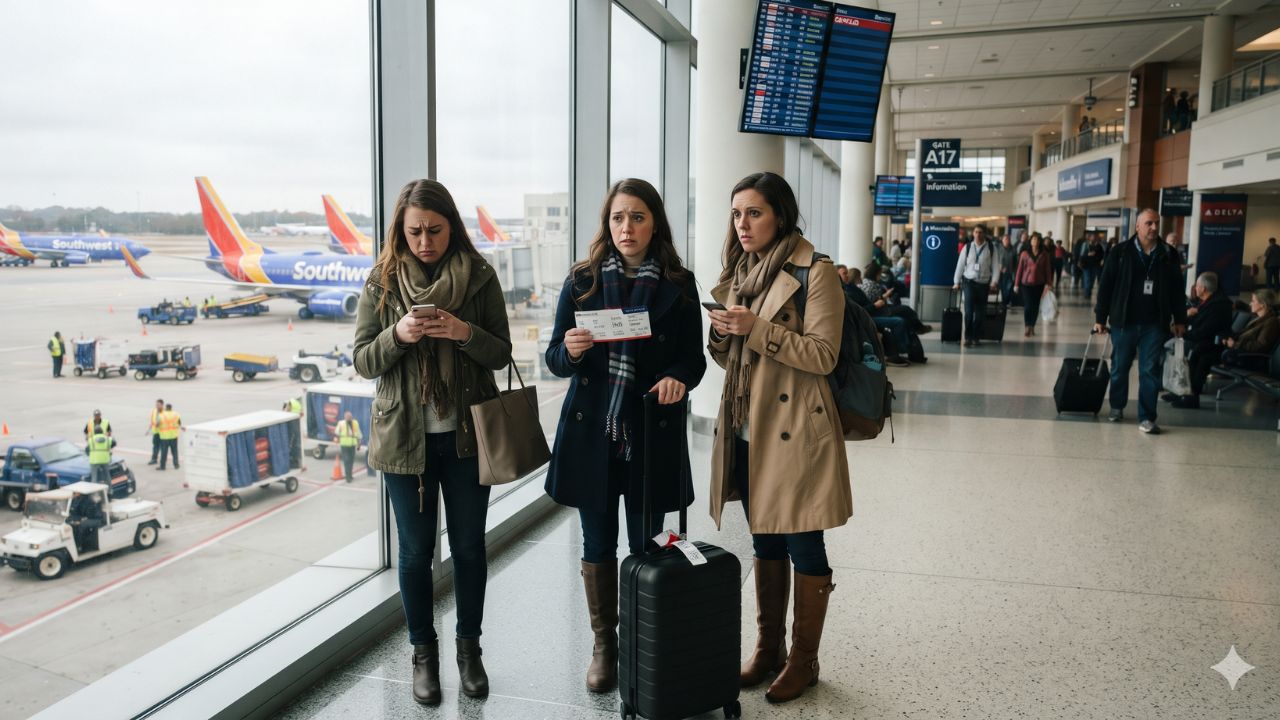
While Atlanta traditionally processes more passengers than any aviation hub on Earth, it was Miami International Airport that bore the brunt of nationwide flight turmoil on 2 November 2026, recording 274 delayed flights and identical 19 percent departure and arrival disruption rates. Across the United States, commercial aviation tracking confirmed 2,426 flight delays and 82 outright cancellations across domestic and international operations by 12:52 pm ET. Driven by intensive air traffic management spacing initiatives from the Federal Aviation Administration, departure delays in South Florida reached an average of 105 minutes, creating widespread ripple effects across airline networks anchored by Southwest Airlines, American Airlines, JetBlue, and United Airlines.
Ground Stoppages and Coastal Storms: The Core Disruption Hubs
The primary epicenter of Monday's aviation delays was South Florida, where convective weather fronts moving off the Atlantic coastline forced air traffic control centers to enforce spacing programs. Miami International Airport (MIA) led the nation in flight adjustments, with 274 flights held behind schedule. Departures and arrivals at MIA suffered identical 19 percent disruption rates, stalling American Airlines connecting banks that link North America with Latin America and the Caribbean. Neighboring Jacksonville (JAX) also absorbed 15 flight delays as air corridors across north Florida tightened.
In the Southeast, Hartsfield-Jackson Atlanta International Airport (ATL) logged 126 delayed flights, registering a 6 percent departure delay rate. In New England, Massport's Boston Logan International Airport (BOS) accumulated 91 delays, matching Atlanta with a 6 percent departure delay rate as coastal maritime winds slowed arrivals. In Texas, Houston George Bush Intercontinental Airport (IAH) recorded 76 delays, logging a 6 percent departure delay rate and a 4 percent arrival delay rate. Further north along the Eastern Seaboard, Newark Liberty International Airport (EWR) posted 59 delays, while Detroit Metro Wayne County Airport (DTW) tracked 38 flight setbacks.
Meteorological challenges also extended to the Pacific Northwest and the Mountain West. Low morning visibility caused by dense radiation fog prompted departure holds averaging 30 minutes at Seattle-Tacoma International Airport (SEA). In Southern California, heavy tarmac volume at San Diego International Airport (SAN) triggered an FAA ground delay program, forcing flights into average holds of 29 minutes. Meanwhile, Ted Stevens Anchorage International Airport (ANC) in Alaska handled 37 delays, and Salt Lake City International Airport (SLC) in Utah logged 29 delayed departures.
| Airport Gateway | Primary Operating City | Recorded Delays | Departure Delay Rate | Arrival Delay Rate | Primary Operational Factor |
|---|---|---|---|---|---|
| Miami International (MIA) | Miami, Florida | 274 | 19% | 19% | FAA weather spacing (105-minute avg holds) |
| Hartsfield-Jackson (ATL) | Atlanta, Georgia | 126 | 6% | N/A | Downline spacing & connecting bank shifts |
| Boston Logan (BOS) | Boston, Massachusetts | 91 | 6% | N/A | Coastal wind management & corridor holds |
| George Bush Intercontinental (IAH) | Houston, Texas | 76 | 6% | 4% | Gulf airspace congestion & runway metering |
| Newark Liberty (EWR) | Newark, New Jersey | 59 | N/A | N/A | New York metro airspace congestion |
| Detroit Metro Wayne Co (DTW) | Detroit, Michigan | 38 | N/A | N/A | Midwest regional connecting flow control |
| Ted Stevens Anchorage (ANC) | Anchorage, Alaska | 37 | N/A | N/A | Subarctic cross-polar transfer delays |
| Salt Lake City (SLC) | Salt Lake City, Utah | 29 | N/A | N/A | Mountain West hub re-sequencing |
| Jacksonville International (JAX) | Jacksonville, Florida | 15 | N/A | N/A | Regional Florida corridor rerouting |
Airline Performance: Carriers With Heavy Schedule Adjustments
Point-to-point and legacy network carriers experienced operational friction as crew rotations and aircraft rotations fell out of alignment. Southwest Airlines absorbed the heaviest disruption volume, logging 594 flight delays nationwide. Southwest's high aircraft utilization rate means that a weather-related ground hold in Florida or a tarmac metering program in San Diego cascades rapidly into midwestern and western focus cities like Chicago Midway, Nashville, and Denver.
American Airlines recorded 487 flight delays, concentrated heavily around its Latin American gateway in Miami and central hub in Dallas/Fort Worth. JetBlue Airways posted 171 delays, impacted by congested airspace throughout Boston Logan, Fort Lauderdale, and the New York metropolitan area. Regional capacity provider SkyWest Airlines, which operates feeder routes for United, Delta, and American, recorded 146 delays. United Airlines matched that figure with 146 delays across its mainline network, while American's regional subsidiary Envoy Air tracked 65 flight disruptions.
| Airline Operator | Operational Fleet Focus | Recorded Flight Delays | Network Impact Level |
|---|---|---|---|
| Southwest Airlines | Point-to-point national network | 594 | High multi-hub cascading delays |
| American Airlines | Dual-hub international trunk | 487 | Heavy Florida & Caribbean corridor holds |
| JetBlue | East Coast & Caribbean focus | 171 | Boston and Northeast airspace delays |
| SkyWest Airlines | Regional contract feeder | 146 | Secondary hub schedule compression |
| United Airlines | Global intercontinental trunk | 146 | Houston & Newark connecting impacts |
| Envoy Air | American Eagle regional feeder | 65 | Regional feeder cancellations & holds |
What Makes These Transit Hubs Different: Regional Flow and Chokepoint Realities
Understanding the geographical design of America's primary transit airports explains why localized weather triggers systemic national delays. Miami International Airport is not merely a regional Florida airfield; it is the dominant intercontinental bridge connecting North America with South America and the Caribbean Basin. When the FAA enforces 105-minute spacing holds across South Florida, international aircraft arriving from Bogotá, Buenos Aires, or São Paulo burn excess fuel in holding patterns over the Straits of Florida, frequently missing domestic connecting banks.
In Atlanta, Hartsfield-Jackson operates as the world's most concentrated connecting machine. With five parallel runways operating simultaneously across seven parallel concourses, even a minor 6 percent departure delay ripples through hundreds of secondary markets that rely on Delta's coordinated arrival and departure banks. In Boston, Logan Airport's seaside location adjacent to Boston Harbor subjects its airfield to shifting maritime squalls, where runway configurations must shift quickly between ocean approaches and landward departures.
On the West Coast, San Diego International Airport presents a singular operational challenge. Operating as the busiest single-runway commercial airport in North America, Lindbergh Field has zero room for error. When heavy surface taxi volume combines with marine fog layers, the FAA must impose ground delay programs averaging 29 minutes, because aircraft cannot be staggered onto secondary parallel strips.
Visitor Insider Tips: Navigating US Hub Disruptions and Terminal Holds
Travelers caught in air traffic management programs can protect their travel plans by applying practical terminal navigation tactics:
- Bypass Customer Service Queues Using Mobile Apps: When an airline announces an extended delay or cancellation, do not stand in a 200-person line at the customer service desk. Open the airline's mobile application immediately to access digital rebooking tools. Most carriers open automated rebooking options granting free changes to alternative flights departing within 24 hours.
- Master Concourse Transfers at Miami International: If connecting on American Airlines in Miami's Concourse D, use the elevated Skytrain to travel between Gates D1 and D60 instead of walking the mile-long corridor. If your layover stretches beyond three hours, take the complimentary MIA Mover train to the Miami Intermodal Center, where luggage storage and rapid Metrorail connections to downtown Miami are readily available.
- Use the Underground Transportation Spine in Atlanta: While the underground Plane Train connects all concourses at ATL (T, A, B, C, D, E, F), heavy delays often cause overcrowding on train platforms. Walk the climate-controlled pedestrian tunnels between concourses instead, where museum-grade art exhibits and historical installations provide a tranquil walk between gates.
- Leverage Free Public Transit at Boston Logan: If stuck at Logan Airport during a long ground delay, board the Massachusetts Bay Transportation Authority (MBTA) Silver Line SL1 bus directly from the lower terminal curbside. The bus ride into South Station is free, offering direct connections to Amtrak regional trains and downtown Boston hotels.
- Protect Critical Personal Essentials in Hand Luggage: Never place prescription medications, laptop chargers, mobile battery packs, or high-value items into checked baggage. If an aircraft experiences an extended departure hold or gate return, checked baggage remains in the cargo hold while passengers wait in the concourse.
Cultural and Environmental Context: Modernizing Air Traffic and Mitigating Emissions
Aviation ground delays highlight the complex balance between commercial passenger volume and environmental impact. When the FAA implements ground delay programs in Miami, Seattle, or San Diego, holding aircraft at departure gates with engines shut down significantly reduces fuel burn compared to keeping planes running on taxiways or circling in low-altitude holding stacks. Extended taxiway congestion generates thousands of tons of localized carbon dioxide and nitrogen oxide emissions around urban population centers.
Modern air traffic management is transitioning toward NextGen trajectory-based operations, utilizing satellite-based precision navigation to route aircraft around offshore storm cells rather than shutting down broad flight corridors. At airports like Seattle-Tacoma and Boston Logan, municipal port authorities are partnering with airlines to expand electrified gate power systems. These units allow parked airliners to operate onboard air conditioning and avionics from the regional electrical grid, keeping passengers comfortable during departure holds without burning auxiliary jet fuel.
For passengers, recognizing that flight delays are coordinated safety interventions provides perspective. Ground delay programs and flow management initiatives ensure that every airliner departing into turbulent weather maintains safe radar separation, safeguarding millions of travelers as they navigate dynamic national skies.
FAQ: US Flight Disruptions November 2026
What caused the widespread flight delays across US airports on 2 November 2026?
The delays were driven by FAA air traffic spacing programs in South Florida due to convective weather, ground volume in San Diego, morning fog holds in Seattle, and cascading aircraft rotation delays across major airline networks.
Which airport recorded the highest number of flight delays?
Miami International Airport (MIA) logged the highest number of delays, recording 274 delayed flights with 19 percent disruption rates for both arrivals and departures.
Which airlines experienced the largest number of delayed flights?
Southwest Airlines recorded 594 flight delays, followed by American Airlines with 487 delays, JetBlue with 171 delays, SkyWest Airlines with 146 delays, and United Airlines with 146 delays.
What should travelers do if their flight is delayed by an FAA ground hold?
Travelers should monitor airline mobile apps for automatic rebooking options, check flight statuses before departing for the terminal, and carry essential medications and chargers in their carry-on bags.
[As autumn weather patterns test the limits of America's aviation corridors, patience, proactive mobile rebooking, and local airport knowledge turn unexpected layovers into manageable journeys.]
Related Travel Guides
This article is for informational purposes. Flight routes, passenger regulations, visa rules, and transit advisories are subject to change by airlines and aviation authorities. Readers are advised to verify schedules and travel documentation with relevant carriers and border agencies before departure.
Related Stories

Ryanair €2 Billion Fuel Shock Threatens Cheap European Flights: 2027 Airfare Guide & Network Shifts

Jet Airways vs. Boeing NCLAT Battle: Why Manufacturer Litigation Offers No Quick Ticket Refunds for Indian Travel Agents