
US Flight Disruptions 2026: Over 4,180 Delays and 225 Cancellations Strike Las Vegas, Phoenix, and Charlotte

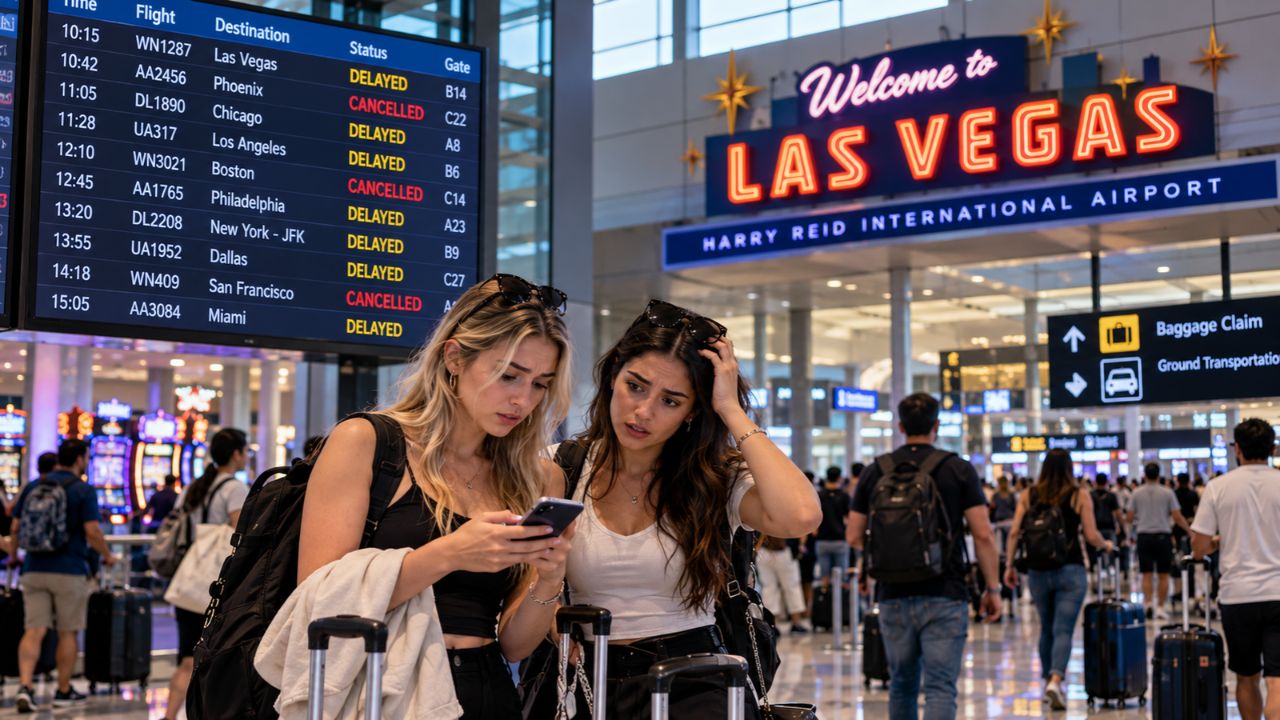
While travelers typically brace for winter blizzards or midsummer thunderstorms, early autumn weather patterns and desert crosswinds caught thousands off guard on October 11, 2026, triggering 4,182 flight delays and 225 cancellations across the United States. In the Southwest, Harry Reid International Airport in Las Vegas led the nation with 45 flight cancellations, while neighboring Phoenix Sky Harbor International Airport endured punishing 83-minute ground delay programs as powerful desert wind gusts forced air traffic controllers to space out incoming aircraft.
Desert Winds to Coastal Runways: Anatomy of a Nationwide Gridlock
The operational friction recorded across the national airspace system on 11 October stemmed from a collision of distinct regional factors: shifting desert wind shears in Nevada and Arizona, low cloud ceilings along the Mid-Atlantic seaboard, and active runway maintenance programs in New England. Data captured at 2:39 pm ET outlined widespread schedule modifications from coast to coast. Charlotte/Douglas International Airport logged the highest delay volume in the country with 458 delayed flights and 11 cancellations, creating widespread connection bottlenecks across American Airlines' secondary southeast transfer bank, where 27% of departures and 25% of arrivals ran behind schedule.
Out west, desert wind conditions proved especially disruptive. Phoenix Sky Harbor recorded 425 delays and 23 cancellations, accompanied by a formal Federal Aviation Administration (FAA) ground delay advisory averaging 83 minutes due to strong surface winds, impacting 27% of departures and 28% of arrivals. Just 250 miles northwest, Harry Reid International Airport in Las Vegas registered 417 delays and 45 cancellations—the highest cancellation total among all tracked US facilities. The FAA issued departure delay advisories in Las Vegas of 15 minutes and increasing as crosswinds whipped across the desert basin, affecting 24% of outbound and 25% of inbound services.
Along the East Coast, weather ceilings and infrastructure projects combined to constrain runway throughput. Boston Logan International Airport recorded 255 delays and 16 cancellations, burdened by an FAA ground delay program averaging 70 minutes caused by active runway construction. At Philadelphia International Airport, persistent low cloud ceilings triggered a 66-minute FAA ground delay program, driving 248 delays and 11 cancellations. In the nation’s capital, Ronald Reagan Washington National Airport logged 271 delays and three cancellations, with low ceilings causing 15-minute increasing departure delays and a 22% arrival delay rate. Further north, New York’s John F. Kennedy International recorded 161 delays and nine cancellations amid weather and traffic management constraints, while LaGuardia absorbed 111 delays and two cancellations.
Major midwestern and southern transit hubs absorbed severe rolling knock-on impacts. Chicago O’Hare recorded 244 delays and 13 cancellations, Dallas-Fort Worth registered 224 delays and 11 cancellations, and Los Angeles International marked 183 delays and 15 cancellations. In Florida, Miami International logged 108 delays and five cancellations, while Gulf Coast regional stations experienced elevated cancellation rates: Pensacola recorded 13 delays and seven cancellations, and Eglin AFB/Destin–Fort Walton Beach absorbed 12 delays alongside 11 cancellations, cutting roughly 14% of departures and 13% of arrivals.
Most Disrupted US Airports and Air Carrier Operations
The operational performance recorded across major US air hubs and domestic carriers on 11 October 2026 outlines the scale of schedule adjustments:
| Airport Name | Code | Delayed Flights | Canceled Flights | Primary FAA Operational Advisory | Departure Delay % | Arrival Delay % |
|---|---|---|---|---|---|---|
| Charlotte/Douglas | CLT | 458 | 11 | Normal operations under volume | 27% | 25% |
| Phoenix Sky Harbor | PHX | 425 | 23 | Ground delay program: 83 min, wind | 27% | 28% |
| Harry Reid (Las Vegas) | LAS | 417 | 45 | Departure delay: 15 min, increasing; wind | 24% | 25% |
| Reagan National | DCA | 271 | 3 | Departure delay: 15 min, increasing; low ceilings | — | 22% |
| Boston Logan | BOS | 255 | 16 | Ground delay program: 70 min, runway construction | 12% | 19% |
| Philadelphia | PHL | 248 | 11 | Ground delay program: 66 min, low ceilings | 17% | 19% |
| Chicago O’Hare | ORD | 244 | 13 | Regional network rotation spacing | 7% | 11% |
| Dallas-Fort Worth | DFW | 224 | 11 | Secondary hub arrival sequencing | 9% | 8% |
| Los Angeles | LAX | 183 | 15 | West Coast coastal flow control | 8% | 11% |
| John F. Kennedy | JFK | 161 | 9 | Departure delay: 15 min, increasing; traffic & weather | 8% | 14% |
| LaGuardia | LGA | 111 | 2 | Airspace volume pacing | — | — |
| Miami | MIA | 108 | 5 | Departure delay: 15 min, increasing; traffic & weather | 7% | 8% |
| Pensacola | PNS | 13 | 7 | Regional connector ground holding | 5% | — |
| Eglin AFB / Destin | VPS | 12 | 11 | Gulf corridor slot cancellations | 14% | 13% |
Among domestic airlines, Southwest Airlines suffered the heaviest disruption, logging 1,034 delays and 32 cancellations. Its delay volume represented 23% of all reported delays across the domestic airline industry. American Airlines followed with 640 delays (17% delay share) and 33 cancellations, largely driven by holding patterns at Charlotte, Philadelphia, and Dallas. Delta Air Lines recorded 374 delays and 20 cancellations, United Airlines registered 293 delays and 17 cancellations, and regional operator SkyWest Airlines marked 200 delays and 13 cancellations. Ultra-low-cost carriers also felt the squeeze: Frontier Airlines reported 117 delays and 11 cancellations (1% cancellation share), while Allegiant Air recorded 108 delays and 12 cancellations (2% cancellation share).
What Makes the Southwest and East Coast Aviation Corridors Different
The disruption profiles seen on 11 October reflect the distinct operational architectures that govern domestic air travel across the American continent.
In the desert Southwest, Las Vegas and Phoenix function as critical leisure engines and massive point-to-point transfer nodes. Harry Reid International sits directly inside a mountain-ringed desert valley, where thermal downdrafts and sudden shifts in mountain winds cross the runway layout, leaving air traffic controllers little choice but to expand landing intervals. Because Southwest Airlines operates a dense point-to-point web through both Las Vegas and Phoenix rather than a rigid hub-and-spoke system, an aircraft delayed by desert wind in Arizona in the morning cascades through four subsequent flights in Denver, Chicago, and Baltimore by evening.
Conversely, the Northeast corridor operates in the most congested air corridor in North America. Facilities like Boston Logan, Philadelphia, and Reagan National share overlapping arrival routing with New York and Baltimore. When autumn weather fronts lower cloud ceilings in Philadelphia to below visual approach standards, or when Boston takes a major runway offline for seasonal maintenance, the capacity of the entire regional network contracts immediately. Flights cannot simply circle indefinitely in dense airspace; instead, the FAA halts aircraft hundreds of miles away at their origin gates through ground delay programs.
Visitor Insider Tips: Navigating Layover Cascades in Las Vegas, Phoenix, and Charlotte
When domestic flight banks begin unraveling, seasoned travelers rely on location-specific strategies rather than waiting in hundred-person terminal queues:
- Harry Reid (LAS) Escape and Terminal Navigation: If your flight out of Las Vegas is canceled or faces multi-hour wind holds, do not join the line at customer service in Concourse C. Instead, use the carrier mobile app immediately to secure alternative departures. If stuck for several hours, take the complimentary inter-terminal shuttle bus over to Terminal 3, which is significantly quieter and offers spacious seating, cleaner charging stations, and shorter security re-entry lines compared to Terminal 1.
- Phoenix Sky Harbor (PHX) Transit and Dining Hacks: During ground delay programs at Sky Harbor, Terminal 4 (housing American and Southwest) becomes crowded quickly. Rather than paying airport prices for generic snacks, take the automated, free PHX Sky Train out to the 44th Street Station. From there, the Valley Metro Light Rail connects you in ten minutes to downtown Tempe for fresh dining, or you can relax at the 44th Street station lobby with free Wi-Fi and quiet workspaces.
- Navigating Charlotte/Douglas (CLT) Connections: Charlotte’s Concourse E is notorious for regional commuter flights, requiring up to a 20-minute walk from Main Concourse A or B. If your inbound flight lands with less than 35 minutes until your connection, inform flight attendants before descent to move forward in the cabin. If you face a long delay, head to the central atrium, find one of the iconic white rocking chairs, and connect to Charlotte’s high-speed municipal Wi-Fi to monitor rolling gate adjustments.
- Rebooking with Southwest During Network Meltdowns: Southwest Airlines operates generous rebooking policies during weather-related ground delays. If your flight is delayed by more than 60 minutes, the mobile app typically unlocks complimentary same-day flight changes without fare differences. Check for non-stop routings or alternate regional airports (such as Burbank or Ontario instead of Los Angeles, or Baltimore instead of Reagan National).
- Documentation and Expense Tracking: Keep digital copies of all boarding passes, delay notifications, and cancellation alerts directly in your smartphone wallet. Retain all receipts for meals, rideshare services, and airport hotel stays, as many credit card travel protection policies cover unexpected expenses once delays exceed four to six hours.
Cultural and Environmental Context: Desert Microclimates, Aging Infrastructure, and Point-to-Point Vulnerabilities
The recurrent flight disruptions experienced across American hubs highlight the deep intersection between seasonal climate dynamics and transportation infrastructure.
In Nevada and Arizona, urban growth across the Las Vegas Valley and the Salt River Valley has altered localized surface heat retention. Autumn brings sharp temperature contrasts between scorching daytime heat and cool mountain nights, creating strong pressure differentials that generate unpredictable thermal downdrafts and high surface winds across airport approach paths. For desert cities that rely on hospitality, entertainment, and convention tourism as primary economic drivers, flight ground stops directly impact hotel occupancy, culinary revenues, and conference schedules.
Across the Northeast, the challenge lies in modernizing aging coastal infrastructure that operates near full capacity. Airports like Boston Logan must execute critical runway resurfacing and taxiway safety enhancements before harsh winter freezes set in. However, performing heavy asphalt maintenance while accommodating hundreds of daily operations in coastal winds inevitably creates scheduling friction.
Finally, the disruption exposes the structural vulnerability of high-utilization airline schedules. Modern airlines keep aircraft in the air up to 12 hours a day, minimizing ground turnaround times to maintain profitability. When a single ground delay program in Phoenix or Boston holds aircraft for 70 to 83 minutes, the entire crew and airframe rotation fractures, proving that air travel resilience depends just as much on smart passenger contingency planning as it does on favorable desert weather.
FAQ: Navigating US Airport Delays and Cancellations 2026
What should I do if my flight is affected by an FAA ground delay program?
Monitor your airline app for updated departure and boarding times before heading to the airport. Ground delay programs manage arrivals by holding aircraft at origin gates, meaning your departure time may change dynamically.
Can I switch flights for free if my flight faces a weather or wind delay?
Most major carriers, including Southwest, American, and Delta, activate travel waivers during severe weather or ground stop events. These waivers allow passengers to change departure dates or times without paying change fees or fare differences.
Why does wind cause such severe delays at Phoenix and Las Vegas airports?
Desert valleys experience strong thermal downdrafts and crosswinds that exceed safe crosswind landing limits for parallel runways. Air traffic control must expand aircraft separation distances or reconfigure active runways, sharply reducing hourly arrival capacity.
Am I entitled to an airline-paid hotel if my domestic flight is canceled due to weather?
Airlines are not legally required by federal law to provide hotel vouchers or meal compensation for delays caused by weather, wind, or air traffic control initiatives, though elite loyalty status or premium travel credit cards may provide reimbursement.
Whether crossing desert skies or eastern runways, proactive tracking and flexible routing remain the smartest navigational tools for any journey.
Related Travel Guides
- US Flight Delays and Cancellations Surge Past 4,500 as Severe Weather and Ground Stops Impact Dallas, Houston, and Chicago
- US Flight Disruptions Mount with 2,328 Delays and 105 Cancellations Across Major Hubs
- US Flight Gridlock: 2,328 Delays and 105 Cancellations Hit Major Hubs From San Diego to Seattle and Orlando
Disclaimer
This article is for informational and educational purposes only. It does not constitute legal, financial, or professional advice. While we strive to provide accurate and up-to-date information, travel policies, regulations, and conditions change rapidly. Always verify information with official sources before making travel decisions. Nomad Lawyer makes no representations about the accuracy, reliability, completeness, or suitability of the information provided. Readers should consult qualified professionals for advice specific to their circumstances. The views expressed in this article are those of the author and do not necessarily reflect the views of Nomad Lawyer.
Raushan Kumar
Founder & Lead Developer
Full-stack developer with 11+ years of experience and a passionate traveller. Raushan built Nomad Lawyer from the ground up with a vision to create the best travel and law experience on the web.
Learn more about our team →