
US Flight Cancellations Exceed 1,600 Amid FAA Staffing and Storms
Airlines cancel 1,657 US flights and delay 3,425 more as severe thunderstorms and FAA staffing shortages disrupt major airport hubs.

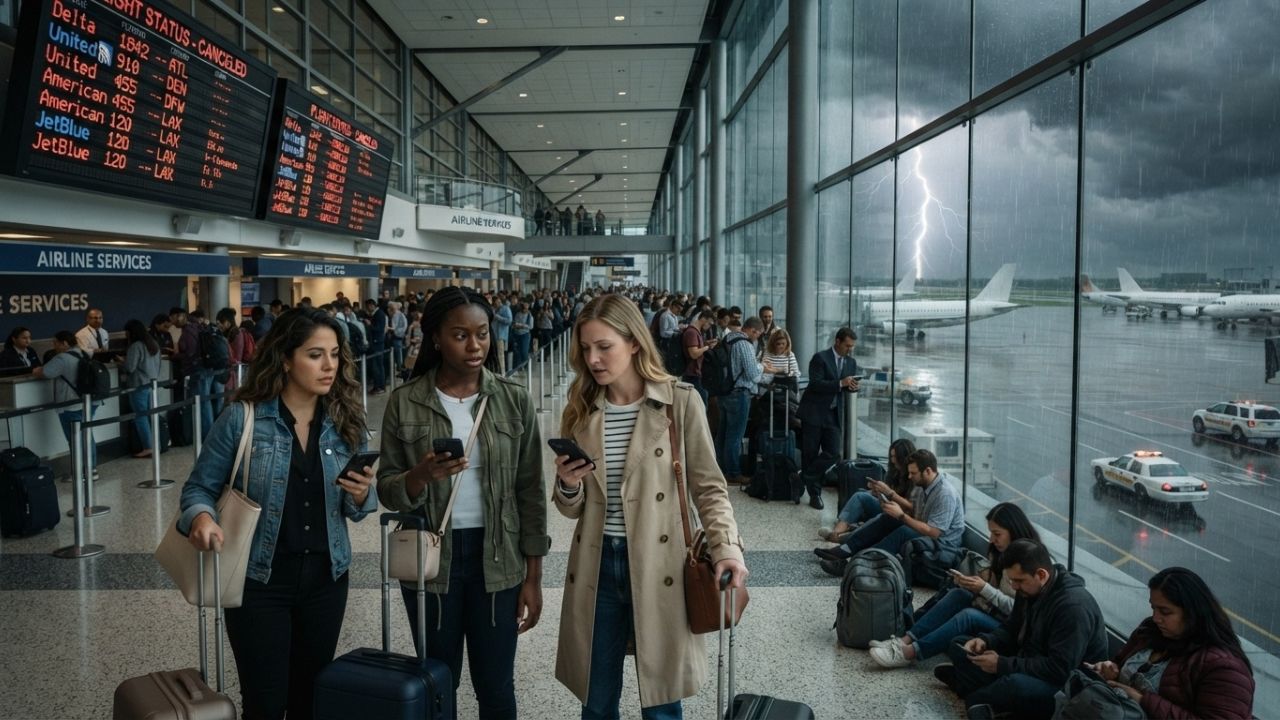
Image generated by AI
US Flight Cancellations Exceed 1,600 Amid FAA Staffing and Storms
SEO Title: US Flight Cancellations & Delays: FAA ATC Staffing Alert 2026
Meta Description: Severe US flight cancellations reach 1,657 as 3,425 delays impact hubs. Review LaGuardia, O'Hare, and Newark transit alerts, plus DOT refund rules.
Slug: us-flight-cancellations-delays-faa-staffing-weather-2026
Standfirst: A nationwide disruption has hit domestic air travel, with tracking logs showing 1,657 US flight cancellations and delays totaling 3,425 due to a mix of severe storms and FAA traffic control staffing limits.
Three Headlines
Factual / News Headline
- US flight cancellations reach 1,657 and delays hit 3,425 as FAA staffing shortages and thunderstorms disrupt major hubs.
Curiosity-Gap (Discover) Headline
- The ATC staffing shortages and weather flow restrictions cascading flight cancellations across US airport hubs.
Problem-Solving (Search) Headline
- What to do if your US flight is cancelled: How to claim cash refunds and overnight hotel lodging under DOT guidelines.
Article
A major operational bottleneck has disrupted the domestic aviation network, with US flight cancellations and delays leaving thousands of passengers stranded. Flight tracking systems recorded 1,657 cancellations and 3,425 delays nationwide on July 28, 2026, as of 1:44 pm ET. The disruption began when the FAA implemented flow restrictions into New York City and Philadelphia due to thunderstorms, which were worsened by staffing shortages at the New York Air Route Traffic Control Center.
Airport Hub and Airline Performance Impacts
The operational fallout concentrated around key Northeast corridors and major connecting hubs:
- New York Gateways: LaGuardia (LGA) reported the highest cancellation total with 441 flights, followed by John F. Kennedy (JFK) with 336 cancellations and Newark Liberty (EWR) with 207 cancellations.
- Midwest & Southern Hubs: Chicago O'Hare (ORD) recorded 306 delays, serving as the country's primary delay hotspot, while Hartsfield-Jackson Atlanta (ATL) logged over 200 delays.
- Other Disrupted Hubs: Major slowdowns also affected Philadelphia (PHL), Boston Logan (BOS), Reagan National (DCA), Baltimore/Washington (BWI), Orlando (MCO), and Nashville (BNA).
- Southwest & American: Southwest Airlines logged the highest delay volume with 536 delayed flights, while American Airlines reported 513 delays.
- Regional & Mainline Cancellations: Republic Airways reported 382 cancellations, and Endeavor Air logged 272 cancellations (representing the highest cancellation rate). JetBlue reported 226 cancellations due to its Northeast-heavy network.
Data Table
The table below outlines the delay and cancellation totals across affected airports and airlines:
US Flight Disruption and Capacity Statistics (FlightAware Data July 28, 2026)
| Disruption Metric (Airports / Airlines) | Delays Reported (July 28) | Cancellations Reported (July 28) | Primary Operational Catalyst |
|---|---|---|---|
| LaGuardia Airport (LGA) | Varies | 441 cancellations | FAA flow limits & regional storms |
| John F. Kennedy Airport (JFK) | Varies | 336 cancellations | ATC staffing shortages (New York Center) |
| Newark Liberty Airport (EWR) | Heavy delays | 207 cancellations | Northeast corridor arrival constraints |
| Chicago O'Hare Airport (ORD) | 306 delays | Modest cancellations | Mid-west traffic sequence slowdowns |
| Southwest Airlines | 536 delays | Low cancellations | Network continuity preservation strategy |
| American Airlines | 513 delays | Modest cancellations | Hub congestion (PHL, ORD, CLT) |
| Republic Airways | Varies | 382 cancellations | Regional hub feeder sequence limits |
| Endeavor Air (Delta Connection) | Varies | 272 cancellations | High eastern corridor sector exposure |
| JetBlue | Varies | 226 cancellations | Northeast network capacity limits |
Passenger Rights & Advisory (Information Gain & Experience)
For travelers caught in this nationwide disruption, passenger rights regarding refunds and care are governed by the US Department of Transportation (DOT) guidelines:
US DOT Cash Refund Rules
Under federal guidelines, if an airline cancels a flight for any reason—including weather, ATC staffing, or technical issues—and the passenger chooses not to travel on a rescheduled flight, they are entitled to a full cash refund:
- Original Form of Payment: Refunds must be returned to the original form of payment (e.g., credit card) within seven business days for credit card purchases, rather than as travel vouchers.
- Significant Delays: If a flight is delayed significantly (typically 3 hours or more for domestic routes) and the passenger chooses to cancel the ticket, they are entitled to a cash refund.
Controllable vs. Uncontrollable Delays
Under the DOT Airline Customer Service Dashboard, major carriers (including American, Delta, United, JetBlue, and Southwest) have committed to specific care standards for "controllable" disruptions (such as airline staffing shortages):
- Meals & Refreshments: Provided for delays of three hours or more from the scheduled departure time.
- Hotel Accommodation: Airlines must provide complimentary hotel lodging and roundtrip shuttle transport if a controllable cancellation or delay forces an overnight stay.
- Important Note: Weather is classified as uncontrollable, meaning airlines are not legally required to provide hotels. However, because today's disruptions involve a mix of storms and FAA staffing shortages, travelers should request that carriers clarify the primary cause of their specific delay to determine if hotel vouchers apply.
Industry Outlook
Our analysis indicates that US aviation networks remain highly sensitive to staffing issues in busy traffic control sectors. When severe weather limits landing rates, staffing shortages in regional ATC centers prevent the system from recovering quickly, turning minor storms into multi-day national travel events.
Furthermore, flight tracking systems show that regional feeder networks absorb a disproportionate share of cancellations. Mainline carriers prioritize keeping their widebody and high-capacity domestic flights active, choosing to cancel regional flights operated by partners like Republic and Endeavor to keep gates and runways clear at busy hub airports.
Related: India and Sri Lanka Launch Honeymoon Transit and Flight Advisory
Related: Thailand Confirms 30-Day Visa-Free Entry for Indian Tourists
Related: Iceland Records Near One Million Arrivals as Keflavík Airport Capacity Expands
Disclaimer
This article is for informational and educational purposes only. It does not constitute legal, financial, or professional advice. While we strive to provide accurate and up-to-date information, travel policies, regulations, and conditions change rapidly. Always verify information with official sources before making travel decisions. Nomad Lawyer makes no representations about the accuracy, reliability, completeness, or suitability of the information provided. Readers should consult qualified professionals for advice specific to their circumstances. The views expressed in this article are those of the author and do not necessarily reflect the views of Nomad Lawyer.
Kunal K Choudhary
Co-Founder & Contributor
A passionate traveller and tech enthusiast. Kunal contributes to the vision and growth of Nomad Lawyer, bringing fresh perspectives and driving the community forward.
Learn more about our team →