
U.S. Corporate Travel Spending Surges to Three-Year High
American Express Q2 2026 results reveal an 8% increase in U.S. commercial T&E spending, boosting business hubs like New York, Dallas, and Atlanta.

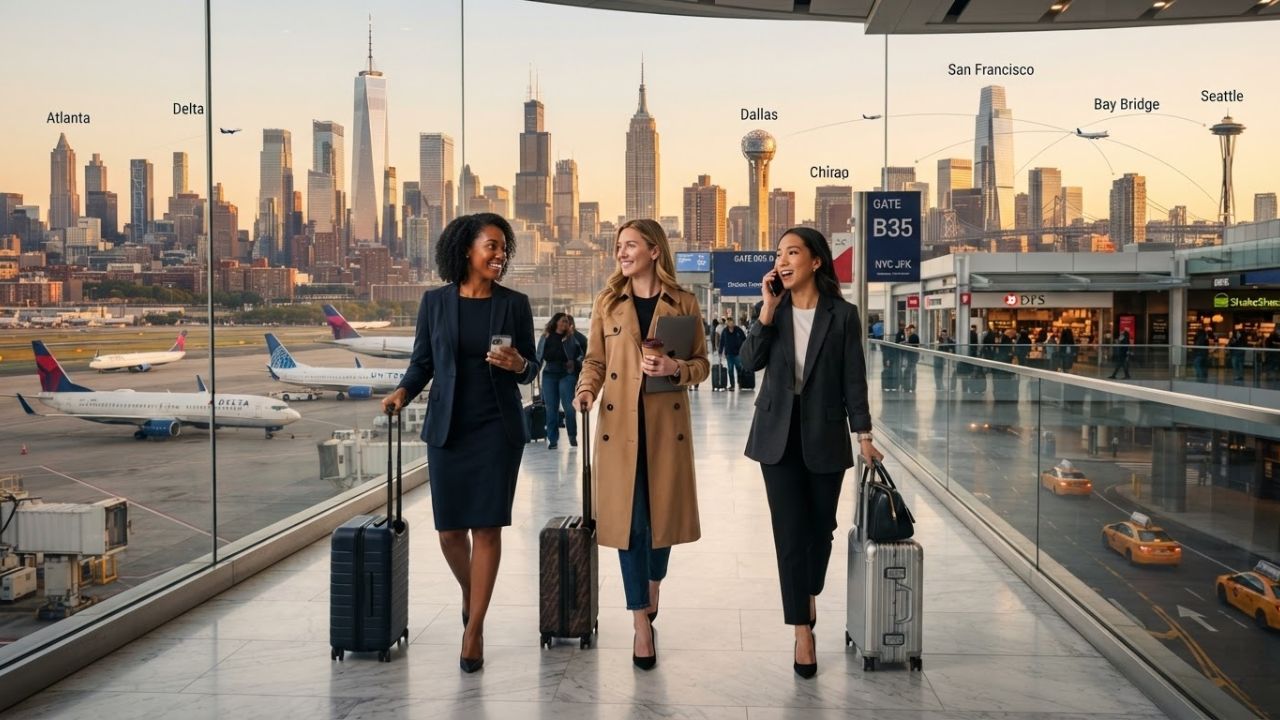
Image generated by AI
U.S. Corporate Travel Spending Surges to Three-Year High
SEO Title: U.S. Corporate Travel Spending Guide: Amex Q2 2026
Meta Description: American Express Q2 2026 data shows U.S. corporate travel spending at a three-year high. Compare business hubs, airline metrics, and flight passenger rights.
Slug: us-corporate-travel-hubs-american-express-data-2026
Standfirst: This comprehensive U.S. corporate travel spending guide outlines how business travel expenditure has reached a three-year high. Data from American Express’ second-quarter 2026 results indicates an 8% year-on-year increase in U.S. commercial travel and entertainment (T&E) spending, driving economic growth across key aviation hubs.
Article
This comprehensive U.S. corporate travel spending guide outlines how business travel expenditure has reached a three-year high. Data from American Express’ second-quarter 2026 results indicates an 8% year-on-year increase in U.S. commercial travel and entertainment (T&E) spending, driving economic growth across key aviation hubs.
Corporate travel expenditure across the United States shows renewed momentum, with major cities emerging as central hubs. Airlines, hotels, dining sectors, and convention centers are recording increased demand as businesses expand travel budgets for client meetings and trade conferences.
Central Aviation Gateways and Regional Business Hubs
Corporate travel growth is concentrated across the nation's primary economic and transit gateways:
- New York: Remains the primary center for financial, legal, and international business travel, supported by John F. Kennedy International (JFK), LaGuardia (LGA), and Newark Liberty (EWR) airports.
- Chicago: Serves as a major convention hub, anchored by McCormick Place and O'Hare International Airport (ORD) flight connections.
- Dallas: Benefits from corporate headquarters relocations, utilizing Dallas/Fort Worth International Airport (DFW) as a central connection gateway.
- Atlanta: Supported by Hartsfield-Jackson Atlanta International Airport (ATL), the primary hub for Delta Air Lines, connecting regional and domestic routes.
- San Francisco: Silicon Valley technology firms generate high volumes of venture capital and executive transit.
- Seattle: Concentrates travel demand from global cloud computing, aerospace, and software organizations via Seattle-Tacoma International (SEA).
Commercial Customer Spending and Sector-Specific Growth
American Express reported its fastest commercial billing growth in three years. While U.S. commercial customer spending grew 5% year over year, specific travel sectors registered double-digit increases:
- Airline Purchases: Climbed 10% year over year, reflecting rising ticket booking volumes.
- Restaurant Spending: Increased 10% year over year, supporting premium metropolitan dining.
- Hotel and Lodging: Rose 5% year over year, maintaining positive growth in business room nights.
International commercial spending outpaced domestic trends, growing 12% year over year, driven by multinational corporate expansion and cross-border trade.
Geopolitical Stability and Customer Demographics
Financial reviews show that while travel involving the Middle East faced regional disruptions due to geopolitical developments, global travel demand expanded. Overall travel spending grew approximately 10% during the quarter, indicating that travel budgets remained active.
Additionally, affluent U.S. consumers maintained high leisure demand, with consumer T&E spending climbing 13% year over year. The combination of corporate recovery and high consumer demand has supported airline revenues and hotel occupancy rates.
US DOT Passenger Rights for Corporate Travelers
For business travelers transiting through major hubs:
- US DOT Delay Refund Rules: If a domestic or international flight is canceled or delayed by more than three to six hours, and the passenger chooses to cancel, they are entitled to a full cash refund, regardless of ticket type.
- Controllable Delay Benefits: If a delay is caused by controllable airline issues, carriers must provide meal vouchers after three hours and free hotel lodging if the delay extends overnight.
- Overbooking Protections: If a passenger is involuntarily bumped due to airline overbooking, they are entitled to compensation up to 400% of the one-way fare, capped at $1,550.
- Biometric Checking: Major airports use digital boarding gates to speed up connection queues during tight layover windows.
Data Table
American Express Q2 2026 Commercial Spending Metrics
| Financial Parameter / Metric | Q2 2026 Growth (Year-over-Year) | Direct Influence on Corporate Travel |
|---|---|---|
| Total Billed Business Growth | +9% YoY | Highest overall transaction growth in three years |
| U.S. Commercial Customer Spending | +5% YoY | Reflects renewed business confidence and travel budgets |
| U.S. Commercial T&E Spending | +8% YoY | Drives hotel booking volume and airline premium sales |
| Goods & Services Spending | +4% YoY | Supports corporate operational and retail purchasing |
| International Commercial Spending | +12% YoY | Accelerates cross-border executive travel and expansion |
| U.S. Consumer T&E Spending | +13% YoY | Highlights high travel demand among affluent consumers |
| Airline Spending | +10% YoY | Drives capacity expansions at major metropolitan hubs |
| Restaurant Spending | +10% YoY | Boosts corporate entertainment and business dining |
| Lodging Spending | +5% YoY | Maintains consistent occupancy rates at business hotels |
| Net Income | $3.11 billion | Solidifies financial stability across card payment systems |
Why This Matters
For travelers on this route, the real impact is that rising corporate travel volumes lead to lower seat availability in business class cabins during mid-week commuter slots. From a logistical perspective, this means that travelers should download carrier apps to check connection gates in real time, especially during tight transfer windows at DFW or ATL. Corporate travelers should secure corporate room rates early, as hotel occupancy in convention cities like Chicago reaches capacity during trade events.
Industry Outlook
Airlines are introducing customized corporate booking portals to offer business clients flexible rebooking options during weather delays. As airport authorities expand automated security checkpoints, traveler processing times will decrease. Over the next year, expect travel management companies to launch AI-driven itinerary management tools to coordinate transit bookings in real time. This digital integration will reduce travel disruption costs.
Related Travel Guides
Disclaimer
This article is for informational and educational purposes only. It does not constitute legal, financial, or professional advice. While we strive to provide accurate and up-to-date information, travel policies, regulations, and conditions change rapidly. Always verify information with official sources before making travel decisions. Nomad Lawyer makes no representations about the accuracy, reliability, completeness, or suitability of the information provided. Readers should consult qualified professionals for advice specific to their circumstances. The views expressed in this article are those of the author and do not necessarily reflect the views of Nomad Lawyer.
Preeti Gunjan
Contributor & Community Manager
A passionate traveller and community builder. Preeti helps grow the Nomad Lawyer community, fostering engagement and bringing the reader experience to life.
Learn more about our team →