
US Airlines Cut Flights as Fuel Costs Surge While Passenger Demand Keeps Aviation Strong
US Airlines Cut Flights as Fuel Costs Surge While Passenger Demand Keeps Aviation Strong

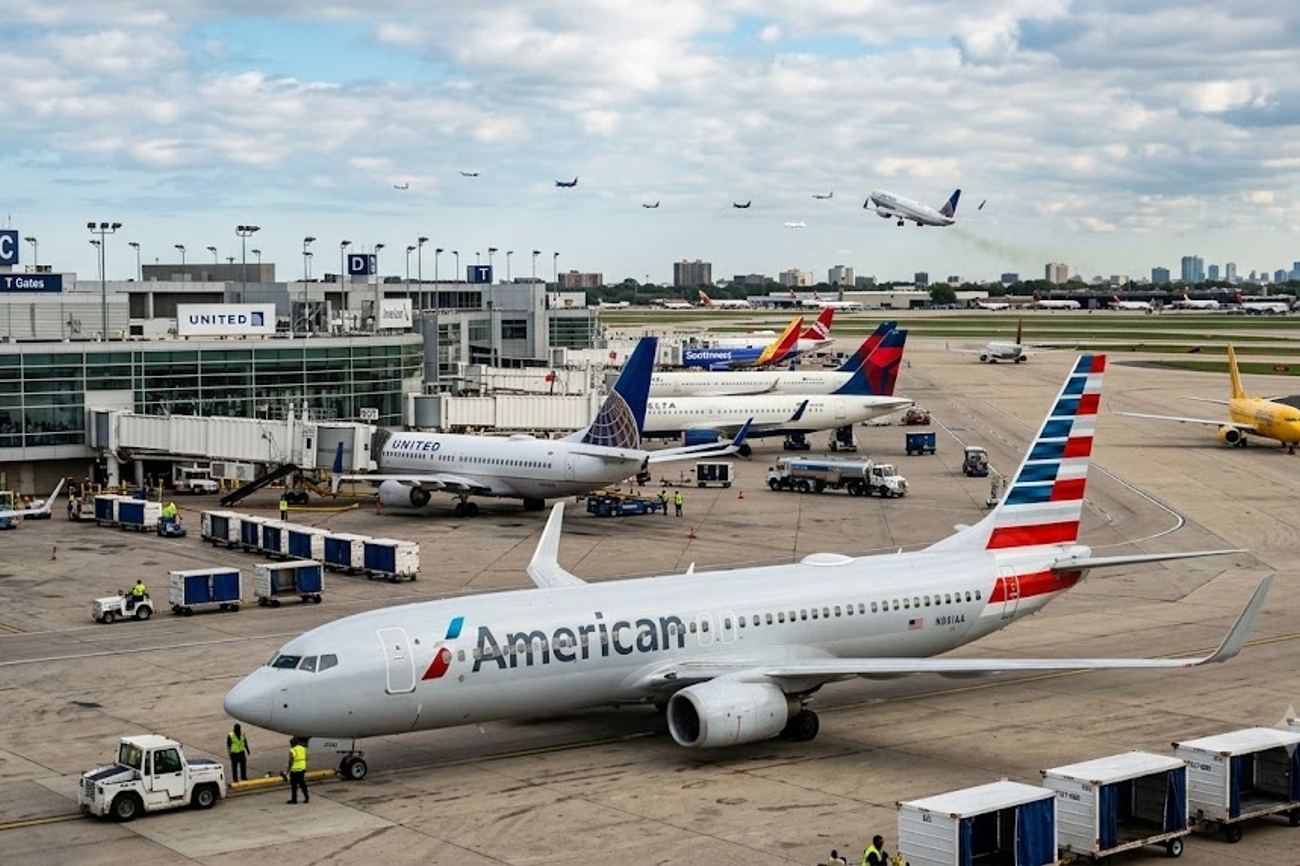
Image generated by AI
21% of all US airline operating expenses were consumed by fuel costs in the first quarter of 2026, a figure that has triggered a systemic shift in how major carriers deploy their fleets. This financial pressure is forcing a pivot away from the aggressive market-share expansion that defined the post-pandemic recovery, replacing it with a disciplined, profitability-first model of capacity management.
The Economics of Strategic Retrenchment
The current volatility in jet fuel pricing has transformed the US aviation sector's approach to network planning. For decades, the industry standard during periods of high demand was to increase seat availability to capture as many passengers as possible. However, the current fiscal environment—where fuel and labor costs dominate the balance sheet—has made that strategy untenable.
According to data from Airlines for America, the cost structure of the modern US carrier is heavily skewed toward two primary variables: labor, which accounts for roughly 34% of expenses, and fuel, which sits at 21%. Because labor contracts are typically fixed over multi-year periods, fuel remains the most volatile lever affecting a carrier's bottom line. When fuel prices spike, the marginal cost of operating a flight on a low-yield route can quickly exceed the revenue generated from ticket sales.
This has led to a "selective pruning" of networks. Rather than broad-scale cuts, airlines are utilizing granular financial data to identify "underperforming services"—routes where the cost per available seat mile (CASM) is too high relative to the revenue per available seat mile (RASM). By removing these specific flights, carriers can redirect their aircraft to high-demand corridors where passengers are more likely to pay a premium, thereby insulating the airline from fuel price swings.
Capacity Adjustments Across the Big Three
The response to these pressures is not uniform, but the trend toward austerity is evident across the three largest domestic players. Each is employing a slightly different tactical approach to protect its margins.
| Airline | Primary Strategic Shift | Core Objective |
|---|---|---|
| American Airlines | Individual route auditing | Balancing revenue opportunities against fuel burdens |
| United Airlines | Removal of low-profit services | Prioritizing financial returns over market share |
| Southwest Airlines | Slowing overall capacity growth | Increasing aircraft productivity and cost efficiency |
American Airlines is currently conducting a deep-dive review of its schedule. Instead of blanket reductions, the carrier is scrutinizing the economics of specific markets. If a route's profitability has weakened due to the increased cost of fuel, American is prepared to reduce frequency or eliminate the service entirely. This ensures that every takeoff is financially justified.
United Airlines has taken a more explicit stance on profitability over expansion. The carrier has openly stated that certain planned flights are no longer financially attractive. By removing these services, United is signaling a move away from the "growth at any cost" mentality. Interestingly, United continues to see robust booking numbers in premium and business travel sectors, suggesting that the capacity cuts are a calculated financial hedge rather than a reaction to a dying market.
Southwest Airlines, which operates a high-frequency domestic model, is facing a different challenge. Its business model relies on rapid aircraft turnarounds and high utilization. As fuel costs rise, the cost of maintaining a massive domestic footprint increases. Consequently, Southwest has slowed its planned capacity growth, indicating that further reductions are possible if fuel prices do not stabilize.
Expert Analysis: The "Demand-Capacity Paradox"
For the modern traveler, the current state of the US aviation market presents a paradox: demand for air travel is high, yet the number of available seats is shrinking. In a traditional economic model, high demand leads to increased supply. Here, the opposite is occurring because the cost of supply (fuel) has become too expensive to justify the risk of lower-yield flights.
For travelers booking domestic routes, the direct consequence is a reduction in flexibility. When United Airlines or American Airlines cuts a "marginal" route, the remaining flights on that route often see a spike in occupancy. This creates a pricing floor; with fewer seats available and steady demand, airlines have less incentive to offer discounted fares.
The pricing pressure this creates means that "budget" travel is becoming harder to find on secondary routes. As carriers consolidate their fleets onto "power routes"—those with the highest profitability—passengers in smaller or less lucrative markets will likely face higher ticket prices and fewer timing options.
Furthermore, this shift indicates a long-term change in the International Air Transport Association (IATA) framework for domestic US travel. We are moving from an era of "connectivity for the sake of network reach" to "connectivity for the sake of margin." The business logic is simple: it is better to fly a full plane on a profitable route than two half-empty planes on a subsidized route.
Key Takeaways
- Fuel costs now represent 21% of operating expenses for US carriers, while labor accounts for 34%.
- Capacity cuts are not a result of declining travel demand, but a reaction to the increased cost of operating flights.
- Major carriers including United, American, and Southwest are prioritizing "revenue per flight" over total passenger volume.
- Passengers should expect fewer flight options on secondary routes and potentially higher fares due to limited seat availability.
- The industry is shifting toward a "profitability-first" scheduling model that may persist throughout 2026.
FAQ: US Airline Capacity 2026
Why are flight options decreasing if more people want to fly? Airlines are facing higher fuel costs, making some routes unprofitable. To protect their finances, they are removing flights that don't make enough money, even if those flights are relatively full.
Will ticket prices go up because of these capacity cuts? Likely yes. When airlines reduce the number of seats available while demand remains strong, the laws of supply and demand typically drive ticket prices higher, especially on routes with limited competition.
Which airlines are most affected by these changes? American, United, and Southwest have all explicitly mentioned adjusting their capacity and growth plans in response to fuel costs, though the impact varies by specific route.
Are airlines canceling entire destinations? Rather than abandoning cities entirely, most are reducing the frequency of flights or removing specific time slots that are less profitable.
The era of cheap, abundant seat capacity is yielding to a cold calculation of fuel burn versus profit margin.
Related Travel Guides
- Philippines Strengthens Batanes Aviation as Basco Weather Bid and Itbayat Terminal Works Support Travel
- Lima Overtakes Santiago and Others as the Only Major Peruvian Airport to Record Chilean Tourist Arrival Growth for Eight Consecutive Months in 2026
- Uzbekistan Airways And flydubai Boost Global Travel With New Tourism Connectivity Deal
Disclaimer
This article is for informational and educational purposes only. It does not constitute legal, financial, or professional advice. While we strive to provide accurate and up-to-date information, travel policies, regulations, and conditions change rapidly. Always verify information with official sources before making travel decisions. Nomad Lawyer makes no representations about the accuracy, reliability, completeness, or suitability of the information provided. Readers should consult qualified professionals for advice specific to their circumstances. The views expressed in this article are those of the author and do not necessarily reflect the views of Nomad Lawyer.
Raushan Kumar
Founder & Lead Developer
Full-stack developer with 11+ years of experience and a passionate traveller. Raushan built Nomad Lawyer from the ground up with a vision to create the best travel and law experience on the web.
Learn more about our team →