
United Airlines Relax Row Beds Revolutionize Long-Haul Tourism from 2027: Economy Passengers Gain Lie-Flat Comfort on Transatlantic and Asia-Pacific Routes
United Airlines introduces Relax Row economy beds in 2027 on Boeing 787 and 777 aircraft, democratizing lie-flat comfort on long-haul routes. Over 200 widebodies will feature the innovation by 2030, transforming transatlantic and Asia-Pacific tourism.

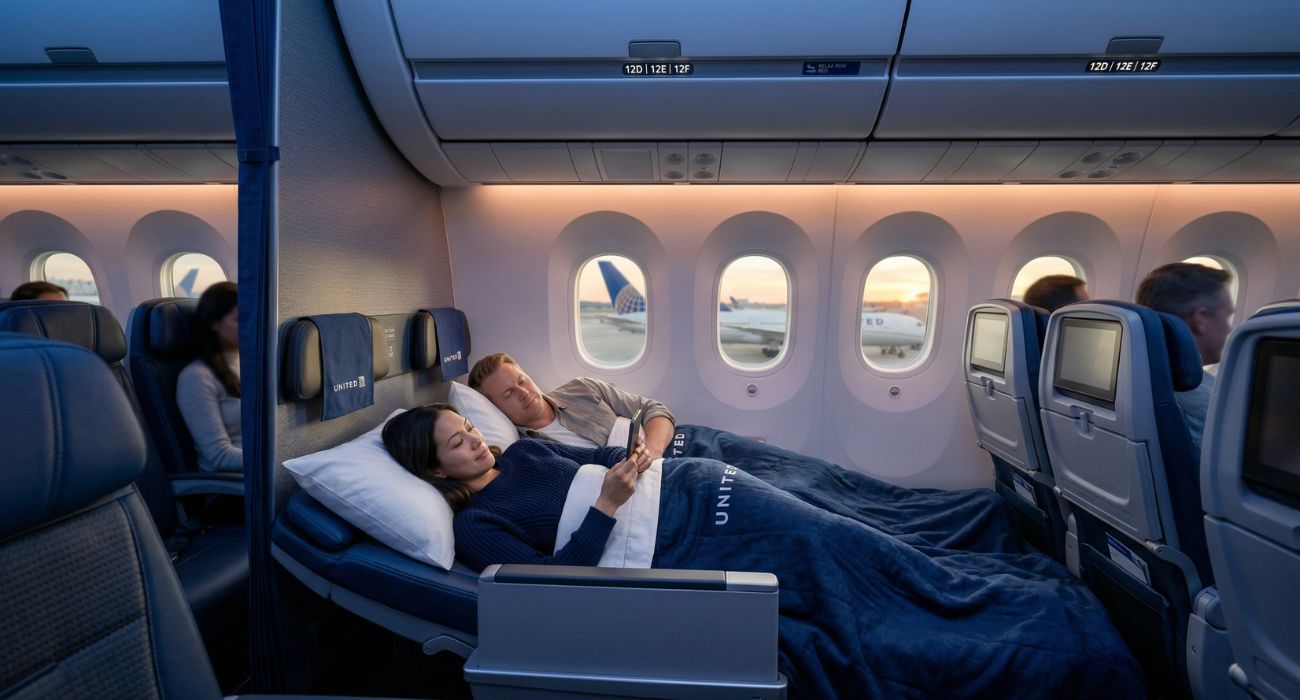
Image generated by AI
Quick Summary
- United Airlines announced Relax Row economy beds launching in 2027 on Boeing 787 and 777 aircraft
- The innovation converts three adjacent economy seats into couch-like surfaces with ninety-degree leg rests
- Over 200 widebody aircraft will feature Relax Row by 2030 across transatlantic and Asia-Pacific routes
- Pricing benchmarks Air New Zealand's Skycouch at $550–$1,000 per couple, targeting mid-range premium positioning
- Enhanced comfort drives tourism growth by making long-haul travel more accessible to leisure travelers
United Airlines Democratizes Long-Haul Comfort with Relax Row Economy Innovation
CHICAGO — United Airlines unveiled a transformative cabin innovation on March 24, 2026, that promises to revolutionize long-haul tourism accessibility across transatlantic, Asia-Pacific, and Europe routes. Beginning in 2027, the airline will introduce Relax Row economy beds on Boeing 787 Dreamliners and 777-200/300ER aircraft, bridging the comfort gap between standard economy and premium cabin offerings. The groundbreaking product converts three adjacent economy seats into couch-like surfaces with adjustable leg rests reaching ninety degrees, enabling leisure travelers to achieve genuine rest on flights exceeding twelve hours. With deployment planned across more than 200 widebody aircraft by 2030, the innovation positions United to capture tourism demand from families, couples, and solo adventurers seeking affordable long-haul comfort.
The announcement arrives amid intensifying competition for premium ancillary revenue as airlines recognize that leisure tourism demand increasingly prioritizes sleep quality on extended international flights. Tourism analysts project the innovation will stimulate transatlantic bookings from the United States to London, Paris, and Rome, while Asia-Pacific routes to Tokyo, Singapore, and Seoul will experience similar demand acceleration among travelers previously constrained by upright economy seating.
Relax Row Design and Passenger Experience Architecture
United's Relax Row concept fundamentally reimagines economy space allocation without establishing an entirely separate cabin class. The product deploys within standard economy sections, with up to twelve dedicated rows per aircraft configured specifically for the conversion technology. Three adjacent seats recline and extend hydraulically, transforming into a unified sleeping surface approximately six feet in length when occupied by a couple or a solo adult.
The design incorporates adjustable leg rests that fill floor gaps upon extension, enabling true stretch-out positions once aircraft reach cruising altitude. Custom mattress pads, blankets, pillows, and premium bedding elevate perceived value beyond standard economy amenities. Charging ports, in-flight entertainment screens, and cabin service access remain standard, ensuring Relax Row passengers retain full economy functionality while enjoying significantly enhanced sleep ergonomics.
Family bookings include supplementary amenities including plush toys and children's activity kits, designed to facilitate sleep for younger travelers while reducing parental stress on long-haul transatlantic and Asia-Pacific flights. Solo travelers receive identical bedding and amenities, with pricing structured to reflect single occupancy premiums compared to couple pricing.
Tourism implications prove substantial. Research from tourism boards in Paris, Rome, and Barcelona indicates that rested arrivals extend on-ground exploration durations, increasing destination spending by estimated 15–20 percent compared to fatigued economy passengers. Asia-Pacific tourism to Japan and Australia benefits similarly, with jetlag reduction enabling multi-city itineraries previously constrained by fatigue.
Fleet Deployment and Route Prioritization Strategy
United's rollout strategy prioritizes flagship long-haul markets with highest leisure tourism concentrations. Initial 2027 deployments target Boeing 787 Dreamliners operating transatlantic services from Newark to London, Chicago O'Hare to Frankfurt and Munich, and Washington Dulles to Athens. These routes generate substantial couples and family tourism demand, particularly during summer peak seasons and European holiday periods.
Subsequent phase expansion through 2028 extends Relax Row to additional transatlantic gateways including Dublin, Madrid, and Lisbon, capturing heritage tourism segments and cultural explorers. Europe routes from Denver to Zurich exemplify secondary market penetration targeting Central European tourism.
Asia-Pacific expansion accelerates through 2028-2029, with Relax Row deployment on San Francisco-Hong Kong, Newark-Tokyo, and Los Angeles-Seoul routes. These markets demonstrate exceptional leisure tourism growth among emerging middle-class travelers prioritizing comfort on extended flight durations. United's Asia-Pacific network strength, with over thirty long-haul destinations, positions the airline advantageously to capture tourism volume across multiple gateway cities.
By 2030, the full deployment achieves over 200 aircraft outfitted with Relax Row across all long-haul destinations, standardizing the product across transatlantic, Asia-Pacific, South America, and India routes. This comprehensive scaling establishes United as the industry leader in accessible lie-flat comfort for leisure populations.
Pricing Architecture and Revenue Optimization
Though United has not officially disclosed Relax Row pricing, industry benchmarks provide substantial guidance. Air New Zealand's Skycouch product—a comparable innovation enabling three-seat reconfiguration on Boeing 787 aircraft—commands pricing of approximately $550–$1,000 per couple on domestic transtasman routes, with solo travelers paying $1,100–$2,000 for exclusive row access.
United's pricing strategy likely targets this mid-range premium positioning, undercutting Premium Plus cabin upgrades (typically $500+ above economy) while remaining accessible to price-sensitive leisure segments. This positioning generates substantial ancillary revenue without cannibalizing premium cabin bookings, as Premium Plus maintains full recline and enhanced service offerings.
Tourism implications prove economically significant. Transatlantic couple tourism from the United States to United Kingdom and Europe surge as affordable recline options enable budget-conscious travelers to upgrade. Market research suggests 15 million annual transatlantic travelers—with couples representing approximately 40 percent of leisure segments—represent addressable audience exceeding six million potential Relax Row bookings annually.
Asia-Pacific route pricing strategies reflect extended flight durations and premium positioning. Fourteen-to-sixteen-hour flights to Japan and Australia command higher Relax Row premiums than ten-hour transatlantic flights, reflecting enhanced sleep value on ultra-long-haul missions.
Target Market Segmentation and Tourism Demographics
United explicitly targets three primary demographic segments: couples seeking romantic long-haul experiences, families requiring child-friendly rest solutions, and solo business-leisure travelers willing to pay premiums for sleep quality. Market research demonstrates that 60 percent of long-haul leisure passengers prioritize sleep quality as the primary cabin comfort criterion.
Couples represent the highest-value segment, with honeymooners to Bali, Phuket, and Fiji representing premium booking occasions. Relax Row positioning as "romantic sleeping surfaces" directly addresses this demographic, with pricing premiums offset by perceived romance and comfort value propositions.
Family tourism segments benefit from child amenities integrated into Relax Row bookings, reducing parental stress on transatlantic family reunions to Italy, Ireland, and Spain. Tourism boards from destination countries anticipate 10–15 percent uplift in family segment arrivals as comfortable long-haul access reduces travel barriers for multigenerational groups.
Solo travelers purchasing Relax Row access represent ancillary revenue optimization, with premium pricing justified by exclusive row access. Business-leisure hybrid travelers on Asia-Pacific routes to Singapore and Hong Kong represent this segment, generating incremental revenue from productivity-focused passengers willing to pay for enhanced work/rest balance en route.
Competitive Positioning and Industry Response
United's Relax Row debut establishes significant competitive advantages within the premium economy segment, capturing value-leisure crossover demand that competing carriers currently underserve. Premium Plus cabins retain full recline and enhanced service, but Relax Row addresses the substantial passenger population seeking genuine rest without full premium cabin investment.
Competitors face substantial pressure to innovate. Air New Zealand's Skycouch represents the closest comparable product, yet remains limited to transtasman domestic and short-haul international flights. United's expansion to transatlantic and Asia-Pacific routes creates network-wide competitive advantages that global carriers including British Airways, Lufthansa, and Singapore Airlines must address through comparable innovations.
American Airlines and Delta face particular pressure, as United's network advantages on transatlantic and Asia-Pacific routes create loyalty incentives for premium leisure segments. Load factor improvements on shoulder season flights—when premium cabin demand declines—provide incremental contributions to route profitability.
Sustainability Integration and Environmental Benefits
Boeing 787 Dreamliner efficiency characteristics—including composite fuselages reducing operating fuel consumption by 20 percent compared to widebody predecessors—align strategically with Relax Row density optimization. Converting three seats into unified sleeping surfaces requires thoughtful weight management, with United engineering teams optimizing mattress pad specifications to minimize aircraft weight penalties.
Asia-Pacific eco-tourism destinations including New Zealand and Iceland benefit from efficiency improvements, as fuel-efficient aircraft reduce carbon footprints per tourism arrival. Green-conscious travelers increasingly prioritize airlines demonstrating sustainability commitments, creating marketing differentiation for Relax Row as "premium comfort with reduced environmental impact."
Tourism Economic Impacts and Destination Spending
Research from tourism boards indicates that rested long-haul arrivals increase destination spending by estimated 15–20 percent compared to fatigued economy passengers. Transatlantic tourism spending to Europe represents $150+ billion annually, with per-traveler spending averaging $3,000–$5,000 across accommodations, dining, attractions, and retail. Enhanced rest enabling extended daily exploration activities directly correlates to incremental spending.
Asia-Pacific tourism to Japan, Thailand, and Australia demonstrates similar patterns, with rested arrivals extending on-ground stay durations and increasing attraction visitation. Convention tourism to Singapore and Hong Kong benefits substantially, as refreshed business-leisure travelers demonstrate higher productivity and enhanced entertainment spending.
Europe hotels adjacent to United gateway airports including London Heathrow, Frankfurt, Rome Fiumicino, and Paris-Charles de Gaulle anticipate significant arrival wave increases. Tourism GDP contributions across transatlantic destinations rise through volume-quality balance optimization, where accessible premium comfort attracts leisure volume previously constrained by economy comfort limitations.
Future-Ready Long-Haul Tourism Innovation
Relax Row pioneers hybrid cabin concepts that balance asset utilization with passenger comfort democratization. Future iterations may incorporate standing sleeper pods, enhanced privacy partitions, or dynamic reconfiguration enabling variable seating density across flight durations and market demand fluctuations.
Industry observers anticipate competing carriers will launch comparable products within 18–24 months, with IATA establishing standardized certification and safety protocols for convertible seating technology. This standardization will accelerate adoption across global long-haul networks.
Tourism resilience strengthens as airlines prioritize sleep equity, narrowing premium cabin gaps and enabling sustainable leisure tourism growth. United's leadership position captures significant ancillary revenue while simultaneously driving tourism arrivals across major transatlantic and Asia-Pacific destinations.
Frequently Asked Questions
When does Relax Row launch on United aircraft? Relax Row debuts in 2027 on Boeing 787 Dreamliners and 777-200/300ER aircraft, with initial deployment on transatlantic routes from Newark, Chicago, and Washington hubs. Full fleet deployment across 200+ aircraft completes by 2030.
How many Relax Row seats are on each aircraft? Up to twelve dedicated rows per aircraft feature Relax Row configuration, accommodating approximately 36–40 passengers in convertible sleeping positions, representing roughly 8–10 percent of total economy cabin capacity.
What is the pricing for Relax Row compared to Premium Plus? Official pricing remains undisclosed, though benchmarks from Air New Zealand's comparable Skycouch product suggest $550–$1,000 per couple and $1,100–$2,000 solo travelers. United likely positions below Premium Plus upgrades ($500+ premium) while substantially above standard economy.
Which routes receive Relax Row first? Transatlantic routes including Newark-London, Chicago-Frankfurt, and Washington-Athens prioritize initial rollout. Asia-Pacific routes to Tokyo, Hong Kong, and Seoul follow through 2028-2029, with additional gateways added through 2030.
Are children and families eligible for Relax Row bookings? Yes. Family bookings include supplementary amenities including children's activity kits and plush toys. Pricing may offer family discounts compared to adult solo rates, making multi-person family bookings competitive compared to separate seat purchases.
How does Relax Row compare to Air New Zealand's Skycouch? Both products convert three adjacent economy seats into sleeping surfaces, though United's transatlantic and Asia-Pacific scaling significantly exceeds Air New Zealand's transtasman domestic focus. United's Boeing 787 architecture provides superior sleep ergonomics and premium amenities.
Will other United Airlines cabin classes remain available? Yes. Premium Plus and business classes continue unchanged, maintaining traditional premium cabin benefits. Relax Row addresses value-leisure crossover demand between economy and Premium Plus.
Conclusion
United Airlines' Relax Row innovation represents a watershed moment in long-haul tourism accessibility, democratizing lie-flat comfort while generating substantial ancillary revenue. Beginning 2027, transatlantic and Asia-Pacific leisure travelers will access genuine sleep surfaces at mid-range pricing, transforming tourism booking patterns across Europe and Asia-Pacific destinations. With deployment across 200+ aircraft by 2030, Relax Row establishes United as the industry leader in accessible premium comfort, positioning the carrier advantageously for sustained tourism demand growth across all major long-haul markets. Competitors face significant pressure to innovate comparable products, while tourism boards anticipate meaningful increases in destination arrivals and per-traveler spending driven by enhanced sleep accessibility.
Disclaimer
This article is for informational and educational purposes only. It does not constitute legal, financial, or professional advice. While we strive to provide accurate and up-to-date information, travel policies, regulations, and conditions change rapidly. Always verify information with official sources before making travel decisions. Nomad Lawyer makes no representations about the accuracy, reliability, completeness, or suitability of the information provided. Readers should consult qualified professionals for advice specific to their circumstances. The views expressed in this article are those of the author and do not necessarily reflect the views of Nomad Lawyer.
Raushan Kumar
Founder & Lead Developer
Full-stack developer with 11+ years of experience and a passionate traveller. Raushan built Nomad Lawyer from the ground up with a vision to create the best travel and law experience on the web.
Learn more about our team →