
United Airlines Relax Row Economy: New Mid-Tier Long-Haul Beds Launch 2027
United Airlines unveils Relax Row economy beds for long-haul flights launching 2027. The mid-tier upsell bridges standard and premium economy across 200+ widebody aircraft by 2030.

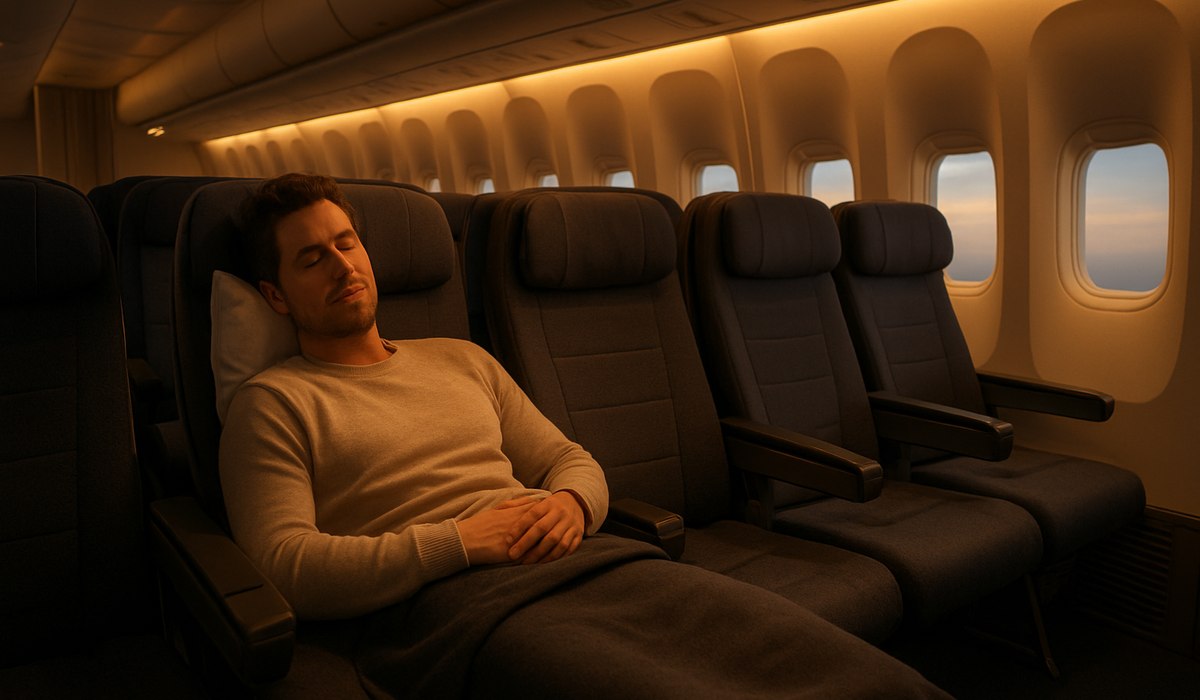
Image generated by AI
United Airlines Relax Row Economy Beds Launch 2027: What Travelers Need to Know
United Airlines announced a groundbreaking cabin innovation on March 24, 2026, introducing Relax Row economy beds as a strategic mid-tier seating option for long-haul international flights. The airline's new Relax Row product represents an ambitious industry pivot, designed to sit between traditional economy and premium economy without directly competing with either cabin class. Starting in 2027, United will debut this innovative seating solution on Boeing 787 Dreamliners and 777 widebody aircraft, with plans to expand the offering across more than 200 widebody jets by 2030. Each aircraft will feature up to 12 dedicated Relax Row sections, enabling United to monetize long-haul comfort at meaningful scale.
What Is United Airlines' Relax Row Economy Product?
United's Relax Row economy represents a calculated response to evolving passenger expectations for mid-range long-haul seating without premium price tags. Rather than creating an entirely new cabin class, Relax Row operates as a tiered upgrade within economy, offering enhanced comfort through specialized seating architecture that accommodates extended rest periods on transcontinental and transatlantic routes.
The concept centers on convertible bed-style seating that extends flat or semi-flat, addressing the primary complaint of long-haul economy passengers: inability to rest effectively during overnight flights. By limiting Relax Row sections to 12 per aircraft, United optimizes revenue potential while managing cabin density constraints. This approach allows the airline to test market demand without wholesale cabin reconfiguration, a critical advantage over competitor programs requiring structural modifications.
Industry analysts view Relax Row economy as positioned between basic economy and traditional premium economy, filling a persistent gap in United's cabin hierarchy. This positioning matters strategically: premium economy commands 2-3× economy fares, while Relax Row likely targets passengers willing to pay 30-50% premiums for demonstrable comfort gains on 8-14 hour flights.
When Will Relax Row Launch and Which Aircraft Will Feature It?
United's rollout timeline reflects deliberate commercialization strategy prioritizing operational testing before fleet-wide deployment. The inaugural Relax Row economy debut occurs in 2027 on the Boeing 787-9 Dreamliner, an aircraft class already optimized for long-haul operations with advanced cabin systems. The 787's modular cabin architecture supports easier retrofit installation compared to legacy widebodies, making it an logical launch platform.
Boeing 777 aircraft will follow 787 deployment, with both aircraft types representing United's modern widebody backbone serving premium international routes. These aircraft operate the airline's longest transcontinental and transatlantic corridors—precisely where sleep quality during flight generates highest passenger willingness-to-pay.
The 2030 target for 200+ widebody installations implies aggressive implementation across United's entire Boeing 787, 777, and potentially select Airbus A350 fleets. This timeline suggests roughly 50-70 aircraft annually receiving Relax Row retrofit installations, a substantial capital commitment signaling executive confidence in the product's revenue potential.
For current United frequent flyers, this timeline matters: you may encounter Relax Row availability on specific routes beginning mid-to-late 2027, initially on limited daily flights before broader availability emerges. Early adopter frequent flyer members will likely access advance booking windows or loyalty bonuses for Relax Row upgrades during launch phases.
Expected Pricing and Competitive Positioning
United hasn't publicly announced definitive Relax Row economy pricing, but industry structure suggests likely positioning. Premium economy on United's long-haul fleet typically commands 80-120% premiums over economy base fares on transatlantic routes. A typical economy fare ($800-1,200) translates to premium economy pricing of $1,400-2,600.
Relax Row economy likely targets $1,100-1,600 positioning—roughly 40-80% above standard economy, significantly below premium economy tiers. This pricing hypothesis aligns with United's strategic intent: capturing price-sensitive passengers reluctant to accept $1,400+ premium economy commitments but willing to invest modest additional capital for tangible comfort improvements.
Competitive context matters. Delta's Delta Comfort+ and American's Premium Economy both operate at higher price points, creating white space for mid-tier products. Southwest's lack of assigned seating structure leaves it outside this competitive set entirely. International carriers like Lufthansa and Air France offer premium economy, but their pricing similarly exceeds the apparent Relax Row target zone.
Revenue management systems will prove crucial to successful Relax Row economy monetization. Dynamic pricing based on demand, booking window, and route utilization will likely determine actual pricing realization. Frequent flyers with elite status may access upgrade availability, though United will likely protect inventory for direct Relax Row bookings to maximize revenue capture.
Scale and Industry Impact of United's Relax Row Expansion
The planned expansion to 200+ widebody aircraft by 2030 positions Relax Row economy as industry-defining, with implications extending beyond United's fleet. If successful, competitors face adoption pressure for similar mid-tier products, potentially reshaping long-haul cabin economics across North American carriers.
From United's perspective, 200+ aircraft × 12 Relax Row seats = 2,400 daily potential Relax Row bookings assuming 100% utilization across its long-haul network. At $200-400 per-ticket premiums (relative to standard economy), annual incremental revenue could reach $175-280 million at reasonable utilization assumptions. This scale justifies significant capital investment in cabin modifications and crew training.
The competitive implications extend internationally. European and Asian carriers already offer premium economy; Relax Row economy creates new category-level competition requiring strategic responses. Smaller carriers may struggle to justify similar investments, potentially ceding differentiation to network carriers with sufficient fleet scale.
Cabin crew operations change meaningfully with Relax Row introduction. Expanded seating configurations require modified beverage service protocols, modified oxygen system considerations, and adjusted passenger flow management. United's training investments will represent non-trivial implementation costs partially offsetting projected revenue gains.
Key Data Table: United Airlines Relax Row Specifications
| Specification | Details |
|---|---|
| Product Launch Year | 2027 |
| Initial Aircraft Types | Boeing 787-9, Boeing 777 |
| Seats Per Aircraft | Up to 12 Relax Row sections |
| Fleet Target by 2030 | 200+ widebody aircraft |
| Estimated Annual Deployments | 50-70 aircraft (2027-2030) |
| Competitive Positioning | Between economy and premium economy |
| Expected Pricing Range | $1,100-$1,600 on transcontinental/transatlantic |
| Flat/Semi-Flat Configuration | Yes, convertible bed-style seating |
| Estimated Daily Capacity | 2,400 seats across fleet at full deployment |
| Revenue Potential | $175-280 million annually at maturity |
What This Means for Travelers
Understanding Relax Row economy positioning helps long-haul passengers optimize booking strategies and value assessment:
-
Evaluate Your Route: Relax Row makes sense primarily on flights exceeding 8 hours where sleep quality meaningfully impacts recovery. Shorter long-haul flights (5-7 hours) may not justify premium upgrades.
-
Compare Against Premium Economy: Before booking Relax Row, assess whether premium economy pricing on your specific route justifies full-cabin premium amenities (priority boarding, dedicated lounges, enhanced meals) versus Relax Row's focused sleep enhancement.
-
**Monitor Frequent
Disclaimer
This article is for informational and educational purposes only. It does not constitute legal, financial, or professional advice. While we strive to provide accurate and up-to-date information, travel policies, regulations, and conditions change rapidly. Always verify information with official sources before making travel decisions. Nomad Lawyer makes no representations about the accuracy, reliability, completeness, or suitability of the information provided. Readers should consult qualified professionals for advice specific to their circumstances. The views expressed in this article are those of the author and do not necessarily reflect the views of Nomad Lawyer.
Raushan Kumar
Founder & Lead Developer
Full-stack developer with 11+ years of experience and a passionate traveller. Raushan built Nomad Lawyer from the ground up with a vision to create the best travel and law experience on the web.
Learn more about our team →