
United Airlines Launches Revolutionary Polaris 2.0 Business Class on All Singapore Changi to San Francisco Flights from August 2026, Featuring Sliding Suite Doors, 4K Screens, and Starlink Wi-Fi
United Airlines deploys Polaris 2.0 Business Class on all 14 weekly Singapore Changi (SIN)–San Francisco (SFO) flights from August 2026, featuring sliding privacy doors, 4K screens, Bluetooth audio, and complimentary Starlink Wi-Fi.

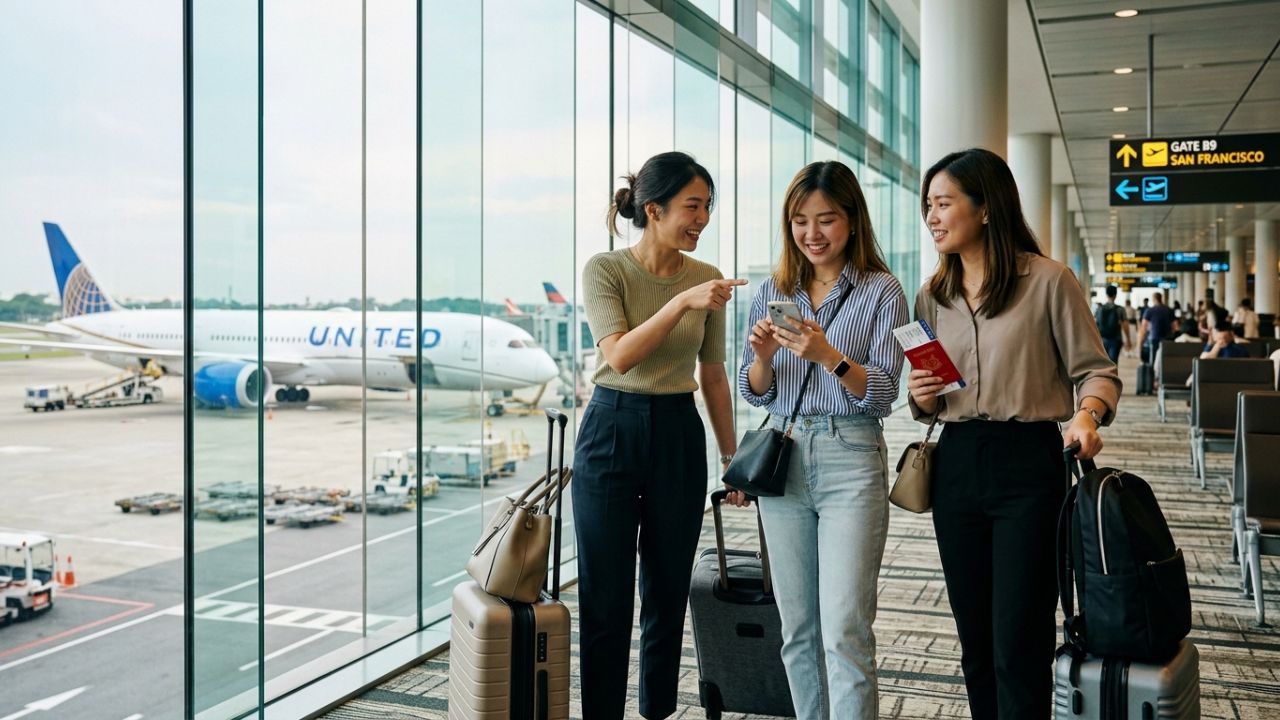
Image generated by AI
United Airlines Launches Revolutionary Polaris 2.0 Business Class on All Singapore Changi to San Francisco Flights from August 2026, Featuring Sliding Suite Doors, 4K Screens, Starlink Wi-Fi, and 64 Premium Suites Per Flight
Published on May 13, 2026
One of the most coveted Business Class products in global aviation is arriving on one of the world's most commercially significant transpacific corridors — and the implications for premium travelers flying between Singapore and the United States are genuinely extraordinary. United Airlines has confirmed the full deployment of its next-generation Polaris 2.0 Business Class on all flights between Singapore Changi Airport (SIN) and San Francisco International Airport (SFO), commencing August 2, 2026 — covering all 14 weekly nonstop services on this critical transpacific route. The upgraded Boeing 787-9 aircraft carrying the new Polaris 2.0 cabin will feature sliding private suite doors, 4K entertainment screens, Bluetooth audio, wireless charging, complimentary Starlink Wi-Fi, and the extraordinary Studio Suite upgrade option — delivering a Business Class experience that positions United as a genuinely formidable competitor to Singapore Airlines on one of the most premium-travel-intensive routes in Asian aviation. For every traveler who has ever dreamed of arriving in Singapore — or San Francisco — having truly slept, in actual privacy, in genuine luxury, this is the product that makes it possible.
Quick Summary:
- United Airlines Polaris 2.0 Business Class fully deployed on all Singapore Changi (SIN) ↔ San Francisco (SFO) nonstop flights from August 2, 2026 — covering all 14 weekly services.
- Boeing 787-9 aircraft upgraded to carry the new Polaris 2.0 product, featuring 64 Business Class suites per aircraft on this route.
- Key Polaris 2.0 features: Sliding private suite doors, 4K entertainment screens, Bluetooth audio connectivity, wireless device charging, and complimentary Starlink satellite Wi-Fi.
- Studio Suites — premium upgrade option offering larger screens, more cabin space, and enhanced dining configurations — available on select seats within the Polaris 2.0 cabin.
- Direct competitive positioning against Singapore Airlines — the route's dominant premium carrier — with United's technology-forward product targeting high-yield business and luxury leisure travelers.
- Tourism and business stimulus: The upgrade is expected to boost premium traveler volumes between Singapore, the US West Coast, and onward US connections, stimulating both countries' tourism and trade sectors.
- Early booking strongly advised — Polaris 2.0 suites on the SIN–SFO corridor are expected to generate exceptionally high demand from US-based United MileagePlus members and Singapore-based premium business travelers.
Polaris 2.0: What United Airlines Has Built for the Future of Business Class
To understand why the Polaris 2.0 Business Class matters so profoundly on the Singapore–San Francisco route, it is worth spending a moment understanding what United has actually built — and why this represents a fundamental step change from the original Polaris product.
United's original Polaris Business Class — introduced in 2016 — was a significant improvement over its predecessor, offering lie-flat beds, direct aisle access, and enhanced dining on long-haul routes. But in a market where Qatar Airways' Qsuite, Singapore Airlines' new Business Class, and Emirates' First Class have progressively raised the benchmark for premium cabin design, the original Polaris required an evolutionary response.
Polaris 2.0 delivers that response across four critical dimensions:
Privacy — The sliding suite door is the headline feature. Passengers can fully close their suite, creating a private cabin environment that eliminates the social exposure of open seat configurations. In a world where premium travelers increasingly work during flights or value uninterrupted sleep, a door is not a luxury detail — it is a fundamental product requirement.
Entertainment — The 4K Ultra HD seatback screens bring cinematic display quality to the seat-level viewing experience, a meaningful upgrade from the 1080p screens in the original Polaris cabin. Combined with Bluetooth audio that eliminates the need for wired headsets, the entertainment system represents a genuine premium consumer electronics experience at 35,000 feet.
Connectivity — Starlink satellite Wi-Fi — the SpaceX-operated low Earth orbit internet constellation — delivers speeds meaningfully faster than the legacy Ka-band systems that have historically been standard on long-haul aircraft. On a 17-hour Singapore–San Francisco flight, the ability to video-conference, upload large files, and stream content without throttling transforms the cabin into a functional flying office for business travelers.
Dining — The Studio Suite configuration includes enhanced dining arrangements that allow Business Class passengers to dine at a properly configured surface rather than the tray-table format of conventional seat products.
Singapore Changi to San Francisco: Why This Route Matters
The Singapore–San Francisco corridor is one of the most commercially strategic transpacific aviation routes in global aviation — and understanding its specific characteristics explains precisely why United chose it as a priority deployment for Polaris 2.0.
Singapore Changi Airport is consistently ranked the world's finest airport — the Jewel's extraordinary indoor waterfall and garden complex, the airport's extraordinary dining and retail environment, and the operational precision of one of the world's most efficiently managed aviation gateways make it the ideal premium product launchpad for a carrier seeking to claim premium positioning in the Asian market.
Singapore itself — a city-state of extraordinary financial sophistication, culinary excellence, architectural ambition, and cultural richness — generates an enormous premium business travel demand in both directions. Singapore is one of the world's great financial centers, home to major regional headquarters for companies spanning banking, technology, pharmaceuticals, and maritime industries. Business Class demand on the Singapore–US corridor is among the highest yield-per-seat of any transpacific market.
San Francisco International Airport (SFO) — United's Pacific hub and the primary gateway for the US technology sector — is the natural US terminus for Singapore's corporate and technology traveler base. Silicon Valley's extraordinary concentration of technology companies has created a sustained premium business travel relationship between San Francisco and Singapore that generates consistent year-round demand for the highest-quality available Business Class products.
The Singapore Airlines Factor: United's Most Significant Competitive Move
Singapore Airlines — holder of the "World's Best Business Class" title across multiple years at the Skytrax World Airline Awards — has historically dominated the premium end of the Singapore–US corridor, with its extraordinary new Business Class (featuring full private suites with closing doors, leather seats, and custom Lalique amenity kits) setting a benchmark that other carriers on this route have struggled to match.
United's Polaris 2.0 deployment on the SIN–SFO route from August 2026 represents the carrier's most direct competitive challenge to Singapore Airlines' premium supremacy on this corridor since the original Polaris launch.
The competitive calculus is straightforward: Singapore Airlines operates with a scheduling advantage and home-market preference among Singapore-based business travelers. United's counter is a technology-forward Polaris 2.0 product — specifically Starlink Wi-Fi (Singapore Airlines does not yet offer Starlink on this route), the 4K screen specification, and Bluetooth audio — alongside United's distinct network advantage for US-originating travelers who can connect through San Francisco to hundreds of American cities without additional transatlantic complexity.
The FAQ section notes that Singapore Airlines plans its own next-generation Business Class for 2027 — meaning United's Polaris 2.0 window of technological advantage is approximately 12 months. This context makes the August 2026 launch timing strategically sharp: United is positioning itself to capture a premium passenger segment during the window where its technology package is genuinely ahead.
San Francisco and Singapore: The Destinations That Make This Route a Dream
Beyond the aircraft and the cabin product, it is worth spending a moment on the extraordinary destinations that bookend this route — because the journey between San Francisco and Singapore is one of the world's great geographic travel stories.
San Francisco — arguably America's most visually dramatic major city, where Victorian painted ladies face off against the bay, fog rolls in from the Pacific to embrace the Golden Gate, and the extraordinary neighborhoods of the Mission, Haight-Ashbury, North Beach, and the Castro each contain a distinctly different cultural universe — is a city that rewards the kind of arrival energy that only a Polaris 2.0 suite can reliably deliver after a 17-hour transpacific crossing.
Singapore — the Lion City, where hawker centres serve extraordinary Hainanese chicken rice and laksa alongside Michelin-starred restaurants, where the Gardens by the Bay supertrees glow at night, where the Marina Bay Sands infinity pool provides the world's most photographed urban skyline view, and where the extraordinary Peranakan cultural heritage of the Katong and Joo Chiat neighborhoods reveals a cultural richness that Singapore's gleaming modernity sometimes obscures — is a destination of consistently increasing depth and desirability for premium international travelers.
Flying between these two extraordinary cities in a Polaris 2.0 suite — arriving rested, connected, fed, and genuinely cared for — is one of the defining premium travel experiences that 2026 has to offer.
Guide for Travelers:
- Book Polaris 2.0 seats now at united.com — the SIN–SFO route's premium cabin is expected to generate exceptional demand from both ends of the corridor. United MileagePlus Premier members gain early access to upgrade inventory, so status holders should check upgrade availability immediately.
- The Studio Suite upgrade — available on select seat positions within the Polaris 2.0 cabin — offers the most significant space and dining enhancement within the Business Class cabin. Confirm Studio Suite seat map positions directly with United before booking if maximum comfort is the priority.
- Starlink Wi-Fi is complimentary for Polaris 2.0 passengers from August 2026 — plan your work schedule accordingly. The 17-hour SIN–SFO flight becomes a genuinely productive workday with satellite internet speeds that support video conferencing, large file transfers, and real-time collaboration.
- Arrive at Singapore Changi early — Changi's extraordinary Terminal 2 and Terminal 3 environments (United operates from Terminal 3) are among the world's finest airports for pre-flight dining, the Jewel waterfall attraction, and the exceptional Singapore Airlines and United Club lounges.
- San Francisco airport transit: BART (Bay Area Rapid Transit) connects SFO's international terminal directly to downtown San Francisco in approximately 30 minutes for US$12 — the fastest and most cost-efficient way to reach the city from the airport.
- MileagePlus redemptions: The SIN–SFO Business Class route is a premium award sweet spot for United MileagePlus members — check saver award availability from 14 months in advance to maximize the value of Polaris 2.0 on a points ticket.
- Best time to visit Singapore: Year-round — Singapore's equatorial climate provides consistent warmth (26–32°C) throughout the year. February–April tends to have slightly lower rainfall probability. June–August is peak Singapore tourism season coinciding with the Great Singapore Sale.
- Best time to visit San Francisco: September–November delivers San Francisco's finest weather — Indian summer warmth, clear skies, and the city at its most comfortable. June is famously foggy (Karl the Fog is a San Francisco institution), while September brings the brilliant warm days that reward visitors who move beyond the fog season.
Related Travel Guides
- Qatar Airways Resumes Helsinki and Tokyo Haneda Routes from July 2026
- Lufthansa Acquires 90% Majority Stake in ITA Airways for €325 Million, Reshaping European Aviation
- Asia's Worst Aviation Day of 2026: 448 Cancellations and 2,942 Delays Across India, China, Japan, and UAE
Singapore and San Francisco are two of the world's most magnetic, extraordinary, and aspirationally desirable cities — and from August 2026, United Airlines is connecting them with a Business Class experience that transforms the journey between them into something worthy of the destinations on either end. The Polaris 2.0 Business Class — with its sliding suite door, 4K cinematic screen, Bluetooth audio, Starlink Wi-Fi, and Studio Suite upgrade option — represents United's most serious and convincing statement about what premium long-haul travel can and should feel like. The SIN–SFO corridor has never lacked premium demand. It has sometimes lacked premium competition. That changes in August 2026. Book now, book early, and book Polaris 2.0 — because when you slide that suite door closed somewhere over the vast Pacific and the stars appear in the window, you will understand exactly why premium travel, done right, is worth every mile point and every dollar.
Disclaimer
This article is for informational and educational purposes only. It does not constitute legal, financial, or professional advice. While we strive to provide accurate and up-to-date information, travel policies, regulations, and conditions change rapidly. Always verify information with official sources before making travel decisions. Nomad Lawyer makes no representations about the accuracy, reliability, completeness, or suitability of the information provided. Readers should consult qualified professionals for advice specific to their circumstances. The views expressed in this article are those of the author and do not necessarily reflect the views of Nomad Lawyer.
Kunal K Choudhary
Co-Founder & Contributor
A passionate traveller and tech enthusiast. Kunal contributes to the vision and growth of Nomad Lawyer, bringing fresh perspectives and driving the community forward.
Learn more about our team →