
Why United Airlines Loaded an Embraer ERJ145 With Sandbags for Testing Operations
Why United Airlines Loaded an Embraer ERJ145 With Sandbags for Testing Operations

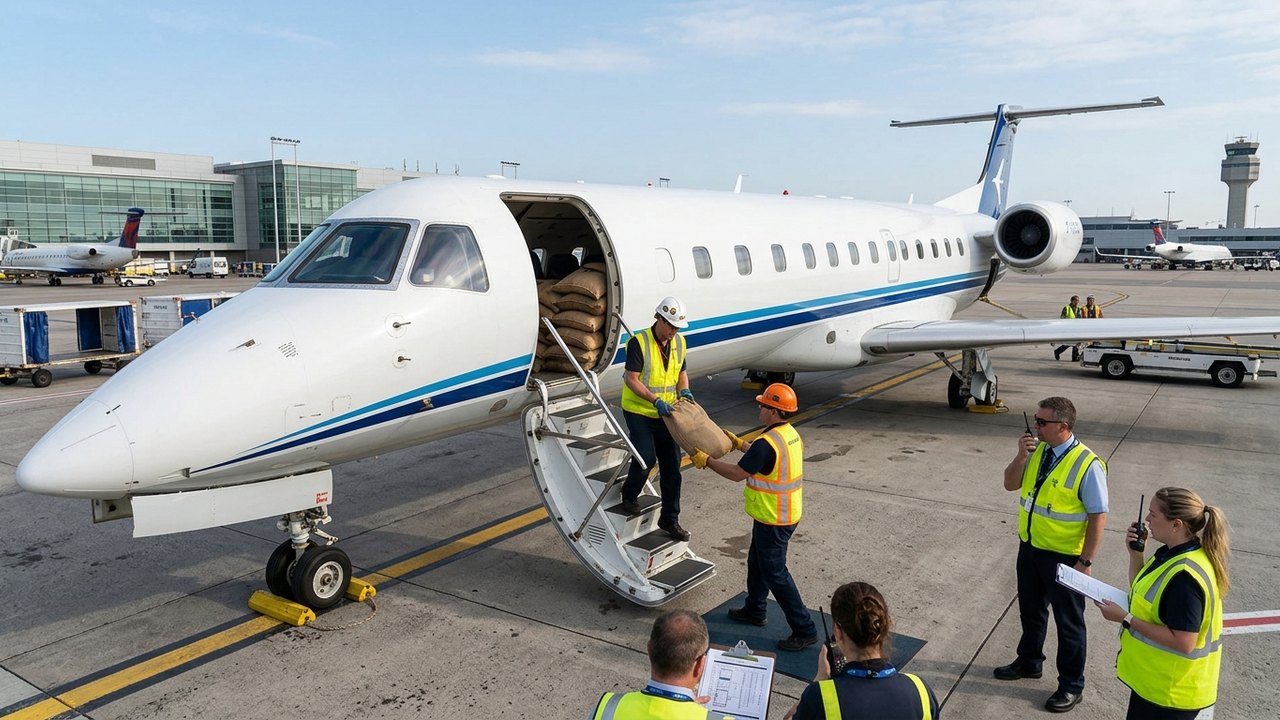
Image generated by AI
[Chicago, June 26, 2026] — United Airlines recently loaded an Embraer ERJ145 regional jet with hundreds of sandbags, a move that has drawn attention across aviation circles and sparked curiosity among travelers and industry watchers alike. The aircraft, a staple of United Express regional operations, was filled with the heavy ballast material as part of a structured operational procedure. The event took place at a United maintenance and operational facility, where engineers and ground crews carried out the unusual but highly deliberate loading process.
United Airlines and the Embraer ERJ145 Regional Fleet
United Airlines operates one of the most extensive regional networks in the United States, relying heavily on the Embraer ERJ145 to connect smaller cities with its major hub airports. The ERJ145, a 50-seat regional jet, has been a workhorse of the United Express brand for years, typically flown by regional partner carriers under contract with United. These aircraft serve routes where larger mainline jets would be economically unviable, linking communities to United's hubs at Chicago O'Hare International Airport (ORD), Denver International Airport (DEN), Houston George Bush Intercontinental Airport (IAH), Newark Liberty International Airport (EWR), and Washington Dulles International Airport (IAD).
The ERJ145 features a distinctive configuration with a single seat on one side of the aisle and a double seat on the other, making it easily recognizable on airport ramps across the country. While the aircraft type has been gradually retired by some carriers in favor of larger, more efficient regional jets, it remains an important component of United's network strategy, particularly for thin routes and essential air service obligations.
Sandbags as Ballast: A Standard Aviation Testing Practice
The decision to fill the ERJ145 with sandbags is rooted in established aviation weight and balance testing protocols. Airlines and aircraft manufacturers routinely use ballast — often in the form of sandbags, water tanks, or specialized weighted containers — to simulate passenger loads during various types of testing and certification activities. Sandbags are particularly favored because they are inexpensive, easy to handle, and can be distributed precisely throughout the cabin to replicate specific loading scenarios.
In this case, the sandbags were used to mimic the weight and distribution of a full complement of passengers and their carry-on baggage. The ERJ145 has a maximum seating capacity of 50 passengers, and each sandbag typically represents the average weight of an individual passenger as defined by regulatory standards. The Federal Aviation Administration (FAA) provides standard average passenger weights that airlines use for weight and balance calculations, and these figures are periodically updated to reflect changing population demographics.
By loading the aircraft with sandbags corresponding to these standardized weights, United's operational and engineering teams can evaluate how the aircraft performs under realistic loading conditions without the need to recruit dozens of volunteers for each test.
Weight and Balance Calculations Drive Safety and Efficiency
Weight and balance is one of the most fundamental safety considerations in aviation. Every commercial flight requires precise calculations to ensure that the aircraft's center of gravity falls within acceptable limits established by the manufacturer. If an aircraft is loaded improperly — either too heavy or with the center of gravity too far forward or aft — it can experience handling difficulties, reduced performance, and in extreme cases, catastrophic control issues.
The Embraer ERJ145, like all certified aircraft, has a defined envelope of acceptable center of gravity positions. This envelope dictates where cargo, passengers, and fuel must be placed to maintain safe flight characteristics. Sandbag loading allows ground crews and engineers to test various loading configurations, verifying that the aircraft remains within its operational limits under different scenarios.
These tests can be conducted for several reasons, including validating updated weight and balance software, training new load planners, recalibrating onboard systems, or complying with regulatory requirements following maintenance work. The FAA mandates that airlines maintain accurate weight and balance programs, and periodic testing is a key component of compliance.
United's Regional Operations and Training Requirements
United Airlines contracts with multiple regional carriers to operate its United Express flights, including companies such as SkyWest Airlines, Air Wisconsin, and GoJet Airlines. These partner carriers operate the ERJ145 on United's behalf, and coordination between United and its regional partners requires standardized procedures for everything from passenger service to aircraft loading.
The sandbag testing may also serve a training function. New ground handling personnel need hands-on experience with aircraft loading procedures, and using sandbags allows them to practice without the pressure of managing live passengers. This is particularly important for regional aircraft like the ERJ145, where the smaller cabin size means that weight distribution is more sensitive to changes than on larger aircraft.
Training with ballast loads also helps crews understand the practical implications of weight and balance on aircraft performance. For example, loading too much weight in the rear of the cabin can shift the center of gravity aft, potentially making the aircraft less stable in pitch. By experimenting with different sandbag configurations, ground staff can observe these effects in a controlled environment.
The Broader Context of Aircraft Ballast Testing Across the Industry
United Airlines is far from alone in using sandbags for aircraft testing. The practice is widespread across the global aviation industry and dates back decades. Manufacturers like Embraer, Boeing, and Airbus all use ballast during flight testing programs for new aircraft types. During certification campaigns, prototype aircraft are often loaded with thousands of pounds of ballast to simulate maximum gross weight conditions, allowing test pilots to evaluate performance at the edges of the flight envelope.
Airlines also use ballast for ferry flights when aircraft are being repositioned without passengers. In these cases, ballast may be needed to keep the aircraft within its center of gravity limits, particularly if cargo is not available to provide the necessary weight distribution. Sandbags are a simple, effective solution that can be loaded and unloaded quickly at any airport.
The practice extends beyond commercial aviation as well. Military operators frequently use ballast for training missions, and cargo airlines sometimes employ ballast when flying with partial loads. The versatility and low cost of sandbags make them an enduring tool in aviation operations worldwide.
Impact on Regional Aviation Safety and Operational Reliability
The use of sandbags in United's ERJ145 testing underscores the airline's commitment to maintaining rigorous safety standards across its regional network. While regional jets may seem like small aircraft compared to wide-body international types, they carry the same regulatory requirements for weight and balance accuracy. A miscalculation on a 50-seat regional jet can be just as dangerous as one on a 300-seat wide-body.
For United, ensuring that its regional partners adhere to the highest standards is both a safety imperative and a brand protection measure. Passengers booking United Express flights expect the same level of safety and professionalism as they would on a mainline United flight, and the airline's oversight of regional operations is designed to deliver on that expectation.
The testing also has implications for operational efficiency. Accurate weight and balance calculations allow pilots to optimize fuel burn, takeoff speeds, and flap settings. Even small improvements in loading efficiency can translate to meaningful fuel savings across thousands of regional flights per year, contributing to both cost reduction and environmental performance goals.
Why This Matters: The Hidden Discipline Behind Every Regional Flight
The image of an Embraer ERJ145 filled with sandbags may appear unusual to outside observers, but it represents one of the most important behind-the-scenes disciplines in commercial aviation. Weight and balance testing is not a dramatic or visible part of the passenger experience, yet it is foundational to every safe flight that departs from any airport in the world.
United Airlines' decision to conduct this testing on its ERJ145 fleet highlights the often-overlooked reality that regional aviation requires the same engineering rigor as long-haul international operations. The ERJ145 may be a small aircraft, but it operates in the same airspace, under the same regulatory framework, and with the same zero-tolerance approach to safety deviations as a Boeing 777 or an Airbus A350.
For the regional aviation sector, which faces ongoing challenges from pilot shortages, fleet modernization decisions, and economic pressures on thin routes, maintaining operational integrity through practices like ballast testing is a signal that safety remains the non-negotiable priority. As United continues to evaluate its regional fleet strategy — including the gradual transition toward larger, more efficient regional jets — the ERJ145 and the testing procedures associated with it remain a critical part of the airline's present-day operational landscape.
The sandbags loaded onto that ERJ145 are a reminder that behind every departure, there is a meticulous process of calculation, verification, and testing that most passengers never see. It is this invisible infrastructure of safety practices that allows millions of regional flights to operate reliably year after year, connecting communities that depend on air service for economic survival and social connectivity.
Related Travel Guides
Disclaimer
This article is for informational and educational purposes only. It does not constitute legal, financial, or professional advice. While we strive to provide accurate and up-to-date information, travel policies, regulations, and conditions change rapidly. Always verify information with official sources before making travel decisions. Nomad Lawyer makes no representations about the accuracy, reliability, completeness, or suitability of the information provided. Readers should consult qualified professionals for advice specific to their circumstances. The views expressed in this article are those of the author and do not necessarily reflect the views of Nomad Lawyer.
Preeti Gunjan
Contributor & Community Manager
A passionate traveller and community builder. Preeti helps grow the Nomad Lawyer community, fostering engagement and bringing the reader experience to life.
Learn more about our team →