
Venezuela Rocked by Fresh Aftershock After Deadly Twin Earthquakes, Rescue Teams Race Against Time as Aftershock Risk Persists
Venezuela hit by magnitude 4.7 aftershock following rare 7.2 and 7.5 twin earthquakes. Rescue operations continue amid h

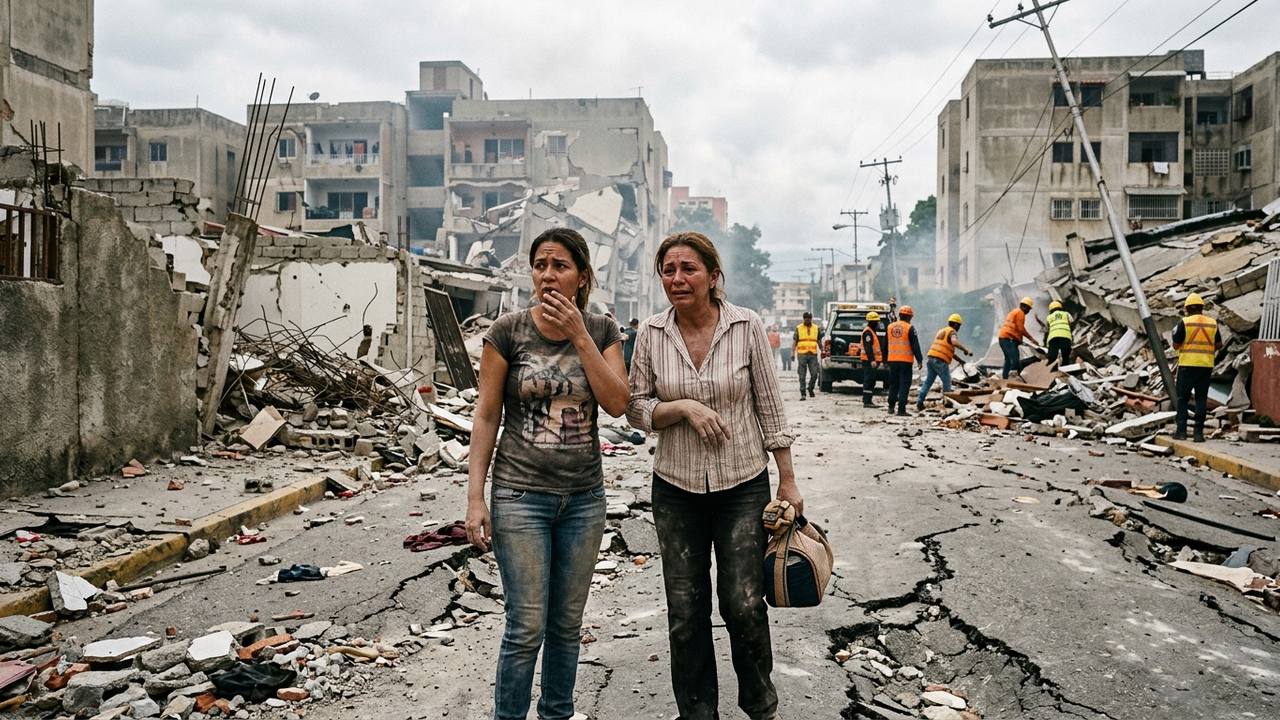
Image generated by AI
[Caracas, June 27, 2026] — Venezuela is grappling with a renewed seismic threat as a magnitude 4.7 aftershock struck the region following a catastrophic sequence of twin earthquakes measuring 7.2 and 7.5. This latest tremor has intensified the urgency of ongoing search-and-rescue operations and forced thousands of displaced citizens to remain in temporary shelters.
The recent activity has placed the nation's emergency infrastructure under extreme pressure, with officials warning that the risk of further collapses remains high. As rescue teams race against time to locate survivors, the geological instability of northern Venezuela continues to pose a significant threat to both civilians and first responders.
Magnitude 4.7 Aftershock Strikes Northern Venezuela
The latest seismic event occurred at 10:16 p.m. GMT, according to data provided by the United States Geological Survey (USGS). The epicenter was identified approximately 54 kilometers north of El Limón, originating at a shallow depth of roughly 10 kilometers.
While this specific tremor was considerably less powerful than the primary shocks earlier in the week, its impact was felt across vast areas of northern Venezuela. Industry observers note that such aftershocks are particularly dangerous in the current environment, as they can trigger the collapse of buildings that were already structurally compromised by previous activity.
The Rare Phenomenon of the Seismic Doublet
The current crisis was initiated by an exceptionally rare geological occurrence known as a seismic doublet. In this scenario, two massive earthquakes—measuring 7.2 and 7.5 magnitude—struck within a mere 39 seconds of each other.
Unlike a standard earthquake sequence where a main shock is followed by smaller tremors, this rapid-fire succession of high-magnitude events amplified the destruction. Structures that might have survived a single 7.2 magnitude quake were severely weakened in the first few seconds, leaving them unable to withstand the second violent jolt. This has resulted in widespread failure of residential homes, commercial hubs, and critical public infrastructure.
Search and Rescue Efforts Under High-Risk Conditions
A massive mobilization of military units, firefighters, medical personnel, and civilian volunteers is currently underway. These teams are utilizing heavy machinery to clear mountains of collapsed concrete and debris in an effort to reach trapped individuals.
To increase the probability of finding survivors, specialized units have deployed search cameras and trained canine teams. However, the operational environment remains perilous. Authorities have cautioned that every subsequent aftershock increases the likelihood of further structural failures, endangering the lives of those working within the ruins. Consequently, a large portion of the population continues to avoid returning to their homes, opting for open-air spaces or government-managed shelters until professional structural assessments can be completed.
Probability of Further Seismic Activity
Seismologists indicate that aftershocks are a standard part of the Earth's crust adjusting after a major rupture. Depending on the geological makeup of the region and the scale of the initial event, these tremors can persist for weeks or even months.
Current USGS projections suggest an 8% probability that another earthquake exceeding magnitude 6.0 will occur within the next seven days. While the statistical likelihood is relatively low, the potential for devastation remains high given the current state of the built environment. Officials are urging the public to adhere strictly to safety protocols and maintain emergency readiness.
Tectonic Vulnerability of the Caribbean and South American Plates
Venezuela's susceptibility to these events is rooted in its location within a highly active tectonic zone. The country sits where the Caribbean Plate and the South American Plate interact, creating immense geological tension over long periods.
When this accumulated energy is released, it results in earthquakes of varying intensities. While Venezuela may not experience major shocks as frequently as some of its neighbors, several active fault systems run directly through the northern regions. Because these faults are located beneath densely populated urban centers, the potential for high casualty rates and massive infrastructure loss is significant, making seismic resilience a primary goal for national disaster management.
Long-Term Recovery and Infrastructure Restoration
The path to recovery for the affected communities is expected to be long and costly. Beyond the immediate need to find survivors, the state must now address the widespread disruption of essential services.
| Impacted Sector | Status/Observation |
|---|---|
| Residential Housing | Widespread collapse and severe structural weakening |
| Healthcare Facilities | Various degrees of disruption to medical services |
| Education | Schools damaged or being used as temporary shelters |
| Power Grid | Electricity networks experiencing significant outages |
| Transport | Highways and bridges under safety evaluation |
| Communication | Local networks disrupted in heavily hit zones |
Restoring these systems will require a coordinated effort involving government agencies, international humanitarian partners, and financial aid. Engineers are currently tasked with the slow process of auditing bridges and roads to determine which routes are safe for heavy transit.
Disruptions to Regional Travel and Transport
The seismic sequence has created significant hurdles for transportation within the affected regions. Authorities have implemented temporary restrictions on several major travel routes to allow for comprehensive structural safety inspections.
For those attempting to move through or visit northern Venezuela, reports suggest that transport services may be intermittently affected by ongoing aftershocks and road closures. Travelers are advised to rely on official government updates and maintain flexible contingency plans, as access to certain communities remains prioritized for emergency services.
Scientific Implications of the Doublet Event
The global scientific community is treating the Venezuelan event as a critical case study. The occurrence of two large-scale earthquakes seconds apart is a rarity that provides invaluable data for researchers.
By analyzing the telemetry and seismic waves from this event, scientists hope to improve earthquake forecasting models and better understand how faults interact during complex sequences. Furthermore, the disaster has highlighted the absolute necessity of enforcing modern, earthquake-resistant building codes to minimize the loss of life during such unpredictable geological events.
Why This Matters: The Broader Aviation and Travel Impact
The Venezuelan seismic crisis underscores a critical vulnerability in regional infrastructure that extends beyond immediate casualties. From an aviation and travel perspective, the "seismic doublet" phenomenon demonstrates that traditional risk assessments—which often account for a single main shock—may be insufficient for high-risk tectonic zones.
The disruption of ground transport and the potential for airport infrastructure damage in northern regions can create sudden "black holes" in regional connectivity. For the travel industry, this emphasizes the need for real-time, hyper-local intelligence and the implementation of more robust emergency evacuation protocols. As climate-driven disasters increase, the overlap of geological instability and infrastructure fragility in South America suggests that "resilience" must move from a buzzword to a mandatory engineering standard for all transport hubs in the Caribbean-South American corridor.
Related Travel Guides
Disclaimer
This article is for informational and educational purposes only. It does not constitute legal, financial, or professional advice. While we strive to provide accurate and up-to-date information, travel policies, regulations, and conditions change rapidly. Always verify information with official sources before making travel decisions. Nomad Lawyer makes no representations about the accuracy, reliability, completeness, or suitability of the information provided. Readers should consult qualified professionals for advice specific to their circumstances. The views expressed in this article are those of the author and do not necessarily reflect the views of Nomad Lawyer.
Kunal K Choudhary
Co-Founder & Contributor
A passionate traveller and tech enthusiast. Kunal contributes to the vision and growth of Nomad Lawyer, bringing fresh perspectives and driving the community forward.
Learn more about our team →