
UK Air Traffic Control Failures and Fuel Shortages Trigger 2,100+ European Flight Delays in 2026
A systemic collapse in UK air traffic control staffing and jet fuel shortages at Gatwick have caused over 150 cancellations and 2,100 delays across Europe's major aviation hubs.

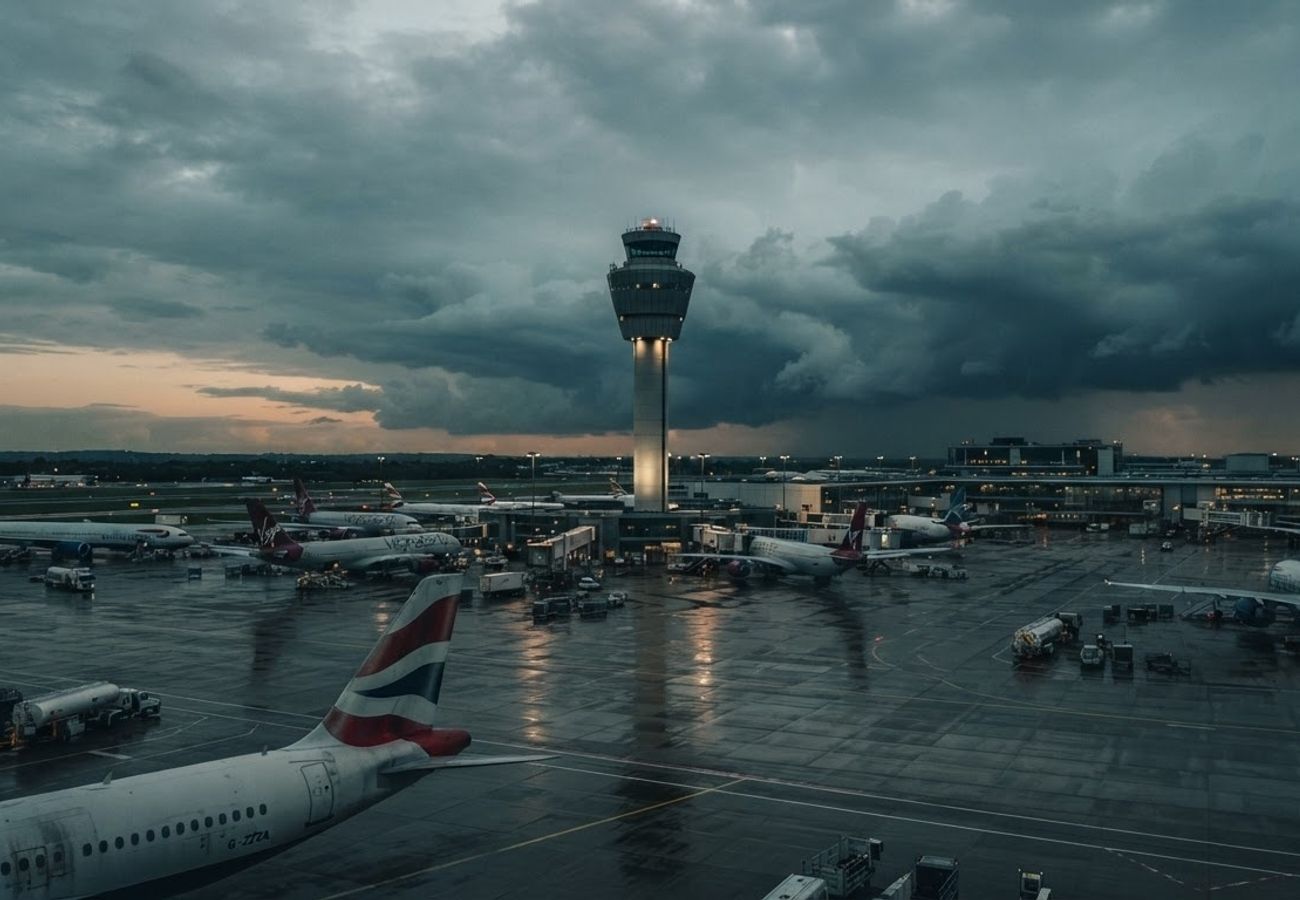
Image generated by AI
Over 2,100 flights have been delayed and more than 150 cancelled across Europe's primary aviation hubs following a surge in air traffic control (ATC) failures and critical fuel supply shortages. The disruption, centered heavily around London's airspace, has created a ripple effect impacting passengers throughout the continent during the peak August travel window.
Systemic Failures in London's Congested Airspace
The aviation infrastructure surrounding London, specifically at Heathrow and Gatwick, has once again emerged as the primary catalyst for regional travel chaos. Flight tracking data and disruption monitors reveal that staffing deficits within the UK's air traffic control network are driving a cycle of rolling delays that destabilize airline schedules across the European sector.
The severity of the situation is underscored by reports from major low-cost carriers. In mid-August, one prominent airline disclosed that delays attributed to UK air traffic control had surged by more than 80% compared to the previous year. In a single morning, more than 30 of the carrier's flights were stalled, with the airline explicitly labeling these disruptions as avoidable consequences of chronic staff shortages.
This volatility is exacerbated by the inherent capacity limitations of Heathrow and Gatwick. Industry datasets indicate that these hubs operate with a baseline of moderate delays even under normal conditions. When a technical glitch or a staffing gap occurs, this existing congestion rapidly transforms into mass cancellations.
Historical data highlights the fragility of this system. Analysts frequently point to a 2025 incident where a radar failure at the Swanwick air traffic control center resulted in over 150 cancellations and widespread systemic delays, serving as a blueprint for how a single point of failure in London airspace can paralyze the broader network.
Fuel Scarcity and Weather Pressures at Gatwick
Adding to the staffing crisis, London Gatwick issued an urgent alert to airline partners in early August regarding a shortage of jet fuel. This supply constraint has forced carriers to make difficult operational choices, including the rescheduling of services, the consolidation of flight rotations, or total cancellations when aircraft cannot be refueled at alternative destinations.
While Gatwick remains operational, the necessity of managing limited fuel reserves has created a secondary bottleneck. Because the airport already operates with tight runway capacity, any delay in a single departure creates a cascading effect, contributing to the thousands of late departures currently reported across the continent.
Simultaneously, adverse weather patterns have intensified the strain. Real-time aviation alerts show that storms and high winds have triggered "high impact" notifications for airport delays. These weather events have forced controllers to implement extended holding patterns, tactical ground stops, and diversions, further clogging an already saturated system.
When fuel shortages, staffing gaps, and severe weather converge, the resulting disruption is exponential. Passengers often experience a sudden spike in cancellations even after a storm has passed, as the system struggles to recover from the combined pressure of these three distinct failure points.
Continental Ripple Effects at Major European Hubs
The crisis is not contained within the UK borders. Data from passenger rights services indicate that the "knock-on" effect has severely impacted other primary European gateways, including Paris Charles de Gaulle, Amsterdam Schiphol, and Rome Fiumicino.
Rome Fiumicino has been particularly hard hit, reporting more than 150 cancelled flights in August alone, averaging over a dozen cancellations per day. The disruption has been most acute on domestic and intra-European routes, specifically services connecting to Catania. Because these regional flights often serve as feeders for long-haul journeys, the instability in Italy has directly impacted London-bound traffic and vice versa.
The interconnected nature of European aviation means that a cluster of failures at a few hubs can lead to massive numbers of stranded passengers. A previous analysis showed that a single day of simultaneous disruption at Heathrow, Gatwick, Schiphol, and Charles de Gaulle affected more than 2,600 flights. Recovering from such an event often takes several days as airlines struggle to reposition crews and aircraft.
Labor Instability and Industrial Action Risks
Beyond technical and environmental factors, the European aviation sector is grappling with a fragile labor market. In the UK, the lack of transparency regarding contingency planning for ATC staffing has led to increased pressure from consumer advocates and airlines.
Localized industrial action is also creating total operational shutdowns. For instance, Norwich Airport announced a complete closure for one day in late August due to a 24-hour strike by air traffic control staff, leaving all booked passengers to seek rebooking options.
On a broader scale, the precedent for disruption is well-established. Previous ATC strikes in France have resulted in the cancellation of over a thousand flights within a few days. Industry forecasts for 2026 suggest these flashpoints will persist as negotiations over pay and working conditions continue across multiple European jurisdictions.
Analysts now suggest that these layered pressures—ranging from local strikes to systemic staffing gaps—have become a structural feature of European air travel. The industry is currently characterized by periods of relative stability interrupted by sudden, unpredictable spikes in volatility.
Why This Matters: The Traveler's Perspective
For the modern traveler, this situation means that the "recovery" of aviation post-pandemic is incomplete. While flight volumes have returned to record highs, the underlying infrastructure—the controllers, the fuel pipelines, and the ground staff—has not scaled accordingly.
From a logistical standpoint, this creates a high-risk environment for any itinerary involving tight connections. A 60-minute transfer at a hub like Heathrow or Schiphol is now a high-stakes gamble. Travelers should expect "erratic" operational environments for the remainder of the summer.
From a legal perspective, passengers must be vigilant about their rights under UK and EU regulations. When cancellations are labeled as "extraordinary circumstances" (such as weather or ATC strikes), airlines may attempt to avoid paying compensation. However, staffing shortages and fuel management issues may be viewed differently by regulators, potentially opening the door for passenger claims.
The era of seamless European transit has been replaced by a period of systemic fragility, where a single staffing gap in London can strand a traveler in Rome.
Related Travel Guides
Disclaimer
This article is for informational and educational purposes only. It does not constitute legal, financial, or professional advice. While we strive to provide accurate and up-to-date information, travel policies, regulations, and conditions change rapidly. Always verify information with official sources before making travel decisions. Nomad Lawyer makes no representations about the accuracy, reliability, completeness, or suitability of the information provided. Readers should consult qualified professionals for advice specific to their circumstances. The views expressed in this article are those of the author and do not necessarily reflect the views of Nomad Lawyer.
Kunal K Choudhary
Co-Founder & Contributor
A passionate traveller and tech enthusiast. Kunal contributes to the vision and growth of Nomad Lawyer, bringing fresh perspectives and driving the community forward.
Learn more about our team →