
UAE and Saudi Arabia Enforce Widespread Airline Suspensions as Cirium Logs Over 47% Flight Cancellations Across Riyadh, Dammam, and Jeddah: What Every Traveller Must Know

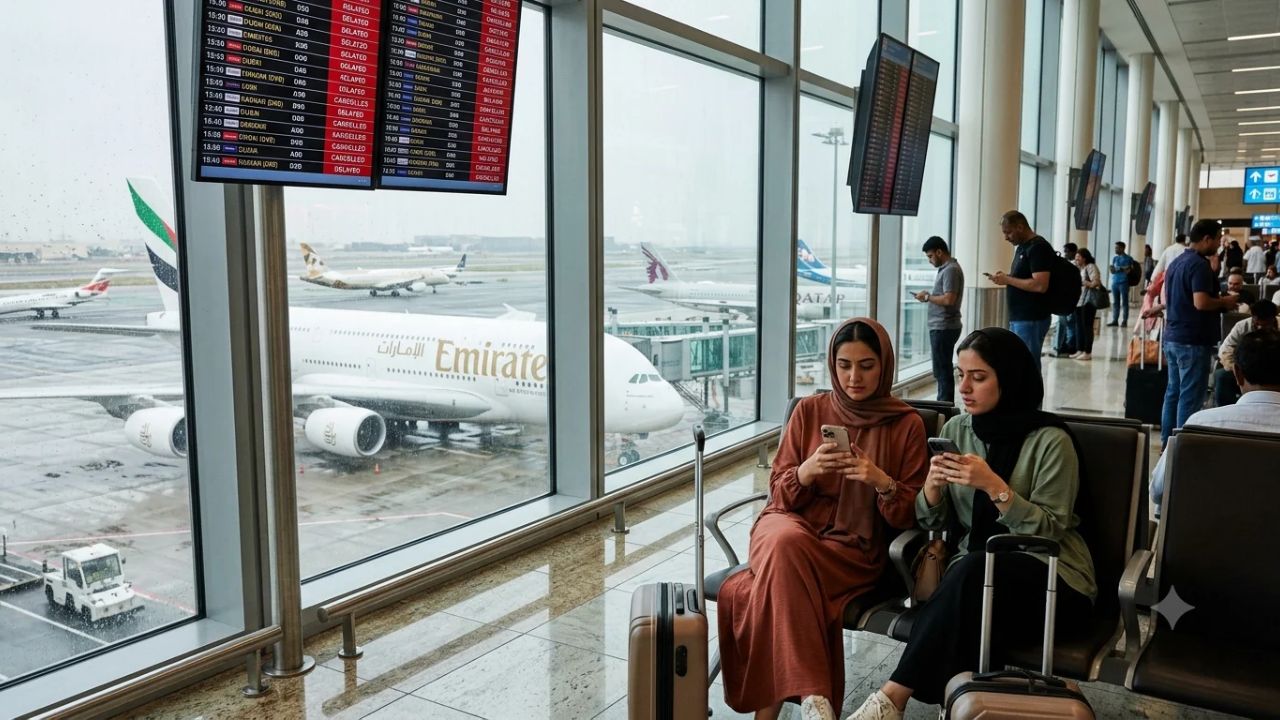
Commercial aviation schedules linking the United Arab Emirates and the Kingdom of Saudi Arabia have collapsed into widespread disruption, with regional and international airlines enacting multi-day route suspensions across vital Gulf air corridors. Guided by precautionary security advisories and airspace directives issued by civil aviation authorities and global diplomatic missions, flag carriers including Emirates, Etihad Airways, flydubai, and Air Arabia have grounded dozens of daily rotations. The operational halt has reverberated into South Asia, forcing Indian carriers and SriLankan Airlines to freeze Arabian Peninsula links while aviation intelligence data confirms that nearly half of all scheduled departures from key Saudi gateways have been cancelled.
According to operational tracking analytics compiled by Cirium, 552 out of 1,178 monitored domestic and international flights across Saudi Arabia's primary airfields were cancelled or grounded under strict no-fly designations during peak disruption intervals, representing an aggregate departure cancellation rate between 46.86% and 47.37%. With Riyadh's King Khalid International Airport enduring an unprecedented 81.42% flight cancellation rate, tens of thousands of business travelers, pilgrimage delegations, and international transiting passengers face compounding delays, strict check-in deadlines, and re-routing across secondary hubs.
Quick Summary: Essential Travel Alert Facts
- Scale of Groundings: Independent telemetry from Cirium shows that 552 of 1,178 scheduled departures across Saudi Arabia were cancelled, representing an overall disruption rate of 46.86% to 47.37%.
- Hardest-Hit Hubs: King Khalid International Airport (RUH) in Riyadh suffered an 81.42% cancellation rate (298 of 366 flights cut), followed by Dammam at 45.80% and Abha at 45.45%.
- UAE Carrier Freezes: Emirates has suspended flights to Riyadh, Jeddah, and Dammam while keeping selective Madinah services active; Etihad Airways has paused all Riyadh and Dammam routes alongside specific Jeddah frequencies; Air Arabia and flydubai have cancelled dozens of sector rotations.
- South Asian Aviation Spillover: Air India, Air India Express, IndiGo, Akasa Air, and SriLankan Airlines have instituted multi-day suspensions on scheduled services linking Colombo, Mumbai, and Delhi to Saudi commercial centers.
- Diplomatic & Legal Warnings: Consular missions from the United States and Australia have issued strict safety advisories, reminding travelers that filming, recording, or publishing footage of security incidents or military defense operations violates strict host-nation penal codes.
Saudi Airport Hub Impact: Cirium Aviation Telemetry
The operational paralysis across the Arabian Peninsula has not affected all gateways equally. Aviation risk assessments have led carriers to concentrate route suspensions on central and eastern corridors while maintaining guarded, time-restricted arrival and departure windows at western Red Sea terminals and northern regional facilities.
Ground operations at King Khalid International Airport (RUH) in Riyadh have experienced the most severe curtailment, as international airlines unilaterally pulled aircraft from overnight layovers and cancelled daytime turns. By contrast, King Abdulaziz International Airport (JED) in Jeddah has maintained over 77% of its scheduled movements, operating under altered approach trajectories designed to buffer regional airspace safety margins.
CIRIUM AVIATION HUB DISRUPTION DATA: SAUDI ARABIA DEPARTURES
| Saudi Airport Facility | Scheduled Flights | Cancelled / No-Fly | Disruption Percentage |
|---|---|---|---|
| King Khalid Int'l (Riyadh - RUH) | 366 departures | 298 cancelled | 81.42% |
| King Fahd Int'l (Dammam - DMM) | 131 departures | 60 cancelled | 45.80% |
| Abha Regional Airport (AHB) | 44 departures | 20 cancelled | 45.45% |
| Prince Mohammad Int'l (Madinah) | 102 departures | 24 cancelled | 23.53% |
| King Abdulaziz Int'l (Jeddah - JED) | 385 departures | 87 cancelled | 22.60% |
| Cumulative Monitored Corridor | 1,178 departures | 552 cancelled | 46.86% - 47.37% |
Secondary regional airports across the Kingdom present a fragmented operational landscape:
- Madinah (MED): Operating at moderate capacity with selective reductions, retaining strategic religious charter and scheduled services under continuous air traffic control monitoring.
- Abha (AHB) and Taif (TIF): Experiencing acute regional capacity drops, with southern approach vectors subject to periodic tactical ground stops.
- Gassim (ELQ) and Al Jouf (AJF): Maintaining baseline domestic links to western hubs, although regional cross-border flights from UAE low-cost carriers face ongoing schedule reviews.
Airline Operational Breakdown: Carrier Route Holds and Active Flights
Carriers operating through the Gulf have shifted from ad-hoc, gate-side delays toward proactive, multi-day systemic flight cancellations. This systemic posture allows airline operations control centers (OCC) to protect airframes, avoid out-of-station crew duty-time expirations, and maintain network stability outside the affected corridor.
CARRIER-BY-CARRIER STATUS & SPECIFIC ROUTE AFFECTED
| Airline | Primary Route Status & Holds | Active / Monitored Operations |
|---|---|---|
| Emirates | Direct services suspended to Riyadh, | Monitored operations to Madinah active |
| (Dubai Hub - DXB) | Dammam, and Jeddah | including flights EK807 and EK809 |
| Etihad Airways | All Abu Dhabi flights to Riyadh and | Selective international overflights; |
| (Abu Dhabi - AUH) | Dammam paused; Jeddah EY601-EY604 cut | repatriation flights on standby |
| flydubai | Systemic network revision; regional | Completed arrivals: FZ919, FZ831 (JED); |
| (Dubai Hub - DXB) | sectors under active dispatch evaluation | FZ872 from Gassim (ELQ) operating |
| Air Arabia | Direct cancellations: Dammam (G9160, | Scheduled services to Jeddah, Madinah, |
| (Sharjah - SHJ) | G9163, G9167), Riyadh (G9151), Abha/Taif | Tabuk, and Hail operating under review |
| South Asian Lines | Multi-day holds by Air India, Air India | Rerouted deep-corridor flights via |
| (India & Sri Lanka) | Express, IndiGo, Akasa, and SriLankan | southern maritime navigation routes |
Emirates
From its hub at Dubai International Airport (DXB), Emirates has instituted route-wide temporary suspensions for all nonstop services connecting Dubai with Riyadh, Jeddah, and Dammam. However, humanitarian and religious travel access to the holy city of Madinah remains partially preserved under enhanced flight-monitoring protocols, with specific rotations including Flight EK807 and Flight EK809 maintaining scheduled operations.
Etihad Airways
Operating from Zayed International Airport (AUH) in Abu Dhabi, Etihad Airways has grounded its entire scheduled flying program to Riyadh and King Fahd International Airport in Dammam. Furthermore, dedicated high-capacity passenger rotations linking Abu Dhabi and Jeddah—specifically designated flight numbers EY601, EY602, EY603, and EY604—have encountered scheduled cancellations, leaving travelers reliant on partner airline re-routings or delayed booking windows.
flydubai
The Dubai-based hybrid carrier has transitioned into a dynamically managed contingency schedule. While several high-frequency business routes remain frozen, flydubai successfully operated and turned around flights FZ919 and FZ831 to Jeddah, as well as flight FZ872 inbound from Gassim. The airline cautions passengers that operations to emerging and secondary destinations—including Neom Bay, AlUla, Hail, Hofuf, Yanbu, and The Red Sea International Airport—are subject to immediate suspension based on hourly flight-dispatch assessments.
Air Arabia
Headquartered at Sharjah International Airport (SHJ), Air Arabia has formally confirmed cancellations on an array of primary point-to-point routes into Saudi Arabia. Confirmed cancellations include:
- Sharjah to Dammam: Flights G9160, G9163, and G9167.
- Sharjah to Riyadh: Flights G9151 and G9154.
- Sharjah to Regional Gateways: Flight G9195 to Abha and Flight G9187 to Taif.
- Maintained Operations: Reduced frequencies to Jeddah, Madinah, Tabuk, and Hail remain on the departure boards, subject to extended pre-departure slot verifications.
South Asian and Indian Subcontinent Carriers
The disruption has quickly rippled across the Arabian Sea. Major Indian carriers—including full-service operator Air India and budget airlines Air India Express, IndiGo, and Akasa Air—have declared multi-day route holds across their networks serving Riyadh, Dammam, Jeddah, and Madinah. Similarly, SriLankan Airlines has prolonged its suspension of nonstop services connecting Bandaranaike International Airport in Colombo with Riyadh and Dammam, citing international airspace advisories and the necessity to avoid dynamic safety corridors.
Strategic Economic and Tourism Impact Across the Arabian Gulf
The bilateral aviation market connecting the UAE and Saudi Arabia represents one of the highest-yielding commercial corridors in international transport. The abrupt reduction of airline seat capacity has introduced immediate friction into the hospitality, corporate, and leisure tourism ecosystems of both nations.
Hotel Occupancy and Stranded Passenger Dynamics
Luxury business properties and airport-adjacent hotels in Riyadh and Dubai report abrupt, countervailing occupancy trends. In hubs like Riyadh, where departure cancellations topped 81%, hotels have seen an influx of unplanned stay extensions from stranded corporate executives and flight crews. Conversely, future leisure and business booking pipelines have contracted sharply as international visitors postpone regional itineraries, leaving resort properties in Dubai and the Red Sea facing elevated short-term vacancy rates.
Disruption to MICE and Corporate Travel Summits
The UAE-Saudi corridor acts as the operational artery for the Middle East’s Meetings, Incentives, Conferences, and Exhibitions (MICE) sector. With multi-national enterprises regularly commuting between regional headquarters in Dubai and burgeoning operational centers in Riyadh, the grounding of over 500 flights has forced event organizers to defer high-profile summits, transition bilateral trade panels into virtual environments, and absorb significant non-refundable venue expenditures.
Religious and Pilgrim Itinerary Realignment
The curtailment of flights into western Saudi Arabia has introduced logistical strain for pilgrimage operators managing Umrah travel. While Madinah and Jeddah continue to receive limited air traffic, travel agencies across Europe, North America, and South Asia are being forced to systematically re-allocate thousands of confirmed pilgrim groups onto secondary carriers, extend ground transit links from alternative airports, or roll bookings into upcoming fiscal quarters.
Rise of Intermodal Regional Transit
With point-to-point commercial aviation severely constrained, corporate travel management companies have begun exploring alternative ground and intermodal transport corridors. Executive private car services, cross-border coach links through validated transit corridors, and charter maritime crossings across the Red Sea are seeing unprecedented inquiry volumes from travelers requiring indispensable regional transit.
Legal and Consular Protocols: Security Laws and Passenger Rights
Government diplomatic missions in Riyadh and Abu Dhabi, including the United States Mission to Saudi Arabia and the Australian Department of Foreign Affairs and Trade (DFAT), have updated their consular travel bulletins, urging foreign nationals to maintain elevated situational awareness and adhere strictly to domestic security regulations.
MANDATORY LEGAL, REGULATORY & PASSENGER DIRECTIVES
| Category / Entity | Details / Impact |
|---|---|
| Regulatory Domain | Binding Rule & Operational Protocol |
| Host-Nation Digital Media Laws | Strict ban on filming, photographing, or publishing security |
| (Strict Penal Enforcement) | incidents, military movements, or aerial defense activities |
| Carrier Check-In Deadlines | flydubai and regional airlines enforce strict counter closures |
| (Pre-Departure Rules) | exactly 60 minutes prior to adjusted departure timings |
| Passenger Redress Framework | Full rebooking, complimentary date changes, travel vouchers, or |
| (GCAA & GACA Standards) | 100% ticket refunds processed via original booking channels |
| Aircraft Insurance Mandates | International hull and liability policies require complete airline |
| (EASA, FAA & GCAA Compliance) | compliance with active regional NOTAMs and no-fly advisories |
Critical Legal Notice: Photography and Media Restrictions
Consular advisories prominently remind foreign visitors of strict local legislation regarding national security reporting. In both Saudi Arabia and the UAE, capturing, uploading, or circulating unauthorized video footage or photographs depicting military installations, air defense interceptions, or security-related incidents is a severe criminal offense punishable by heavy financial penalties, immediate detention, and deportation. Travelers are urged to source information exclusively from verified government news agencies and official aviation dispatches.
Passenger Rights and Rebooking Remedies
Under aviation governance standards enforced by the UAE General Civil Aviation Authority (GCAA) and Saudi Arabia's General Authority of Civil Aviation (GACA), passengers impacted by regulatory route cancellations are entitled to robust remedies:
- Full Fare Refunds: Travelers electing not to proceed with their journeys are entitled to 100% refunds of the unused portion of their tickets, with waivers applied to administrative cancellation fees.
- Complimentary Date Rebooking: Airlines are offering penalty-free rebooking options for travel within a 14- to 30-day window from the original travel date on equivalent cabins.
- Original Booking Channel Mandate: Claims, flight adjustments, and cash refunds must be initiated directly through the point of sale—whether via the airline's official digital platform or an authorized corporate travel management agency.
Strategic Traveler Checklist: Navigating UAE-Saudi Flight Disruptions
To avoid becoming stranded at airport departure halls, travelers holding tickets on routes between the UAE, Saudi Arabia, and connecting global destinations should implement the following tactical measures:
- Monitor Direct Flight Tracking, Not Terminal Boards: Terminal departure displays can lag behind operational network declarations. Check the live operational status of your specific flight number through the airline's official mobile application or verified flight dispatch portals before leaving your residence or hotel.
- Observe Strict Check-In Window Deadlines: Do not assume delayed flights allow delayed check-in. Regional carriers like flydubai enforce rigid counter closures exactly 60 minutes prior to scheduled or rescheduled takeoff times. Passengers arriving after this cut-off forfeit boarding rights.
- Keep Telecommunication Profiles Current: Ensure your active mobile phone number and primary email address are accurately logged inside your airline Passenger Name Record (PNR) to receive instantaneous SMS alerts and automated rebooking notifications.
- Prepare Redundant Travel Financing: Extended airport stays and unplanned layovers necessitate immediate liquidity. Ensure international credit cards have adequate credit limits to secure independent lodging or emergency secondary travel arrangements if airline accommodation desks face lengthy queues.
Frequently Asked Questions
Why have UAE and Saudi airlines suspended flights between the two countries?
Airlines have paused flights following precautionary advisories issued by civil aviation authorities and international regulatory agencies concerning regional security dynamics, environmental factors, and dynamic airspace management protocols.
What percentage of flights have been cancelled in Saudi Arabia?
According to aviation analytics firm Cirium, 552 out of 1,178 scheduled departures across Saudi Arabia were cancelled or placed under no-fly restrictions during peak disruption periods, translating to an overall cancellation rate of approximately 46.86% to 47.37%.
Which Saudi airport has experienced the highest cancellation rate?
King Khalid International Airport (RUH) in Riyadh has been the most severely impacted, recording an 81.42% cancellation rate with 298 out of 366 scheduled flights grounded.
Are Emirates flights still operating to Saudi Arabia?
Emirates has suspended direct services connecting Dubai with Riyadh, Jeddah, and Dammam. However, monitored operations to Prince Mohammad bin Abdulaziz Airport in Madinah remain active, including flights EK807 and EK809.
What should passengers do if their flight is cancelled?
Affected travelers should not go to the airport without a confirmed rebooking. They should contact their operating airline or booking agency directly through official websites or mobile apps to request a penalty-free flight date change, an alternative routing, or a 100% monetary ticket refund.
Related Travel Guides
- Etihad Airways Flight EY22 from Toronto to Abu Dhabi Diverts to Amman Due to Critical In-Flight Medical Emergency: What Every Traveller Must Know
- Condor Launches Daily Nonstop Berlin–Abu Dhabi Flights: Airbus A320neo Schedule, Etihad Codeshare, and Middle East Network Expansion
- Queensland Unveils South East Paddock-to-Plate Food Corridors and Enforces Mandatory Farmgate Biosecurity Around Brisbane: What Every Traveller Must Know
Disclaimer
This article is for informational and educational purposes only. It does not constitute legal, financial, or professional advice. While we strive to provide accurate and up-to-date information, travel policies, regulations, and conditions change rapidly. Always verify information with official sources before making travel decisions. Nomad Lawyer makes no representations about the accuracy, reliability, completeness, or suitability of the information provided. Readers should consult qualified professionals for advice specific to their circumstances. The views expressed in this article are those of the author and do not necessarily reflect the views of Nomad Lawyer.
Raushan Kumar
Founder & Lead Developer
Full-stack developer with 11+ years of experience and a passionate traveller. Raushan built Nomad Lawyer from the ground up with a vision to create the best travel and law experience on the web.
Learn more about our team →