
Etihad Airways Flight EY22 from Toronto to Abu Dhabi Diverts to Amman Due to Critical In-Flight Medical Emergency: What Every Traveller Must Know

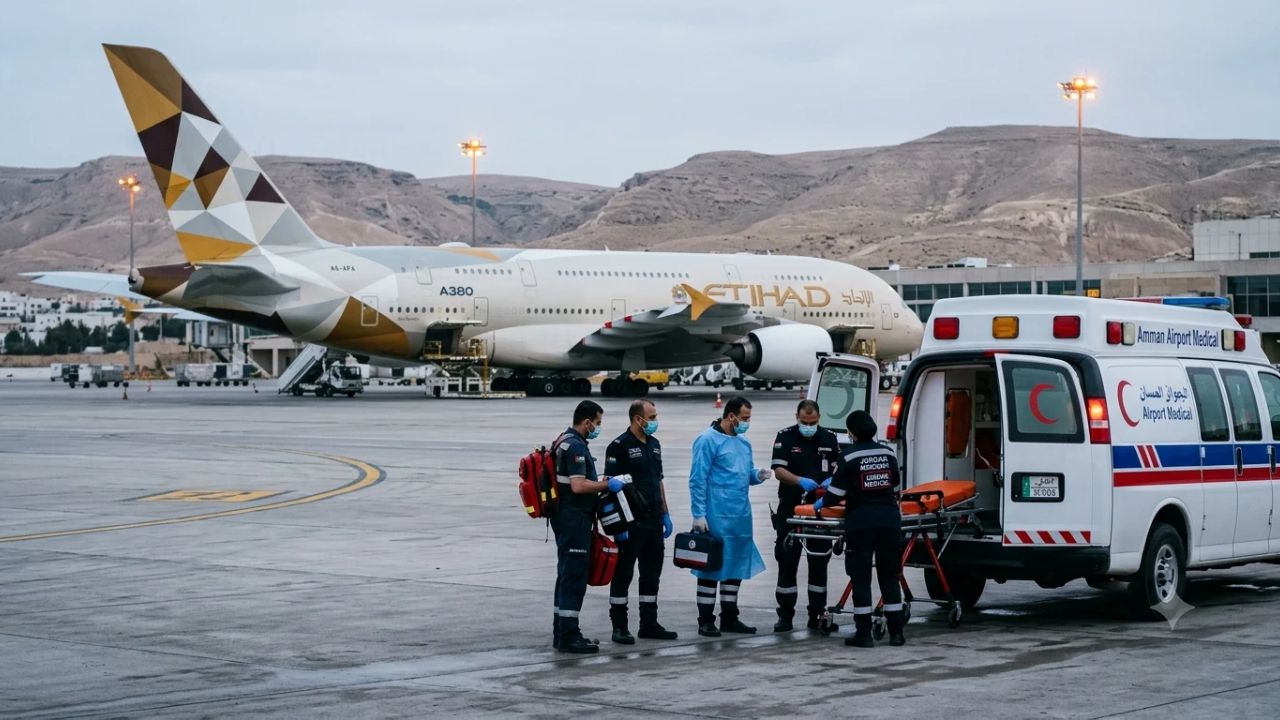
An Etihad Airways flagship Airbus A380-800 operating Flight EY22 from Toronto Pearson International Airport to Abu Dhabi's Zayed International Airport was forced to make an emergency diversion to Queen Alia International Airport in Amman, Jordan, following a life-threatening medical emergency at cruising altitude. Approximately nine hours and 45 minutes into the transoceanic voyage, as the double-decker superjumbo entered Middle Eastern airspace, cabin crew initiated emergency resuscitation procedures before consulting ground-based medical specialists via satellite datalink to execute an immediate unscheduled landing.
Emergency medical teams and advanced life-support ambulances met the aircraft on the tarmac in Amman, swiftly stabilizing the passenger and transferring them to a specialized medical facility. Following a four-hour and eleven-minute ground turnaround involving medical evacuations, comprehensive refueling, performance recalculations, and revised regional air traffic control clearances, the aircraft resumed its journey, touching down safely in Abu Dhabi later that afternoon.
Quick Summary: Key Facts and Travel Impact
- Emergency Flight Diversion: Etihad Airways Flight EY22 (callsign ETD22), operated by an Airbus A380-800, diverted to Queen Alia International Airport (AMM) in Amman, Jordan, on Sunday, 18 October 2026.
- Transatlantic Route Disruption: The flight originated at Toronto Pearson International Airport (YYZ) on Saturday, 17 October, carrying passengers on an 11,000-kilometer nonstop routing toward Zayed International Airport (AUH) in Abu Dhabi.
- Rapid Satellite Telemedicine: Nearly ten hours into the journey, flight attendants linked directly with ground-based emergency physicians via satellite communications, prompting the captain to declare a medical emergency and descend into Jordan.
- Tarmac Medical Evacuation: Paramedics boarded the aircraft immediately upon landing at 7:17 AM local time in Amman, stabilizing the critically ill passenger before transporting them to a local hospital.
- Four-Hour Ground Turnaround: After refueling, weight-and-balance verification, and updated flight plan clearances across the Arabian Peninsula, EY22 departed Amman at 11:28 AM and landed safely in Abu Dhabi at 2:44 PM GST.
Transatlantic Departure from Toronto Pearson: Flight EY22 Profile
The long-haul transatlantic journey commenced on Saturday, 17 October 2026, at Toronto Pearson International Airport (YYZ), Canada’s busiest international gateway. Flight EY22 serves as a premier nonstop link connecting North America with the United Arab Emirates, deploying Etihad Airways' flagship double-decker Airbus A380-800 (registration A6-APJ).
Pushing back from the gate in Ontario, the superjumbo executed a smooth takeoff at 2:09 PM EDT, embarking on an 11,000-kilometer flight path scheduled to take more than 13 hours. The aircraft climbed to its initial cruising altitude, tracing a conventional eastbound transatlantic airway across eastern Canada, the North Atlantic Ocean, and mainland Europe, before steering southeast toward the Arabian Gulf for its scheduled arrival at Zayed International Airport (AUH) in Abu Dhabi.
ETIHAD FLIGHT EY22 DIVERSION OPERATIONAL TELEMETRY AND FLIGHT LOG
| Operational Metric | Official Flight Parameters & Recorded Milestone |
|---|---|
| Commercial Flight Number | EY22 / Callsign: ETD22 |
| Aircraft Type & Model | Airbus A380-800 (Double-Decker Superjumbo) |
| Aircraft Tail Registration | A6-APJ |
| Departure Origin | Toronto Pearson International Airport (YYZ) - Took off 2:09 PM EDT (Oct 17, 2026) |
| Scheduled Final Destination | Zayed International Airport, Abu Dhabi (AUH) |
| Total Route Distance | Approximately 11,100 km (Nonstop Transoceanic Sector) |
| Time of In-Flight Event | Approx. 9 Hours, 45 Minutes after takeoff (Entering Middle Eastern Airspace) |
| Unscheduled Diversion Airport | Queen Alia International Airport (AMM), Amman, Hashemite Kingdom of Jordan |
| Amman Touchdown Time | Sunday, 18 October 2026 at 7:17 AM Local Time |
| Ground Stand Duration | 4 Hours, 11 Minutes (Medical Evacuation, Refueling, Recalculations) |
| Resumption Departure Time | Sunday, 18 October 2026 at 11:28 AM Local Time |
| Final Touchdown in Abu Dhabi | Sunday, 18 October 2026 at 2:44 PM GST (Delayed Arrival) |
Crisis at Cruising Altitude: Satellite Telemedicine and Diversion Protocols
Nearly ten hours into the transatlantic crossing, as the A380 traversed regional airspace bordering the Levant, cabin crew were alerted to an acute in-flight medical emergency (IFME). A passenger exhibited severe physiological distress that exceeded the diagnostic and therapeutic capabilities of standard onboard emergency medical kits (EMK) and supplemental oxygen cylinders.
Flight attendants immediately deployed formal inflight emergency protocols:
- Medical Assessment & Cabin Broadcast: Cabin crew initiated primary triage and broadcasted a public announcement requesting assistance from credentialed healthcare professionals traveling on board.
- Satellite Medical Teleconsultation: Simultaneously, the flight deck utilized satellite datalink communications to connect directly with specialized on-call emergency physicians contracted by the airline's global medical support provider.
- Clinical Recommendation for Immediate Landing: Evaluating the patient’s rapidly deteriorating vital signs and critical clinical indicators in real time, consulting physicians advised the flight crew that immediate advanced hospital intervention was mandatory to prevent catastrophic loss of life.
- Airfield Selection & Descent Declaration: The pilot-in-command selected Queen Alia International Airport (AMM) in Amman, Jordan—an airfield with expansive runways capable of accommodating the A380 superjumbo and located adjacent to specialized tertiary medical centers. The flight crew declared a medical priority emergency with regional Air Traffic Control (ATC) and commenced an expedited descent.
IN-FLIGHT MEDICAL EMERGENCY (IFME) PROTOCOLS & PASSENGER ENTITLEMENTS
| Operational Stage | Flight Crew & Technical Action | Passenger Support & Legal Framework |
|---|---|---|
| In-Flight Deterioration | First aid kit, emergency oxygen, | Qualified onboard volunteers assist |
| (Cruising Altitude) | satellite ground doctor link | under Good Samaritan principles |
| Diversion Decision | Captain selects nearest suitable | Cabin crew provide updates; no cash |
| (Levant Airspace) | A380 runway; declares priority ATC | compensation under Montreal Conv. |
| Tarmac Medical Evacuation | Priority taxi to stand; emergency | Duty of care applies; passengers |
| (Amman Airport Stand) | paramedics board immediately | remain on board with refreshments |
| Technical & Route Reset | Refueling, performance data reset, | Flight crew monitor rest hours; |
| (Turnaround Phase) | overflight permits updated | missed connections rebooked at AUH |
Response on the Tarmac in Amman: Coordinated Medical Evacuation
The four-engine Airbus A380 touched down smoothly on Runway 08L/26R at Queen Alia International Airport at 7:17 AM local time on Sunday, 18 October 2026. Because Jordanian air traffic authorities and airport dispatch had received advance notice of the incoming critical patient, emergency services were positioned along the taxiway prior to touchdown.
Upon coming to a complete stop at the designated remote stand, the following multi-agency response went into effect:
- Direct Medical Extraction: Specialized airport paramedics and physicians boarded via mobile stair units, administering emergency stabilizing care inside the cabin before carefully transferring the patient into a waiting ambulance for transit to a nearby hospital in Amman.
- Aircraft Refueling: Having consumed fuel reserves during the descent and diversion maneuvering, the A380 took on thousands of gallons of aviation kerosene to meet mandatory regulatory fuel reserves for the onward leg to Abu Dhabi.
- Weight, Balance, and Performance Recalculation: Because aircraft operating weights change significantly following partial fuel burn, passenger deplaning, and baggage offloading, flight dispatchers recalculated performance data, flap settings, and trim configurations.
- Airspace Clearances: Flight dispatchers submitted amended flight plans and secured revised overflight clearances across Saudi and Gulf airspace corridors.
- Onboard Passenger Care: Cabin crew maintained climate control, provided water and meal services, and delivered regular briefings to the remaining passengers during the 4-hour, 11-minute ground wait.
Flight Resumption and Safe Arrival at Zayed International Airport
With all operational approvals secured, medical offloading formalized, and updated flight manifests confirmed, Flight EY22 pushed back from its stand in Amman and took off at 11:28 AM local time.
The remaining flight sector traversed Jordanian and Arabian airspace without incident. The aircraft entered UAE airspace and made a final landing at Zayed International Airport (AUH) in Abu Dhabi at 2:44 PM GST on Sunday, 18 October 2026.
Etihad Airways issued an official statement commending the flight crew, cabin attendants, and Jordanian emergency services for their disciplined adherence to international aviation safety standards. The carrier confirmed that the patient was receiving specialized treatment in Jordan and that ground agents in Abu Dhabi were assisting transiting passengers with seamless rebooking on connecting flights across Asia, Australia, and the Indian subcontinent.
Passenger Rights and Airline Obligations During In-Flight Medical Diversions
Unscheduled medical diversions represent one of the most operationally complex events in commercial aviation, creating significant schedule disruptions for hundreds of travelers. From a regulatory perspective, international air law governs how airlines and passengers interact during these extraordinary incidents:
- Exemption from Statutory Cash Compensation: Under major passenger rights regimes—including the Canadian Air Passenger Protection Regulations (APPR), European Regulation (EC) 261/2004, and standard international civil aviation conventions—medical emergencies are classified as extraordinary circumstances entirely outside the airline's operational control. Consequently, airlines are exempt from paying cash delay compensation.
- Mandatory Duty of Care: While monetary compensation is not mandated, airlines remain legally bound to fulfill their basic duty of care. If a diversion causes prolonged ground delays or forces an overnight layover, the operating carrier must provide complimentary meals, refreshments, telecommunication access, and hotel accommodations where applicable.
- Missed Connection Protections: When a medical diversion causes passengers to miss connecting flights, the ticketing carrier is obligated to rebook travelers onto the next available flight to their final ticketed destination at no additional charge, or offer an alternative routing through partner airlines.
Practical Traveler Advice: Navigating Long-Haul Flight Disruptions
To mitigate the personal and financial impact of unexpected flight diversions, long-haul international passengers should incorporate the following travel safeguards:
- Keep Essential Medications in Carry-On Luggage: Never pack vital prescription medications in checked baggage. Maintain at least a 72-hour surplus of daily medications in personal cabin bags to ensure uninterrupted access during unexpected airport diversions or tarmac delays.
- Secure Comprehensive Travel Health Insurance: Verify that travel insurance policies include robust trip-interruption and emergency medical evacuation coverage, which reimburse non-refundable expenses caused by unscheduled mid-route layovers.
- Monitor Rebooking Portals via Airline Apps: In the event of an unscheduled diversion, connect immediately to airport Wi-Fi or cellular networks upon landing to check automated rebooking notices on the airline’s mobile application before joining customer service queues.
- Disclose Pre-Existing Medical Conditions Prior to Departure: Travelers with significant cardiac, respiratory, or circulatory health conditions should consult an aerospace medicine physician before boarding ultra-long-haul flights exceeding ten hours.
Looking Ahead: Advanced Telemedicine Integration in Commercial Aviation
The successful management of Etihad Flight EY22 highlights the critical role of modern satellite communication systems and global ground telemedicine networks in safeguarding passenger health at 35,000 feet. As commercial airlines expand ultra-long-haul routes connecting North America directly with the Middle East and Asia, carriers are investing heavily in automated external defibrillators (AED), advanced diagnostic telemetry, and direct video links to trauma physicians.
Through disciplined technical execution, rapid communication with Jordanian air traffic authorities, and seamless emergency coordination on the ground in Amman, Etihad Airways ensured the immediate survival of an acutely ill passenger while maintaining the safe transit of hundreds of travelers to their final destination in Abu Dhabi.
Frequently Asked Questions
Why did Etihad Airways Flight EY22 divert to Jordan on 18 October 2026?
Etihad Flight EY22 from Toronto to Abu Dhabi diverted to Queen Alia International Airport in Amman, Jordan, because a passenger experienced a critical in-flight medical emergency requiring urgent hospital intervention that could not be treated on board.
What aircraft type was involved in the Etihad EY22 diversion?
The flight was operated by Etihad Airways' flagship double-decker Airbus A380-800, registered under tail number A6-APJ.
How long was Etihad Flight EY22 delayed in Amman?
The aircraft spent 4 hours and 11 minutes on the ground at Queen Alia International Airport in Amman, allowing paramedics to evacuate the patient, while crew refueled the aircraft and recalculated flight performance profiles.
Are passengers entitled to cash delay compensation for medical flight diversions?
No. Under international aviation regulations and Canadian Air Passenger Protection Regulations (APPR), mid-air medical emergencies are deemed extraordinary circumstances beyond the airline’s control, exempting the carrier from paying monetary compensation. However, airlines must fulfill duty-of-care obligations and rebook missed connections.
What time did Etihad EY22 finally arrive in Abu Dhabi?
After departing Amman at 11:28 AM local time, Flight EY22 landed safely at Zayed International Airport (AUH) in Abu Dhabi at 2:44 PM GST on Sunday, 18 October 2026.
Related Travel Guides
- UAE and Saudi Arabia Enforce Widespread Airline Suspensions as Cirium Logs Over 47% Flight Cancellations Across Riyadh, Dammam, and Jeddah: What Every Traveller Must Know
- Condor Launches Daily Nonstop Berlin–Abu Dhabi Flights: Airbus A320neo Schedule, Etihad Codeshare, and Middle East Network Expansion
- Queensland Unveils South East Paddock-to-Plate Food Corridors and Enforces Mandatory Farmgate Biosecurity Around Brisbane: What Every Traveller Must Know
Disclaimer
This article is for informational and educational purposes only. It does not constitute legal, financial, or professional advice. While we strive to provide accurate and up-to-date information, travel policies, regulations, and conditions change rapidly. Always verify information with official sources before making travel decisions. Nomad Lawyer makes no representations about the accuracy, reliability, completeness, or suitability of the information provided. Readers should consult qualified professionals for advice specific to their circumstances. The views expressed in this article are those of the author and do not necessarily reflect the views of Nomad Lawyer.
Raushan Kumar
Founder & Lead Developer
Full-stack developer with 11+ years of experience and a passionate traveller. Raushan built Nomad Lawyer from the ground up with a vision to create the best travel and law experience on the web.
Learn more about our team →