
UAE Launches Emergency 30-Day Visa Extension and Overstay Relief as Airspace Disruptions Stranded Travellers from Russia, US, UK, and European Markets
The United Arab Emirates has implemented a controlled 30-day immigration grace framework and temporarily paused overstay

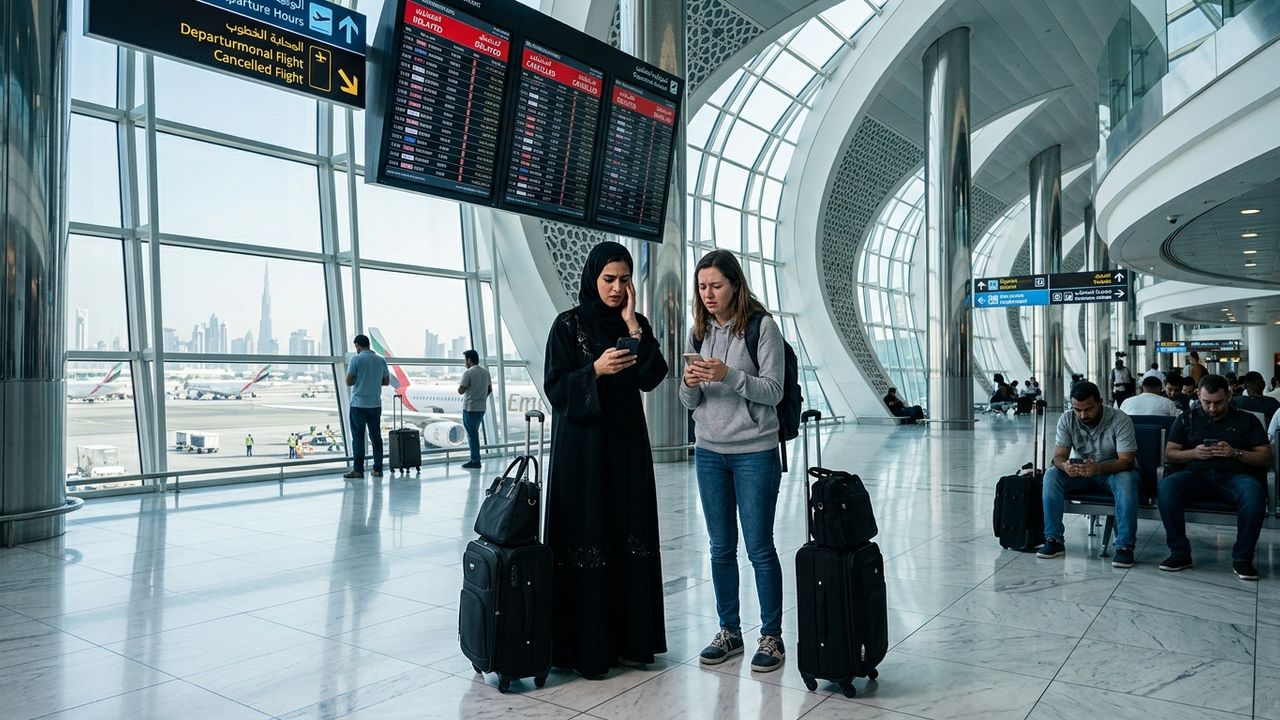
Image generated by AI
The United Arab Emirates has introduced a temporary immigration relief framework addressing the growing backlog of stranded passengers caused by widespread airspace disruptions and flight cancellations across the Middle East. The measure grants a 30-day visa extension and pauses overstay fines for affected travellers, impacting nationals from Russia, the United States, the United Kingdom, Turkey, Canada, Germany, Spain, and additional global markets relying on UAE transit hubs.
The policy serves as a crisis-response mechanism designed to stabilize global passenger movement, prevent unfair penalty accumulation, and provide structured exit or visa regularisation options for travellers unable to depart due to aviation bottlenecks. Under standard regulations, overstays in the UAE incur a penalty of AED 50 per day. However, this emergency framework temporarily suspends that financial accumulation for verified cases, offering a controlled window for resolution.
UAE Activates 30-Day Grace Window Managed by ICP
The Federal Authority for Identity, Citizenship, Customs and Port Security (ICP) is overseeing the implementation of the grace period. Authorities have structured the 30-day window as a "controlled compliance reset" rather than a standard visa extension. The system targets travellers who were prevented from exiting the UAE within their visa validity period due to airspace closures and flight disruptions.
The relief mechanism operates as a final corrective phase following earlier disruption-linked exemption measures. During the grace period, eligible passengers are provided two structured pathways: exit the UAE without accumulating fines or regularise their immigration status through official channels. Once the 30-day window closes, standard enforcement protocols resume immediately, and suspended penalties are reactivated for any remaining overstays.
Digital Integration Streamlines Eligibility and Relief Processing
The UAE's relief framework relies on a digitally integrated immigration system linking airport exit records, visa databases, and ICP monitoring tools. Eligibility is determined through automated verification processes tied to specific disruption events.
Travellers flagged as eligible experience an automatic suspension of penalty accumulation. The operational workflow requires affected passengers to follow a defined pathway:
- Verification: Immigration records are cross-referenced with disruption data to confirm eligibility.
- Selection: Travellers choose between a penalty-free exit or status correction.
- Resolution: Departure or visa updates automatically close the case within the system.
- Reactivation: Upon the expiration of the 30-day window, all suspended penalties reactivate if the traveller remains without valid status.
This structured approach ensures a transition from emergency relief back to standard enforcement without overwhelming immigration processing systems.
Transit Hub Pressure: Russia, US, UK, Turkey, Canada, Germany, and Spain
The emergency measure addresses multi-country exposure resulting from instability in Middle Eastern airspace operations. The disruption has created a domino effect across global aviation networks, with flight rerouting, sudden cancellations, and corridor restrictions increasing pressure on UAE airports as primary transit nodes.
Russia, US, and UK Passengers Face Long-Haul Interruptions Travellers from Russia, the United States, and the United Kingdom represent a significant volume of long-haul transit passengers routed through UAE hubs for connections to Asia, Africa, and Australia. Russian passengers have encountered limited direct access options and rerouted flight corridors, heightening dependency on UAE airports. US travellers have experienced extended delays due to restructured global flight paths, while UK passengers have faced connection instability across Europe–Middle East–Asia corridors. These disruptions have generated extended layovers and unintended overstays for passengers trapped in transit cycles.
Turkey, Canada, and Germany Experience High Connectivity Sensitivity Markets in Turkey, Canada, and Germany show high sensitivity to UAE transit availability. Turkish travellers frequently utilize UAE hubs for connections to Asia and Africa, making them vulnerable to airspace restrictions. Canadian long-haul routes into Asia and the Middle East rely heavily on Emirates and Etihad transit networks, which faced schedule disruptions during regional instability. German travellers, including business and tourism sectors, encountered significant schedule re-routing due to European air corridor adjustments and Middle Eastern airspace limitations, leading to delayed return journeys and temporary visa validity breaches.
Spain and European Markets Hit by Cascading Delays Spanish travellers and broader European markets have been impacted by indirect aviation disruptions. Passengers using Dubai and Abu Dhabi as transit points for Asia-Pacific destinations have faced delayed onward connections caused by rerouted flight paths and hub congestion. The European aviation network has experienced cascading effects from airspace restrictions, extending travel times and creating missed connection scenarios that resulted in temporary overstays among transit passengers.
Impact Analysis: Country-Specific Disruptions and Relief Benefits
The following table outlines the specific challenges and relief benefits for key affected nations based on current transit patterns and disruption impacts.
| Country | Main Travel Challenge | UAE Transit Impact | Relief Benefit |
|---|---|---|---|
| Russia | Route instability and limited direct connectivity | Extended UAE layovers | Fine suspension + exit flexibility |
| US | Long-haul rerouting via Middle East hubs | Delayed onward travel | Penalty-free grace exit |
| UK | Europe–Asia connection disruption | Transit overstays | Temporary visa protection |
| Turkey | High dependency on UAE transit corridors | Flight delays and congestion | Status correction option |
| Canada | Asia-bound long-haul disruption | Missed connections | Controlled exit relief |
| Germany | Business travel delays and rerouting | Airport congestion | AED 50/day suspension window |
| Spain | European network delay spillover | Transit delays via UAE | No-penalty departure window |
Global Stabilisation and Enforcement Outlook
The UAE's temporary visa relief framework functions as a critical stabilisation tool for international mobility. By pausing daily overstay accumulation, the policy prevents exponential penalty growth for stranded passengers, particularly in cases of extended delays caused by factors beyond their control.
For airlines, the measure reduces passenger processing congestion at departure terminals. For immigration authorities, it enables the structured resolution of stranded cases while maintaining enforcement integrity. The framework reinforces the UAE's position as a resilient global aviation hub by ensuring that travellers affected by external aviation instability are not penalised unfairly.
The 30-day grace period represents a targeted intervention to manage disrupted passenger flows. As the window approaches its conclusion, immigration enforcement will return to full strength, marking the end of this emergency mobility adjustment phase.
| Country | Main Travel Challenge | UAE Transit Impact | Relief Benefit |
|---|---|---|---|
| Russia | Route instability and limited direct connectivity | Extended UAE layovers | Fine suspension + exit flexibility |
| US | Long-haul rerouting via Middle East hubs | Delayed onward travel | Penalty-free grace exit |
| UK | Europe–Asia connection disruption | Transit overstays | Temporary visa protection |
| Turkey | High dependency on UAE transit corridors | Flight delays and congestion | Status correction option |
| Canada | Asia-bound long-haul disruption | Missed connections | Controlled exit relief |
| Germany | Business travel delays and rerouting | Airport congestion | AED 50/day suspension window |
| Spain | European network delay spillover | Transit delays via UAE | No-penalty departure window |
Key Takeaways
- Emergency Grace Period: The UAE has activated a 30-day visa extension and temporarily suspended the standard AED 50 per day overstay penalty for travellers stranded by regional airspace disruptions and flight cancellations.
- Managed by ICP: The Federal Authority for Identity, Citizenship, Customs and Port Security (ICP) oversees the framework as a controlled compliance reset, offering eligible passengers options to exit penalty-free or regularise their status.
- Affected Markets: Nationals from Russia, the US, UK, Turkey, Canada, Germany, Spain, and other countries relying on UAE transit hubs are impacted by the measure due to long-haul rerouting, missed connections, and extended layovers.
- Digital Verification: Eligibility is determined through automated digital integration of immigration and disruption records. Penalties are automatically suspended for verified cases, and reactivation occurs upon the window's closure.
- Enforcement Resumes: The relief framework is time-bound. Once the 30-day period ends, standard overstay penalties and enforcement protocols resume immediately for any remaining overstays.
FAQ
How is eligibility for the visa grace period determined? Eligibility is verified through the UAE's digital immigration system. The ICP cross-references passenger records with data on airspace closures and flight disruptions to automatically identify travellers unable to depart within their visa validity. Eligible passengers do not need to manually apply for the fine suspension; the system flags them and pauses penalties automatically.
What options are available to travellers during the 30-day grace window? Eligible stranded travellers must choose between two pathways: exit the UAE without penalty or regularise their immigration status through official channels. The system records the traveller's selection and closes the case upon departure or status update.
When do the AED 50 per day overstay fines restart? The suspension of overstay fines is temporary and limited to the 30-day grace window. Once this period closes, enforcement returns to full strength, and suspended penalties reactivate for any travellers who remain in the UAE without valid status.
Does this relief apply to all overstays or only disruption-related cases? The framework applies specifically to travellers affected by verified regional airspace disruptions, flight cancellations, and aviation bottlenecks. It is designed for passengers stranded due to circumstances beyond their control, rather than general overstays unrelated to the current aviation instability.
Related Travel Guides
Disclaimer
This article is for informational and educational purposes only. It does not constitute legal, financial, or professional advice. While we strive to provide accurate and up-to-date information, travel policies, regulations, and conditions change rapidly. Always verify information with official sources before making travel decisions. Nomad Lawyer makes no representations about the accuracy, reliability, completeness, or suitability of the information provided. Readers should consult qualified professionals for advice specific to their circumstances. The views expressed in this article are those of the author and do not necessarily reflect the views of Nomad Lawyer.
Preeti Gunjan
Contributor & Community Manager
A passionate traveller and community builder. Preeti helps grow the Nomad Lawyer community, fostering engagement and bringing the reader experience to life.
Learn more about our team →