
Typhoon Saudel Triggers 743 Flight Cancellations and 4,668 Delays Across Tokyo and Asian Hubs in 2026
Severe weather from Typhoon Saudel and operational pressures have caused 743 cancellations and 4,668 delays across 23 Asian airports, including Tokyo and Beijing.

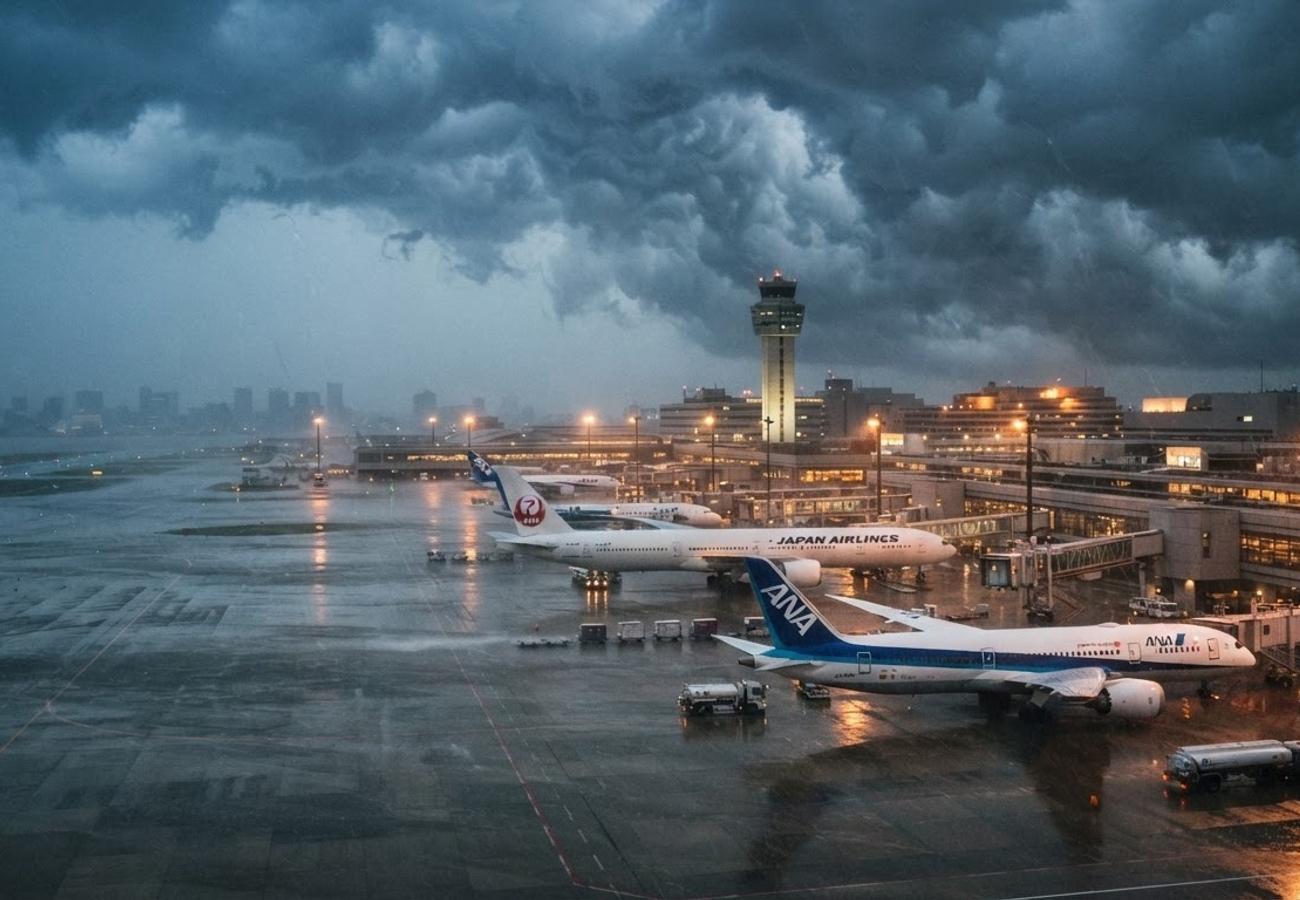
Image generated by AI
[Tokyo, August 26, 2026] — A massive wave of aviation disruption has paralyzed travel across Asia, with 4,668 delays and 743 flight cancellations recorded across 23 major airports. The chaos is primarily driven by the approach of Typhoon Saudel and systemic operational pressures affecting critical hubs in Japan, China, India, and Saudi Arabia.
The current crisis is centered around the Ryukyu Islands and Okinawa, where Typhoon Saudel is creating extreme volatility for flight schedules. Beyond the weather, major aviation centers including Tokyo, Naha, Beijing, Guangzhou, Shanghai, and Shenzhen are struggling with severe operational bottlenecks, leaving thousands of passengers stranded.
Weather Systems and Operational Pressures Impacting Asia
Typhoon Saudel is the primary catalyst for the current instability, with the storm expected to pass just north of Okinawa starting Wednesday morning local time. Meteorological forecasts indicate the storm will maintain its current intensity for a window of 18 to 24 hours before it begins to weaken.
While the storm's center is projected to stay north of Okinawa, aviation officials warn that slight shifts in the storm's trajectory could drastically alter local wind speeds and marine conditions, further complicating flight paths. Following its passage through the Ryukyu Islands, Saudel is forecast to move westward on Wednesday before turning southwest toward eastern China, with a projected landfall near northern Fujian or Zhejiang on Friday.
Beyond the weather, the industry is grappling with a combination of aircraft scheduling conflicts, crew availability shortages, essential maintenance requirements, and general airport congestion. These factors have compounded the effects of the typhoon, leading to a cascading failure of aircraft rotations across the region.
Airport-Specific Disruption Data
The scale of the disruption varies by hub, with Naha Airport emerging as the epicenter for cancellations, while Beijing hubs are seeing the highest volume of delays.
| Airport | Delays | Cancellations | Primary Affected Carriers |
|---|---|---|---|
| Naha Airport | 63 | 228 | ANA Wings, Japan Transocean Air, Skymark |
| Beijing Capital Intl | 674 | 32 | Air China |
| Beijing Daxing Intl | 597 | 62 | China Southern, China Eastern |
| Guangzhou Baiyun Intl | 500 | 17 | China Southern, China Eastern |
| Tokyo Haneda Intl | 472 | 49 | Japan Airlines, All Nippon Airways |
| Indira Gandhi Intl | 253 | 11 | IndiGo, SpiceJet |
Carrier Impact Analysis: Airlines Facing Maximum Disruption
Several major carriers are reporting systemic failures across their networks. In Japan, Japan Airlines is seeing widespread interruptions in Tokyo, Osaka, Kansai, Fukuoka, Kagoshima, Amami, Miyako, and Ishigaki. Similarly, All Nippon Airways (ANA) and its subsidiary ANA Wings are facing heavy cancellations in Tokyo, Naha, Osaka, Kobe, Fukuoka, Kagoshima, Miyako, and Ishigaki. Japan Transocean Air Co. has also reported significant losses in service across Naha, Kansai, Fukuoka, Miyoko, and Ishigaki.
In China, the "Big Three" are heavily impacted. Air China is recording the highest number of delays, particularly in its hubs of Beijing, Shanghai, Shenzhen, Guangzhou, and Chengdu. China Eastern Airlines reports substantial disruptions in Shanghai, Hangzhou, Chengdu, Shenzhen, Beijing, Xi’an, and Guangzhou. China Southern Airlines is seeing its network strained in Beijing, Guangzhou, Hangzhou, and Zhengzhou.
The disruption extends beyond East Asia. In India, IndiGo and SpiceJet are reporting significant delays at Indira Gandhi International Airport in Delhi and hubs in Mumbai, with Air India, Air India Express, and Akasa Air also affected. Meanwhile, in Saudi Arabia, Saudia, Flynas, and flyadeal are managing disruptions in Riyadh and Jeddah.
Passenger Guidance for Navigating Travel Chaos
With the storm expected to linger and operational pressures remaining high, industry observers recommend the following steps for affected travelers:
- Pre-Departure Verification: Confirm flight status via official airline apps or websites before departing for the airport to avoid unnecessary transit.
- Buffer Time: Allocate significantly more time for security and check-in procedures as airport congestion increases.
- Immediate Communication: Contact the carrier immediately following a cancellation to secure the first available alternative flight or initiate a refund request.
- Carry-On Essentials: Ensure all critical medications, travel documents, electronic chargers, and valuables remain in carry-on luggage, as checked bag retrieval may be delayed during operational meltdowns.
- Real-Time Monitoring: Keep notifications active for gate changes and schedule updates.
Why This Matters: The Logistical Ripple Effect
For the modern traveler, this event highlights a critical vulnerability in the "hub-and-spoke" aviation model. When a primary hub like Tokyo Haneda or Beijing Capital experiences a surge in delays, it creates a "domino effect" that impacts flights thousands of miles away. For instance, the delays in Delhi and Riyadh, while not caused by Typhoon Saudel, are often linked to the disruption of long-haul aircraft rotations that originate or terminate in the affected East Asian hubs.
From a legal and logistical standpoint, the overlap of "Acts of God" (the typhoon) and "Operational Failures" (crew and maintenance issues) creates a complex environment for passenger compensation. Travelers should be aware that while weather-related cancellations are typically non-compensable, operational failures may entitle passengers to different levels of support depending on local aviation laws.
As Typhoon Saudel moves toward eastern China, the focus of the disruption will likely shift from Japan to the Zhejiang and Fujian provinces. Travelers should expect a secondary wave of cancellations toward the end of the week.
Aviation data for this report was captured on August 25, 2026, at 3:10 pm ET / August 26, 12:40 am IST via FlightAware.
Related Travel Guides
Disclaimer
This article is for informational and educational purposes only. It does not constitute legal, financial, or professional advice. While we strive to provide accurate and up-to-date information, travel policies, regulations, and conditions change rapidly. Always verify information with official sources before making travel decisions. Nomad Lawyer makes no representations about the accuracy, reliability, completeness, or suitability of the information provided. Readers should consult qualified professionals for advice specific to their circumstances. The views expressed in this article are those of the author and do not necessarily reflect the views of Nomad Lawyer.
Preeti Gunjan
Contributor & Community Manager
A passionate traveller and community builder. Preeti helps grow the Nomad Lawyer community, fostering engagement and bringing the reader experience to life.
Learn more about our team →