
Turkish Airlines Flight TK17 Boeing 777-3F2ER Istanbul to Toronto Diverts to Manchester Airport UK on 28 July 2026 After North Sea Technical Fault
Turkish Airlines Flight TK17, a Boeing 777-3F2ER travelling from Istanbul to Toronto, diverted to Manchester Airport on 28 July 2026 after a technical fault forced a North Sea holding pattern and emergency landing.

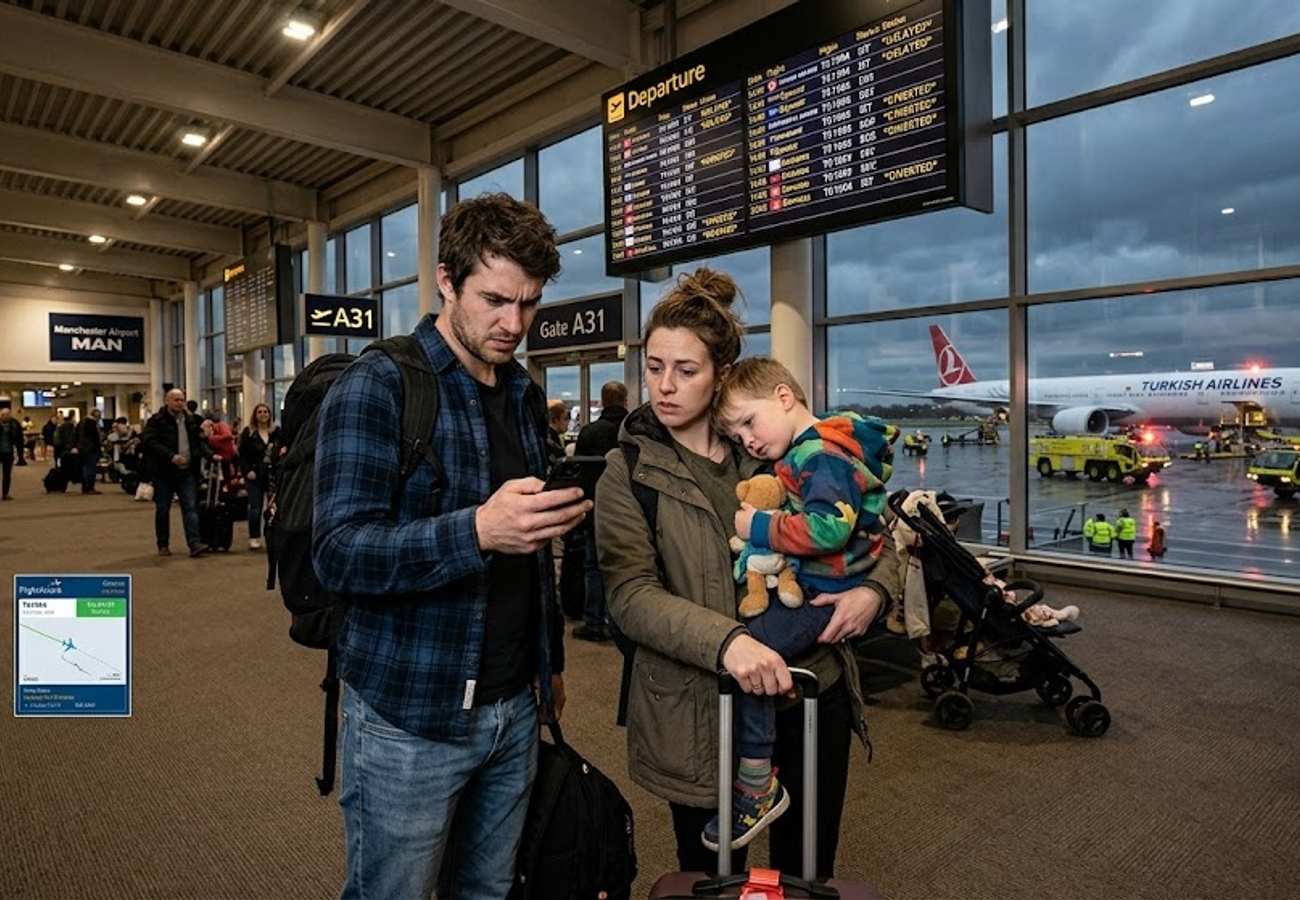
Image generated by AI
A fully loaded Boeing 777-3F2ER carrying transatlantic passengers dropped from 32,000 feet into a tactical holding pattern over the North Sea, burning fuel for over an hour before executing an emergency landing at Manchester Airport. The aircraft landed safely on Runway 23L at approximately 19:30 local time, underwent three hours of engineering inspections, and then completed the remaining seven-hour crossing to Toronto Pearson International.
The Core Transit Update
On Tuesday 28 July 2026, Turkish Airlines Flight TK17, operated by a Boeing 777-3F2ER registered as TC-JJR, departed Istanbul Airport bound for Toronto Pearson International. Approximately four hours into the transatlantic sector, while cruising at 32,000 feet over the North Sea, the flight deck registered a technical fault requiring immediate operational evaluation.
Following established transoceanic aviation protocols, the crew descended the widebody jet to 26,000 feet and entered a controlled holding pattern over maritime airspace. This orbit served a dual purpose: it allowed the pilots to systematically work through quick-reference checklists alongside air traffic controllers, and it reduced the aircraft's weight through deliberate fuel consumption, lowering structural load on the landing gear prior to touchdown on British soil.
Air traffic controllers coordinated descent vectoring while ground crews at Manchester Airport positioned emergency fire appliances along the perimeter as a standard precautionary measure. The heavily laden twin-jet completed its approach without further incident, touching down smoothly on Runway 23L at approximately 19:30 local time. Emergency services escorted the aircraft directly to a remote stand where specialised engineering teams were already waiting.
Once positioned on the apron, qualified technicians carried out a comprehensive tarmac inspection to isolate the underlying system malfunction and verify structural airworthiness. After resolving the specific technical fault, engineers completed diagnostic checks across the avionics systems to ensure compliance with international safety benchmarks. Following maintenance sign-off and replenishment of jet fuel reserves, Flight TK17 received official clearance from UK civil aviation authorities to resume its transatlantic leg. Approximately three hours after its unscheduled arrival, the aircraft pushed back and departed Manchester for the remaining seven-hour passage to North America.
Transit Schedule & Route Specifications
| Parameter | Detail |
|---|---|
| Flight Number | TK17 |
| Operator | Turkish Airlines |
| Aircraft Type | Boeing 777-3F2ER |
| Registration | TC-JJR |
| Origin | Istanbul Airport (IST) |
| Planned Destination | Toronto Pearson International (YYZ) |
| Diversion Airport | Manchester Airport (MAN), United Kingdom |
| Date of Diversion | 28 July 2026 |
| Cruise Altitude at Fault | 32,000 feet |
| Holding Altitude | 26,000 feet |
| Holding Location | North Sea maritime airspace |
| Time into Flight at Fault | Approximately 4 hours |
| Landing Runway | 23L |
| Landing Time (Local) | Approximately 19:30 |
| Ground Time at Manchester | Approximately 3 hours |
| Remaining Flight Time to Toronto | Approximately 7 hours |
| Cause | En-route technical fault |
Traveler Logistics Guide: Navigating a Mid-Flight Diversion
From a ground-level perspective, the best way to navigate an unexpected diversion like the TK17 incident is to understand the operational realities before you even board. Transatlantic flights operating under ETOPS (Extended-range Twin-engine Operations Performance Standards) must remain within calculated flying distances of suitable alternate airfields at all times. This means your aircraft is never truly "stranded" over the ocean—diversion corridors through UK airspace, Shannon in Ireland, and Keflavík in Iceland exist precisely for these scenarios.
Connection Planning After a Diversion
If your flight diverts to an intermediate hub like Manchester, expect a minimum two-to-four-hour ground time for engineering inspections, refuelling, and any necessary customs clearance for passengers who may need to disembark. For travelers with onward connections from Toronto Pearson to other North American destinations, build a buffer of at least three hours into your layover. Airlines typically rebook affected passengers automatically when a diversion causes a missed connection, but having your booking reference and the airline's app loaded on your phone speeds up the re-accommodation process at the transfer desk.
Digital Transit Policies at Manchester
Manchester Airport participates in the UK's electronic passport gates (e-gates) system for eligible nationalities, which can expedite processing if passengers are required to clear immigration during an extended diversion. However, in most technical diversion scenarios like TK17, passengers remain on board or in a secure transit area while engineering work is completed. If you are a non-UK resident required to clear border control, ensure your Electronic Travel Authorisation (ETA) is secured in advance—the UK's ETA scheme now applies to all visitors, including those transiting through British airports on diverted flights.
Practical Advice for the North Sea Corridor
Airlines file flight plans with pre-designated diversion airfields before departure. When booking a transatlantic route that crosses the North Atlantic track system, check whether your carrier has interline agreements with ground handlers at common diversion airports. Turkish Airlines maintains engineering support agreements at major UK hubs, which is why Manchester was selected over closer but less-equipped alternatives. For travelers concerned about diversions, carrying a fully charged power bank, a downloaded offline map of likely diversion cities, and your airline's customer service number stored locally can transform a stressful three-hour ground stop into a manageable pause.
Infrastructure Impact Assessment
The TK17 diversion underscores the enduring importance of the UK's aviation infrastructure as a transatlantic safety net. Manchester Airport's ability to receive a fully loaded Boeing 777-3F2ER on short notice, deploy emergency services, and provide qualified engineering support within minutes demonstrates why British regional hubs remain designated alternate airfields for North Atlantic routing.
This incident also highlights the operational resilience of modern twin-engine widebody operations under ETOPS guidelines. The decision to hold over the North Sea rather than attempt an immediate landing with full transatlantic fuel tanks reflects disciplined risk management. By burning fuel to reach a safe landing weight, the crew reduced structural stress on the airframe and landing gear, a procedure that requires precise coordination with air traffic control to maintain separation from other traffic in congested maritime airspace.
For regional connectivity, diversions like this reinforce the case for maintaining robust engineering and customs capabilities at secondary airports. Manchester's Runway 23L handled the arrival without disrupting scheduled operations, a testament to the airport's capacity planning. As transatlantic traffic volumes recover and grow through 2026, the frequency of precautionary diversions to UK and Irish airports will likely increase proportionally, making the continued investment in ground infrastructure at these hubs a regional economic and safety imperative.
Internal Connection
For more on how global airlines are managing network disruptions and safety incidents, explore our coverage of Emirates Restores 96% of Global Network and the Boeing 777F Low Flyby in Texas that raised safety questions across the aviation community. Regional airspace congestion is also forcing unexpected diversions closer to home, as seen when Envoy Air Flight ENY3603 was diverted from Chicago O'Hare to Fort Wayne on the Knoxville to Chicago route.
Related Travel Guides
Disclaimer
This article is for informational and educational purposes only. It does not constitute legal, financial, or professional advice. While we strive to provide accurate and up-to-date information, travel policies, regulations, and conditions change rapidly. Always verify information with official sources before making travel decisions. Nomad Lawyer makes no representations about the accuracy, reliability, completeness, or suitability of the information provided. Readers should consult qualified professionals for advice specific to their circumstances. The views expressed in this article are those of the author and do not necessarily reflect the views of Nomad Lawyer.
Preeti Gunjan
Contributor & Community Manager
A passionate traveller and community builder. Preeti helps grow the Nomad Lawyer community, fostering engagement and bringing the reader experience to life.
Learn more about our team →