
Turkish Airlines Orders 12 HAVELSAN Flight Simulators to Expand Pilot Training
Turkish Airlines expands its pilot training infrastructure, ordering 12 HAVELSAN simulators to support its 800-aircraft fleet goal by 2033.

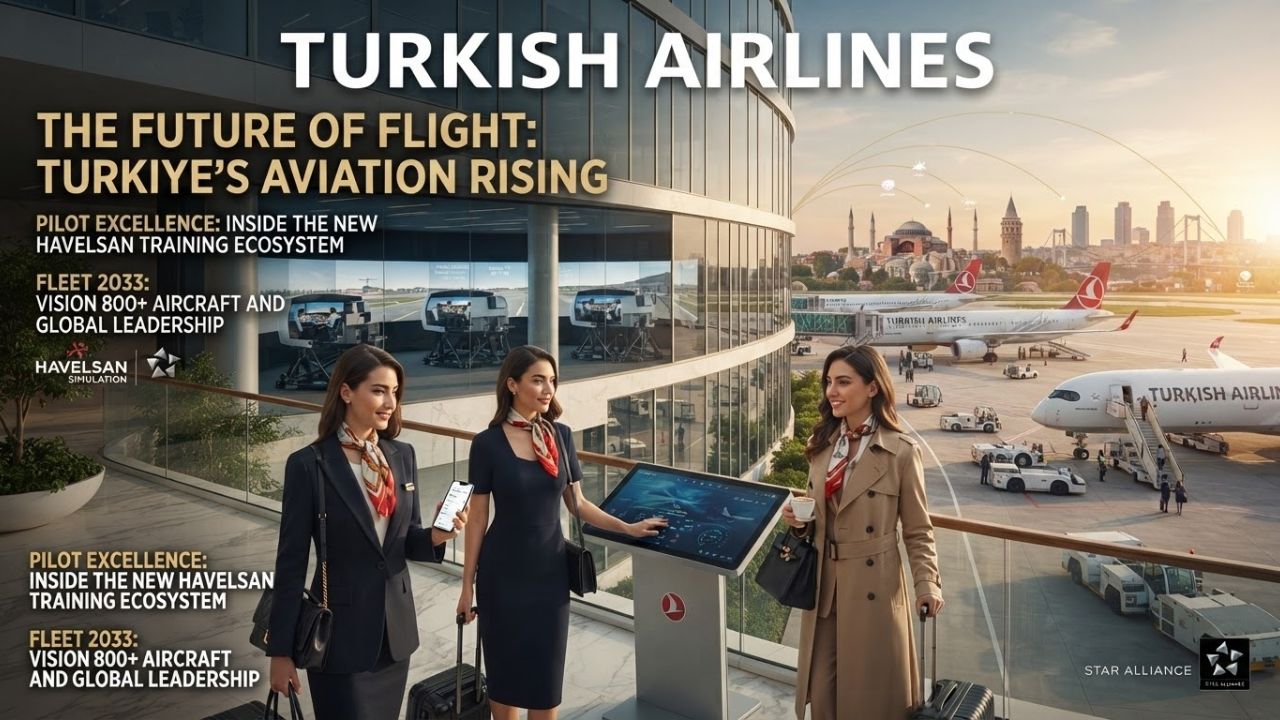
Image generated by AI
Turkish Airlines has signed an agreement with domestic technology manufacturer HAVELSAN to acquire 12 new flight simulators to support its long-term fleet growth.
Domestic Technology and Training Infrastructure
To support its plan to operate a fleet of over 800 aircraft by 2033, Turkey's national flag carrier is expanding its pilot training capabilities.
Under the new agreement, HAVELSAN will supply 12 locally manufactured training devices—comprising eight Full Flight Simulators (FFS) and four Flight Training Devices (FTD).
The project marks HAVELSAN's entry into widebody flight simulation, producing simulators for both narrowbody and widebody passenger aircraft. The training devices will be distributed across the carrier's three training campuses and integrated into the new Flight Training Center, which is scheduled for completion by 2028.
Pilot Training Infrastructure Breakdown
- Simulator Order Details: Consists of 8 Full Flight Simulators (FFS) and 4 Flight Training Devices (FTD) built by HAVELSAN.
- Domestic Technology Milestone: HAVELSAN will develop widebody flight simulators in Turkey for the first time.
- Three-Campus Expansion: Simulators will be deployed across three active training hubs to serve domestic and third-party airline pilots.
- Flight Training Center Target: Completion of the new training facility is scheduled by 2028.
- Fleet Support Goal: Expanding capacity to prepare flight crews for a projected fleet of over 800 aircraft by 2033.
Pilot Training Standards & Passenger Protections (Information Gain)
Cockpit simulation technology plays a direct role in flight safety, and pilot training constraints can affect schedules:
- EASA Level D Certification: All simulators deployed by Turkish Airlines are certified to European Union Aviation Safety Agency (EASA) Level D standards—the highest rating for flight simulation. This ensures realistic recreation of cockpit systems and emergency responses.
- Crew Scheduling Delays: If an airline faces crew shortages or delays in recurrent pilot training, flights may be delayed. Under standard passenger protection rules, carriers must provide rebooking or refunds for controllable scheduling disruptions.
- Safety Training Scope: Simulators allow flight crews to repeatedly practice emergency landing procedures, engine failures, and extreme weather scenarios in a controlled environment.
Industry Analyst View
Our analysis indicates that localizing flight simulator production with HAVELSAN allows Turkish Airlines to bypass bottlenecks in pilot training.
As the carrier targets doubling its fleet to 800 aircraft, cockpit conversion times must be minimized. Localizing production reduces the carrier's dependence on Western European training hubs, providing the pilot training capacity needed to support its international route expansion.
1. Turkish Airlines Active HAVELSAN Simulator Fleet (July 2026)
| Simulator Category / Fleet | Device Type | Certification Level | Operational Status |
|---|---|---|---|
| Airbus A320neo / ceo | 3 Full Flight Simulators | EASA Level D | Actively used in training |
| Boeing 737 MAX | 3 Full Flight Simulators | EASA Level D | Actively used in training |
| Boeing 737NG | 1 Full Flight Simulator | EASA Level D | Actively used in training |
| New Order (All Types) | 8 FFS & 4 FTD | EASA Level D (Planned) | Scheduled for delivery |
Key Takeaways
- Twelve New Simulators: Turkish Airlines orders 8 FFS and 4 FTD units from HAVELSAN.
- 800-Aircraft Fleet Goal: The expansion supports the airline's fleet target for 2033.
- Widebody Simulation Launch: HAVELSAN enters the widebody aircraft simulation market in Turkey.
- Flight Training Center 2028: The new campus facility will be completed by 2028.
FAQ
What simulator devices are included in the new order?
The order includes eight Full Flight Simulators (FFS) and four Flight Training Devices (FTD) manufactured by HAVELSAN.
What certification do these simulators hold?
The active simulators are certified to EASA Level D, which is the highest classification for flight simulator realism and safety.
When will the new Flight Training Center be completed?
Turkish Airlines expects to complete the construction of the new Flight Training Center by 2028.
Related Travel Guides
- Finnair Lowers 2026 Capacity Growth Target to One Percent Due to Middle East Cancellations but Upgrades Revenue Forecast
- Turkish Airlines Joins SAFFA Fund I to Accelerate Global Sustainable Aviation Fuel Production Alongside Airbus and Burnham Sterling Asset Management
- Hobart Airport Receives Australian Airports Association Excellence Award for Commercial Growth During Half Billion Dollar Tasmania Terminal Expansion
Disclaimer
This article is for informational and educational purposes only. It does not constitute legal, financial, or professional advice. While we strive to provide accurate and up-to-date information, travel policies, regulations, and conditions change rapidly. Always verify information with official sources before making travel decisions. Nomad Lawyer makes no representations about the accuracy, reliability, completeness, or suitability of the information provided. Readers should consult qualified professionals for advice specific to their circumstances. The views expressed in this article are those of the author and do not necessarily reflect the views of Nomad Lawyer.
Kunal K Choudhary
Co-Founder & Contributor
A passionate traveller and tech enthusiast. Kunal contributes to the vision and growth of Nomad Lawyer, bringing fresh perspectives and driving the community forward.
Learn more about our team →