
World Aviation Festival 2026 in Lisbon Showcases AI Turnaround Innovations by Turkish Airlines, TAP, and Alaska Airlines
At the World Aviation Festival 2026 in Lisbon, Turkish Airlines, TAP Air Portugal, and Alaska Airlines unveil AI ramp monitoring, smart tags, and voice bots.

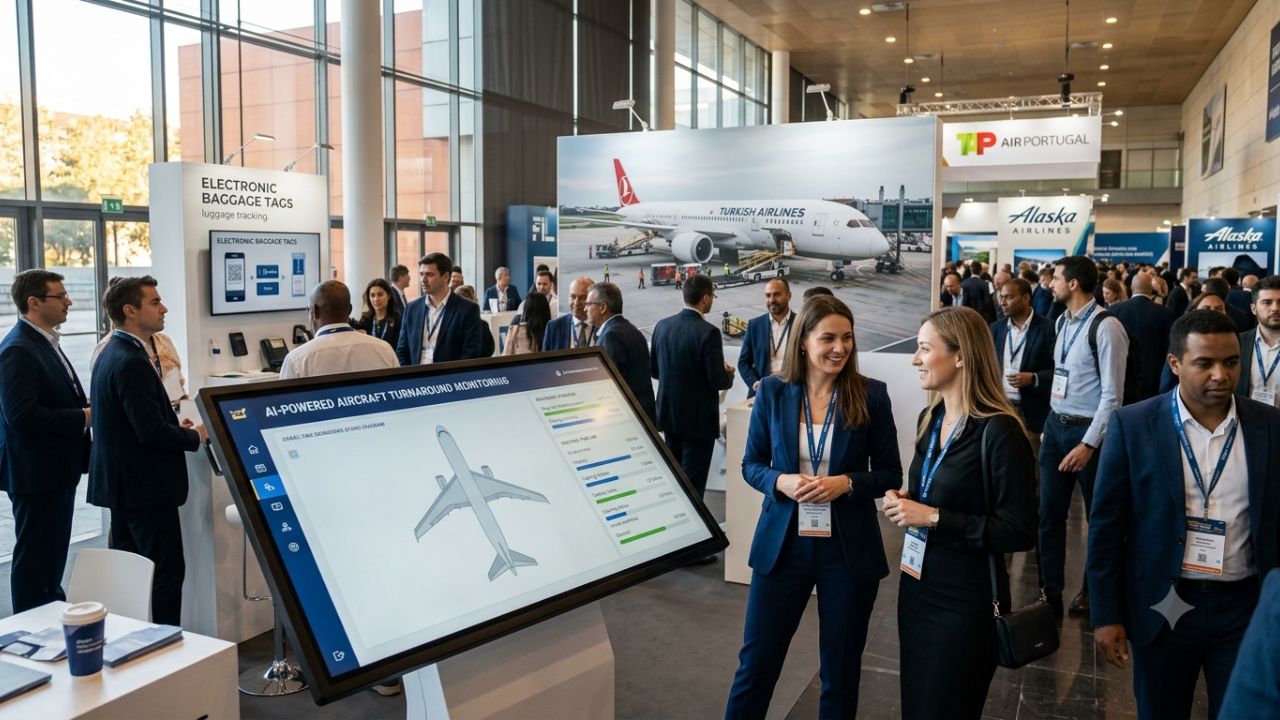
The World Aviation Festival 2026 opened at Feira Internacional de Lisboa on 13 October, bringing together more than 4,500 industry leaders and 600 speakers as Turkish Airlines, TAP Air Portugal, and Alaska Airlines unveiled operational artificial intelligence platforms designed to eliminate turnaround delays and overhaul passenger service.
Organized by Terrapinn and running through 15 October 2026, the three-day summit marks a decisive transition from experimental machine-learning trials to live airfield deployments.
Major research presented on opening day—including Assaia's Turnaround Report identifying an 11.1-minute average apron delay costing airlines $44 billion annually—demonstrated how computer vision, digital electronic luggage tags, and generative voice agents are reshaping commercial flight operations.
===================================================================================
             WORLD AVIATION FESTIVAL 2026: EVENT AND OPERATIONAL BENCHMARKS
===================================================================================

 [SUMMIT SPECIFICATIONS]
  * Dates: 13 to 15 October 2026
  * Host Complex: Feira Internacional de Lisboa (FIL), Lisbon, Portugal
  * Scale: 4,500+ Registered Attendees | 600+ Global Speakers | 3-Day Summit
  * Key Tracks: Airport & Airline Collaboration Track, Ancillary Arena, Startup Theatre

 [MAJOR RESEARCH BENCHMARKS]
  * Assaia 2026 Turnaround Report:
    - Average Q1 2026 turnaround delay: 11.1 minutes beyond schedule.
    - Potential annual industry cost savings: Up to $44 billion.
    - AI-monitored turnarounds operate 36% closer to target departure times.
  * Raven Customer Growth Index:
    - Evaluated 101 airlines across generative AI travel queries.
    - Airlines cited in 78% of answers, but direct website links provided in only 27%.
    - 85 of 101 airlines lose direct referral traffic to OTAs; $3 billion revenue gap.

 [ENTERPRISE AIRLINE TECH ANNOUNCEMENTS]
  * Turkish Airlines: Turnaround AI using ramp cameras; 30+ events tracked at 92%+ accuracy.
  * Alaska Airlines: Deploying BAGTAG Pulse with Apple Find My and Google Find Hub.
  * TAP Air Portugal: Resolving pre-flight visa bottlenecks (30% of call center traffic).
  * Pegasus Airlines: Investing in Zingly.ai agentic voice AI for customer operations.
  * EL AL & Arbitrip: Ancillary hotel platform generates 35,000 hotel room nights in month one.
===================================================================================
The Core Aviation Update: Lisbon Convenes 4,500 Leaders at World Aviation Festival 2026
The commercial aviation sector faces intensifying cost pressures, airspace congestion, and passenger expectations for seamless digital interaction.
At the World Aviation Festival 2026 in Lisbon, the focus centered on practical operational execution.
Rather than theoretical discussions, global network carriers and low-cost operators presented verified performance data showing how artificial intelligence directly improves punctuality, ancillary revenue, and customer recovery during irregular operations.
The 2026 conference introduced dedicated operational tracks, including the Airport and Airline Collaboration Track and the Ancillary Arena.
These stages highlighted the structural necessity of data synchronization between aircraft operators, airport authorities, ground handlers, and air navigation service providers.
When an inbound aircraft touches down, ground handlers must coordinate baggage offloading, lavatory servicing, potable water replenishment, cabin cleaning, catering delivery, and fueling within strict gate occupancy windows.
Failing to coordinate any single element produces cascading delays across subsequent flight sectors.
KEY ANNOUNCEMENTS AT WORLD AVIATION FESTIVAL 2026
| CARRIER / ENTITY | TECHNOLOGY PARTNER | CORE OPERATIONAL DEPLOYMENT |
|---|---|---|
| Turkish Airlines | In-House Ramp Systems | Turnaround AI: Computer vision |
| apron monitoring (92%+ accuracy) | ||
| Alaska Airlines | BAGTAG | BAGTAG Pulse e-tag deployment |
| with Apple/Google Find My | ||
| Alaska Airlines | Meili | Integrated digital car rental |
| booking platform for flyers | ||
| TAP Air Portugal | Ada / Cresta / Meta | WhatsApp concierge expansion; |
| automated pre-trip visa advice | ||
| Pegasus Airlines | Zingly.ai | Agentic voice AI for phone |
| guest service resolution | ||
| EL AL | Arbitrip | Ancillary hotel booking engine |
| (35,000 room nights in month 1) | ||
| Bristol Airport | OneReg | Digital safety management |
| system for £400M upgrade plan |
Aircraft Turnaround Benchmarks: The $44 Billion Assaia Efficiency Gap
A central briefing of the festival came from aviation technology specialist Assaia, which unveiled its comprehensive 2026 Turnaround Report.
Analyzing thousands of commercial flights across North American and European hubs during the first quarter of 2026, Assaia revealed that ground turnarounds exceeded their scheduled duration by an average of 11.1 minutes.
This operational drift represents an enormous financial penalty for global aviation.
ASSAIA 2026 TURNAROUND METRICS SUMMARY
| Entity / Route | Metrics | Operational Status |
|---|---|---|
| OPERATIONAL PARAMETER | BENCHMARK STATISTIC | FINANCIAL / PRACTICAL IMPACT |
| Average Apron Turnaround Delay | 11.1 minutes per flight | Exceeds published block time |
| Estimated Global Industry Loss | $44 billion annually | Extra fuel burn, crew overtime, |
| gate fees, missed connections | ||
| AI-Monitored Apron Improvement | 36% closer to schedule | Predictable ground milestones |
| and reduced ramp idle time |
The Mechanism of Ramp Bottlenecks
An 11.1-minute delay on an initial morning flight creates severe downstream disruption.
Aircraft assigned to four or six daily sectors accumulate compounded delays, causing late-evening flight cancellations due to airport nighttime curfews or crew duty-time limits.
Assaia's field data showed that gates equipped with automated computer-vision monitoring operated 36% closer to target departure times.
By analyzing real-time video feeds from existing apron cameras, algorithms track exactly when jet bridges connect, when fuel hoses attach, and when baggage conveyors finish loading.
When a service step falls behind schedule, ramp controllers receive instant predictive alerts, allowing supervisors to intervene minutes before the scheduled pushback.
Airline Visibility in AI Search: Raven Index Identifies $3 Billion Revenue Leak
While ramp operations dominated airfield discussions, commercial distribution strategies faced scrutiny in research presented by aviation consultancy Raven.
Raven's Customer Growth Index analyzed how 101 global airlines appear across conversational generative AI search engines when prospective passengers query flight options, fares, and itineraries.
RAVEN CUSTOMER GROWTH INDEX: KEY FINDINGS
| EVALUATION CRITERION | RECORDED METRIC | COMMERCIAL SIGNIFICANCE |
|---|---|---|
| Airline Brand Mention Rate | 78% of travel queries | High awareness by AI models |
| Direct Airline Website Links | 27% of responses | Severe conversion gap |
| Third-Party OTA Link Dominance | 85 of 101 airlines | Traffic diverted to aggregators |
| Top-Ranked Carrier in AI Search | Finnair | Optimal digital structured data |
| Estimated Lost Industry Revenue | $3 billion annually | Displaced direct ticket margins |
The findings expose a commercial vulnerability: while AI models accurately mention airlines in 78% of travel planning prompts, they provide a clickable direct link to the carrier's booking website in only 27% of cases.
For 85 of the 101 airlines examined, AI search assistants routed users to third-party online travel agencies (OTAs) and metasearch engines rather than direct brand websites.
Raven estimated that this structural failure to optimize content for AI search engines costs carriers roughly $3 billion annually in lost direct booking revenues and intermediary distribution fees.
Finnair emerged as the top-performing carrier, demonstrating that airlines with clean, structured schema metadata, transparent pricing APIs, and accessible digital assets capture direct customer traffic from generative search tools.
Carrier Technology Deployments: Turkish Airlines, TAP, Alaska, and Pegasus
Leading international carriers used the Lisbon festival to demonstrate live technological solutions solving complex operational challenges.
ENTERPRISE CARRIER CASE STUDIES AND PERFORMANCE
| CARRIER | SYSTEM / PLATFORM | TECHNICAL PERFORMANCE & MILESTONES |
|---|---|---|
| Turkish Airlines | Turnaround AI | Tracks 30+ apron events via cameras; |
| achieves 92%+ detection accuracy; | ||
| supports fleet goal of 1,000 by 2036 | ||
| Alaska Airlines | BAGTAG Pulse & Meili | Apple Find My & Google Find Hub e-tag; |
| over-the-air bag re-tagging; car hire | ||
| TAP Air Portugal | Digital Concierge & IROPS | Pre-trip visa triage (30% call share); |
| mobile app flight rebooking & refund | ||
| Pegasus Airlines | Zingly.ai Voice Agent | Agentic voice bots for telephone guest |
| service resolution during disruptions |
Turkish Airlines: Ramp Camera Vision Tracking
Elif Rümeysa Erikel, Senior Programme Manager for Ramp Operations at Turkish Airlines, presented the carrier's proprietary Turnaround AI platform.
Installed across its global mega-hub at Istanbul Airport (IST), the system utilizes standard CCTV security cameras positioned along terminal gates to monitor ground handling activities automatically.
The system tracks more than 30 distinct physical events—including catering truck docking, fueling hose attachment, baggage container uncoupling, and pushback tug positioning—achieving over 92% detection accuracy under operational conditions.
By linking timestamps to specific aircraft registrations and parking stands, ramp dispatchers identify developing bottlenecks early.
Erikel emphasized that this level of operational control is essential to support the airline's strategic growth target: expanding its commercial fleet to 1,000 aircraft by 2036.
Alaska Airlines: BAGTAG Pulse and Find My Integration
Alaska Airlines announced a major upgrade to its baggage handling architecture by partnering with BAGTAG to roll out BAGTAG Pulse, a third-generation electronic luggage tag.
Unlike disposable thermal paper tags attached at airport check-in desks, the permanent electronic device mounts securely to passenger luggage.
Key technical capabilities include:
- Multi-Network Asset Tracking: Built-in compatibility with both the Apple Find My network and Google Find Hub, enabling passengers to pinpoint their luggage location directly through native smartphone operating systems.
- Over-the-Air Flight Updates: When a passenger experiences a tight flight connection or diversion, the airline can wirelessly update the electronic e-paper display on the bag tag remotely, printing the new onward flight number and routing barcode without requiring the passenger to retrieve and re-check their bag.
Alongside BAGTAG Pulse, Alaska announced an integration with travel technology provider Meili, allowing flyers to book personalized car rentals directly within the carrier's digital channels.
TAP Air Portugal: Resolving the 30% Pre-Trip Visa Bottleneck
Hosting the summit in Lisbon, national flag carrier TAP Air Portugal detailed how customer support automation begins long before passengers arrive at the gate.
Sofia Lufinha, Chief Customer Officer at TAP Air Portugal, revealed that approximately 30% of all incoming contact center calls concern basic pre-travel information, particularly complex visa, passport, and transit regulations.
To eliminate this call center queue, TAP is deploying automated post-booking notifications that parse passenger nationality and route requirements, delivering customized entry advisories directly to travelers' smartphones.
The carrier is also expanding self-service flight rebooking across its mobile application during irregular operations, and enhancing its WhatsApp concierge service through automated chatbots to support travelers beyond top-tier elite frequent flyers.
Pegasus Airlines and EL AL: Voice Bots and Ancillary Growth
Turkish low-cost carrier Pegasus Airlines revealed an equity investment in conversational AI specialist Zingly.ai.
The carrier is deploying agentic voice bots capable of understanding natural speech accents over the telephone, answering inquiries, and processing flight rebookings during schedule disruptions without human agent transfers.
Concurrently, travel technology firm Arbitrip revealed that its ancillary hotel booking integration for Israeli carrier EL AL generated more than 35,000 hotel room nights within its initial 30 days of operation, demonstrating how airlines can expand non-ticket commercial revenues.
Air Passenger and Traveler Logistics Guide: Navigating Smart Luggage and AI Rebooking
The rapid deployment of aviation technology delivers immediate operational benefits for air travelers who understand how to leverage these tools.
===================================================================================
               AIR TRAVELER LOGISTICS: SMART BAGGAGE & AIRPORT TRANSIT
===================================================================================

 [SMART LUGGAGE MANAGEMENT]
  * Electronic Baggage Tags (BAGTAG Pulse):
    - Update luggage tags via airline mobile apps during remote check-in.
    - Enable location sharing across Apple Find My or Google Find Hub.
    - Eliminates waiting in terminal bag-drop check-in lines.

 [IRREGULAR OPERATIONS (IROPS) SURVIVAL]
  * Bypass Contact Center Queues:
    - Use carrier self-service mobile app modules (TAP, Alaska, Turkish) immediately.
    - Claim alternative rebooking or automatic meal/hotel vouchers within the app.
  * Turnaround Delay Awareness:
    - If inbound aircraft turnaround exceeds 11 minutes past schedule, anticipate
      cascading gate delays; monitor gate pushback tugs and baggage conveyors.

 [LISBON AIRPORT (LIS) & FIL VENUE NAVIGATION]
  * Terminal Division:
    - Terminal 1: All arrivals and scheduled network departures (TAP, Star Alliance).
    - Terminal 2: Low-cost departures only (accessible via free 3-minute shuttle).
  * Rapid Transit to FIL Convention Complex:
    - Metro Red Line (Linha Vermelha) links Airport directly to Oriente Station
      (3 stops, approx. 6 minutes). FIL is a 4-minute walk from Oriente exit.
===================================================================================
Leveraging Electronic Bag Tags and Smartphone Tracking
As carriers like Alaska Airlines deploy third-generation smart tags, travelers can streamline airport departure routines:
- Home Digital Check-In: Travelers activate their electronic baggage tag via Bluetooth or NFC using the airline mobile application, displaying the correct IATA routing barcode on the e-paper screen before leaving home.
- Dedicated Fast-Drop Lanes: Passengers bypass standard check-in desks and deposit tagged luggage directly at automated bag-drop conveyor belts.
- Mishandled Luggage Recovery: If a bag misses a connecting flight, passengers can track the bag's ramp location via Apple Find My or Google Find Hub, providing ground agents with exact GPS coordinates rather than waiting for manual baggage search reports.
Navigating Flight Disruptions via Self-Service Portals
When weather or technical issues ground flights, traditional phone queues quickly become overwhelmed. Travelers should execute a digital-first recovery strategy:
- In-App Flight Swapping: Access carrier mobile applications immediately upon receiving cancellation alerts. Systems like TAP Air Portugal's self-service portal allow passengers to select alternate itineraries or initiate refunds without speaking to an airport gate agent.
- Pre-Trip Visa Compliance: Because airlines enforce strict documentation rules to avoid immigration fines, passengers traveling internationally must verify electronic travel authorizations (such as ETIAS for Europe or ESTA for the United States) 72 hours before departure.
Lisbon Airport (LIS) and Feira Internacional de Lisboa Transit Logistics
For business travelers attending conferences at Feira Internacional de Lisboa (FIL) or connecting through Lisbon Humberto Delgado Airport (LIS):
- Terminal Separation Protocols: All commercial international arrivals land at Terminal 1. However, travelers departing on low-cost carriers (such as Ryanair, easyJet, or Wizz Air) must board the free airport shuttle bus outside Terminal 1 Departures to reach the departures-only Terminal 2. Allow an extra 30 minutes for this transfer.
- Direct Metro Transit to FIL / Parque das Nações: The Lisbon Metro Red Line (Linha Vermelha) connects Lisbon Airport station directly to Oriente station in just three stops (roughly six minutes). FIL is located 400 metres north of Oriente station, allowing attendees to transit between flight arrivals and exhibition halls in under 15 minutes.
Airport Infrastructure and Operational Impact: Ground Automation to Autonomous Ramps
Beyond individual carrier announcements, the World Aviation Festival demonstrated a broader transformation taking place across airport infrastructure.
AIRPORT INFRASTRUCTURE & GROUND AUTOMATION MATRIX
| Entity / Route | Metrics | Operational Status |
|---|---|---|
| OPERATIONAL DOMAIN | INNOVATION HIGHLIGHT | COLLABORATING ENTITIES |
| Autonomous Ramp Vehicles | Electric baggage tugs and | AeroVect, Azalea Robotics, |
| robotic container transports | Delta Air Lines (Atlanta) | |
| Airport Safety Compliance | Cloud safety management systems | Bristol Airport, OneReg |
| for £400M terminal upgrade | (First UK deployment) | |
| Multilingual Ramp Voice | Generative voice AI for ground | Humoniq, Moonware, |
| Coordination | crew dispatch during disruption | Terrapinn Startup Theatre |
Autonomous Airside Mobility
Presentations at the festival's Startup Theatre by robotics innovators AeroVect, Azalea Robotics, and Moonware illustrated why airside aprons provide an ideal environment for autonomous driving technology:
- Structured Geographic Environments: Airport aprons feature strictly marked roadways, standardized speed limits, and clear regulatory boundaries that simplify autonomous navigation compared to unpredictable public city streets.
- Live Fleet Operations: Azalea Robotics confirmed that its autonomous vehicle fleet is operating on active ramp surfaces at Hartsfield-Jackson Atlanta International Airport (ATL), supporting ground handling operations for Delta Air Lines.
Digital Safety Oversight at Regional Hubs
In the United Kingdom, Bristol Airport confirmed a partnership with aviation compliance software provider OneReg, marking the vendor's first British airport contract.
Bristol Airport is deploying the digital safety platform to coordinate operational reporting, regulatory audits, and hazard tracking across its £400 million development programme.
By replacing disjointed spreadsheets and paper checklists with centralized cloud oversight, the airport ensures that physical expansion projects do not compromise daily airside safety standards.
As the World Aviation Festival 2026 concluded its opening sessions in Lisbon, the global aviation sector established a clear consensus: operational efficiency and customer satisfaction are inextricably linked.
Airlines that deploy artificial intelligence to monitor ramp turnarounds, track luggage in real time, and automate irregular passenger recovery will protect operating margins while delivering a superior travel experience.
Frequently Asked Questions
What are the official dates and location for the World Aviation Festival 2026?
The World Aviation Festival 2026 takes place from 13 to 15 October 2026 at the Feira Internacional de Lisboa (FIL) exhibition complex in Lisbon, Portugal, hosting over 4,500 attendees and 600 speakers.
How much money could airlines save by fixing aircraft turnaround delays?
According to Assaia's 2026 Turnaround Report, eliminating the 11.1-minute average ground turnaround delay recorded across North American and European airports could save the global airline industry up to $44 billion annually.
How does Alaska Airlines' BAGTAG Pulse electronic luggage tag work?
BAGTAG Pulse is an electronic baggage tag featuring Apple Find My and Google Find Hub tracking, allowing travelers to track luggage location via smartphones while enabling airlines to update routing barcodes wirelessly during flight transfers.
How accurate is Turkish Airlines' Turnaround AI platform?
Turkish Airlines' Turnaround AI uses gate CCTV cameras to monitor more than 30 distinct ground servicing events, achieving over 92% detection accuracy under operational conditions to help ramp teams resolve departure bottlenecks.
Related Travel Guides
Disclaimer
This article is for informational and educational purposes only. It does not constitute legal, financial, or professional advice. While we strive to provide accurate and up-to-date information, travel policies, regulations, and conditions change rapidly. Always verify information with official sources before making travel decisions. Nomad Lawyer makes no representations about the accuracy, reliability, completeness, or suitability of the information provided. Readers should consult qualified professionals for advice specific to their circumstances. The views expressed in this article are those of the author and do not necessarily reflect the views of Nomad Lawyer.
Preeti Gunjan
Contributor & Community Manager
A passionate traveller and community builder. Preeti helps grow the Nomad Lawyer community, fostering engagement and bringing the reader experience to life.
Learn more about our team →