
Turkey's Megaproject Rail Corridor Connecting Europe to Saudi Arabia Through Syria and Jordan Reshapes Middle East Trade Routes and Pilgrimage Travel in 2026
Turkey is accelerating a transformative rail corridor linking Europe directly to the Gulf, Saudi Arabia, and holy cities of Mecca and Medina, challenging maritime trade dominance and reshaping regional geopolitics.

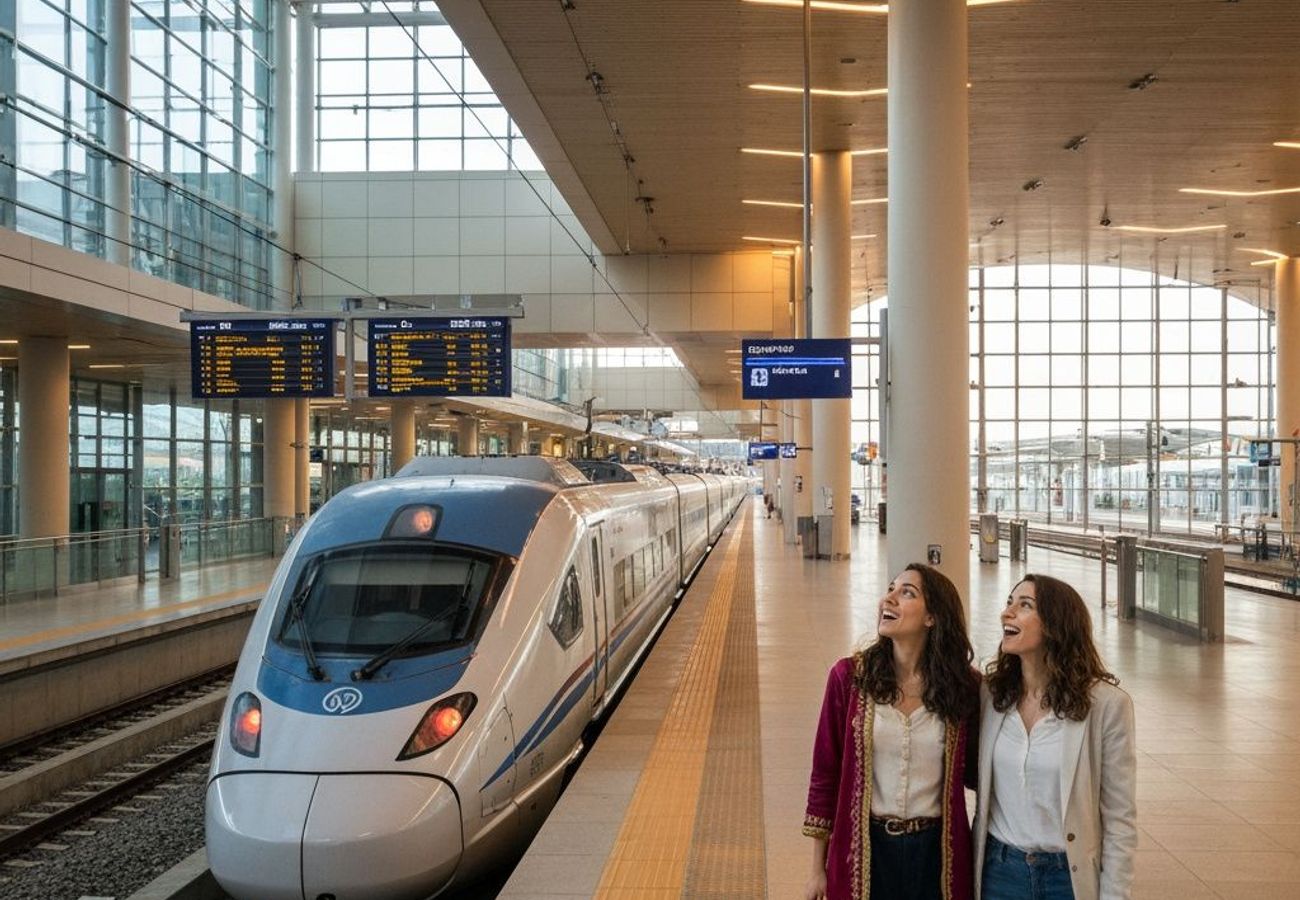
Image generated by AI
A Continental Vision: Turkey's Bold Rail Gambit
Turkey is orchestrating one of the Middle East's most ambitious infrastructure plays—a transcontinental rail corridor that will fundamentally rewire how Europe connects with the Arabian Peninsula. The initiative bridges Syria and Jordan in a continuous overland network extending into Saudi Arabia, linking religious pilgrimage destinations Mecca and Medina alongside the futuristic NEOM megaproject.
This isn't just another logistics project. It's a strategic repositioning that challenges maritime shipping dominance, strengthens Turkey's position as a continental hub, and creates an entirely new dimension for how millions of travelers—from freight handlers to pilgrims—move between continents.
The Strategic Architecture Behind the Corridor
The rail corridor operates on a deceptively simple premise: bypass congested maritime chokepoints entirely. Instead of shipping goods through the Suez Canal or routing passengers via crowded airports, an integrated land-based network would move freight and travelers at accelerated speeds through stable, synchronized cross-border infrastructure.
Turkish transport planners in Ankara see this as a logistics revolution. Early trials are already underway—freight movements through Iraq are testing cross-border readiness and customs alignment before full-scale operations launch. These test runs validate the operational groundwork necessary for a three-year development timeline toward initial service.
Saudi Arabia isn't a passive participant. The Kingdom is actively shaping the corridor to serve its Vision 2030 economic diversification goals, connecting industrial zones, trade hubs, and—crucially—the holiest sites in Islam. A direct rail route to Mecca and Medina would transform religious tourism overnight, potentially accommodating millions of pilgrims annually without aviation bottlenecks.
Reddit: "A rail corridor to Mecca would be life-changing for hajj logistics. Imagine flying into Istanbul and taking a direct train to the holy cities instead of connecting through Saudi airports." — r/travel
What Makes This Different From Competing Mega-Infrastructure
The Turkey-Saudi rail corridor doesn't exist in isolation. It's competing directly with other regional connectivity frameworks. The IMEC Trade Corridor (India-Middle East-Europe), for instance, emphasizes hybrid maritime-rail systems through port hubs. The Suez Canal remains the established maritime chokepoint moving roughly 12% of global trade annually.
But this rail corridor merges functions competitors can't easily replicate: simultaneous freight efficiency and religious pilgrimage capacity. It also creates genuine redundancy—if maritime routes face disruption (as they did during Red Sea tensions in 2024-2025), overland alternatives become invaluable.
The geopolitical implications are equally significant. Israel's port-based trade strategy faces indirect pressure as logistics flow inland rather than through maritime bottlenecks. Turkey deepens bilateral cooperation with Saudi Arabia, reflecting a broader realignment of regional alliances away from maritime-dependent models.
The Feasibility Question: What's Actually Happening
Here's where ambition meets reality. The corridor remains in feasibility assessment phase. Technical teams are evaluating route stability, infrastructure readiness, border logistics, and multi-country coordination requirements. This is no small task—synchronizing rail operations across Turkey, Syria, Jordan, and Saudi Arabia requires unprecedented diplomatic alignment on technical standards, customs procedures, and security protocols.
Saudi Arabia is still reviewing integration requirements. Officials have tentatively suggested operations could begin within approximately three years, though finalized funding agreements remain elusive. The trial freight movements through Iraq are producing operational data, but they're also revealing the complexity of cross-border rail movement in a region where political relationships remain volatile.
The corridor's success depends entirely on sustained coordination. One border closure, one customs dispute, one security incident could disrupt the entire network. That's why early trials are methodical—the stakes are geopolitical, not just commercial.
Economic Transformation: Supply Chains Reimagined
If realized, this corridor would fundamentally reshape global supply chains. Industrial zones along the route could access Europe and Asia simultaneously via land. Energy products, construction materials, and consumer goods could move faster and more predictably than maritime alternatives.
For energy-dependent economies, this is transformative. Saudi Arabia could diversify export routes, reducing vulnerability to maritime chokepoints. Turkey positions itself as the indispensable transit hub, collecting logistical fees and consolidating its role as the bridge between continents.
Manufacturing hubs emerging along the corridor would benefit from predictable, faster delivery windows to European markets—a competitive advantage against maritime-dependent competitors. This addresses a critical vulnerability exposed during pandemic-era supply chain disruptions.
The Pilgrimage Revolution: Hajj Reimagined
Beyond commerce, the corridor presents a revolutionary opportunity for Islamic pilgrimage. Millions of hajjis currently fly into Saudi Arabia or endure multi-leg journeys. A direct rail link from Istanbul to Medina and Mecca would offer pilgrims an alternative combining affordability, cultural immersion, and capacity that aviation simply cannot match.
During peak hajj seasons (typically in June), Saudi Arabia's airports become bottlenecks. A rail corridor could absorb overflow traffic, reduce flight congestion, and offer pilgrims a contemplative overland journey to Islam's holiest sites. Religious travel, tourism, and freight integration becomes possible on a single infrastructure platform.
This dimension explains why both Turkey and Saudi Arabia are advancing the vision despite political uncertainties. The convergence of economic necessity, trade ambition, and spiritual accessibility creates stakeholder alignment that transcends typical geopolitical friction.
The Geopolitical Chessboard: Competition and Cooperation
This corridor must be understood within broader Middle Eastern infrastructure competition. Nations are effectively racing to control transit routes linking Asia and Europe. Iran's northern corridor to the Caspian region, Gulf port developments, and overland Silk Road initiatives all represent competing visions.
The Turkey-Saudi rail corridor explicitly challenges maritime dominance. By internationalizing logistics, it reduces chokepoint vulnerability but also decentralizes control—no single nation or canal authority can throttle the network. That's attractive to powers seeking independence from maritime choke points like the Strait of Hormuz.
Simultaneously, the corridor strengthens Turkey-Saudi bilateral relations at a moment when regional alignments are shifting. Both nations seek to position themselves as infrastructure architects shaping 21st-century trade dynamics rather than passive participants.
Timeline and Realistic Expectations
Officials have outlined a three-year window for initial operations, but this assumes optimistic conditions: secured funding, political stability across all transit nations, completed feasibility studies, and synchronized infrastructure standards. Any single variable shifting could extend timelines significantly.
What's certain is that discussions are accelerating. Turkish transport authorities are actively coordinating with Saudi counterparts. Iraqi transit trials are generating operational data. Jordanian and Syrian governments are evaluating route options.
The corridor isn't hypothetical—it's moving from concept to preliminary execution. Whether it succeeds depends on sustained political will, secured international financing, and the region's ability to maintain the coordination required for such an unprecedented project.
The first nation to control transcontinental rail corridors wins the logistics wars of the 21st century—and Turkey knows it.
Related Travel Guides
Disclaimer
This article is for informational and educational purposes only. It does not constitute legal, financial, or professional advice. While we strive to provide accurate and up-to-date information, travel policies, regulations, and conditions change rapidly. Always verify information with official sources before making travel decisions. Nomad Lawyer makes no representations about the accuracy, reliability, completeness, or suitability of the information provided. Readers should consult qualified professionals for advice specific to their circumstances. The views expressed in this article are those of the author and do not necessarily reflect the views of Nomad Lawyer.
Raushan Kumar
Founder & Lead Developer
Full-stack developer with 11+ years of experience and a passionate traveller. Raushan built Nomad Lawyer from the ground up with a vision to create the best travel and law experience on the web.
Learn more about our team →