
Travelers Stranded at Toronto Pearson International Airport as Air Canada and More Airlines Face Eleven Flight Cancellations and Several Delays, Affecting Major Routes Through Punta Cana, Warsaw, Austin, Bogotá, Raleigh, and Beyond
Toronto Pearson International Airport faces chaos as Air Canada cancels 11 flights and reports widespread delays to Wars

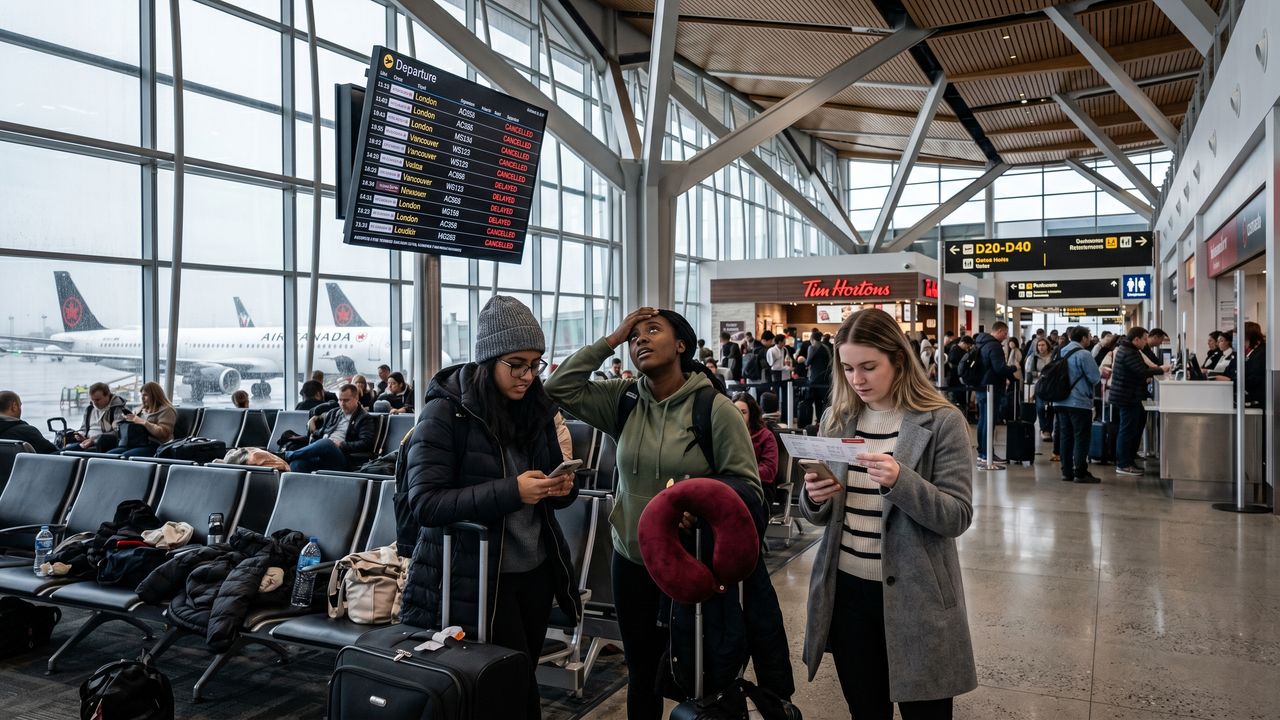
Image generated by AI
[Toronto, June 29, 2026] — Massive operational disruptions at Toronto Pearson International Airport have left hundreds of passengers stranded after Air Canada and its subsidiaries cancelled 11 flights and reported widespread delays across critical international and domestic corridors. The systemic failures have severely impacted travel to major hubs including Warsaw, Bogotá, Austin, Raleigh, and Punta Cana, creating significant congestion at one of North America's primary aviation gateways.
The sudden wave of cancellations has placed immense pressure on airport infrastructure, forcing business travelers, families, and connecting passengers to scramble for alternative arrangements. While airline staff are currently working to rebook affected travelers, the simultaneous disruption of multiple high-traffic routes has slowed movement across transborder and international services, leading to visible strain within the terminal.
Operational Disruptions Hit Toronto Pearson International Airport
Flight tracking data indicates that Toronto Pearson International Airport (YYZ) served as the epicenter of the recent travel chaos. A total of 11 flights were grounded across two primary airline datasets, cementing YYZ as the most affected facility in the current network disruption. The concentration of these cancellations at a primary connecting hub means that the impact extends far beyond the immediate departures, creating a ripple effect for passengers who rely on Toronto for transfers to other global destinations.
The disruptions were not limited to a single carrier, although Air Canada and its leisure-focused arm, Air Canada Rouge, bore the brunt of the operational failures. The scale of the delays has hampered the fluidity of both arrival and departure sequences, leaving many passengers waiting in extended queues for customer service assistance.
Global Reach of Flight Cancellations and Delays
While the most severe congestion occurred in Toronto, the operational instability extended to several other key airports across Canada, the United States, Europe, and Mexico. Industry sources indicate that the network flexibility for travelers was significantly reduced as multiple gateways experienced simultaneous failures.
In Western Canada, Edmonton International Airport recorded two cancellations, while Calgary International Airport also saw two flights removed from the schedule. In the United States, Chicago O’Hare and Phoenix Sky Harbor each reported two cancellations. Further isolated disruptions were noted at Montreal–Trudeau International Airport, Stockholm Arlanda Airport, and Mexico City's Benito Juárez International Airport, each reporting a single cancelled flight.
The breadth of affected cities is extensive, spanning from domestic Canadian routes in Halifax, Kelowna, and Quebec City to international destinations such as London, Paris, Rome, and Incheon. The instability touched nearly every major region, including South American routes to São Paulo and Lima, and African connections to Cairo.
Summary of Flight Disruptions by Carrier
The following data outlines the specific number of cancellations and delays attributed to the primary carriers operating out of the affected hub.
| Airport | Airline | Cancelled Flights | Delayed Flights |
|---|---|---|---|
| Toronto Pearson Int’l | Air Canada | 9 | 57 |
| Toronto Pearson Int’l | Air Canada Rouge (ACA) | 2 | 14 |
Passenger Guidance During Aviation Disruptions
With the current volatility in flight schedules, industry observers recommend that passengers take proactive steps to mitigate the stress of travel delays. The following protocol is suggested for those facing cancelled or delayed itineraries:
Real-Time Monitoring Travelers should prioritize digital communication channels. Monitoring official airline apps, email notifications, and SMS alerts is the fastest way to receive rebooking confirmations or updated departure times.
Direct Communication Passengers currently at the airport are advised to seek assistance at airline service desks. For those not yet on-site, utilizing online chat systems or telephone support is recommended to avoid the physical congestion of airport queues.
Understanding Passenger Rights It is essential for travelers to review the specific policies of their carrier. Depending on the cause of the cancellation—whether it was within the airline's control or due to external factors—passengers may be eligible for compensation or hotel vouchers. In the European Union, specific regulations provide stringent protections and financial compensation for eligible passengers.
Exploring Alternatives When primary rebooking options are unavailable, passengers are encouraged to inquire about the next available flight or explore alternative transportation methods, such as rail or bus services, particularly for domestic routes.
Why This Matters: The Fragility of Hub-and-Spoke Networks
The events at Toronto Pearson International Airport illustrate a critical vulnerability in the modern "hub-and-spoke" aviation model. When a primary hub like YYZ experiences even a modest number of cancellations—in this case, 11 flights—the systemic impact is disproportionately large. Because these flights often serve as the "spoke" connecting dozens of smaller cities to the rest of the world, a single cancelled aircraft can strand passengers from five different origins who were all intending to connect to a single destination.
The fact that routes to Warsaw, Bogotá, and Austin were all affected simultaneously suggests a broader operational failure rather than a localized weather event. This level of disruption highlights the thin margins of error in current airline scheduling. When delays mount, crew rotations are disrupted, leading to further cancellations in a compounding cycle of instability. For the aviation industry, this serves as a reminder that operational resilience at major gateways is the only way to prevent localized issues from becoming international travel crises.
Related Travel Guides
Disclaimer
This article is for informational and educational purposes only. It does not constitute legal, financial, or professional advice. While we strive to provide accurate and up-to-date information, travel policies, regulations, and conditions change rapidly. Always verify information with official sources before making travel decisions. Nomad Lawyer makes no representations about the accuracy, reliability, completeness, or suitability of the information provided. Readers should consult qualified professionals for advice specific to their circumstances. The views expressed in this article are those of the author and do not necessarily reflect the views of Nomad Lawyer.
Raushan Kumar
Founder & Lead Developer
Full-stack developer with 11+ years of experience and a passionate traveller. Raushan built Nomad Lawyer from the ground up with a vision to create the best travel and law experience on the web.
Learn more about our team →