
Travelers Impacted at Toronto Pearson International Airport as Air Canada, Jazz, KLM and Other Airlines Ground 11 Flights with Numerous Delays, Disrupting Major Routes to Dublin, Denver, Gatwick, Charleston, Cincinnati and Beyond
Toronto Pearson International Airport sees 11 flights grounded as Air Canada, Jazz, and KLM face major delays affecting

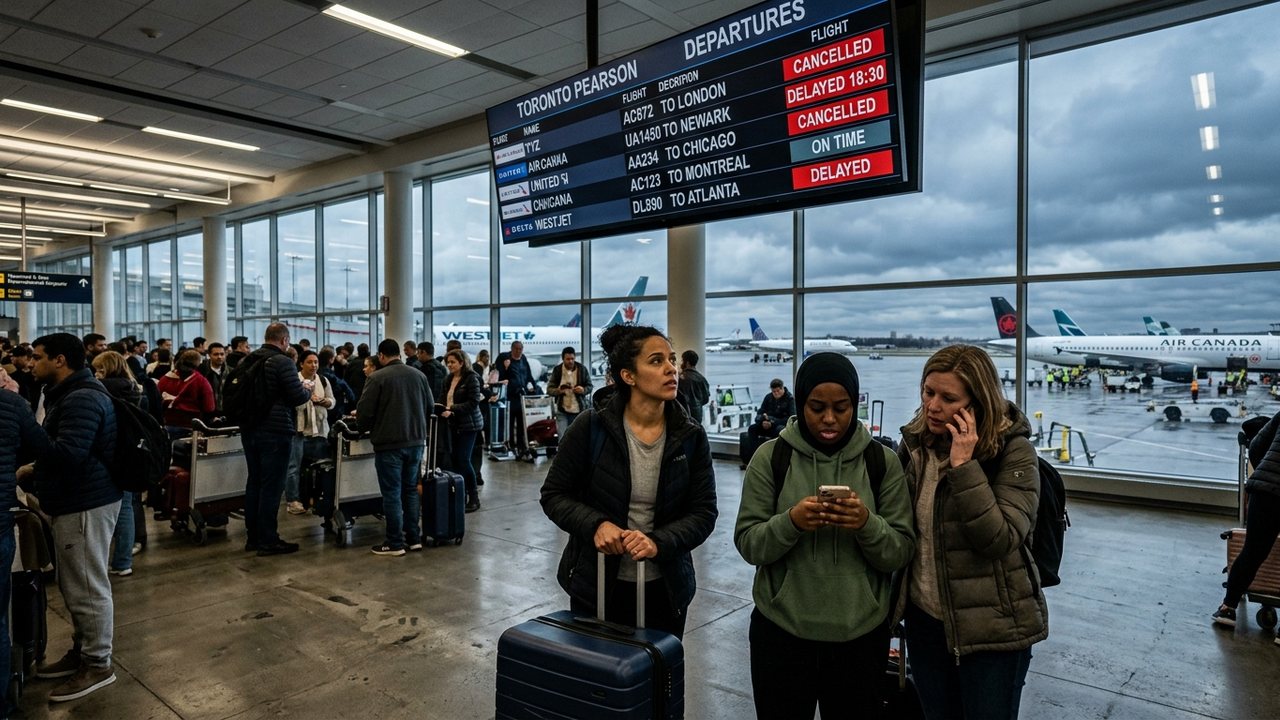
Image generated by AI
[Toronto, June 26, 2026] — A significant operational breakdown at Toronto Pearson International Airport has left thousands of passengers stranded after Air Canada, Jazz, KLM, and other carriers grounded 11 flights and reported widespread delays. The disruptions have severely impacted major international and domestic corridors, specifically affecting routes to Dublin, Denver, Gatwick, Charleston, and Cincinnati.
The sudden surge in flight cancellations and scheduling conflicts has created a ripple effect across the aviation network, forcing passengers to seek urgent rebooking options. According to flight tracking data, the instability at Canada's primary hub has triggered a cascade of delays for travelers connecting through key North American and European transit points.
Air Canada and KLM Lead Flight Cancellations at Toronto Pearson
The scale of the disruption is most evident in the volume of grounded aircraft at Toronto Pearson International Airport. Industry sources indicate that Air Canada bore the brunt of the operational failures, accounting for six of the total cancellations. Other significant impacts were recorded for Jazz (operating for Air Canada), which saw three flights grounded, while KLM and Air Canada Rouge each had one flight cancelled.
While the epicenter of the crisis remained in Toronto, the operational fallout extended far beyond Ontario. Reports show that isolated cancellations and significant delays were recorded on routes linked to several other major gateways, including Hartsfield-Jackson Atlanta, Winnipeg, Saskatoon, John Glenn Columbus, Amsterdam, Vienna, and Halifax. This indicates a systemic issue affecting the broader network of flights crossing Canada, the United States, and Europe.
The following table provides a detailed breakdown of the grounded flights at the primary affected hub:
| Airport | Airline | Cancelled Flights | Delayed Flights |
|---|---|---|---|
| Toronto Pearson Int’l | Air Canada | 6 | 38 |
| Toronto Pearson Int’l | Jazz (ACA) | 3 | 20 |
| Toronto Pearson Int’l | KLM | 1 | 0 |
| Toronto Pearson Int’l | Air Canada Rouge (ACA) | 1 | 16 |
Global Reach of Aviation Disruptions
The impact of these groundings has resonated across a vast array of global destinations. Flight data reveals that the disruption affected travel to and from a massive list of cities, spanning multiple continents. In North America, cities such as New York, Los Angeles, Chicago, Miami, Orlando, Las Vegas, and Dallas-Fort Worth experienced irregularities. Canadian hubs including Vancouver, Calgary, Edmonton, Montreal, and Victoria were also caught in the delays.
European travel was equally compromised, with passengers heading to London (Heathrow and Gatwick), Paris, Athens, Lisbon, Zurich, Istanbul, and Warsaw facing extended wait times. The disruptions also reached as far as Doha, Guangzhou, Cairo, and Lima, illustrating how a localized failure at a major hub like Toronto Pearson can destabilize global flight schedules.
Passenger Protocols for Handling Flight Cancellations
With numerous travelers currently stranded or facing missed connections, aviation officials recommend a structured approach to managing these setbacks. Passengers are advised to remain calm and prioritize real-time communication.
Monitoring official airline applications, email notifications, and SMS alerts is the most efficient way to receive rebooking confirmations. For those already at the terminal, visiting the airline service desk is recommended, though those not yet at the airport are encouraged to use online chat systems or phone lines to avoid the congestion of physical queues.
Industry observers also emphasize the importance of knowing passenger rights. In the European Union, for example, passengers may be entitled to financial compensation depending on the cause of the cancellation. Travelers are urged to review the specific terms and conditions of their carriers to determine if they qualify for hotel vouchers, meal reimbursements, or full refunds.
Strategic Alternatives for Stranded Travelers
When primary flight options are exhausted, passengers are encouraged to look beyond the original carrier. This includes inquiring about the next available flight on a partner airline or exploring alternative transportation methods. For domestic travel within North America or Europe, trains and long-distance buses are often viable substitutes when air traffic is paralyzed.
Maintaining flexibility with itineraries and staying in constant contact with airline representatives is the most effective way to minimize the duration of travel delays.
Why This Matters: The Fragility of Hub-and-Spoke Networks
The events at Toronto Pearson International Airport highlight a critical vulnerability in the modern aviation industry: the extreme sensitivity of the "hub-and-spoke" model. When a primary hub experiences even a small number of cancellations—in this case, 11 grounded flights—the resulting "network effect" can disrupt thousands of passengers who may not even be flying on the cancelled aircraft.
The data shows that while only 11 flights were fully cancelled, the number of delayed flights was significantly higher, particularly for Air Canada and Jazz. This suggests that the cancellations created a backlog of aircraft and crew rotations, leading to a systemic slowdown. For the aviation industry, this serves as a reminder that operational resilience is not just about keeping planes in the air, but about managing the recovery of the schedule once a disruption occurs.
Furthermore, the involvement of multiple carriers (Air Canada, KLM, Jazz) suggests that the issue may have been related to airport infrastructure, air traffic control, or weather, rather than a single airline's internal failure. This interdependence means that a failure at one gateway can effectively "freeze" travel for passengers across three different continents, emphasizing the need for better cross-airline coordination during crisis events.
Related Travel Guides
Disclaimer
This article is for informational and educational purposes only. It does not constitute legal, financial, or professional advice. While we strive to provide accurate and up-to-date information, travel policies, regulations, and conditions change rapidly. Always verify information with official sources before making travel decisions. Nomad Lawyer makes no representations about the accuracy, reliability, completeness, or suitability of the information provided. Readers should consult qualified professionals for advice specific to their circumstances. The views expressed in this article are those of the author and do not necessarily reflect the views of Nomad Lawyer.
Preeti Gunjan
Contributor & Community Manager
A passionate traveller and community builder. Preeti helps grow the Nomad Lawyer community, fostering engagement and bringing the reader experience to life.
Learn more about our team →