
Travel Turmoil Hits Newark Liberty International Airport as Air France and United Cancel 4 Flights and Face Several Delays, Disrupting Major Routes to Burlington, Montreal, Philipsburg, Phoenix, Detroit, and More
Air France and United face disruptions at Newark Liberty International Airport with 4 cancellations and 280 delays affec

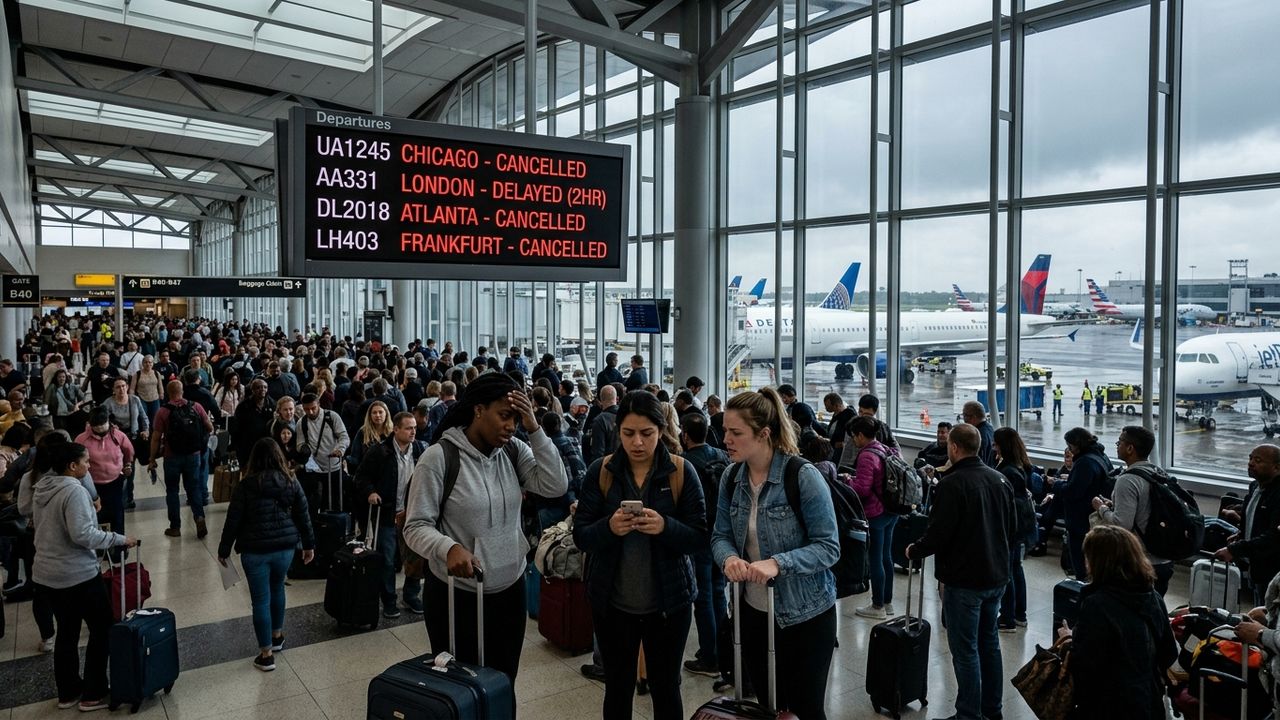
Image generated by AI
[Newark, June 26, 2026] — Air France and United Airlines are managing significant operational disruptions at Newark Liberty International Airport, where four flight cancellations and a high volume of delays are currently impacting major domestic and international routes. The instability is affecting travel to key destinations including Burlington, Montreal, Philipsburg, Phoenix, and Detroit, forcing thousands of passengers to seek rebooking options.
Operational Instability at Newark Liberty International Airport
Newark Liberty International Airport, a primary hub for United Airlines and a critical transatlantic gateway for Air France, is experiencing a surge in scheduling conflicts. While the number of total cancellations remains relatively low, the ripple effect of delayed departures has created substantial congestion.
Industry sources indicate that the disruption is not isolated to a single region but is affecting a vast network of cities. The instability spans North America, Europe, the Caribbean, and Asia, highlighting the fragility of hub-and-spoke operations when primary gateways face technical or operational hurdles.
Flight Disruption Data for United and Air France
According to flight tracking data, the burden of the current turmoil falls primarily on United Airlines due to its massive footprint at the Newark facility. While Air France has seen a smaller number of cancellations, the impact on transatlantic connectivity remains a point of concern for travelers heading to Europe.
The following data outlines the specific impact on the two carriers at the Newark hub:
| Airport | Airline | Cancelled Flights | Delayed Flights |
|---|---|---|---|
| Newark Liberty Intl | Air France | 1 | 20 |
| Newark Liberty Intl | United | 3 | 260 |
Global Network of Affected Destinations
The scope of the disruption extends far beyond the New Jersey corridor. Reports show that the operational backlog is impacting flights connecting to a diverse array of global cities.
In North America, passengers traveling to Washington, Toronto, Atlanta, Nashville, Boston, Burlington, Cincinnati, Dallas, Detroit, Fort Lauderdale, Greensboro, Houston, Las Vegas, Los Angeles, Orlando, Miami, Chicago, Phoenix, Pittsburgh, Raleigh-Durham, Fort Myers, San Francisco, St Louis, Tampa, Halifax, Ottawa, Montreal, Jackson Hole, Palm Beach, Portland, Rochester, and San Diego are facing potential itinerary changes.
International disruptions are equally widespread. Affected European routes include Paris, Brussels, Berlin, Frankfurt, Munich, London, Amsterdam, Madrid, Athens, Naples, and Rome. Caribbean and Latin American destinations such as Santo Domingo, Montego Bay, Cancun, Nassau, Aruba, Philipsburg, and Lima are also seeing impacts. Additionally, long-haul routes to Singapore and Delhi have been noted in the disruption network.
Passenger Guidance for Flight Cancellations
With the current volatility at Newark, aviation officials recommend that travelers adopt a proactive approach to manage their itineraries. When a flight is cancelled, the following steps are advised to minimize travel stress:
Real-Time Monitoring Passengers should prioritize updates via official airline mobile applications, SMS alerts, and email notifications. Checking the airline's website for real-time status updates is more reliable than relying on airport departure boards, which may lag during peak disruption periods.
Direct Communication Channels Industry observers suggest using online chat systems or phone support to avoid the long queues typically found at airport service desks. However, for those already at Newark Liberty International, the physical service counters remain the primary point for immediate rebooking.
Understanding Passenger Rights Travelers are encouraged to review the specific terms of carriage for their airline. In certain jurisdictions, such as the European Union, passengers may be entitled to financial compensation or hotel accommodations if the cancellation falls under the airline's control.
Exploring Alternative Transit If rebooking options are unavailable or unsuitable, passengers should inquire about the next available flight or consider alternative transportation, such as rail or bus services for domestic routes within the Northeast corridor.
Impact Analysis of Newark Hub Disruptions
The current situation underscores a critical vulnerability in modern aviation: the "hub effect." Because Newark serves as a central node for both United’s domestic network and Air France’s transatlantic bridge, a small number of cancellations can trigger a massive volume of delays.
When three flights are cancelled for a carrier as large as United, the resulting displacement of aircraft and crew can lead to the 260 delays observed in the data. This creates a bottleneck that affects not just the departing passengers, but also incoming flights that cannot find available gates or ground support.
Why This Matters (Information Gain)
This incident provides a clear case study in the difference between "cancellation volume" and "operational impact." While four cancelled flights may seem negligible in the context of a major international airport, the resulting 280 combined delays demonstrate how systemic fragility works.
For the aviation industry, this highlights the ongoing challenge of recovery time. When a hub like Newark experiences a "clot" in its schedule, the recovery process is not linear. Each delayed flight pushes back the next, creating a compounding effect that can take days to resolve.
Furthermore, the wide geographic spread of affected cities—from Delhi to Philipsburg—illustrates the interconnectedness of global aviation. A localized issue in New Jersey effectively becomes a global logistics problem, impacting tourism and business travel across four continents. This reinforces the necessity for airlines to invest in more robust predictive scheduling and for passengers to maintain high levels of flexibility when traveling through primary global hubs.
Related Travel Guides
Disclaimer
This article is for informational and educational purposes only. It does not constitute legal, financial, or professional advice. While we strive to provide accurate and up-to-date information, travel policies, regulations, and conditions change rapidly. Always verify information with official sources before making travel decisions. Nomad Lawyer makes no representations about the accuracy, reliability, completeness, or suitability of the information provided. Readers should consult qualified professionals for advice specific to their circumstances. The views expressed in this article are those of the author and do not necessarily reflect the views of Nomad Lawyer.
Preeti Gunjan
Contributor & Community Manager
A passionate traveller and community builder. Preeti helps grow the Nomad Lawyer community, fostering engagement and bringing the reader experience to life.
Learn more about our team →