
Travel Victoria Unlocks Free Public Transport in 2026
Victoria launches unlimited free trains, trams, and buses in 2026 amid global fuel crisis. Explore Australia's premiere state without paying transit fares.

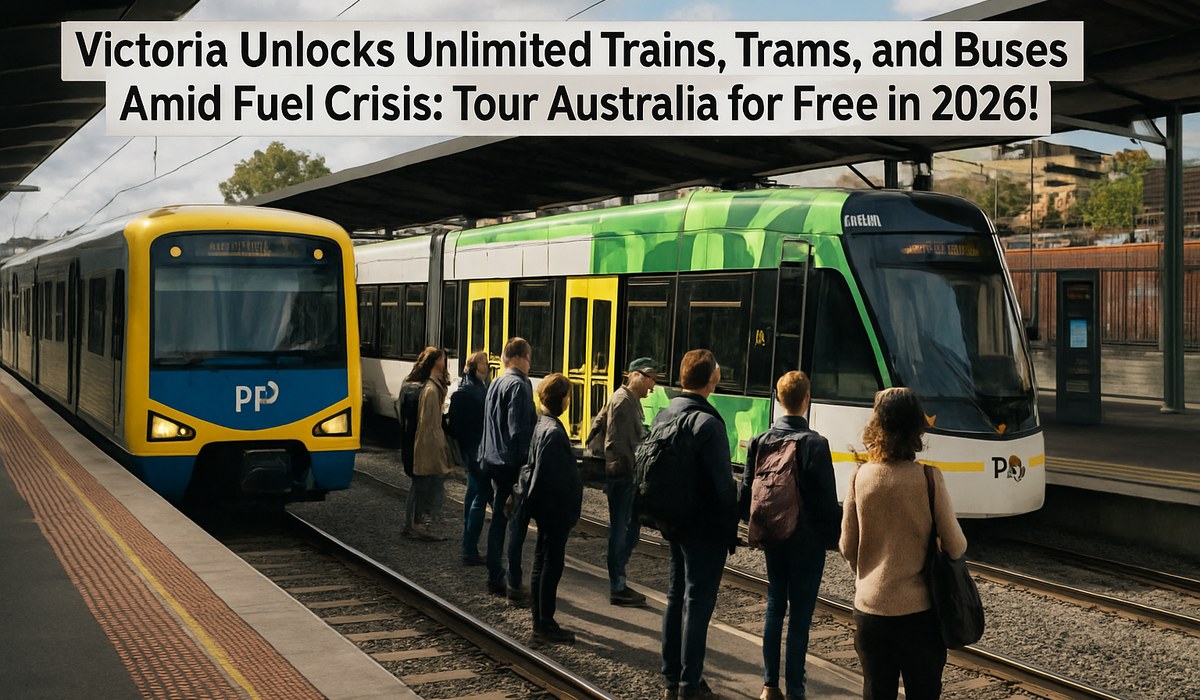
Image generated by AI
Quick Summary
- Victoria state launches fully subsidized public transport across trains, trams, and buses starting March 2026
- Policy responds to spiraling global fuel costs and energy security concerns affecting tourism
- Travelers can access entire regional network without purchasing tickets or passes
- Initiative positions Victoria as a sustainable tourism alternative during geopolitical travel disruptions
Victoria's Free Transport Revolution: What Travelers Need to Know
Australia's Victoria state has announced a watershed policy: starting immediately, all train, tram, and bus services operate under a zero-fare model. The move marks one of the most aggressive public transport subsidies ever implemented in the Southern Hemisphere, eliminating tickets entirely for both locals and visitors.
The Victorian government confirmed that commuter rail networks spanning metropolitan Melbourne and regional destinations—including services to Geelong, Ballarat, and Bendigo—are now operating at no cost to passengers. Tram routes covering over 250 kilometres of track across greater Melbourne require no payment. Bus networks, encompassing both urban and regional services, complete the comprehensive free-access system.
For travelers accustomed to transit cards, passes, and fare gates, this represents a fundamental shift in how mobility functions across the state. Whether arriving at Melbourne Airport or traveling between regional towns, visitors navigate without transaction friction.
The policy takes immediate effect, with transport operators managing the financial transition through consolidated government funding mechanisms. Major transit hubs in Melbourne's CBD, including Flinders Street Station and Southern Cross Station, continue normal operations with identical frequencies but zero barriers to entry.
Why 2026? Understanding the Fuel Crisis Connection
Global energy markets experienced unprecedented volatility beginning in early 2026, directly catalyzing Victoria's decision. The Energy Global Economy Faces Historic Oil Shock From Iran-Israel Conflict disrupted conventional fuel supply chains, pushing petrol prices across Australia toward historically severe levels.
State policymakers recognized that transportation affordability becomes critical when household budgets strain under energy costs. Rather than managing congestion through pricing mechanisms typical of most developed transit systems, Victoria inverted the model: eliminate fares entirely to encourage modal shift away from private vehicles.
The strategy addresses two simultaneous pressures. First, reducing vehicle dependency decreases fuel consumption during supply constraints. Second, free transit preserves tourism revenue by removing entry barriers for international visitors navigating unfamiliar destinations on constrained budgets.
Transport Minister Daniel Andrews framed the announcement as both crisis response and long-term infrastructure investment. Government economists calculated that increased ridership volumes would offset foregone fare revenue while generating broader economic benefits through reduced congestion and improved air quality.
This approach diverges sharply from traditional transit authorities worldwide, which typically increase fares during fuel crises to maintain operational budgets. Victoria's decision reflects confidence in sustained government commitment to transport infrastructure alongside acknowledgment that conventional fare models collapse under energy disruption scenarios.
How to Maximize Your Free Pass: Practical Travel Guide
Travelers arriving in Victoria immediately access complimentary transport without advance registration or documentation. Simply board any train, tram, or bus—no card purchase, booking, or validation required.
Metropolitan Rail Network: Melbourne's suburban train system extends from the city center to outer neighborhoods and satellite communities. Services operate from approximately 5:00 AM through midnight, with reduced frequencies during late-night hours. Regional trains connect Melbourne to destination towns including Warburton (mountain scenery), Ballarat (historic colonial architecture), and Bendigo (cultural institutions). Regional services typically operate on three-hourly schedules outside peak periods.
Tram Infrastructure: Melbourne's iconic tram network provides surface-level transport across the metropolitan area. Routes 1 and 109 circle the central business district, useful for orientation and landmark access. Outer routes penetrate suburbs including Fitzroy, Brunswick, and Footscray. Tram frequency typically ranges from 6–10 minutes during peak hours to 15–20 minutes during off-peak periods.
Bus Coverage: Extensive bus networks supplement rail and tram systems, reaching neighborhoods and regional areas beyond fixed-rail infrastructure. City buses serve high-frequency routes in central Melbourne, while regional buses connect smaller towns and rural areas on daily schedules.
Practical Strategy: Travelers planning multi-day visits should obtain free transport maps from information centers or access digital route-planning through the PTV Journey Planner app. Combine slower regional trains with free accommodation in smaller towns to construct low-cost touring itineraries. Mount Dandenong villages, Healesville wineries, and coastal communities near Geelong become accessible without expensive hired vehicles.
The elimination of payment friction particularly benefits international visitors unfamiliar with Australian transit fare structures, which traditionally involved complex zoning systems and peak/off-peak pricing differentials.
Global Context: How Victoria Compares to Other Free Transit Systems
Victoria's model emerges within broader international experimentation with transit subsidization. However, the scale and universality exceed most precedents outside Eastern Europe and Nordic contexts.
Luxembourg implemented Europe's first fully free national transit system in 2020, targeting labor mobility rather than fuel crisis management. That initiative covered trains, buses, and trams nationwide but served a population of approximately 650,000. Victoria's system extends across 6.5 million residents plus millions of annual tourists—substantially amplifying operational complexity and financial commitment.
The Eurostar's high-speed rail network maintains extensive subsidization for domestic French and Belgian segments while charging international routes premium fares. This hybrid model preserves revenue from long-distance travelers while subsidizing regional connectivity. Victoria's approach abandons this segmentation entirely.
Germany's Berlin and Brandenburg region experimented with low-cost regional rail passes but never eliminated fares completely across all transit modalities. The International Union of Railways has documented that fully free systems prove sustainable only with stable government revenue sources and relatively small populations. Victoria's scale challenges this conventional analysis.
Within the Asia-Pacific region, several cities offer reduced-fare schemes targeting seniors, students, or off-peak users. However, comprehensive zero-fare policies remain exceptionally rare, positioning Victoria as a regional outlier and potential blueprint.
The sustainability dimension distinguishes Victoria's approach. Rather than viewing free transit as temporary crisis response, state planners signal commitment to permanent modal restructuring. This signals Victoria as an environmentally conscious destination during a period when travelers increasingly weight sustainability in destination selection.
Regional Travel Opportunities Unlocked
Victoria's free transport system transforms regional exploration economics. Previously expensive day trips or overnight regional tours suddenly become feasible without transport budgeting.
The Dandenong Ranges, located 60 kilometres east of Melbourne, host mountain villages, mountain ash forests, and boutique accommodations. Free train access via the Belgrave Line makes hiking-focused tourism accessible. Healesville, famous for wineries and wildlife sanctuaries, connects via free regional rail. The Great Ocean Road region, accessible through Geelong via free bus services, enables coastal tourism without vehicle rental costs.
Consider the Asia Slow Travel: Japan & Thailand Lead New Regional Circuit in 2026 emerging across Asia-Pacific markets. Victoria positions itself within this slow-travel paradigm—visitors utilizing free regional trains access smaller towns, agricultural communities, and cultural sites bypassed by premium tour operations. This repositioning attracts budget-conscious international travelers fleeing more expensive European and North American destinations.
Furthermore, the free transport policy aligns with broader Indonesia Tourism 2045: How Sustainability Strategy Reshapes Visitor Economics conversations reshaping Asia-Pacific tourism. Regional governments increasingly recognize that sustainable transport infrastructure attracts quality visitors willing to extend stays and distribute spending
Disclaimer
This article is for informational and educational purposes only. It does not constitute legal, financial, or professional advice. While we strive to provide accurate and up-to-date information, travel policies, regulations, and conditions change rapidly. Always verify information with official sources before making travel decisions. Nomad Lawyer makes no representations about the accuracy, reliability, completeness, or suitability of the information provided. Readers should consult qualified professionals for advice specific to their circumstances. The views expressed in this article are those of the author and do not necessarily reflect the views of Nomad Lawyer.
Raushan Kumar
Founder & Lead Developer
Full-stack developer with 11+ years of experience and a passionate traveller. Raushan built Nomad Lawyer from the ground up with a vision to create the best travel and law experience on the web.
Learn more about our team →