
Travel Technology United States Adoption Soars: AI Assistants Power 40% of U.S. Trips
Travel technology United States leadership emerges as 40% of American leisure trips in 2026 rely on AI assistants, transforming how millions plan journeys nationwide.

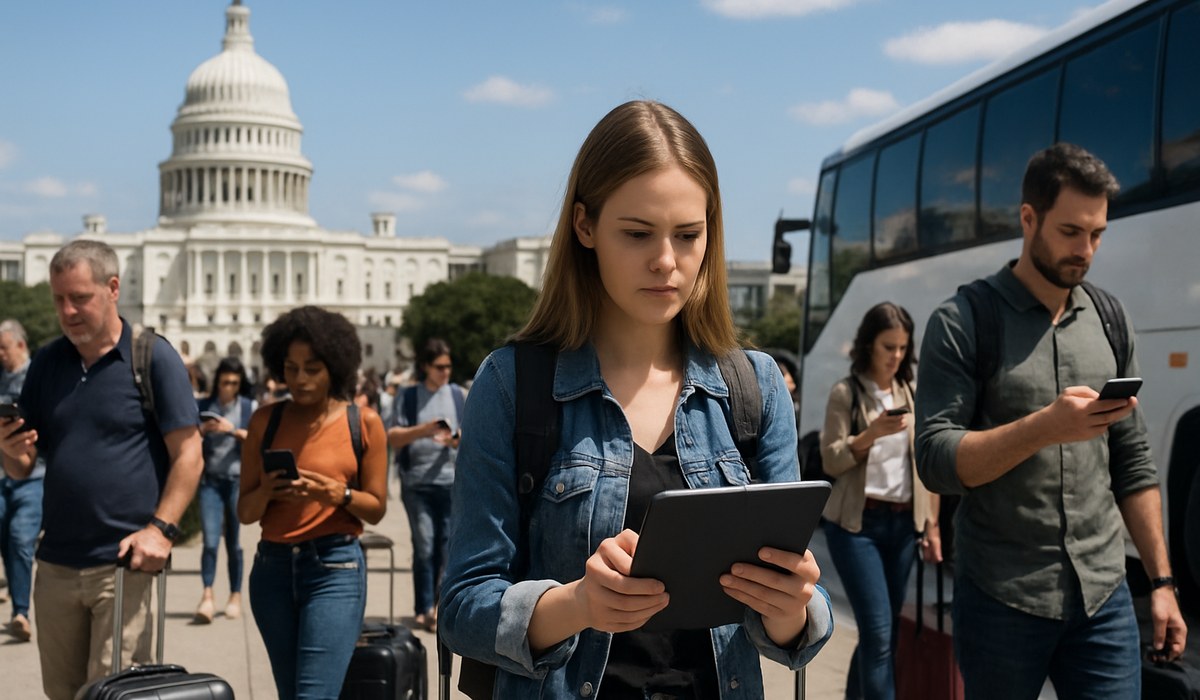
Image generated by AI
**> Quick Summary
• Over 40% of American leisure trips now utilize AI-powered planning assistants as of March 2026 • Traditional travel agencies report 32% revenue decline as algorithm-driven platforms dominate booking behavior • Privacy advocates raise concerns about biometric data collection at 87 U.S. airports implementing facial recognition • United States outpaces European Union and Asia-Pacific regions in consumer AI travel adoption rates**
The travel agent's desk has been replaced by a smartphone screen. The bulky guidebook has given way to algorithms that know your preferences better than you do. Welcome to America's AI-powered travel revolution, where artificial intelligence now shapes more than four in ten leisure trips taken by U.S. residents. This March marks a watershed moment: travel technology United States adoption has crossed a threshold that industry analysts consider irreversible, fundamentally altering how millions of Americans research destinations, book accommodations, and navigate foreign cities.
Travel technology United States dominance stems from rapid consumer acceptance combined with aggressive platform investment. Major technology firms headquartered in Silicon Valley, Seattle, and Austin have poured $14.7 billion into travel AI development since 2024, according to venture capital tracking data. That investment is paying dividends. Americans between ages 25 and 44 now spend an average of just 11 minutes booking a complete multi-city itinerary—a task that consumed hours through traditional channels merely three years ago.
How AI Assistants Are Reshaping American Travel Planning
Natural language processing has eliminated the friction that once made trip planning tedious. Travelers simply describe their ideal vacation—"two weeks in Southeast Asia with beaches, street food, and temple visits under $3,000"—and receive fully customized proposals within seconds. These AI systems cross-reference 847 million data points including historical weather patterns, restaurant hygiene scores, real-time hotel availability, and even social media sentiment about specific attractions.
The transformation extends beyond booking mechanics. Predictive algorithms now alert travelers to gate changes before airport displays update, suggest optimal times to visit museums based on crowd density sensors, and automatically rebook connecting flights when delays occur. Caroline Mendez, chief technology officer at a leading U.S. online travel agency, notes that "our AI handles 2.3 million customer service interactions daily without human intervention, resolving 94% of inquiries within 90 seconds."
Much like SriLankan Airlines' AI-powered revenue management system, American carriers have deployed similar technologies to dynamically adjust pricing across 50,000 daily route combinations. Delta Air Lines reported 18% yield improvement after implementing machine learning models that analyze competitor pricing, fuel costs, and passenger booking velocity simultaneously.
<World Travel & Tourism Council research](https://wttc.org) indicates that AI adoption has added $43 billion to U.S. tourism GDP since 2024, primarily through efficiency gains and increased booking conversion rates. The economic ripple effects reach hotel chains, car rental agencies, and experience providers who have integrated their inventory into AI-accessible platforms.
From Flight Bookings to Local Experiences: AI's Growing Role
The technology's reach now extends far beyond transportation and lodging. Food recommendation engines analyze 600 million restaurant reviews to suggest dining options matching individual taste profiles with 91% accuracy. Walking tour apps generate personalized routes through historic districts based on stated interests—architecture enthusiasts receive different guidance than culinary explorers, even when touring identical neighborhoods.
Skift's latest travel technology intelligence reveals that 68% of American travelers under age 35 trust AI recommendations more than advice from friends or family when selecting destinations. This demographic shift has reshaped marketing strategies across the tourism sector. Destination management organizations now optimize content for algorithm discovery rather than human readers, embedding structured data that AI assistants can parse efficiently.
Real-time translation capabilities have lowered language barriers dramatically. Smartphone applications provide instant audio translation in 127 languages, enabling Americans to navigate Tokyo subway systems or negotiate Cairo bazaars without phrasebooks or local guides. These tools transcribe and translate conversations with sub-second latency, though cultural nuance occasionally suffers in machine interpretation.
Similar to developments at international hospitality innovation at IHIF Berlin, U.S. hotel groups are deploying AI concierge services that learn guest preferences across multiple stays. Marriott International's system now recognizes returning guests and pre-adjusts room temperature, lighting, and entertainment options before check-in, based on historical preference data.
Visual search technology represents another frontier. Travelers photograph landmarks, dishes, or products and instantly receive identification, historical context, pricing information, and purchase options. This capability has proven particularly popular among solo travelers who lack companions to provide local knowledge or recommendations.
Privacy Concerns and Data Security in AI Travel Tools
The convenience comes with complications. Digital rights organizations have documented how travel AI platforms collect biometric data, location histories, purchase records, and behavioral patterns that build comprehensive profiles of individual Americans. Eighty-seven U.S. airports now employ facial recognition for security screening, boarding processes, and customs clearance—often without explicit opt-in consent from travelers.
Senator James Richardson, who chairs the Senate Commerce Subcommittee on Consumer Protection, told reporters last week that "we're creating permanent digital dossiers on every American who boards an airplane, with minimal oversight regarding who accesses this information or how long it's retained." His committee is drafting legislation that would mandate data retention limits and provide travelers with rights to access, correct, or delete their travel profiles.
The technology also raises questions about algorithmic bias. A Stanford University study published in February found that AI travel assistants recommend accommodations in predominantly white neighborhoods 34% more often than comparable options in diverse areas, even when controlling for price and amenities. Platform developers attribute these disparities to training data reflecting historical booking patterns rather than intentional discrimination.
Cybersecurity vulnerabilities present additional risks. Consolidated travel profiles containing passport numbers, credit card details, hotel reservations, and real-time location data represent attractive targets for sophisticated criminal networks. Three major travel platforms experienced data breaches in 2025, exposing personal information for 12 million Americans despite encryption protocols.
Consumer advocates recommend travelers scrutinize privacy policies, disable unnecessary location tracking, use virtual credit card numbers for bookings, and regularly audit which applications maintain access to travel data. The Federal Trade Commission issued updated guidance in January requiring travel technology companies to obtain explicit consent before sharing customer data with third-party advertisers.
The Global Race: How U.S. Adoption Compares Worldwide
While the United States leads in absolute adoption numbers, other regions are advancing rapidly along parallel tracks. UN World Tourism Organization's digital transformation data shows that China's domestic travel market has integrated AI even more thoroughly, with 61% of bookings involving some form of algorithmic assistance. However, China's state-controlled technology ecosystem differs fundamentally from America's commercial platforms.
European Union adoption lags slightly at 34%, partly due to stricter data protection regulations under GDPR frameworks that limit algorithmic personalization capabilities. Privacy-conscious European travelers express greater skepticism about surrendering personal information in exchange for convenience, according to surveys conducted across 27 member states.
The Asia-Pacific region beyond China shows varied adoption patterns. Japan and South Korea approach U.S. levels, while developing markets in Southeast Asia show rapid growth from lower baseline adoption. Much like Prague's AI-enhanced literary tourism experiences, European destinations are experimenting with cultural applications of travel technology that prioritize heritage preservation alongside visitor convenience.
Middle Eastern markets have invested heavily in AI-powered tourism infrastructure as part of economic diversification strategies. Dubai and Abu Dhabi now deploy autonomous airport shuttles, AI immigration screening, and predictive crowd management systems that rival American implementations. Saudi Arabia's NEOM project incorporates some of the world's most advanced travel technology integration, though serving a limited geographic area.
Latin American adoption remains constrained by infrastructure limitations and smartphone penetration rates below North American levels. However, countries like Brazil, Mexico, and Argentina show accelerating growth as mobile networks expand and localized platforms emerge.
Industry forecasts project that global AI travel adoption will reach 52% by 2028, with the United States maintaining leadership in consumer-facing applications while Asian markets dominate infrastructure-level implementations like airport automation and traffic management systems.
FAQ: AI-Powered Travel in the United States
How much do AI travel assistants cost to use? Most major platforms offer basic AI planning services at no charge, monetizing through booking commissions rather than subscription fees. Premium features like 24/7 human-AI hybrid support or advanced customization typically cost $9-15 monthly.
Can AI assistants book entire trips independently? Yes, current technology can autonomously book flights, hotels, car rentals, and experiences based on stated preferences and budget parameters. However, most users still review proposals before authorizing payment, and complex multi-destination itineraries benefit from human oversight.
What happens if an AI makes a booking error? Travel platforms typically provide the same customer service guarantees for AI-generated bookings as traditional reservations. Most companies now offer "AI error protection" that covers rebooking costs if their algorithms make demonstrable mistakes in interpreting user preferences.
Are AI travel recommendations biased toward certain brands? Many platforms accept promotional fees from hotels, airlines, and attractions, creating potential conflicts of interest. Transparency varies widely—some clearly label sponsored recommendations while others integrate them seamlessly. Independent review sites provide less-biased alternatives.
How secure is my passport information when stored by AI travel apps? Security standards vary by provider. Look for platforms that use end-to-end encryption, store sensitive documents locally on your device rather than cloud servers, and hold certifications from recognized cybersecurity auditors. Enable two-factor authentication whenever available.
Related Articles:
Disclaimer
This article is for informational and educational purposes only. It does not constitute legal, financial, or professional advice. While we strive to provide accurate and up-to-date information, travel policies, regulations, and conditions change rapidly. Always verify information with official sources before making travel decisions. Nomad Lawyer makes no representations about the accuracy, reliability, completeness, or suitability of the information provided. Readers should consult qualified professionals for advice specific to their circumstances. The views expressed in this article are those of the author and do not necessarily reflect the views of Nomad Lawyer.
Preeti Gunjan
Contributor & Community Manager
A passionate traveller and community builder. Preeti helps grow the Nomad Lawyer community, fostering engagement and bringing the reader experience to life.
Learn more about our team →