
Thousands Stranded as Europe's Busiest Airports Report 1,900+ Flight Delays
Nearly 2,000 flight delays and 75 cancellations across Europe strand thousands of travellers in March 2026 as UK, Germany, Spain, France, Netherlands face air traffic chaos.

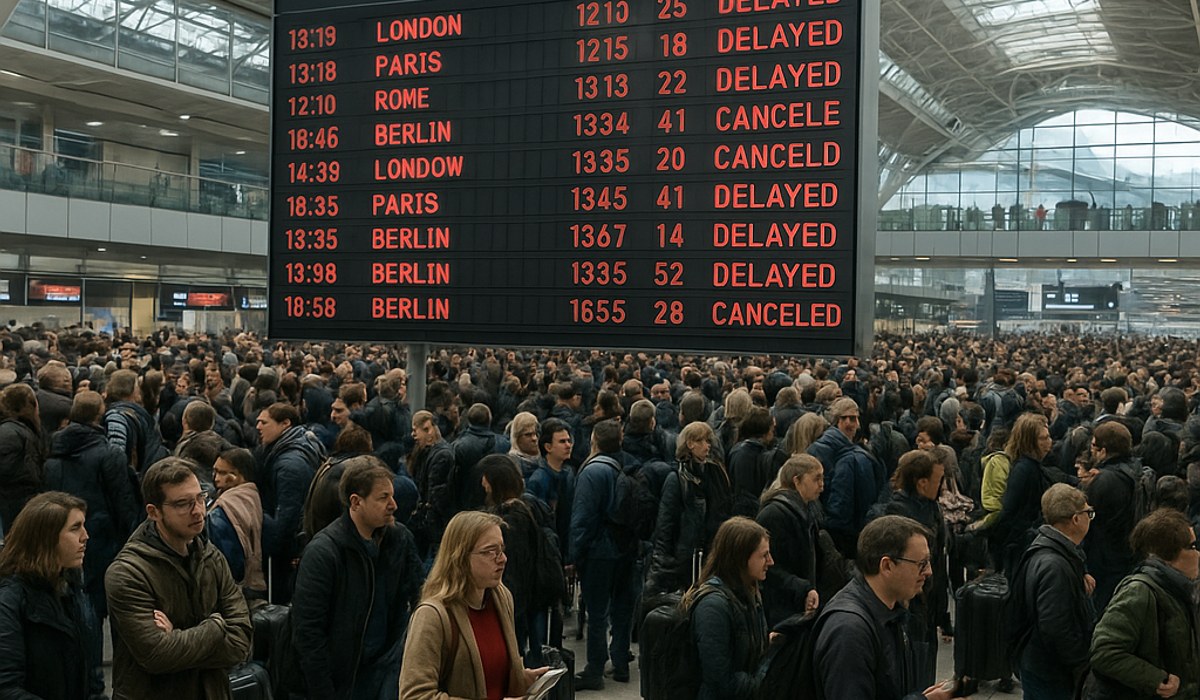
Image generated by AI
Your European vacation just turned into an airport nightmare—1,901 delayed and 75 cancelled flights across the continent's major hubs are stranding thousands of travelers with little warning and limited recourse. This cascading operational breakdown, affecting multiple countries simultaneously, represents one of the most significant disruptions to European air travel this year.
Quick Summary
- 1,901 flights delayed and 75 cancelled across Europe's busiest airports on March 29, 2026
- United Kingdom, Germany, Spain, France, and Netherlands hit hardest by coordinated disruptions
- Major carriers including Lufthansa, SAS, KLM, and Iberia facing severe operational challenges
- Passengers entitled to EU261 compensation for delays exceeding three hours and cancellations
Europe's Flight Chaos: Which Airports and Airlines Are Most Affected
Frankfurt Airport, London Heathrow, Paris Charles de Gaulle, Barcelona El Prat, and Amsterdam Schiphol are reporting the most severe disruptions, with departure boards flooded with red delay notices. The scale of this breakdown mirrors recent flight cancellations through Doha but affects a broader geographic area.
Lufthansa Group operations face the heaviest impact, with the German carrier reporting over 400 delayed departures from its Frankfurt hub alone. The airline's short-haul European network appears particularly vulnerable, with connections to regional airports experiencing delays stretching beyond four hours.
Scandinavian Airlines (SAS) operations through Copenhagen and Stockholm have ground nearly to a halt, with check-in queues extending beyond security checkpoints. KLM's Amsterdam hub shows 312 delayed flights according to FlightAware delay statistics, while Iberia's Madrid and Barcelona operations report 187 disrupted services.
British Airways and easyJet face significant challenges at London's five airports, with Heathrow Terminal 5 becoming a bottleneck for transatlantic connections. Passengers attempting to reach North America report missing connections due to cascading delays from European feeder flights.
Air France operations at Paris Charles de Gaulle show 268 delayed services, with the carrier's regional subsidiary HOP! experiencing complete schedule breakdowns on several domestic routes. Passengers traveling to southern France report delays exceeding six hours.
What's Causing the Widespread Delays Across Multiple Countries
Air traffic control capacity constraints emerged as the primary culprit behind today's continent-wide disruptions. Eurocontrol's live network management system shows severe flow restrictions implemented across five national airspaces simultaneously—an extraordinarily rare occurrence indicating systemic infrastructure strain.
Staffing shortages at air navigation service providers in Germany (DFS), France (DSNA), and the United Kingdom (NATS) forced controllers to implement flow restrictions limiting aircraft movements through critical airspace sectors. These bottlenecks create ripple effects that cascade throughout the European network.
Weather conditions contributed secondary complications, with thunderstorm activity over central Europe forcing aircraft to take longer routing around affected areas. However, meteorological factors alone cannot explain the scale of disruptions affecting airports experiencing clear conditions.
The timing coincides with increased air traffic volumes as carriers expand capacity following winter season reductions. Airlines like Ryanair expanding operations into Ukraine are stretching Europe's air traffic management infrastructure to breaking points not seen since pre-pandemic traffic peaks.
Technical failures at Maastricht Upper Area Control Centre, which manages high-altitude traffic across Belgium, Netherlands, Luxembourg, and northwest Germany, compounded the crisis. The facility experienced intermittent radar coverage gaps lasting approximately 45 minutes during peak morning departure windows.
Airport slot coordination failures also played a role, with scheduling software at several major hubs allowing more departures than air traffic control could safely accommodate. This overbooking of airspace capacity forced last-minute gate holds and runway queuing.
Your Rights: EU261 Compensation and What Airlines Owe You
Passengers stuck in this disruption qualify for substantial compensation under European Union regulations protecting air travelers. EU261 legislation mandates specific financial remedies and care obligations that airlines must fulfill regardless of operational challenges.
For delays exceeding three hours upon arrival at your final destination, you can claim compensation ranging from €250 to €600 depending on flight distance. Flights under 1,500 kilometers qualify for €250, medium-haul routes between 1,500 and 3,500 kilometers entitle you to €400, and long-haul journeys beyond 3,500 kilometers command €600.
Airlines cannot invoke "extraordinary circumstances" exemptions for air traffic control delays caused by staffing shortages or technical failures at navigation service providers. These systemic infrastructure problems fall within airline operational risk, making carriers fully liable for compensation.
Passengers facing cancellations receive identical compensation amounts plus mandatory rerouting on the next available flight or full refund options. If your new routing requires overnight stays, airlines must provide hotel accommodation, meals, and ground transportation at their expense.
The IATA passenger rights framework supplements EU regulations for international connections, ensuring protection extends beyond European borders when your journey originates or terminates within the EU. Keep all receipts for expenses incurred during delays—airlines must reimburse reasonable costs.
Airlines must inform you of these rights at the airport. Failure to provide written notice of your entitlements strengthens compensation claims. Document everything: gate announcements, boarding pass details, and timestamp evidence of when delays occurred.
Submit claims directly to the operating carrier within six years (though earlier submission avoids processing delays). If airlines deny valid claims, national enforcement bodies in each EU member state can compel compliance and impose penalties for systematic violations.
How to Track Your Flight and Find Alternative Routes
Real-time flight tracking tools provide critical visibility into developing situations before you leave for the airport. FlightAware's mobile application offers push notifications for gate changes, delays, and cancellations, giving you advance warning to adjust plans.
Check your flight status directly through airline apps rather than relying solely on email notifications, which often lag behind actual operational changes by 30-60 minutes. Airlines update their internal systems faster than third-party booking platforms receive information.
For travelers already at airports, download the Eurocontrol app to monitor airspace capacity status across your routing. Seeing flow restrictions lifted in real-time helps gauge whether delayed flights might recover on schedule or face extended ground holds.
Google Flights' delay prediction algorithm analyzes historical patterns and current conditions to forecast likely disruption probabilities. While not infallible, these predictions help you make informed decisions about rebooking or waiting for original flights.
Alternative route exploration should begin immediately when delays exceed two hours. Search for flights on different airlines serving the same destination—EU regulations allow you to request rerouting on competitors if your original carrier cannot accommodate you within reasonable timeframes.
Rail alternatives deserve serious consideration for shorter European routes. High-speed trains connecting major cities often provide faster door-to-door transit when factoring in airport security, check-in requirements, and urban transportation to city centers.
Contact your airline's premium phone lines (often accessible with frequent flyer status) rather than waiting in airport queues. Phone agents access broader rebooking options and can secure seats on partner airlines operating under codeshare agreements.
FAQ: European Flight Disruptions
What compensation am I entitled to for today's delays?
You qualify for €250-€600 based on your flight distance if your arrival delay exceeds three hours. Airlines must also provide meals, refreshments, and hotel accommodation if delays require overnight stays. Compensation applies even if disruptions resulted from air traffic control issues, as staffing and technical failures don't qualify as extraordinary circumstances under EU261.
Can I claim compensation if I miss a connecting flight due to these delays?
Yes, if you booked your entire journey as a single ticket, the airline bears responsibility for missed connections resulting from their delayed feeder flights. You're entitled to rerouting on the next available service plus compensation based on your final destination arrival time. Airlines cannot claim connection protection as optional—it's a fundamental obligation.
Should I accept airline meal vouchers or pay myself and claim reimbursement?
Accept vouchers when offered, but keep receipts if you purchase meals independently when vouchers aren't provided. Airlines must reimburse reasonable expenses—roughly €15 for meals during delays under four hours, €30 for longer delays. Document everything including timestamps proving when refreshments weren't available.
How long can I wait before requesting rerouting on another airline?
Request alternative routing immediately for delays exceeding two hours on short-haul flights or three hours on long-haul services. You don't need to wait for cancellation announcements—extended delays triggering care obligations also grant rerouting rights. Airlines often resist competitor rerouting, but EU regulations explicitly permit it.
Will travel insurance cover expenses if airline denies compensation?
Quality travel insurance policies cover additional accommodation and transportation costs when airlines fail to provide mandatory care during disruptions. However, insurance typically doesn't replace EU261 compensation—you can claim both independently. Submit airline claims first, then insurance claims for any uncovered expenses with documentation of airline denial.
Related Articles:
Disclaimer
This article is for informational and educational purposes only. It does not constitute legal, financial, or professional advice. While we strive to provide accurate and up-to-date information, travel policies, regulations, and conditions change rapidly. Always verify information with official sources before making travel decisions. Nomad Lawyer makes no representations about the accuracy, reliability, completeness, or suitability of the information provided. Readers should consult qualified professionals for advice specific to their circumstances. The views expressed in this article are those of the author and do not necessarily reflect the views of Nomad Lawyer.
Kunal K Choudhary
Co-Founder & Contributor
A passionate traveller and tech enthusiast. Kunal contributes to the vision and growth of Nomad Lawyer, bringing fresh perspectives and driving the community forward.
Learn more about our team →