
Airbus A380 Dwarfs Boeing 747: How the Modern Super-Jumbo Compares to Aviation's Iconic Queen
Breaking airline news and aviation industry updates for 2026.

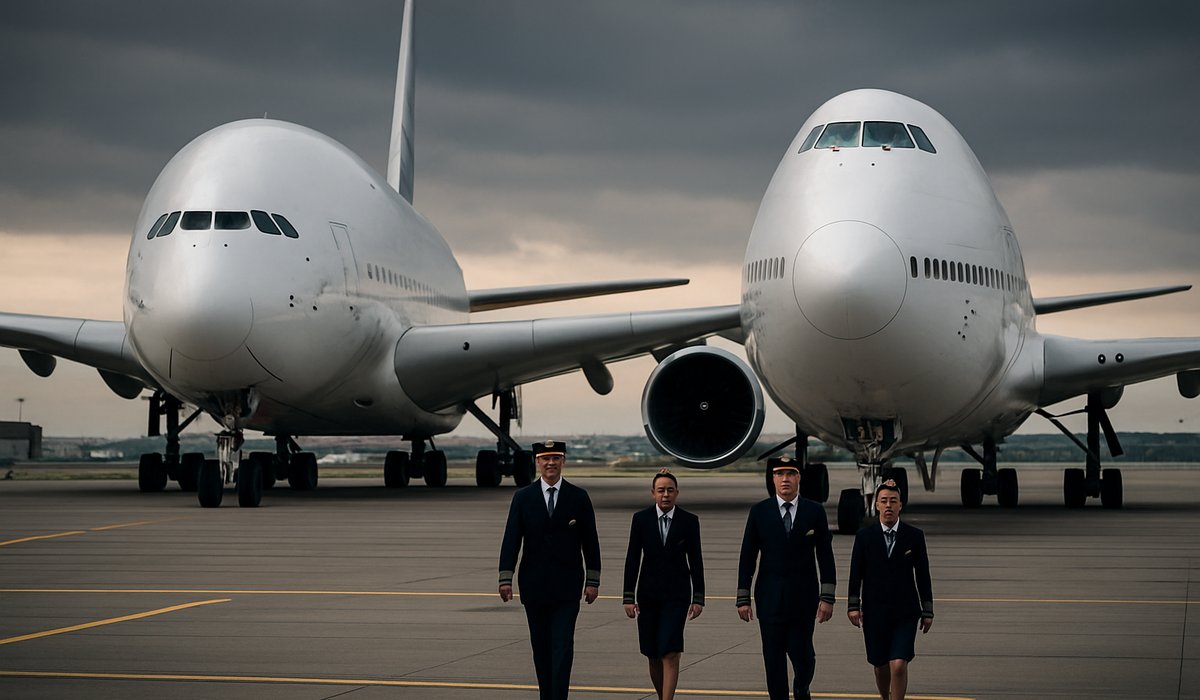
Image generated by AI
Airbus A380 Dwarfs Boeing 747: How the Modern Super-Jumbo Compares to Aviation's Iconic Queen
The next-generation aircraft redefines ultra-long-haul capacity as airlines reassess fleet strategies in a post-pandemic recovery
The Size Disparity Between Two Aviation Giants
The Airbus A380 stands as the defining successor to the Boeing 747, the aircraft that revolutionized commercial aviation for over five decades. While both represent the pinnacle of large-scale aircraft engineering, the French-built A380 significantly exceeds its American predecessor in overall dimensions and passenger-carrying capability.
The A380, which entered commercial service in 2007, was engineered specifically to surpass the 747's design parameters. Where the iconic 747—affectionately known as the "Queen of the Skies"—established the benchmark for long-haul, high-capacity travel, the A380 builds upon those foundational principles with substantially enhanced proportions and operational capabilities.
Comparative Specifications
The A380 outmeasures the Boeing 747-400 variant across critical dimensions. The double-deck, wide-body configuration of the A380 enables airlines to accommodate up to 853 passengers in maximum-density configurations, compared to the 747-400's capacity of approximately 416 to 524 passengers, depending on cabin layout and class segregation.
In terms of physical footprint, the A380's fuselage length, wingspan, and overall structural envelope represent a material increase over the 747's already-impressive proportions. This translates to greater cargo volume, extended range capabilities, and enhanced operational efficiency on ultra-long-haul routes.
Strategic Implications for Global Aviation
The introduction of the A380 marked a fundamental shift in airline fleet strategy. Carriers including Emirates, Singapore Airlines, and Air France adopted the aircraft to maximize per-flight passenger volumes on high-demand international corridors, effectively lowering seat-mile costs and improving profitability on premium routes.
However, the aviation industry's trajectory has since evolved. Changing fuel prices, labor costs, and post-pandemic travel patterns have prompted airlines to reassess their reliance on super-jumbo aircraft. The rise of long-range, twin-engine wide-body jets—such as the Boeing 787 and Airbus A350—has offered airlines greater flexibility and operational efficiency, allowing carriers to maintain profitability while serving thinner route networks.
The Evolution Continues
Both aircraft represent distinct eras of aviation innovation. The 747 pioneered the modern jetliner age, while the A380 pushed ultra-large aircraft design to its practical limits. Yet as the industry pivots toward sustainability, operational flexibility, and point-to-point connectivity, the dominance of these super-jumbos continues to diminish in global fleet compositions.
Frequently Asked Questions
What is the passenger capacity difference between the A380 and 747? The A380 can carry up to 853 passengers in high-density seating, while the 747-400 accommodates 416-524 passengers depending on configuration, making the A380 roughly 60-100% larger in capacity.
Which aircraft is more fuel-efficient? While the A380 consumes more total fuel due to its size, both aircraft face challenges in modern aviation economics. Newer twin-engine aircraft like the Boeing 787 offer superior fuel efficiency per seat-mile.
Why don't airlines buy more A380s? Declining demand reflects changing travel patterns, higher operating costs, limited airport compatibility, and the superior economics of smaller wide-body aircraft on diverse route networks.
Is the Boeing 747 still in service? Yes, though in declining numbers. Most passenger 747s have been retired, though freighter variants remain operational for cargo operations due to their massive cargo capacity.
What makes the A380 larger than the 747? The A380 features a longer fuselage, greater wingspan, and a full double-deck design throughout the cabin, providing substantially more internal volume and passenger accommodation space.
Related Travel Guides
- The MD-11's Tail Engine Mystery: Understanding the Trijet Design That Defined an Aviation Era
- Qantas Project Sunrise: Nonstop Sydney to New York Flights Cut Travel Time in Mid-2028
- Australia Travel Chaos: Massive Inbound Tourism Surge Overwhelms Sydney and Melbourne Airports, Triggering Severe Terminal Disruptions
Disclaimer
This article is for informational and educational purposes only. It does not constitute legal, financial, or professional advice. While we strive to provide accurate and up-to-date information, travel policies, regulations, and conditions change rapidly. Always verify information with official sources before making travel decisions. Nomad Lawyer makes no representations about the accuracy, reliability, completeness, or suitability of the information provided. Readers should consult qualified professionals for advice specific to their circumstances. The views expressed in this article are those of the author and do not necessarily reflect the views of Nomad Lawyer.
Preeti Gunjan
Contributor & Community Manager
A passionate traveller and community builder. Preeti helps grow the Nomad Lawyer community, fostering engagement and bringing the reader experience to life.
Learn more about our team →