
The Whale Museum Opens in Andenes, Norway in 2027 — 300km North of the Arctic Circle, It Could Redefine Arctic Tourism
The Whale, a major new marine museum and whale experience centre designed by Danish architect Dorte Mandrup, is set to open in 2027 on Andøya Island in Andenes, Norway — approximately 300 kilometres north of the Arctic Circle — combining a walkable rooftop observatory, a full-scale whale sculpture, a multisensory underwater experience space, and direct access to sperm and humpback whale watching in a single destination designed to generate year-round international Arctic tourism.

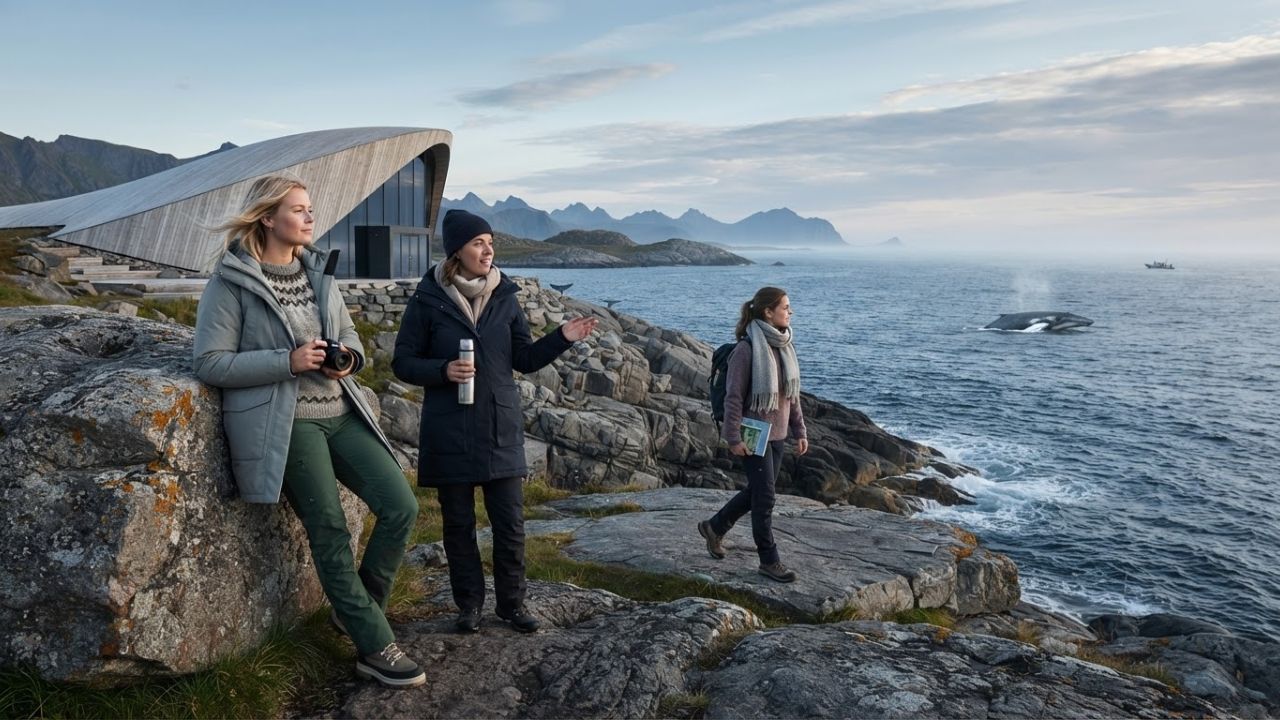
Image generated by AI
The Whale — a landmark marine museum and experiential whale centre designed by Danish architect Dorte Mandrup — is scheduled to open in 2027 in Andenes, a coastal village on Andøya Island approximately 300 kilometres north of the Arctic Circle, with a walkable rooftop overlooking the Norwegian Sea, a full-scale whale sculpture, and a multisensory deep-ocean simulation space that tourism analysts are already positioning as one of Norway's most significant new visitor attractions in a decade.
The project is not arriving into a vacuum. Andenes already holds a well-established global reputation as one of the world's most reliable destinations for whale watching — sperm whales are regularly sighted in summer, humpbacks in winter — but that reputation has been built almost entirely on a seasonal, weather-dependent outdoor experience. The Whale changes that equation by adding a permanent, all-weather, indoor cultural attraction that functions as both a standalone destination and a preparation chamber for the ocean encounters that define the Andenes experience.
Why Andenes on Andøya Island Is the Natural Home for Norway's Most Ambitious Marine Attraction
ANDENES, Norway — The choice of Andenes as the location for The Whale is not arbitrary. The village sits at the northern tip of Andøya Island, surrounded by the deep submarine canyons that drop sharply offshore and create the feeding conditions that sustain large whale populations close to the coastline year-round.
That underwater geography — which makes Andenes one of the very few places on Earth where sperm whales can be reliably encountered from a small coastal village — is precisely what gives The Whale its commercial logic. The museum can position itself as the educational counterpart to an ocean experience that already exists and already draws international visitors. Rather than building demand from scratch, The Whale is entering a destination that has spent decades establishing credibility in the global wildlife tourism market and offering those visitors a reason to stay longer and spend more.
The village currently functions primarily as a seasonal wildlife stop. Visitors arrive for whale watching excursions, spend a night or two, and move on to better-connected destinations such as Tromsø or the Lofoten Islands. The Whale is designed to interrupt that pattern — converting short-stay visitors into multi-day guests who build an itinerary around both the museum and the ocean experiences that surround it.
Dorte Mandrup's Design Turns the Building Itself Into a Destination
The architectural identity of The Whale is central to its tourism strategy. The building's design, created by Danish architect Dorte Mandrup, rises from the coastal landscape in a curved form that references the surrounding rocky terrain rather than imposing a foreign geometry on the Arctic environment.
A walkable rooftop is among the building's defining features. Visitors ascending to the roof gain unobstructed views across the Norwegian Sea, the surrounding mountains, and the Arctic horizon — a vantage point that positions the building as an observatory as much as a museum. The rooftop also looks directly toward the historic Andenes Lighthouse, which has guided vessels along this section of the Norwegian coast since 1859. The sightline between a twenty-first-century architectural landmark and a lighthouse that has operated for more than 165 years creates a layering of time — ancient maritime function alongside contemporary design — that is itself a visitor experience.
Architectural landmarks of this character carry measurable tourism weight. Buildings designed by internationally recognized architects at remote or niche destinations consistently generate visitor traffic beyond the populations that would otherwise reach those locations. The Guggenheim effect — named for the transformation of Bilbao after the opening of the Guggenheim Museum Bilbao in 1997 — has been documented across dozens of destinations where architectural ambition converted marginal tourism markets into internationally recognized cultural destinations. Andenes is positioning The Whale to produce an equivalent transformation at the northern edge of the European travel map.
Sperm Whales in Summer, Humpbacks in Winter: How The Whale Connects Museum and Ocean
The sequencing of the visitor experience at The Whale is deliberate. Travelers will move through the museum's exhibitions — covering whale species, evolution, communication, behaviour, and ocean ecosystems — before boarding whale watching vessels in the waters directly accessible from the Andenes coastline.
That sequencing matters because it changes what visitors see when they reach the ocean. A traveler who understands sperm whale diving behaviour, echolocation, and social structure before the boat departs observes a fundamentally different experience than one who encounters the same animal cold. The museum is designed to transform observers into informed witnesses — a shift that increases visitor satisfaction, generates stronger word-of-mouth, and supports the premium pricing that high-quality Arctic wildlife tourism commands.
The seasonal wildlife calendar at Andenes offers two distinct visitor profiles:
- Summer: Sperm whales are the primary draw, with reliable sightings in the deep waters offshore. Dolphins and seabirds add to the wildlife encounter.
- Winter: Humpback whales migrate into the area, making the cold months equally productive for whale watching, alongside the Northern Lights that draw Arctic tourism visitors to northern Norway between October and March.
A permanent indoor museum attraction that operates regardless of weather or season supports both visitor windows while also creating a third category: travelers who arrive specifically for the museum and add whale watching to their itinerary, rather than arriving for whale watching and discovering the museum incidentally.
Full-Scale Whale Sculpture and Multisensory Underwater Space Define the Exhibition Experience
Inside The Whale, two installations are expected to anchor the visitor experience.
A full-scale whale sculpture will serve as the museum's central physical reference point. The sculpture is designed not purely as a scale model but as a conceptual statement — drawing explicit parallels between whale and human social structures, communication systems, and cooperative behaviours. That framing positions whales not as exotic wildlife but as analogues to human communities, a narrative approach that research in museum visitor engagement consistently shows produces stronger emotional connection and longer dwell time than purely scientific presentation.
A multisensory deep-ocean simulation space will use whale sounds and atmospheric lighting to recreate the sensory environment of the deep sea. The experience is designed to give visitors without diving experience a physical and emotional approximation of the underwater world where whales spend the majority of their lives — a world that is acoustically rich, visually limited, and profoundly different from the surface conditions under which whale watching occurs.
These installations make The Whale accessible and compelling to visitor segments — families, school groups, researchers, and travelers with physical limitations — who cannot participate in open-ocean whale watching but who represent a significant portion of the total addressable tourism market for a destination of this kind.
Røyken Trail, Måltinden Mountain, and Arresten Restaurant Extend the Andenes Itinerary
Beyond the museum itself, Andenes offers outdoor and culinary experiences that The Whale's arrival is expected to make more commercially viable by increasing total visitor dwell time.
The Røyken hiking route covers a two-kilometre circuit with direct views of the coastline and the Andenes Lighthouse, with regular sightings of seals and sea eagles along the path. For visitors with more stamina, Måltinden mountain provides a four-kilometre trail ascending to wide panoramic views across the Arctic coastline — a route that positions Andenes within the broader market for active Arctic nature experiences.
Arresten Restaurant — located inside a former prison building more than 150 years old — is the most distinctive dining experience in the immediate area. The restaurant serves Arctic seafood, reindeer dishes, and regional specialties while preserving original features including cell doors and iron-barred windows. For travelers whose itineraries are increasingly defined by food experiences as much as by wildlife or architecture, Arresten provides a dining proposition that is genuinely unreplicable: the combination of Arctic ingredients, heritage building, and extreme northern latitude creates a restaurant story that generates its own travel motivation.
The Whale's Year-Round Visitor Model and the Tourism Types It Is Built to Attract
One of the most significant structural contributions The Whale makes to Andenes as a tourism economy is its capacity to generate demand across seasons that previously had limited visitor volume.
Northern Norway's tourism calendar currently peaks during the summer Midnight Sun period and the winter Northern Lights season. The shoulder seasons — spring and autumn — carry fewer natural spectacles and correspondingly fewer visitors. A permanent museum attraction whose programming is not weather-dependent creates a reason to visit Andenes in those quieter windows, smoothing out the seasonal demand curve that forces local hospitality businesses to generate most of their annual revenue within compressed high-season periods.
The visitor profiles The Whale is expected to attract include:
- Wildlife enthusiasts seeking the combination of museum learning and ocean whale encounters
- Families with children who need indoor programming alongside outdoor activities
- Students and school groups on structured educational visits
- Marine researchers using the museum as a base for fieldwork in the surrounding waters
- Photographers targeting the architectural exterior, rooftop observatory, and wildlife encounters
- Sustainable tourism travelers drawn by the museum's conservation and ocean protection messaging
The diversity of that visitor profile is what makes The Whale more than a single-purpose attraction. Each segment represents a different booking channel, a different average spend, and a different seasonal window — collectively building a more resilient year-round tourism economy for Andenes than whale watching alone has been able to sustain.
What The Whale's 2027 Opening Means for Travelers Planning Norway Arctic Trips Now
For travelers building Norway itineraries in the next 12 to 18 months, The Whale's 2027 opening creates both an immediate planning consideration and a forward travel opportunity.
Andenes is currently accessible from Harstad/Narvik Airport (EVE) and by ferry from other Vesterålen islands. Travelers reaching the destination now — before The Whale opens — experience the whale watching and outdoor circuit in its pre-museum form. Those planning visits from 2027 onward will find a destination that has added a major indoor cultural institution to the existing outdoor offering, making the case for a longer stay considerably stronger.
For travelers who have already visited Tromsø, the Lofoten Islands, or the North Cape, Andenes represents the logical next destination in a deepening relationship with Arctic Norway — a destination that offers equivalent natural drama in a smaller, less commercially developed setting, now anchored by an architectural landmark that gives the visit a cultural dimension to complement the wildlife experience.
FAQ: The Whale Museum Andenes Norway 2027
When does The Whale museum open in Andenes, Norway? The Whale is scheduled to open in 2027 in Andenes, a coastal village on Andøya Island in northern Norway, approximately 300 kilometres north of the Arctic Circle. The exact opening date within 2027 has not been confirmed in available reports.
Who designed The Whale museum in Norway? The Whale was designed by Danish architect Dorte Mandrup. The building features a curved form rising from the coastal landscape, a walkable rooftop with views of the Norwegian Sea and the Andenes Lighthouse (operational since 1859), and interior spaces including a full-scale whale sculpture and a multisensory deep-ocean simulation environment.
What whales can visitors see at Andenes? Sperm whales are the primary whale watching attraction at Andenes during summer months, while humpback whales migrate into the area in winter. Whale watching excursions from Andenes may also include sightings of dolphins and other marine species.
How far is Andenes from the Arctic Circle? Andenes, located on Andøya Island in the Vesterålen region of northern Norway, sits approximately 300 kilometres north of the Arctic Circle. The village is part of the wider region that also encompasses Tromsø and the Lofoten Islands, both of which are established international Arctic tourism destinations.
Related Travel Guides
Disclaimer
This article is for informational and educational purposes only. It does not constitute legal, financial, or professional advice. While we strive to provide accurate and up-to-date information, travel policies, regulations, and conditions change rapidly. Always verify information with official sources before making travel decisions. Nomad Lawyer makes no representations about the accuracy, reliability, completeness, or suitability of the information provided. Readers should consult qualified professionals for advice specific to their circumstances. The views expressed in this article are those of the author and do not necessarily reflect the views of Nomad Lawyer.
Kunal K Choudhary
Co-Founder & Contributor
A passionate traveller and tech enthusiast. Kunal contributes to the vision and growth of Nomad Lawyer, bringing fresh perspectives and driving the community forward.
Learn more about our team →