
Delta Air Lines Regional Route Cuts: Small U.S. Cities Face Hub Flight Loss in 2026
Delta Air Lines is aggressively restructuring its regional network, phasing out small-market 'spoke' flights in favor of premium-heavy hubs, leaving several small U.S. cities at risk of losing their final commercial links.

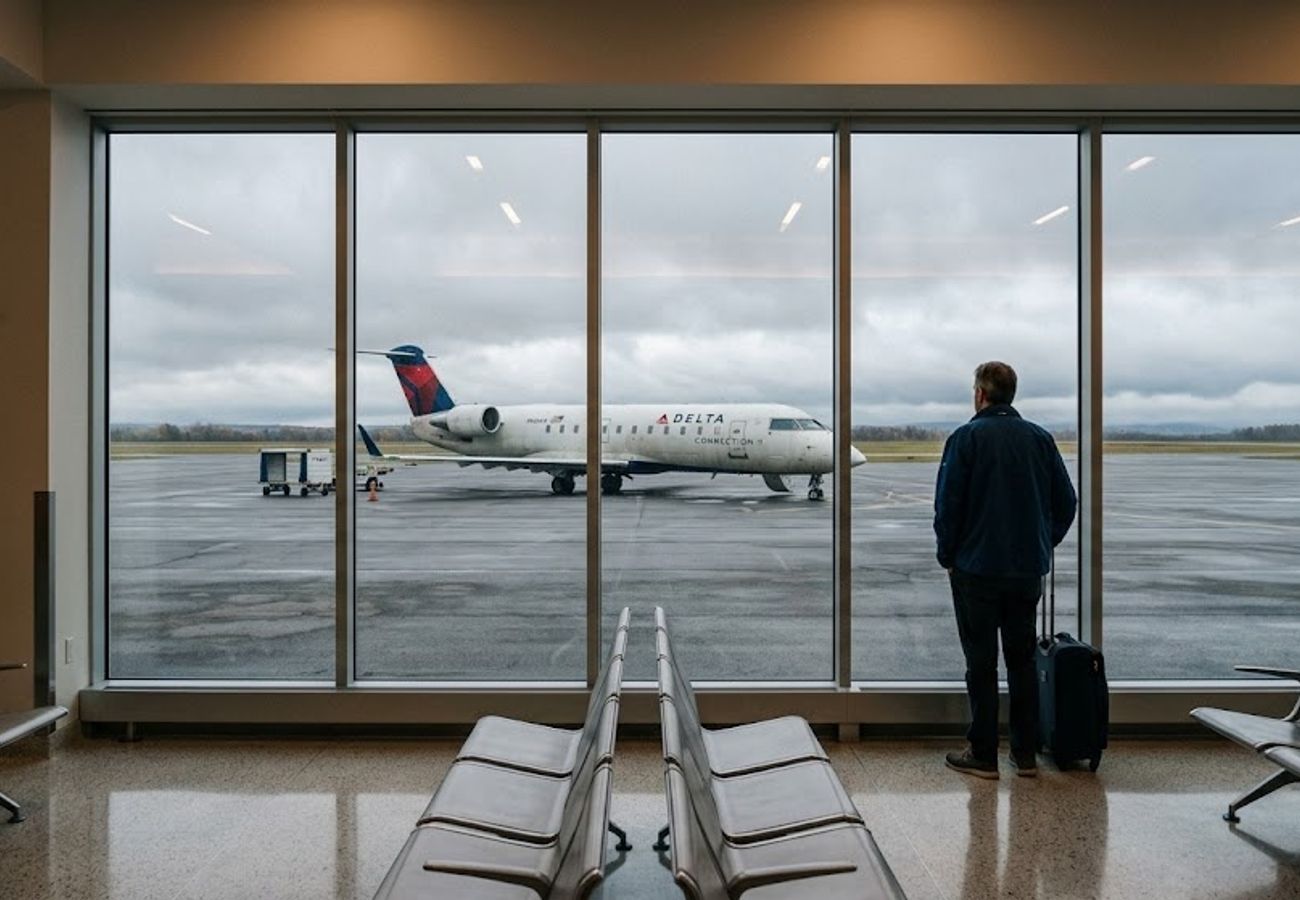
Image generated by AI
[New York, September 17, 2026] — Delta Air Lines is systematically reducing its regional "spoke" network, leaving numerous small-market U.S. cities vulnerable to the total loss of commercial aviation service. The airline's strategic pivot toward high-yield, premium-cabin travelers is forcing a re-evaluation of routes that rely on small regional jets and low-density passenger volumes.
This shift in operational priority has created a volatile environment for residents in smaller municipalities who rely on a single daily flight to connect to major global hubs. While some cities have managed to retain service through political intervention, the underlying economic pressures—including pilot shortages and the retirement of aging aircraft—suggest that further contractions are inevitable across the domestic network.
The Binghamton Warning Sign
The fragility of small-city connectivity was starkly illustrated at the Greater Binghamton Airport (BGM) in New York. In early 2026, Delta announced the termination of its sole remaining service from the airport—a daily flight to Detroit—scheduled to end on February 14. This move was particularly jarring for the local community, as the airport had recently invested $54 million into a comprehensive terminal renovation intended to stabilize and grow air service.
The collapse of the route was driven by unsustainable "load factors," with passenger occupancy estimated between 60% and 70%. For a legacy carrier like Delta, these figures typically fall below the profitability threshold required to maintain a route, regardless of the quality of the ground infrastructure. Had the cancellation proceeded, Binghamton would have been left with zero commercial passenger options.
However, the route was restored on May 7, 2026, following intense lobbying from state and federal officials who highlighted the airport's role as a regional economic driver. Delta subsequently reclassified the February exit as a "temporary pause." While this provided immediate relief, the restoration did not address the systemic fleet constraints or the pilot shortages currently plaguing the Federal Aviation Administration (FAA) regulated airspace.
Who Is Affected by Network Contractions
The risk of service loss is not limited to New York. Delta is actively pruning its regional footprint to maximize the efficiency of larger aircraft and high-demand "focus cities."
| Impact Category | Specific Examples / Details | Risk Level |
|---|---|---|
| Small-Market Spokes | Cities with $\le$ 2 daily flights to a single hub | Critical |
| Regional Jet Routes | Routes served by 50-seat CRJ-200 aircraft | High |
| Texas Regional Hubs | Spoke routes from Austin to Midland and McAllen | Moderate |
| Southern Connections | Reduced frequencies to Memphis and New Orleans | Moderate |
The airline is increasingly moving away from the 50-seat CRJ-200, which once served as the primary vehicle for small-town connectivity. These aircraft are expensive to operate per seat and lack the premium cabins (First Class/Delta One) that the company now prioritizes. As the fleet shifts toward 76-seat aircraft, smaller markets often cannot generate the passenger volume necessary to fill the larger planes, making the routes mathematically unviable.
What This Means for Travelers
For passengers booking flights in these vulnerable markets, the corporate shift toward "premiumization" means that local convenience is now a luxury. When a route "thins"—dropping from multiple daily flights to just one—the utility for business travelers vanishes, which in turn lowers the revenue and accelerates the likelihood of a total cut.
Passenger Impact Assessment:
- Increased Volatility: Flights from small cities are more likely to be cancelled or shifted to secondary hubs with less favorable schedules.
- Higher Costs: As capacity decreases and regional jets are retired, ticket prices for the remaining "last flights" may rise.
- Ground Travel Requirements: Travelers must now factor in "drive-and-fly" logistics, treating their local airport as a primary option but not a guaranteed one.
- Booking Risks: Booking non-refundable fares on a single-daily-flight route carries a higher risk of disruption compared to high-frequency hub routes.
Establishing a Drive-And-Fly Contingency
As the network map contracts, travelers are encouraged to develop a proactive backup plan. When Delta initially exited Binghamton, it directed passengers toward alternative hubs including Syracuse, Elmira, and Ithaca.
For a resident of Binghamton, the drive to Syracuse Hancock International Airport is approximately 75 miles, taking roughly one hour and 15 minutes. While this adds ground transit time, larger airports typically offer more frequent flights and a wider array of destinations, often resulting in lower base fares that offset the cost of fuel and parking.
Contingency Planning Checklist:
- Map Alternatives: Identify the three nearest airports and calculate precise drive times.
- Audit Parking: Compare long-term parking rates; while small airports like BGM often offer cheap or free parking, larger hubs may charge $15 to $25 per day.
- Carrier Comparison: Identify which other airlines serve these alternative airports to avoid being locked into a single carrier's schedule.
- Intermodal Options: Research regional bus or shuttle services that integrate with airline booking systems, allowing for baggage check-in at local transit points.
FAQ: Delta Regional Service 2026
How can I tell if my local flight is at risk of being cancelled? Watch for a reduction in daily frequency. If a route drops to a single daily flight or shifts from a major international gateway to a secondary hub, it is a strong indicator that the airline is re-evaluating the route's viability.
Why is Delta retiring 50-seat regional jets? The 50-seat CRJ-200s are less fuel-efficient per passenger and lack the premium seating configurations that Delta's current business model prioritizes. The airline is transitioning to larger 76-seat aircraft to improve margins.
What should I do if my only local flight is cancelled? Immediately check the nearest regional hubs. In many cases, driving 60-90 miles to a larger airport provides more flight options, better pricing, and a lower probability of further cancellations.
Will government intervention always save small-city flights? No. While political pressure saved Binghamton's Detroit route, airlines ultimately operate on profit margins. Political reprieves are often temporary "pauses" rather than permanent solutions to poor load factors.
The era of the guaranteed small-town flight is ending; flexibility is now the only reliable travel strategy.
Related Travel Guides
Disclaimer
This article is for informational and educational purposes only. It does not constitute legal, financial, or professional advice. While we strive to provide accurate and up-to-date information, travel policies, regulations, and conditions change rapidly. Always verify information with official sources before making travel decisions. Nomad Lawyer makes no representations about the accuracy, reliability, completeness, or suitability of the information provided. Readers should consult qualified professionals for advice specific to their circumstances. The views expressed in this article are those of the author and do not necessarily reflect the views of Nomad Lawyer.
Raushan Kumar
Founder & Lead Developer
Full-stack developer with 11+ years of experience and a passionate traveller. Raushan built Nomad Lawyer from the ground up with a vision to create the best travel and law experience on the web.
Learn more about our team →