
Thailand’s OECD 2028 Push Could Transform Bangkok Into Asia’s Next Global Business Travel And Events Powerhouse
Thailand’s OECD 2028 Push Could Transform Bangkok Into Asia’s Next Global Business Travel And Events Powerhouse

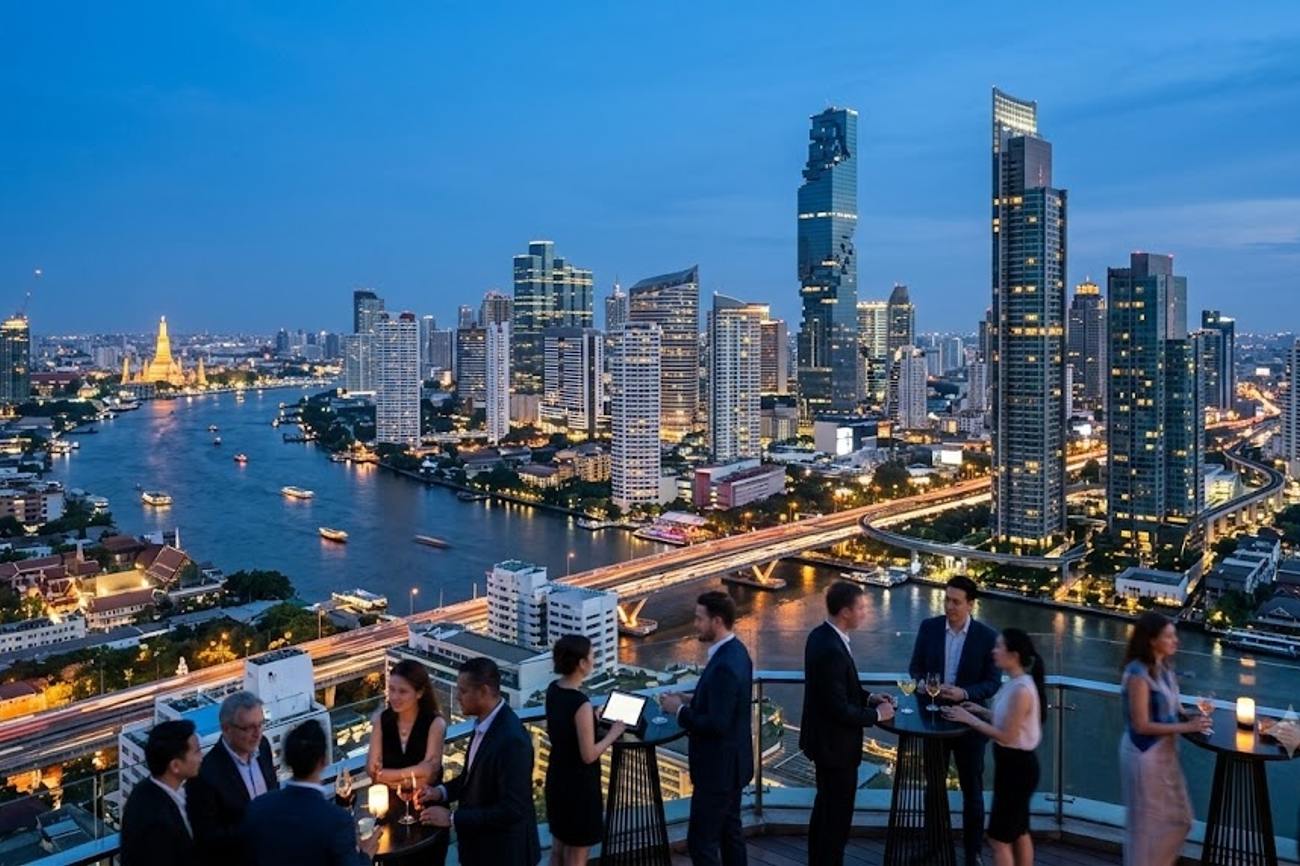
Image generated by AI
Thailand’s targeted OECD membership by 2028 represents a strategic shift from volume-based tourism to value-driven business travel, mirroring a broader regional movement toward high-yield MICE (Meetings, Incentives, Conferences, and Exhibitions) sectors. While Thailand has historically relied on leisure arrivals, the current pivot toward the Organisation for Economic Co-operation and Development (OECD) standards signals an intent to compete directly with established hubs like Singapore and Tokyo for the global corporate events market.
The OECD 2028 Roadmap in Numbers
The Thai government has formally designated OECD accession as a national priority, establishing a hard deadline for full membership by 2028. To meet this benchmark, the administration entered a strategic partnership in September 2026 with the Tony Blair Institute for Global Change. This collaboration is not merely diplomatic; it is a technical overhaul designed to align Thai governance, digital infrastructure, and investment laws with the stringent requirements of the OECD.
The scale of this transformation is evident in the specific policy pillars the government is currently reforming. These include:
- Economic Competitiveness: Redesigning frameworks to boost foreign investment confidence.
- Digital Transformation: Accelerating the adoption of technology within public services to reduce bureaucratic friction for international entities.
- Green Transition: Implementing sustainability standards that align with global ESG (Environmental, Social, and Governance) mandates.
- Governance and Investment: Streamlining policies to encourage higher volumes of foreign business activity.
For the travel industry, these metrics translate into a "confidence premium." When a destination aligns with OECD standards, the perceived risk for Fortune 500 companies and international NGOs decreases, directly increasing the probability of Bangkok being selected for high-spend corporate gatherings. According to data from the World Travel & Tourism Council (WTTC), business travel spending typically exceeds leisure spending per capita, making this shift a critical driver for GDP growth.
Comparative Context: Bangkok vs. Regional Hubs
Bangkok is not operating in a vacuum. The city is leveraging a massive infrastructure advantage—most notably the redevelopment of the Queen Sirikit National Convention Centre (QSNCC)—to close the gap between itself and other Asian powerhouses. Historically, Bangkok has been viewed as a leisure-first destination, whereas Singapore has dominated the MICE sector due to its superior governance and ease-of-doing-business rankings.
The push for OECD membership is a direct attempt to neutralize Singapore's primary competitive advantage: regulatory transparency. By adopting OECD-level governance, Thailand aims to transform Bangkok from a "hospitality hub" into a "governance hub."
| Metric/Feature | Pre-OECD Push (Baseline) | Post-OECD Target (2028) | Regional Benchmark (Singapore/Tokyo) |
|---|---|---|---|
| Primary Traveler Profile | Leisure/Mass Market | High-Yield Business/MICE | Corporate/Diplomatic |
| Regulatory Framework | National Standards | OECD Global Standards | International Gold Standard |
| Digital Integration | Fragmented Public Services | Unified Digital Transformation | Fully Integrated E-Gov |
| Venue Capacity | High (Traditional) | Ultra-High (Modern/Tech-Ready) | High (Tech-Integrated) |
| Investment Climate | Emerging/Developing | Standardized/Transparent | Highly Transparent |
The data suggests that while Bangkok already possesses the physical infrastructure—including Suvarnabhumi Airport's connectivity and a vast luxury hotel inventory—it has lacked the institutional framework to attract the highest tier of global financial and governmental forums. The 2028 goal is designed to fill this institutional void.
What This Means for Travelers
The transition toward an OECD-aligned economy will fundamentally alter the travel experience in Bangkok, particularly for the professional nomad and corporate traveler.
1. Shift in Booking Lead Times As Bangkok attracts more large-scale international exhibitions and government forums, "compression nights" (dates where hotel availability vanishes due to a major event) will become more frequent. If you are planning business travel to Bangkok in 2027 or 2028, booking 12-16 weeks in advance will be necessary during peak MICE seasons to avoid extreme price surges in the luxury and business hotel segments.
2. Digital Friction Reduction The "Digital Transformation" pillar of the OECD push means that visa processing, business permits, and local digital payments are expected to become more streamlined. Travelers can expect a reduction in the bureaucratic hurdles typically associated with setting up short-term business operations in Thailand.
3. Higher-Value Infrastructure The expansion of venues like the QSNCC means that the "center of gravity" for business travel in Bangkok is shifting. Travelers should look for accommodations near the new convention hubs rather than traditional central business districts to minimize transit time. For real-time data on airport capacity and flight frequency supporting these hubs, OAG provides critical insights into the scaling of connectivity at Suvarnabhumi.
Forward Projection: The 2028 Trajectory
Based on current trajectory, Thailand is moving toward a "Dual-Track" tourism economy. Track one remains the high-volume leisure market centered in Phuket, Chiang Mai, and Pattaya. Track two is the high-value, low-volume business sector centered in Bangkok and the Eastern Economic Corridor (EEC).
The integration of the EEC with OECD standards will likely create a new corridor of business travel. We can project a rise in "bleisure" (business + leisure) trips, where corporate travelers extend their stays to visit luxury hubs like Phuket. This synergy is supported by the International Air Transport Association (IATA), which tracks the increasing demand for flexible routing in the Asia-Pacific region.
By 2028, if the OECD accession is successful, Bangkok will likely see a measurable increase in the average daily rate (ADR) for hotels and a shift in the "Length of Stay" (LOS) metric for business travelers, as the city becomes a legitimate base for regional headquarters rather than just a stopover for meetings.
FAQ: Thailand Business Travel 2028
Will hotel prices in Bangkok increase due to OECD accession? Yes. As the city attracts higher-spending corporate delegations and global forums, demand for luxury and business-class accommodation will rise, likely driving up Average Daily Rates (ADR) during major event windows.
Is now a good time to invest in Bangkok business travel services? The data suggests yes. With a clear government mandate for 2028 and active partnerships with the Tony Blair Institute, the infrastructure and regulatory environment are trending toward growth.
Which airlines are expanding to support this MICE growth? While specific carrier expansions are ongoing, the focus remains on increasing wide-body capacity into Suvarnabhumi Airport to accommodate the larger delegations associated with OECD-level international events.
Will the OECD push affect leisure tourists? Indirectly, yes. Improved digital services and governance will likely make visa processes and airport navigation smoother for all international arrivals, not just business travelers.
The transition from a tourist playground to a global boardroom is no longer a theory—it is a documented policy mandate.
#ThailandOECD2028 #BangkokMICEGrowth #TCEBData #ThaiEconomicReform2028 #AsiaBusinessTravelShift
Related Travel Guides
- Dubai Tourism Rebounds As 869,000 Visitors Arrive In August 2026, Signalling Strong Global Travel Recovery
- Portugal Reveals Hidden Travel Paradise With Golden Sands and Calm Waters Away From Tourist Crowds
- US Travel Industry Revolution: $1 Million Wanderlust Campus Initiative to Build Next-Gen Advisor Talent
Disclaimer
This article is for informational and educational purposes only. It does not constitute legal, financial, or professional advice. While we strive to provide accurate and up-to-date information, travel policies, regulations, and conditions change rapidly. Always verify information with official sources before making travel decisions. Nomad Lawyer makes no representations about the accuracy, reliability, completeness, or suitability of the information provided. Readers should consult qualified professionals for advice specific to their circumstances. The views expressed in this article are those of the author and do not necessarily reflect the views of Nomad Lawyer.
Kunal K Choudhary
Co-Founder & Contributor
A passionate traveller and tech enthusiast. Kunal contributes to the vision and growth of Nomad Lawyer, bringing fresh perspectives and driving the community forward.
Learn more about our team →