
Tenerife Prepares for August 2026 Solar Eclipse and Perseid Peak
Teide National Park in Tenerife gears up for a rare astronomical alignment on August 12, 2026, combining a 70% solar eclipse with the Perseid meteor shower.

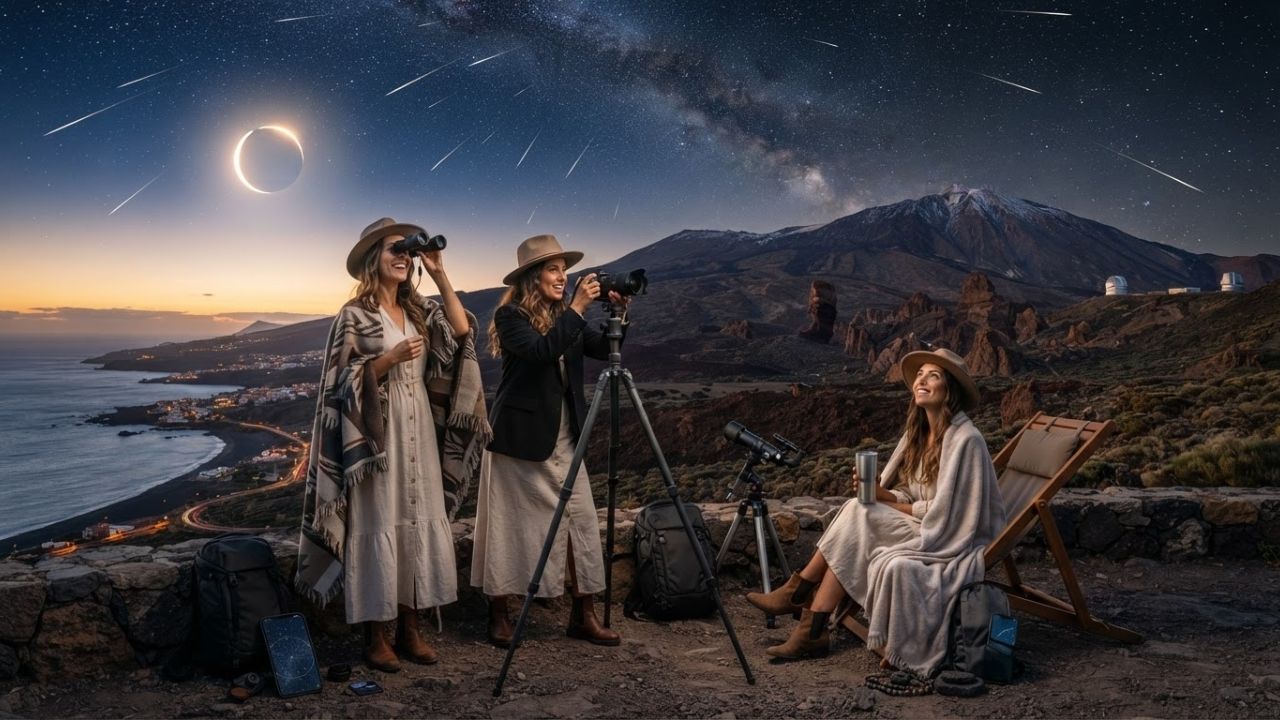
Image generated by AI
Tenerife Prepares for August 2026 Solar Eclipse and Perseid Peak
SEO Title: Tenerife Solar Eclipse & Perseid Meteor Shower Guide August 2026
Meta Description: Tenerife prepares for a 70% solar eclipse and the Perseid meteor shower on August 12, 2026. Learn about Mount Teide stargazing and Starmus VIII.
Slug: tenerife-solar-eclipse-perseids-stargazing-teide-2026
Standfirst: Tenerife is positioning itself as a central hub for astronomical travel, with the upcoming August 12, 2026, solar eclipse and Perseid meteor shower driving record bookings for Tenerife stargazing and astronomy tourism.
Three Headlines
Factual / News Headline
- Tenerife prepares for rare double astronomical event on August 12, 2026, as 70% solar eclipse aligns with Perseid peak.
Curiosity-Gap (Discover) Headline
- The volcanic peaks and protected dark skies turning Tenerife into Europe's best cosmic viewing point this August.
Problem-Solving (Search) Headline
- Stargazing in Teide National Park: How to view the 2026 solar eclipse and Perseid meteors.
Article
A major celestial alignment is redirecting European leisure traffic to the Canary Islands, with the demand for Tenerife stargazing and astronomy tourism experiences rising sharply ahead of the summer season. On August 12, 2026, the Moon will partially obscure the Sun, blocking out approximately 70 percent of solar light from Tenerife. This event aligns with the peak of the Perseid meteor shower, produced as Earth passes through the debris path of comet 109P/Swift-Tuttle.
Mount Teide and Sky Law Protections
The island's volcanic geography and strict environmental rules provide ideal viewing conditions:
- High-Altitude Viewpoint: Teide National Park surrounding Spain's highest peak, Mount Teide (3,715 meters), sits above the regional cloud layers.
- Light Pollution Control: The Canary Islands' Sky Law restricts commercial lighting, keeping night skies dark for telescope observations.
- Atmospheric Clarity: The regional air quality is recognized alongside Hawaii's Mauna Kea and Chile's Atacama Desert for astronomical research.
- Tourism Integration: Local hotels, including Spring Hotel Vulcano, Spring Hotel Bitácora, and Spring Hotel Arona Gran, are offering beach-and-stargazing packages.
- Science Festivals: The island will host the Starmus Festival VIII space and music event in October 2026.
Data Table
The table below outlines the timeline and viewing specifications for Tenerife's 2026 astronomical season:
Tenerife Astronomical Events Schedule and Viewing Profiles 2026
| Event Name / Milestone | Date / Timing | Primary Celestial Feature | Key Stargazing Observation Details |
|---|---|---|---|
| Partial Solar Eclipse | August 12, 2026 (Afternoon) | 70% solar coverage by the Moon | Safe viewing requires certified eclipse glasses |
| Perseid Meteor Shower Peak | August 12, 2026 (Night) | Swift-Tuttle comet debris trail | Minimal moonlight interference due to new moon |
| Teide National Park Tours | Year-round (Peak in August) | Volcanic altitude stargazing | Sitting at 3,715 meters above local clouds |
| Starmus VIII Festival | October 2026 | Global space, science & music | Hosting Nobel Laureates & space researchers |
Why This Matters
For travelers on this route, the real impact is the rare alignment of the eclipse with the new moon phase. Because the eclipse occurs when the Moon is fully dark, there will be no bright moonlight in the sky later that evening. This dark sky condition makes it easier to spot faint shooting stars during the Perseids peak, offering a far better display than in years with a full moon.
From a logistical perspective, this means that travelers planning to view the events must secure their high-altitude transport and park permits early. Teide National Park restricts vehicle access to protect the natural environment, and roads are expected to be closed once parking lots reach capacity. Guided tour buses are the most reliable option for reaching the 3,000-meter viewing areas.
Industry Outlook
Our analysis of the flight data indicates that the Canary Islands will continue to see strong demand from amateur astronomers and nature tourists. By promoting night-sky tourism, Tenerife can successfully diversify its visitor base, reducing its reliance on mass beach tourism and attracting high-yield, environmentally conscious travelers.
Furthermore, market trends suggest that the integration of science festivals like Starmus VIII will strengthen the island's long-term branding. Positioning the destination as a center for space research and conservation helps support local guesthouses, regional tour guides, and scientific education initiatives outside the crowded coastal resort zones.
Related: Saudi Arabia Leads Gulf Security Talks to Protect Middle East Tourism Corridor
Related: Syria Targets 35% Tourism GDP Share by 2030 Amid Infrastructure Modernization
Related: Best European Countries for Cat Lovers in 2026
Disclaimer
This article is for informational and educational purposes only. It does not constitute legal, financial, or professional advice. While we strive to provide accurate and up-to-date information, travel policies, regulations, and conditions change rapidly. Always verify information with official sources before making travel decisions. Nomad Lawyer makes no representations about the accuracy, reliability, completeness, or suitability of the information provided. Readers should consult qualified professionals for advice specific to their circumstances. The views expressed in this article are those of the author and do not necessarily reflect the views of Nomad Lawyer.
Raushan Kumar
Founder & Lead Developer
Full-stack developer with 11+ years of experience and a passionate traveller. Raushan built Nomad Lawyer from the ground up with a vision to create the best travel and law experience on the web.
Learn more about our team →