
Accessible Spain 2026: WTM London Lead Partnership, Barrier-Free Coastlines, and Practical Inclusive Travel Guide

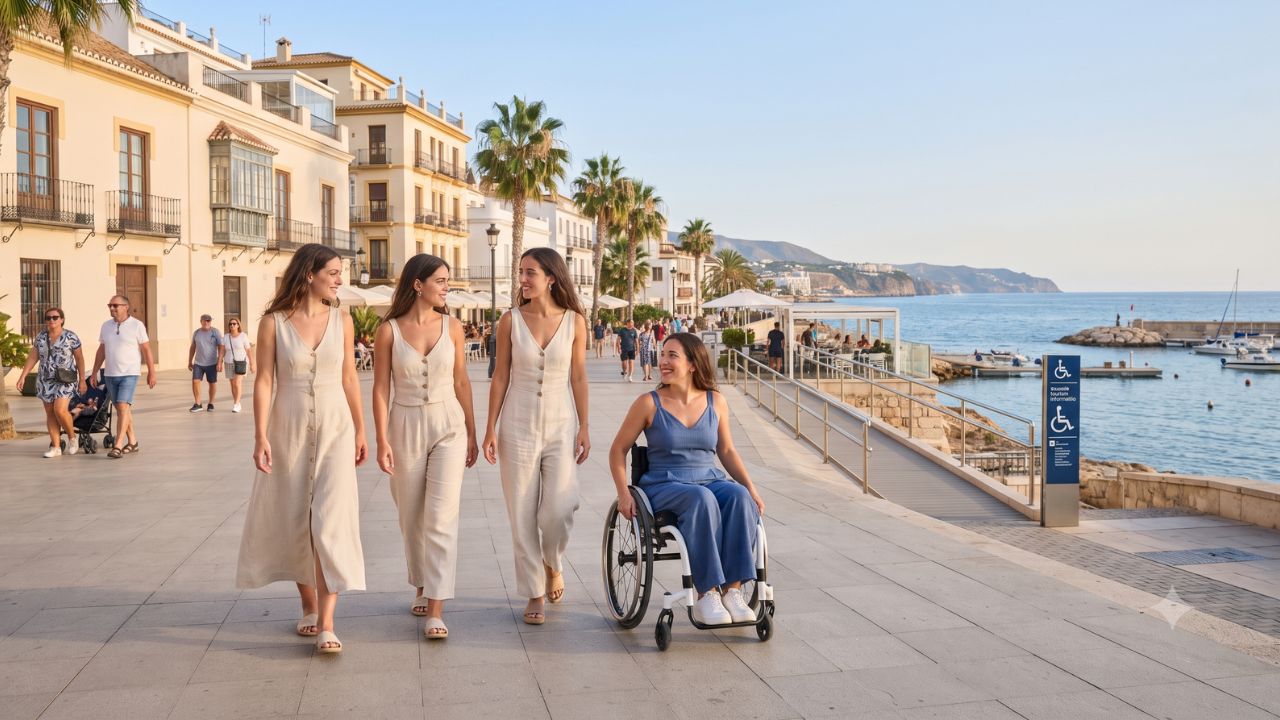
Behind Spain’s record intake of roughly 70.4 million international visitors and €99.892 billion in holiday spending through August 2026 lies a persistent travel hurdle: unverified hotel descriptions and fragmented transport links that still leave travelers with access requirements guessing. On 9 October 2026, the Spanish Tourism Authority confirmed it will serve as the first Lead Accessibility Partner at the World Travel Market London, scheduled for 3 to 5 November at ExCeL London. While destination promoters often rely on broad promotional slogans, Spain’s high-profile presence in the UK capital aims to bridge the gap between glossy marketing and the rigorous, on-the-ground details travelers require—such as roll-in shower measurements, continuous step-free pathways, and guaranteed assistance bookings.
Beyond Generic Marketing: Spain's Lead Role at WTM London and the Push for Verified Accessibility
The formal agreement between Turespaña and WTM London brings inclusive travel to the main stage of the European tourism trade. Under the partnership, Spain plans an international campaign presentation, a dedicated industry accessibility award, and enhanced on-site assistance across the ExCeL London venue. The initiative also provides an update on the Spain for All advisory panel, established by the Spanish Tourist Office in October 2023 to dismantle discrimination across the leisure sector.
This strategic push builds upon Spain's August 2024 Accessibility Findings Report, compiled after three months of intensive roundtables between hospitality professionals, accessibility specialists, and individuals with lived disability experiences. The report identified five systematic priorities: broadening the cultural understanding of accessibility beyond physical mobility, delivering clear and granular information, institutionalizing traveler consultation, collecting accurate operational data, and correcting disconnects across the complete customer journey.
Crucially, the report cautioned the hospitality sector against treating accessibility solely as an issue for manual wheelchair users. Inclusive design encompasses neurodivergent travelers, individuals with visual or auditory impairments, seniors with reduced stamina, and families with young children requiring step-free transit. However, as trade representatives assemble in London, independent travelers must remember that an exhibition sponsorship does not instantly certify every hotel, museum, or regional bus across the Iberian Peninsula. Real freedom of movement depends on verifiable, property-level facts rather than broad destination commitments.
Spain's 2026 Tourism Boom Versus the Accessibility Verification Gap
Spain’s expanding visitor figures highlight the sheer economic weight of the inbound travel market, demonstrating why clear accessibility data has become commercially essential for European operators:
| Tourism Indicator | Official Reporting Window | Confirmed Performance | Annual Rate of Change | Key Strategic Implication for Accessible Travel |
|---|---|---|---|---|
| International Tourist Arrivals | January–August 2026 | Approximately 70.4 million | +5.4% | Escalating arrivals place heavy pressure on specialized accessible rooms and mobility transfers. |
| Inbound Tourist Expenditure | January–August 2026 | €99.892 billion | +8.0% | High traveler spend proves substantial financial capacity to invest in barrier-free infrastructure upgrades. |
| UK-Resident Tourist Arrivals | August 2026 | Approximately 2.4 million | +9.3% | The UK remains Spain's leading foreign market, making London the natural forum for accessibility standards. |
| Renfe High-Speed Fleet (AVE/Avlo) | Operating Network 2026 | National coverage across 30+ hubs | Expansion ongoing | Dedicated H-class spaces and station ramps make rail Spain's most reliable accessible transit mode. |
| WTM London Strategic Alliance | Event Dates: 3–5 Nov 2026 | Lead Accessibility Partner | First-ever designation | Focuses on eliminating booking ambiguities and standardizing end-to-end customer assistance. |
As documented by the National Statistics Institute (INE) through its FRONTUR and EGATUR releases, the United Kingdom accounted for approximately 2.4 million arrivals in August 2026 alone—a 9.3% jump that cemented Britain as Spain's foremost overseas visitor source. Because British holidaymakers drive substantial demand along the Costa del Sol, the Balearic Islands, and the Canary Islands, establishing reliable assistance protocols and clear room specifications directly impacts millions of holiday decisions.
What Makes Spain Different: Accessible Beaches, High-Speed Rail, and Historic City Ramps
Spain stands out in southern Europe for its proactive, decade-long investments in civic accessibility, providing infrastructure that outclasses many neighboring Mediterranean countries when navigated with insider knowledge.
Along the coastline, hundreds of certified playas accesibles (accessible beaches) from Valencia's Malvarrosa to Barcelona's Nova Icària and Malaga's Playa de la Malagueta feature continuous wooden boardwalks extending directly to the tide line. During the summer bathing season, municipal lifeguard stations provide complimentary amphibious wheelchairs (sillas anfibias), adapted changing rooms, hoist equipment, and trained support staff who assist swimmers into the calm Mediterranean waters.
On the railways, Renfe operates the Servicio Atendo, one of Europe's most dependable specialized assistance networks. Available at over 140 major stations across Spain, Atendo coordinates dedicated support personnel who meet passengers at station concourses, operate mechanical boarding lifts for high-speed AVE and Avlo trains, and guide travelers directly to designated H-seats designed for anchored wheelchair travel.
In ancient cities where medieval cobblestones often present physical barriers, municipalities have engineered clever modifications. Cities such as Ávila, Toledo, and Girona have integrated smooth stone pedestrian corridors, public incline elevators, and ramped circuits alongside historic ramparts. In Madrid, world-class cultural institutions like the Prado Museum, the Reina Sofía, and the Thyssen-Bornemisza provide level-access entrances, sensory tactile models of famous masterpieces for visually impaired guests, and American and Spanish Sign Language video guides.
Visitor Insider Tips: Practical Planning for Travelers with Specific Access Needs
Navigating an overseas vacation with specific physical or sensory requirements demands precise preparation. Use these tested strategies when building an itinerary across Spain:
- Avoid the "Accessible Room" Trap: Never rely on a third-party booking engine's generic checkbox for accessibility. Always contact the hotel directly via email or messaging to request exact measurements: confirm the clearance width of the bathroom doorway (at least 80 centimeters is recommended), verify that the shower features a true roll-in entrance without a raised curb, and ask for uncropped photographs of the room layout and toilet grab bars.
- Booking Renfe Atendo Assistance: When purchasing train tickets on Renfe’s website, select the specialized assistance option during the checkout flow. While requests can theoretically be placed up to 12 hours prior to departure, reserve your Atendo service at least 48 to 72 hours in advance, especially during peak holiday periods, to guarantee dedicated staff allocation and platform hoist availability.
- Navigating Urban Metro Networks: In Madrid and Barcelona, download the official transit authority apps (Metro de Madrid and TMB) to check live elevator operating statuses. While Barcelona’s metro system features step-free elevator access at over 90% of its stations, older lines in central Madrid have historic stations that remain stair-access only. If traveling with heavy mobility devices, municipal low-floor city buses (autobuses urbanos) offer mechanical drop-down ramps at every central stop.
- Dining and Tapas Etiquette: Traditional tapas bars in Seville’s Santa Cruz or Madrid’s La Latina frequently feature tall barrel tables and high stools without backrests. For lower seating and step-free access, look for venues with outdoor street terraces (terrazas). Staff are exceptionally accommodating; notifying the host (camarero) upon arrival will prompt them to clear wider aisles or reposition outdoor chairs to accommodate wheelchairs or guide dogs comfortably.
- Specialized Beach Reservations: Accessible beach assistance services with amphibious chairs operate on specific daily schedules, typically between 11:00 and 19:00 from June to September. Contact local municipal tourism offices in advance to confirm whether time slots require pre-booking or operate on a first-come, first-served basis.
Cultural and Environmental Context: Moving from Mass Footfall to Universal Inclusion
Spain's push toward universal accessibility represents more than a commercial hospitality strategy; it reflects a broader civic transformation regarding how public spaces accommodate all citizens. With international arrivals surging past 70.4 million in just eight months, Spanish urban centers and coastal resort towns are feeling the strain of high visitor density. When sidewalks are crowded and outdoor cafe dining spreads across public plazas, individuals with mobility devices, guide dogs, or sensory sensitivities encounter increased friction.
The Spain for All framework and the advisory findings published in August 2024 emphasize that true sustainability requires social equity. Investing in tactile paving, acoustic traffic signals, audible transit announcements, and quiet museum viewing hours ensures that tourism improvements benefit resident communities as well as foreign travelers. By prioritizing clear factual data over exaggerated marketing campaigns at forums like WTM London, Spain is setting an essential benchmark: treating accessibility not as a luxury niche, but as a basic standard of modern European travel.
FAQ: Visiting Spain with Accessibility Requirements 2026
Does the Spain-WTM London partnership certify all Spanish hotels as accessible?
No. The agreement is an industry collaboration focusing on standards and assistance. Travelers must independently verify room dimensions, bathroom configurations, and physical access with individual accommodation providers prior to payment.
How do I arrange station wheelchair assistance on Spanish trains?
Request the free Servicio Atendo when purchasing your ticket online via Renfe, or book it up to 48 hours in advance through the Renfe Atendo app or dedicated customer service hotline.
Are guide dogs legally permitted in public spaces and restaurants in Spain?
Yes. Spanish national law guarantees certified guide and assistance dogs full, unrestricted access to all public transit, hotels, restaurants, cultural venues, and beaches throughout the country.
Which Spanish cities offer the most barrier-free public transport?
Barcelona and Valencia lead the country with near-complete step-free metro stations, 100% ramp-equipped municipal bus fleets, and extensive paved, level pedestrian boulevards throughout their central districts.
When verified facts replace vague promotional promises, traveling through Spain becomes an open and welcoming journey for everyone.
Related Travel Guides
Disclaimer
This article is for informational and educational purposes only. It does not constitute legal, financial, or professional advice. While we strive to provide accurate and up-to-date information, travel policies, regulations, and conditions change rapidly. Always verify information with official sources before making travel decisions. Nomad Lawyer makes no representations about the accuracy, reliability, completeness, or suitability of the information provided. Readers should consult qualified professionals for advice specific to their circumstances. The views expressed in this article are those of the author and do not necessarily reflect the views of Nomad Lawyer.
Raushan Kumar
Founder & Lead Developer
Full-stack developer with 11+ years of experience and a passionate traveller. Raushan built Nomad Lawyer from the ground up with a vision to create the best travel and law experience on the web.
Learn more about our team →