
Southwest Airlines Has No Direct Competition On 60% Of Its Routes: Here's Why That's Changing In 2026
Southwest Airlines Has No Direct Competition On 60% Of Its Routes: Here's Why That's Changing In 2026

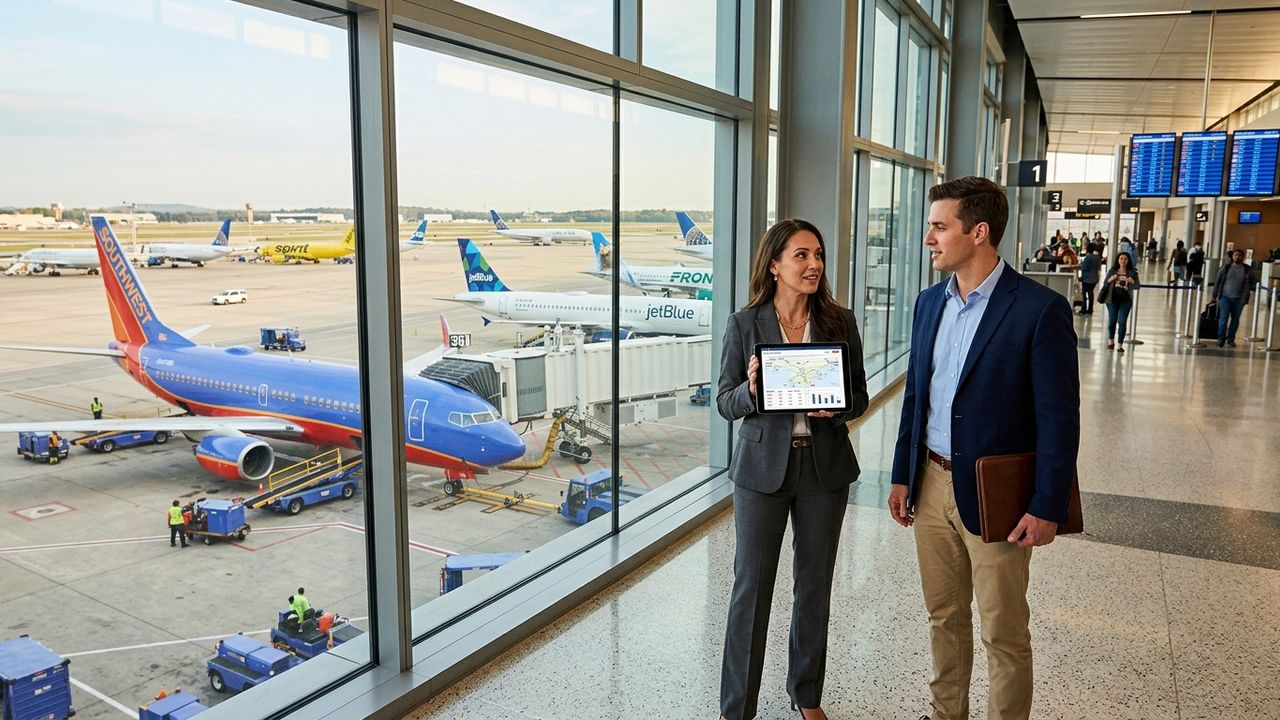
Image generated by AI
Southwest Airlines confronts mounting competitive pressure in 2026 as activist-driven transformation and low-cost expansion threaten monopoly status on 60% of domestic routes.
[Dallas, June 20, 2026] — Southwest Airlines competition is intensifying in 2026 as the carrier navigates a pivotal transformation driven by activist investor pressure and aggressive market expansion by rival airlines. The United States' largest domestic carrier by passengers carried faces a structural shift in its business model, as it dismantles long-standing policies that once protected its position on approximately 60% of routes without direct competition. This comprehensive overhaul includes the introduction of assigned seating, premium cabin products, and checked baggage fees, fundamentally altering the value proposition that historically distinguished the airline from legacy and ultra-low-cost competitors.
Industry observers note that the convergence of these internal changes and external market encroachments marks the most significant challenge to Southwest's operational strategy since the airline's inception. The carrier generated record revenue of $28.1 billion in 2025 while maintaining its status as the top U.S. airline by passenger volume. However, analysts indicate that the conditions insulating Southwest from fare wars and capacity battles are rapidly eroding, forcing the carrier to redefine its market positioning.
Southwest's Route Monopoly Built on Underserved Markets and Secondary Airports
For decades, Southwest Airlines cultivated a network strategy that deliberately avoided the high-cost hub environments dominated by legacy carriers. While competitors concentrated operations at major airports such as Atlanta, Dallas-Fort Worth, Chicago O'Hare, and Newark, Southwest focused on secondary airports and underserved city pairs. This approach allowed the carrier to establish dominant positions on routes where passengers had limited nonstop alternatives.
Flight tracking data and industry analysis estimate that Southwest currently operates without direct competition on approximately 60% of its routes. This figure represents a substantial structural advantage in an industry characterized by intense rivalry for market share. On these uncontested routes, Southwest possessed greater pricing flexibility and the ability to stimulate demand without triggering destructive fare competition.
The airline relied on a dense point-to-point network rather than a traditional hub-and-spoke model. This design reduced dependence on congested hubs and created numerous connections between midsize markets. By focusing on routes that competitors viewed as too small or specialized, Southwest minimized exposure to the margin-eroding battles that frequently plagued legacy carriers at major gateways. The absence of direct rivals on many routes did not guarantee profitability, but it significantly enhanced the airline's capacity to manage yields and schedule density effectively.
Brand Identity Shifts as Southwest Abandons Fee-Free Policies
Southwest's historical success depended on a combination of network dominance and a distinctive customer experience. The airline reinforced its market position through policies that diverged sharply from industry norms, most notably the "Bags Fly Free" initiative. While competitors increasingly generated revenue through ancillary charges, Southwest maintained free checked baggage allowances, creating a tangible cost saving that resonated with travelers.
Open seating further differentiated the carrier, offering flexibility and simplicity that appealed to a broad customer base. The airline's transparent fare structure reduced the complexity associated with product segmentation, encouraging loyalty even when comparable fares were available elsewhere. These policies functioned as a defensive moat, making it difficult for rivals to replicate the total value proposition despite matching base ticket prices.
The strategic landscape shifted dramatically in 2026 as Southwest announced the elimination of these signature features. The carrier introduced assigned seating, premium seating products, basic economy fares, and checked bag fees. Under the new structure, standard passengers face charges of approximately $35 for a first checked bag and $45 for a second bag. These changes dismantle decades-old policies that were widely regarded as core components of the airline's identity, effectively reducing product differentiation.
Activist Investor Pressure Accelerates Revenue-Generating Overhaul
The catalyst for this transformation stems from intensified scrutiny by Elliott Investment Management, which acquired a significant stake in the company and advocated for comprehensive operational reforms. The activist investor argued that Southwest's commitment to traditional policies limited shareholder returns and prevented the airline from capitalizing on revenue opportunities available to competitors. The resulting overhaul targets multiple revenue streams, including higher yields from premium seating, ancillary income from bag fees, and competitive positioning through basic economy products.
Early financial metrics suggest the strategy is gaining traction. Southwest shares outperformed many airline peers during the first half of 2026, prompting analyst upgrades to earnings expectations. The carrier has projected adjusted earnings per share of at least $4.00 for 2026, a marked increase from approximately $0.93 in 2025. Operational data supports these projections; analysis of first-quarter 2026 results by the Southwest Airlines Pilots Association reported an 11.2% year-over-year increase in unit revenue, driven by stronger upsell rates and new revenue initiatives.
Legacy Carriers and Ultra-Low-Cost Rivals Target Southwest's Customer Base
The erosion of Southwest's unique product attributes has created vulnerabilities that competitors are actively exploiting. Industry executives at Delta Air Lines and United Airlines have indicated that Southwest's traditional customer base is now more susceptible to competitive targeting. When differentiation declines, consumer decision-making shifts toward factors such as schedule quality, loyalty program benefits, airport facilities, and international connectivity.
Legacy carriers possess extensive advantages in these areas, operating global networks, premium lounges, and sophisticated frequent flyer ecosystems. Historically, Southwest counterbalanced these strengths with simplicity and customer-friendly policies. As those policies disappear, the gap between Southwest and its larger rivals narrows, potentially weakening the loyalty that once protected the airline in its strongest markets.
Simultaneously, ultra-low-cost carriers are attacking from the price-sensitive end of the market. Frontiers and other low-cost operators continue to refine demand stimulation through aggressive fare structures. Southwest has responded by prioritizing margin over volume, exiting underperforming markets to focus on routes capable of generating stronger returns. This discipline may improve financial performance, but it also creates gaps in service that competitors can exploit to establish footholds in markets Southwest previously served.
Breeze Airways and New Entrants Encroach on Protected Markets
Breeze Airways has emerged as a particularly acute threat in markets that mirror the underserved routes Southwest historically targeted. Rather than concentrating solely on major hubs, Breeze has expanded into city pairs where demand exists but competition remains limited. This expansion strategy directly challenges Southwest's long-standing approach of entering markets before rivals recognized their potential.
Southwest's recent network planning reflects awareness of this threat. Of nine newly announced routes, four reportedly overlap with markets currently served exclusively by Breeze Airways. This overlap signals a willingness by Southwest management to engage competitors directly rather than relying on historical network advantages. The carrier faces a scenario where newer airlines are identifying and capturing the same opportunities that once defined Southwest's growth trajectory.
The combination of network encroachment and reduced differentiation presents a more complex competitive environment than Southwest has encountered in decades. The airline retains significant advantages, including scale, brand recognition, and a vast domestic network. Nevertheless, the structural conditions that once insulated many routes from meaningful competition are changing.
Financial Indicators Highlight Early Gains Amid Competitive Risks
The financial trajectory of Southwest Airlines in 2026 underscores the immediate benefits of the strategic overhaul while highlighting longer-term uncertainties. Revenue metrics are improving, and investor sentiment remains positive as the market responds to the carrier's focus on profitability and yield management. The introduction of assigned seating and premium products allows the airline to capture higher fares from passengers willing to pay for additional comfort, while bag fees contribute substantial ancillary revenue.
However, the operational shift requires managing the transition across a massive fleet of over 800 Boeing 737 aircraft. The sudden move to assigned seating introduces changes to boarding procedures and turnaround times that require careful execution. While early commercial performance appears robust, the loss of brand distinctiveness poses a risk to customer retention. If Southwest becomes increasingly similar to other major carriers, it may face heightened price sensitivity from travelers who no longer perceive unique value in the brand.
Impact Analysis
The transformation of Southwest Airlines in 2026 signals a fundamental realignment of the U.S. airline industry's competitive dynamics. The carrier's ability to operate without direct competition on 60% of its routes provided a buffer that allowed for stable growth and margin protection. However, this buffer relied on a combination of network positioning and a differentiated product. By adopting industry-standard fees and seating assignments, Southwest is voluntarily reducing its differentiation, thereby inviting competition on all fronts.
The structural advantage of route monopoly is diminishing in value as competitors recognize the contestability of Southwest's customer base. Legacy carriers can now leverage their superior loyalty programs and global networks to attract travelers who may no longer view Southwest as distinct from other major airlines. Meanwhile, ultra-low-cost carriers like Breeze Airways are capitalizing on Southwest's market exits to capture demand in secondary markets. The result is a convergence where Southwest must compete on price, service, and network quality simultaneously, a departure from its historical reliance on uncontested routes and fee-free value propositions.
Forward-Looking Conclusion
Southwest Airlines is entering a critical phase where the airline must balance financial modernization with the preservation of market share. The strategic overhaul initiated under activist investor pressure is delivering early revenue gains and improved earnings metrics, validating the financial rationale behind the changes. Yet, the long-term success of this strategy depends on whether Southwest can maintain customer loyalty while redefining its identity in a crowded marketplace. As the factors that reinforced the airline's historic monopoly weaken, the competitive landscape will likely favor carriers that can effectively combine network efficiency with compelling product differentiation. The coming years will determine whether Southwest can sustain its dominance while adapting to an era of intensified rivalry across all segments of the domestic aviation market.
Southwest Airlines competition intensifies in 2026 as strategic overhaul erodes monopoly on 60% of routes amid activist pressure and ULCC expansion.
Related Travel Guides
Disclaimer
This article is for informational and educational purposes only. It does not constitute legal, financial, or professional advice. While we strive to provide accurate and up-to-date information, travel policies, regulations, and conditions change rapidly. Always verify information with official sources before making travel decisions. Nomad Lawyer makes no representations about the accuracy, reliability, completeness, or suitability of the information provided. Readers should consult qualified professionals for advice specific to their circumstances. The views expressed in this article are those of the author and do not necessarily reflect the views of Nomad Lawyer.
Raushan Kumar
Founder & Lead Developer
Full-stack developer with 11+ years of experience and a passionate traveller. Raushan built Nomad Lawyer from the ground up with a vision to create the best travel and law experience on the web.
Learn more about our team →