
South Pacific Cruise Accessibility Under Scrutiny as Australia, Fiji, and Vanuatu Tender Barriers Restrict Island Excursions
While mainland cruise terminals boast step-free boarding, tender-dependent ports across Australia, Fiji, Vanuatu, PNG, and New Zealand leave mobility-impaired passengers stranded.

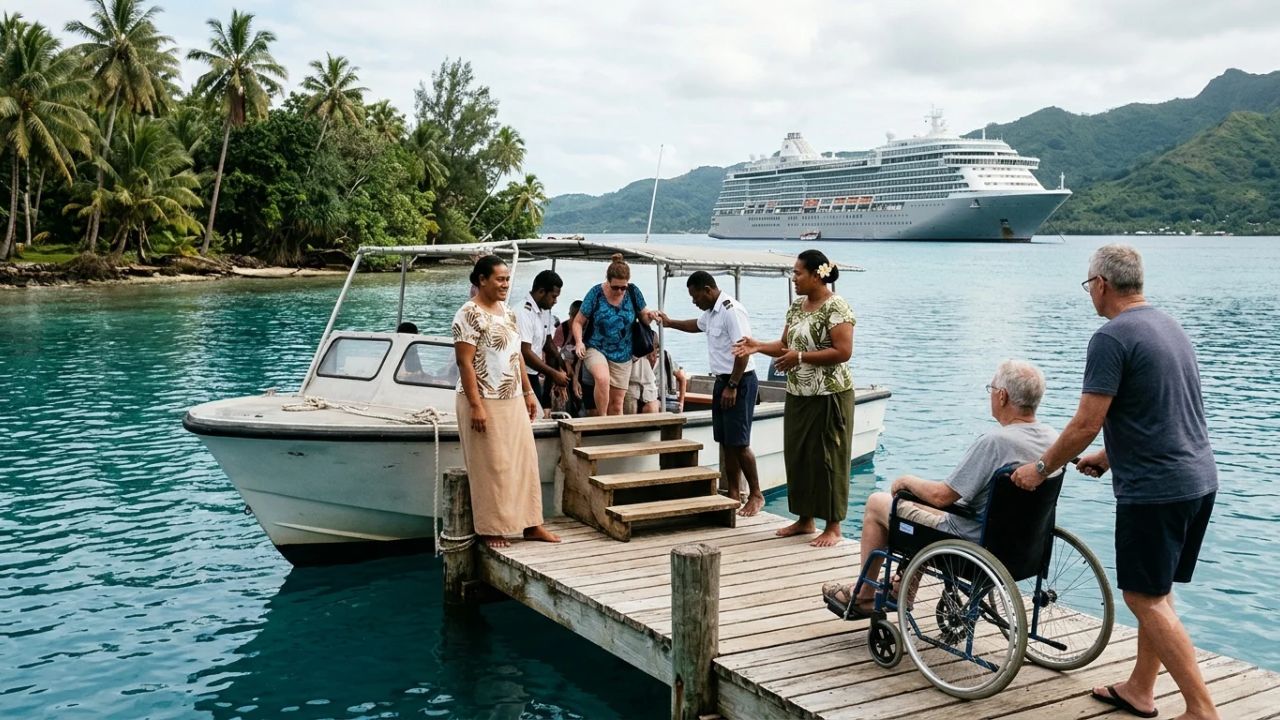
Tender boat transfer operations between anchored ocean liners and remote South Pacific island shorelines
[BRISBANE, Oct 21, 2026] — Cruise itineraries connecting Australia, Papua New Guinea, Fiji, Vanuatu, and New Zealand offer compelling island adventures, but passengers cannot assume equal access at every port of call. While modern mainland gateways feature multi-million-dollar barrier-free terminal infrastructure, disembarkation realities change drastically once vessels drop anchor off remote archipelagos. Carnival Cruise Line officially identifies multiple tender destinations across these five nations where accessible water shuttles are unavailable under its published operating protocols. At the same time, major commercial gateways provide established berths, and Brisbane documents extensive accessible facilities. The decisive question for 2026–2027 travelers is whether they can complete the entire journey from ship to shore excursion, not simply book an accessible cabin.
[!NOTE] Key Operational Findings:
- Mainland Terminal vs. Island Divide: Deepwater terminals like the Brisbane International Cruise Terminal offer elevated covered walkways, lifts, and boarding bridges, yet onward stops like Airlie Beach, Port Douglas, and Kangaroo Island lack accessible water shuttles.
- Operator-Specific Restrictions: Carnival Cruise Line designates key island destinations—including Kiriwina Island (Papua New Guinea), Dravuni Island and Port Denarau (Fiji), Mystery Island (Vanuatu), and Bay of Islands (New Zealand)—as tender ports without accessible water shuttles under published fleet procedures.
- The Two-Transfer Dilemma: At remote stops like Mystery Island, visitors embarking on cultural or hiking tours face an initial tender transfer followed by a secondary small-boat crossing to Aneityum, creating compounding physical hurdles.
- Commercial Footprint: The Cruise Lines International Association (CLIA) recorded 37.2 million global passengers for calendar 2025 across 325 ocean-going ships (approx. 690,000 lower berths), supporting a $198 billion economic footprint in 2024. Yet, destination-level accessibility metrics remain unstandardized.
- Regional Deployment Shifts: Vanuatu has 159 large-ship calls and 37 expedition calls confirmed for 2027 across 12 ports, even as Carnival prepares fleet redeployments beginning in March 2028.
THE BROKEN ACCESSIBLE CRUISE DISCOVERY CHAIN IN OCEANIA
| Column 1 |
|---|
| [STAGE 1: EMBARKATION GATEWAY] |
| Brisbane / Auckland City Wharves |
| * Step-free gangways, level boarding bridges (up to 270m), lifts, accessible check-in. |
| * Status: ACCESSIBLE & VERIFIED |
| v |
| [STAGE 2: OFFSHORE ANCHORAGE & WATER SHUTTLE] |
| Airlie Beach / Kiriwina / Dravuni / Mystery Island |
| * Swell, tidal currents, vessel roll; steep external gangways. |
| * Status: RESTRICTED - Operator water shuttles unable to accommodate non-folding wheelchairs. |
| v |
| [STAGE 3: ISLAND LANDING POINT] |
| Exposed Beaches, Floating Pontoons, Wooden Jetties |
| * Sand landings, tidal step-offs, slippery ladders, steep ramp inclines. |
| * Status: HIGH RISK - Requires independent balance or unassisted ambulation. |
| v |
| [STAGE 4: SHORE ADVENTURE LOGISTICS] |
| Minibuses, Village Paths, Secondary Open Skiffs (e.g., Aneityum) |
| * High entry stairs, lack of wheelchair tie-downs, rugged jungle/coral walking tracks. |
| * Status: BARRIER ENCOUNTERED - "Ambulatory" excursions exclude fully accessible travel. |
Why South Pacific Cruise Accessibility Matters Beyond the Ship
All five countries combine established cruise gateways with island calls that often rely on tender boats. A commercial berth does not itself guarantee wheelchair access, which varies by ship, tide, and specific call.
According to Carnival Cruise Line, tides, weather, and vessel movement govern tender safety, with the captain making the final decision on disembarkation safety. Its ambulatory-accessible tours may require steps, unlike fully accessible options that provide adapted transport.
| Country | Established Berth or Terminal Infrastructure | Tender Stops Without Accessible Carnival Water Shuttles | What Still Needs Checking |
|---|---|---|---|
| Australia | Brisbane International Cruise Terminal has lifts, accessible counters, and boarding bridges. | Airlie Beach, Port Douglas, and Kangaroo Island. | Ship-specific boarding and accessible adventures beyond the mainland gateway. |
| Papua New Guinea | Alotau and Rabaul maintain commercial wharves. | Kiriwina Island. | Whether the cruise vessel berths alongside and whether landing routes are step-free. |
| Fiji | Suva’s Kings Wharf serves cruise liners; Lautoka has a major commercial port. | Dravuni Island and Port Denarau. | Gangway arrangements and accessible onward transport at individual calls. |
| Vanuatu | Port Vila and Santo have maritime infrastructure, including a multipurpose cruise wharf. | Mystery Island. | Tender landing, secondary island crossings, and excursion-level access. |
| New Zealand | Auckland operates Queens and Princes wharves; Port Chalmers receives most Dunedin-bound cruise ships. | Bay of Islands. | Vehicle accessibility for shore transfers and smaller-ship operations. |
Source: Carnival Cruise Line’s published tender-accessibility classifications, checked against relevant port authorities. These are Carnival-specific restrictions, not blanket rules for every operator. Travelers must verify the ship, sailing date, and mobility requirements directly.
Australia Shows Why Accessible Cruise Terminals Do Not Solve Island Tender Barriers
According to the Port of Brisbane, its international cruise terminal offers accessible parking, toilets on both floors, hearing loops, appropriate-height check-in counters, and passenger lifts. Two boarding bridges connect vessels to an elevated walkway of up to 270 metres. Port guidance notes that gradients vary with tide and ship configuration. Its published passenger route includes a boarding bridge of up to 55 metres and rest stops along the walkway, a useful level of detail for mobility planning.
Carnival nevertheless lists Airlie Beach, Port Douglas, and Kangaroo Island among Australian tender calls without accessible water shuttles. A passenger boarding comfortably in Brisbane can encounter an entirely different situation later in the voyage. Reef and island-excursion sellers need port-specific access checks; an accessible departure terminal cannot guarantee every shore adventure.
Papua New Guinea’s Cultural Cruises Raise a Separate Landing Question
According to the Papua New Guinea Tourism Promotion Authority, Alotau, Rabaul, and Kiriwina Island feature prominently in the country’s cruise offering, combining marine activities, cultural visits, and wartime history.
Technical documentation from the PNG Ports Corporation documents Alotau’s overseas berth at 93 metres long, with a declared depth of 10 metres, alongside a separate coastal berth. Those specifications do not establish step-free cruise access. The port’s technical sheet also does not list a dedicated passenger-handling facility, underscoring why travelers need ship-specific landing information.
Kiriwina makes the distinction particularly important. The island offers lagoons and village experiences, but Carnival identifies Kiriwina as a tender destination without accessible water shuttles. Some passengers may therefore be unable to disembark. Agents must confirm whether each Papua New Guinea call uses a berth or anchorage, landing equipment, and accessible transport.
Fiji Pairs Major Cruise Wharves With Tender-Dependent Island Escapes
According to the Fiji Ports Corporation, Suva’s Kings Wharf features a 492-metre quay and handles passenger cruise liners alongside commercial shipping. Lautoka is another major port, but details of step-free cruise gangways and adapted transport require checking with individual operators. Marine capacity does not certify accessible disembarkation.
Carnival identifies Dravuni Island and Port Denarau as tender stops without accessible water shuttles. Denarau is distinct from the commercial ports at Suva and Lautoka; access can change significantly between these destinations. Suppliers should disclose beach surfaces, boat steps, toilet provision, and return-transfer assistance before marketing island visits as accessible.
Vanuatu’s Island Cruise Growth Exposes the Two-Transfer Problem
Vanuatu combines substantial island cruise activity with complex shore logistics. According to its Ministry of Trade and Commerce, the country has 159 large-ship calls confirmed for 2027 across Mystery Island, Port Vila, Lelepa Island, and Luganville, plus 37 expedition calls at 12 ports across all six provinces. These figures relate to Vanuatu alone. The ministry further identifies four-fifths of expedition calls as lying outside Port Vila and Luganville, extending the infrastructure question beyond the main gateways.
The Vanuatu Ports Authority lists Santo’s 360-metre multipurpose wharf, with 22-metre depth, as serving cargo and cruise ships. Mystery Island, however, requires tenders. Royal Caribbean describes an additional boat crossing to Aneityum for certain cultural and hiking excursions, creating two distinct transfer barriers.
Even where ships berth, Princess Cruises’ Luganville Blue Lagoon excursion involves a minibus and steps into the water. Those conditions matter before booking. Vanuatu’s government has also acknowledged planned Carnival fleet redeployments from March 2028. That development does not cancel the published 2026–2027 programme.
New Zealand Highlights the Gap Between Port Investment and Shore Transfers
According to the Port of Auckland, Queens Wharf and Princes Wharf serve cruise passengers in the city centre. Its published 2027 schedule shows Carnival Adventure connections involving Suva, Dravuni, and Mystery Island. These routes combine urban berths with tender-dependent calls. The schedule records a 25 May 2027 departure towards Suva, a 3 June arrival from Dravuni, and a 19 July onward call towards Mystery Island, across separate sailings.
Auckland is also developing Te Waharoa, a new international cruise terminal planned to open in early 2027. The port places it within a NZ$200 million investment programme and plans capacity for 1,500 passengers hourly. Terminal throughput says nothing about island excursions.
Port Otago confirms most Dunedin-bound ships use Port Chalmers, requiring onward transport to the city. Carnival also lists Bay of Islands among tender ports without accessible water shuttles. Both marine transfers and accessible ground vehicles matter.
Why Adventure Excursions Need Their Own Accessibility Classification
Adventure cruising promises reefs, cultural encounters, and wildlife, yet an accessible cabin does not guarantee an accessible tender, beach landing, or minibus.
Carnival separates fully accessible tours from ambulatory options, while adapted vehicles can depend on local availability. Royal Caribbean’s Mystery Island information exposes an additional boat crossing for certain Aneityum experiences. Each segment can impose different demands on mobility and balance. Product descriptions should disclose standing requirements, folding-wheelchair arrangements, ground surfaces, and toilet access before payment.
What the 2026–2027 Cruise Figures Actually Indicate
| Primary-Source Measure | Verified Figure | Operational Meaning |
|---|---|---|
| Global cruise passengers, calendar 2025 | 37.2 million, reported by CLIA in April 2026 | More visitors make consistent disclosure of accessibility increasingly important. |
| CLIA-member ocean-going fleet, 2026 | 325 ships and approximately 690,000 lower berths | Fleet scale does not demonstrate shore access at individual destinations. |
| Vanuatu confirmed 2027 large-ship calls | 159 across four named ports | Regional opportunity is concentrated in identifiable ports and island stops. |
| Vanuatu 2027 expedition cruise calls | 37 across 12 ports | Smaller and remote landing locations require tailored access information. |
| Auckland cruise-precinct investment | NZ$200 million programme; Te Waharoa planned for early 2027 | Passenger-processing upgrades and island accessibility are separate investments. |
Sources: Cruise Lines International Association, Vanuatu Ministry of Trade and Commerce, and Port of Auckland.
CLIA also estimates US$198 billion in global cruise economic impact in 2024, supporting 1.8 million jobs. These estimates demonstrate commercial scale, not the economic cost of inaccessible shore excursions. The measures cover different periods and cannot be combined into a regional growth rate. Vanuatu also reports fewer ships deployed in Australia and falling New Zealand calls alongside greater interest in Pacific islands.
The Overlooked Commercial Risk Is a Broken Accessible Journey
The neglected risk is an unverified route spanning cabin, gangway, tender, landing, transport, attraction, and return. A traveler may successfully board a ship, enjoy an accessible excursion at one port, and still be unable to disembark at the next. Each service may have a different operator, and no single infrastructure description resolves the whole itinerary.
For the trade, that creates a disclosure problem and a product-design opportunity. A port-level accessibility label is insufficient where ship size, weather, or tender design changes the practical outcome. Itinerary assessments could instead record verified transfer methods for each date, distinguish fully accessible products from those requiring steps, and identify suitable alternatives when disembarkation is impossible. This would help advisors avoid unsuitable bookings and allow destination businesses to compete on reliable service rather than vague promises.
Crucially, there is no verified evidence that all five countries lack accessible port infrastructure. The evidence points to a more specific issue: uneven connections between established cruise gateways and remote island experiences. Transparency about those connections is commercially valuable even before new infrastructure is built.
| Journey Stage | Risk Requiring Verification | Operational Response |
|---|---|---|
| Ship to Quay | Gangway angle, door position, and wheelchair clearance | Obtain ship-and-berth access confirmation. |
| Anchored Ship to Island | No accessible tender or unsafe sea conditions | Check operator restrictions and provide alternatives. |
| Island Landing | Steps, sand, slippery pontoons, or uneven paths | Inspect landing routes and mobility assistance. |
| Shore Adventure | Unadapted minibus, difficult terrain, or extra boat crossing | State physical requirements before selling. |
| Return to Vessel | Weather changes or unavailable adapted vehicles | Agree return arrangements and contingency plans. |
Critical Operational Takeaways for Cruise Agents and Tour Operators
- Validate Each Call Individually: Check berth or anchorage plans, tender type, marine conditions, and ship-specific mobility policies before promising shore access.
- Audit the Full Excursion Chain: Record gangway gradients, transfer steps, surface conditions, adapted vehicle availability, toilets, and return arrangements.
- Differentiate Accessibility Categories: Do not market a tour requiring independent steps as fully wheelchair accessible.
- Secure Written Confirmation: Obtain operator advice on equipment limitations, assistance policies, and alternatives before collecting final payment.
- Plan Contingencies: Offer suitable onboard or accessible-shore alternatives and explain applicable cancellation and refund terms.
What This Means for the Future of South Pacific Cruising
Future competitive advantage may depend as much on shore access as cruise volumes. New terminals improve embarkation, while accessible tenders and adapted transport determine who can explore remote islands. Vanuatu’s 2027 call programme and Auckland’s infrastructure plans show different aspects of the same challenge. For cruise lines and destinations, the long-term opportunity is to treat accessible adventures as an integrated operating requirement rather than an optional addition to a scenic itinerary.
Frequently Asked Questions (PAA)
Are all South Pacific cruise ports inaccessible to wheelchair users?
No. Brisbane documents accessible facilities, and other ports have established berths. The vessel, gangway, and onward transport determine individual accessibility.
Which destinations are identified as having no accessible Carnival water shuttles?
Carnival lists examples including Airlie Beach, Port Douglas, Kiriwina Island, Dravuni Island, Port Denarau, Mystery Island, and Bay of Islands. These restrictions are operator-specific.
Can travellers visit Mystery Island without a tender?
Royal Caribbean describes Mystery Island as a tender port. Some activities also involve a separate boat journey to Aneityum. Check both crossings before booking.
Does an alongside berth guarantee an accessible shore excursion?
No. Gangways, vehicles, or uneven ground can create barriers. Princess Cruises’ Luganville Blue Lagoon itinerary, for example, specifies minibus transport and steps to the lagoon.
What should advisers confirm for 2026–27 South Pacific cruises?
Check tender arrangements, accessible shuttles, step-free transfers, facilities, and alternatives for the exact sailing.
Related Travel Guides
Disclaimer
This article is for informational and educational purposes only. It does not constitute legal, financial, or professional advice. While we strive to provide accurate and up-to-date information, travel policies, regulations, and conditions change rapidly. Always verify information with official sources before making travel decisions. Nomad Lawyer makes no representations about the accuracy, reliability, completeness, or suitability of the information provided. Readers should consult qualified professionals for advice specific to their circumstances. The views expressed in this article are those of the author and do not necessarily reflect the views of Nomad Lawyer.
Raushan Kumar
Founder & Lead Developer
Full-stack developer with 11+ years of experience and a passionate traveller. Raushan built Nomad Lawyer from the ground up with a vision to create the best travel and law experience on the web.
Learn more about our team →