
US Airlines Execute Massive FAA Emergency Drill at Salt Lake City Airport to Secure International Travel and Prevent Catastrophic Travel Chaos: Latest Airline News
As global tourists demand absolute operational safety, major US airlines execute a highly intense FAA-mandated emergency crash drill at SLC to protect millions of international passengers from devastating travel chaos.

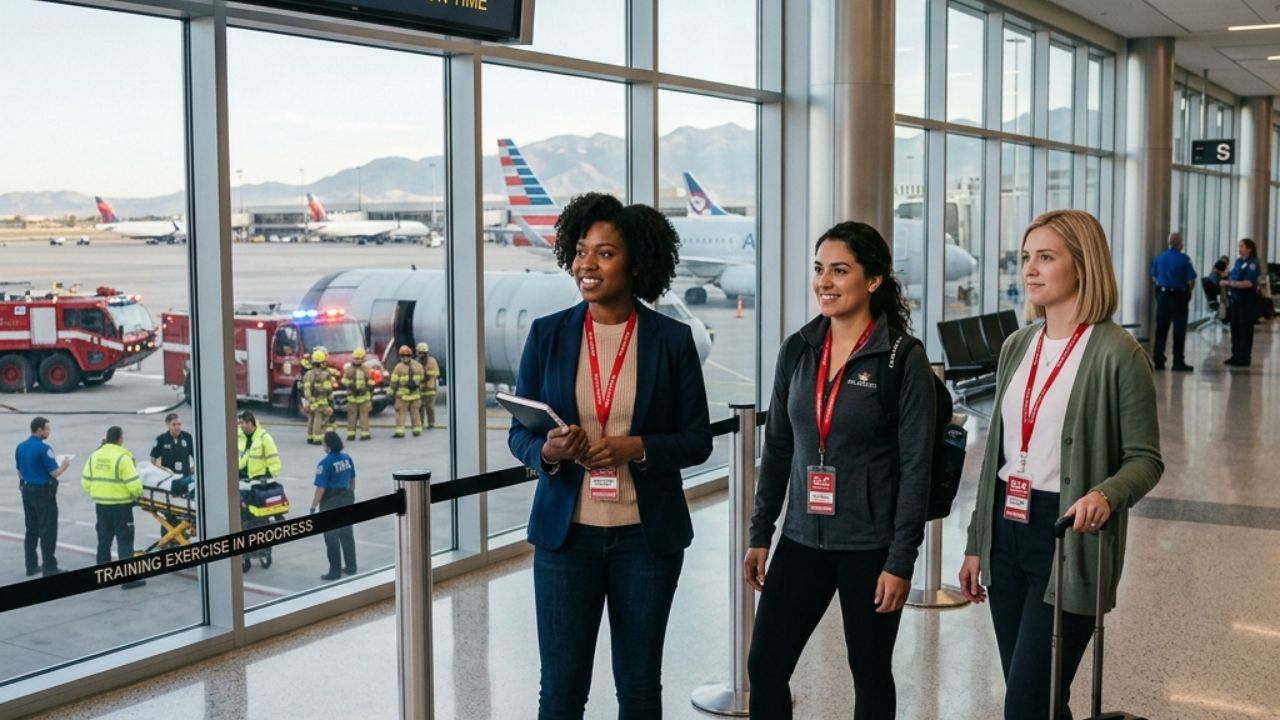
Image generated by AI
A Flawless Defense Against Aviation Disaster
While the broader global aviation network frequently collapses under the terrifying weight of sudden flight cancellations, unpredictable terminal emergencies, and systemic travel chaos, the United States aviation infrastructure is aggressively proving its resilience. Delivering highly critical, reassuring airline news, industry officials have confirmed the successful execution of a massive, full-scale FAA-mandated emergency drill at Salt Lake City International Airport (SLC). While desperate passengers at overseas mega-hubs attempt to dodge devastating airport disruptions and severely delayed connections, these exclusive aviation updates reveal that major carriers—including United, Delta, American, Southwest, Alaska, and JetBlue—united in a flawless display of multi-agency coordination. By deliberately simulating a catastrophic medium-sized commercial aircraft crash on the tarmac, this terrifyingly realistic exercise aggressively guarantees that travelers arriving from Canada, Mexico, the United Kingdom, Germany, India, and Australia can transit safely and efficiently through highly critical U.S. hubs like SLC, LAX, ORD, DFW, and ATL.
Expanded Overview: Orchestrating the Ultimate Crisis Response
The strategic execution of this massive emergency drill serves as undeniable proof of the extreme operational standards required to manage a modern aviation mega-hub. Historically, when localized airport emergencies occur—such as severe tarmac accidents or terminal fires—the resulting bottleneck completely destroys the stability of the entire national network, instantly stranding thousands of passengers.
To completely eradicate this threat, FAA regulations legally mandate that primary airports execute these highly intense, full-scale validations every three years. At SLC, the operation was staggering in its scale; over 200 participants, including federal agencies, specialized helicopter units, and highly trained local responders violently descended upon the simulated crash site. Volunteers actively portraying injured passengers were utilized to brutally test real-time fire suppression, complex medical triage, and structural rescue operations. By heavily integrating airline operational teams directly with local fire departments, the drill ensures that if a real-world disaster strikes, the immediate response will be overwhelmingly rapid, completely preventing the secondary wave of systemic flight delays that ruins international itineraries.
Section-Wise Breakdown of the Safety Operation
The Multi-Agency Drill Execution
The absolute core of this operational victory is the flawless communication achieved between disparate emergency teams. Airline partners fiercely participated to guarantee their internal crisis management protocols integrate seamlessly with local incident command systems. This massive coordination actively aims to reduce real-world operational disruption, massively accelerating crisis response times. In an era where a single closed runway can cascade into thousands of delayed flights nationwide, proving that an airport can instantly secure a crash site and safely restore parallel flight operations is the ultimate defense against aviation gridlock.
Defending Against Tourism Declines
This massive display of operational reliability arrives at a highly critical moment for the U.S. economy, which is currently battling a fierce drop in international inbound tourism. Verified government travel data confirms that in 2025, the United States suffered a terrifying loss of roughly 4 million international visitors compared to 2024, directly triggering a devastating 4.6% drop in tourism spending. The largest declines severely impacted crucial markets like Canada, Germany, and India. By aggressively publicizing the absolute safety and efficiency of U.S. airports, the aviation industry is frantically working to reverse this trend and lure highly lucrative overseas tourists back to American soil.
Restoring International Passenger Confidence
The financial stakes surrounding this emergency preparedness are monumental. Overseas visitors are highly valuable, spending nearly $1,950 per trip. In Q3 2025 alone, 12.3 million international travelers arrived by air, heavily reliant on the absolute safety of hubs like SLC. While the UK remains a massive European market, providing over 1.2 million arrivals, Australian outbound travel to the U.S. has suffered a troubling 5% decline. Airlines and airports are utilizing these successful drills to powerfully broadcast a message of supreme safety to these specific international demographics, proving that the U.S. aviation network is the most secure and well-managed system on the planet.
Inbound Tourism Metrics & Passenger Volumes Table
To fully comprehend the highly calibrated financial parameters that dictate the necessity of these massive airport safety drills, the following table explicitly details the core international visitor volumes and demographic shifts currently driving U.S. aviation policy:
| Target International Market | Tourism & Arrival Metrics (Based on 2025 Data) |
|---|---|
| Canada | Historically the largest market; saw 1.7 million Q3 air arrivals despite significant annual declines |
| Mexico | Saw 968,000 Q3 air arrivals; modest growth offset broader international declines |
| United Kingdom | Massive European source market delivering over 1.2 million air arrivals in Q3 |
| Japan, Germany & India | Remain highly critical, top-tier overseas source markets for long-haul U.S. travel |
| Australia | Highly lucrative long-haul market currently suffering a 5% decline in outbound U.S. travel |
| Total Q3 2025 Arrivals | 12.3 million total international air arrivals processed safely through U.S. gateways |
| Economic Value | Overseas visitors inject massive revenue, averaging nearly $1,950 in spending per trip |
Passenger Impact: Navigating the Terminal with Absolute Confidence
For the modern international commuter and tourist, the passenger impact of these highly intense safety validations is emotionally liberating. The modern demographic is increasingly demanding absolute logistical reliability, actively turning away from travel itineraries routed through disorganized, politically unstable, or poorly managed foreign transit hubs.
While the actual FAA-mandated drill is perfectly isolated and does not cause a single scheduled flight delay, the psychological reassurance it provides to the passenger is massive. Travelers arriving from Europe or Asia can transit through SLC knowing that every emergency protocol has been recently and violently tested. However, aviation experts still fiercely recommend that passengers actively protect their own itineraries by obsessively checking flight statuses during peak seasons, maintaining highly flexible connection times through massive hubs like LAX and DFW, and securing comprehensive travel insurance to survive any unrelated, weather-induced disruptions.
Industry Analysis: Reliability as the Ultimate Competitive Advantage
From a macroeconomic and industry operations perspective, SLC’s successful emergency drill highlights a highly strategic, incredibly fierce battle for global market share. Travel analysts argue that in a post-pandemic landscape severely plagued by economic hesitation and policy shifts, absolute operational reliability is the ultimate competitive advantage for any mega-hub.
Airports that heavily invest in aggressive emergency preparedness—backed directly by credible FAA government mandates—position themselves as the undisputed, elite gateways for global travelers. Salt Lake City International Airport fiercely maintains some of the highest on-time departure rates and lowest cancellation rates in the country. By consistently proving that it can seamlessly handle disaster scenarios without collapsing its commercial schedule, SLC ensures that massive global carriers like Delta and United will continue to funnel their most highly profitable international connecting traffic through its secure, highly efficient terminals.
Conclusion: A Highly Secure Horizon for U.S. Aviation
The flawless execution of the SLC Airport emergency drill is exponentially more than a routine regulatory requirement—it represents a massive, triumphant victory in the mission to completely secure and stabilize international travel into the United States. By perfectly matching intense, full-scale tactical response coordination with the vast operational resources of major U.S. airlines, the aviation sector has proven that it is fiercely committed to protecting its passengers from both physical danger and severe logistical chaos. As legacy hubs in other parts of the world continue to drown in devastating delays and massive operational failures, the U.S. domestic network stands as a highly anticipated sanctuary of safety and efficiency, guaranteeing a magnificent, chaos-free journey for millions of global tourists.
Key Takeaways
- Massive Tactical Drill: SLC Airport successfully executed a highly intense, FAA-mandated emergency drill simulating a medium-sized commercial aircraft crash.
- Major Airline Integration: United, Delta, American, Southwest, Alaska, and JetBlue actively participated to flawlessly sync airline operations with local emergency responders.
- Zero Flight Delays: The full-scale, 200-person exercise was brilliantly isolated from commercial traffic, causing absolutely zero disruptions to scheduled passenger flights.
- Battling Tourism Declines: The massive display of safety actively aims to restore passenger confidence following a terrifying 4 million visitor drop in U.S. inbound tourism in 2025.
- Protecting Global Connections: The drill forcefully guarantees the safety of highly lucrative international travelers from Canada, the UK, Germany, and Australia transiting through massive U.S. mega-hubs.
Disclaimer: The emergency response protocols, inbound tourism statistics, and specific passenger arrival metrics presented in this report are based on official FAA regulations, SLC Airport communications, and 2025 U.S. government travel data. Network capacity adjustments, specific airport safety policies, and international travel visa requirements are extremely volatile and subject to continuous change. International travelers routing through the United States are urgently advised to ensure they possess all necessary travel documentation and monitor their specific booking status directly via their airline's official portal.
Disclaimer
This article is for informational and educational purposes only. It does not constitute legal, financial, or professional advice. While we strive to provide accurate and up-to-date information, travel policies, regulations, and conditions change rapidly. Always verify information with official sources before making travel decisions. Nomad Lawyer makes no representations about the accuracy, reliability, completeness, or suitability of the information provided. Readers should consult qualified professionals for advice specific to their circumstances. The views expressed in this article are those of the author and do not necessarily reflect the views of Nomad Lawyer.
Kunal K Choudhary
Co-Founder & Contributor
A passionate traveller and tech enthusiast. Kunal contributes to the vision and growth of Nomad Lawyer, bringing fresh perspectives and driving the community forward.
Learn more about our team →