
Sharjah International Airport Faces Travel Turmoil With 67 Flight Delays and 3 Cancellations Across 35 Global Cities
Operational disruptions at Sharjah International Airport have resulted in 67 flight delays and 3 cancellations, impacting travel to Egypt, Germany, Bahrain, and beyond.

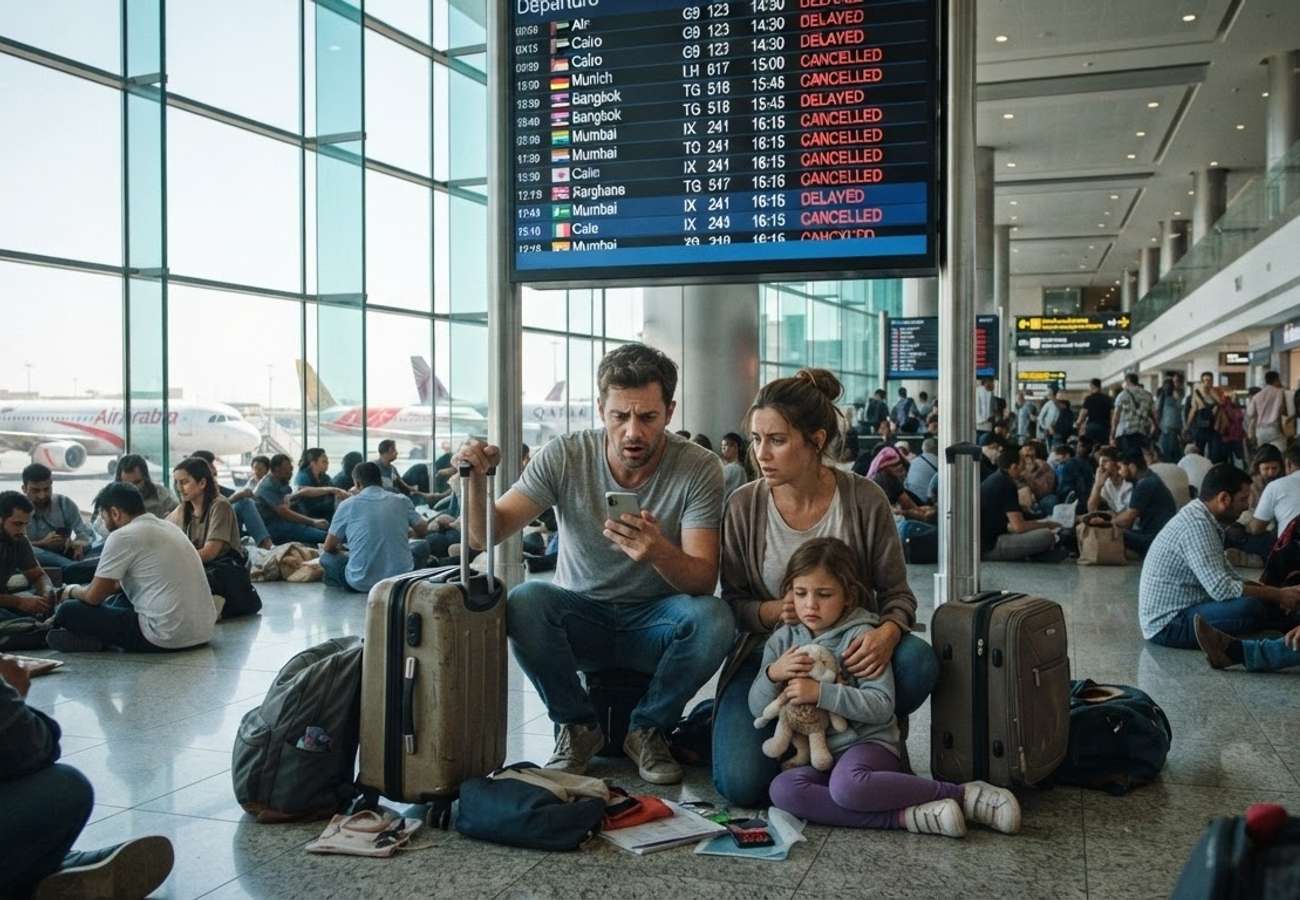
Image generated by AI
[Sharjah, July 9, 2026] — Operational instability at Sharjah International Airport has triggered significant travel turmoil, resulting in 67 flight delays and 3 total cancellations. The disruption is currently impacting passengers traveling to and from major urban centers in Egypt, Germany, Bahrain, Greece, and Jordan, among other international destinations.
The scale of the disturbance underscores the vulnerability of regional aviation hubs, where a localized operational bottleneck can create a ripple effect across global networks. As a primary gateway for budget travel and regional connectivity within the United Arab Emirates, any instability at Sharjah International Airport (SHJ) immediately affects a diverse array of international markets.
Global Reach of Sharjah Airport Disruptions
The operational challenges at the hub have radiated outward, affecting flight schedules in 35 different cities. The geographic spread of these disruptions is extensive, spanning the Middle East, South Asia, Southeast Asia, Europe, and North Africa.
Impacted destinations include major hubs such as Bangkok, Cairo, Munich, Moscow, and Doha. Specifically, travelers heading to or from the following cities have experienced schedule changes:
- Middle East & North Africa: Bahrain, Amman, Beirut, Baghdad, Erbil, Aleppo, Damascus, Doha, Cairo, Alexandria, and Dammam.
- Asia: Bangkok, Phuket, Islamabad, Karachi, Tashkent, Colombo, Chattogram, Dhaka, Delhi, Kozhikode, Goa, Mumbai, and Jaipur.
- Europe & Eurasia: Krakow, Bergamo, Munich, Moscow, Yerevan, and Tbilisi.
- Regional: Abha and Medina.
This wide distribution demonstrates how a concentrated period of turmoil at a single UAE facility can disrupt business schedules and holiday plans across four continents.
Air Arabia and Other Carriers Facing Operational Pressure
Data indicates that Air Arabia has borne the brunt of the operational failures. As the primary carrier operating out of the hub, Air Arabia recorded 51 delays and 3 cancellations, the highest volume of any airline involved in the disruption.
While Air Arabia faced the most severe impact, several other international and regional carriers reported delays, although they managed to avoid total flight cancellations. These airlines include:
- South Asian Carriers: Air India Express, Biman Bangladesh Airlines, Fly Jinnah, and US-Bangla Airlines.
- Middle Eastern Carriers: Qatar Airways, Royal Jordanian, Air Cairo, Nile Air, and Pakistan International Airlines.
- Other Operators: Fly Cham.
Industry observers note that while the number of outright cancellations remained low, the high volume of delays suggests a systemic operational struggle rather than isolated aircraft failures.
Breakdown of Flight Cancellations and Delays
The following data provides a detailed look at the operational impact per airline based on flight tracking reports.
| Airline | Cancelled Flights | Delayed Flights |
|---|---|---|
| Air Arabia | 3 | 51 |
| Air India Express | 0 | 3 |
| Biman Bangladesh Airlines | 0 | 1 |
| Fly Jinnah | 0 | 2 |
| Fly Cham | 0 | 2 |
| Air Cairo | 0 | 1 |
| Nile Air | 0 | 1 |
| Pakistan International Airlines | 0 | 1 |
| Qatar Airways | 0 | 2 |
| Royal Jordanian | 0 | 2 |
| US-Bangla Airlines | 0 | 1 |
Analysis of Airport-Specific Impacts
While the majority of the turmoil manifested as delays, a small number of total cancellations occurred across a few specific airports. Sharjah International Airport (SHJ) was the epicenter, accounting for 3 of the total cancellations.
Other facilities that recorded a single cancellation include:
- Suvarnabhumi Bangkok International (BKK)
- Domodedovo International (DME)
- Alexandria International Airport (HBE)
The concentration of delays over cancellations suggests that airlines are attempting to maintain their schedules despite operational headwinds, opting for late departures rather than removing flights from the board entirely.
Passenger Guidance for Managing Flight Disruptions
For travelers caught in the current turmoil, aviation experts recommend a proactive approach to minimize stress and financial loss.
Immediate Actions for Passengers Travelers should prioritize real-time communication. Monitoring official airline apps, email notifications, and SMS alerts is essential for receiving rebooking confirmations. If already at the terminal, passengers are encouraged to visit the airline service desk immediately. Those not yet at the airport should utilize online chat systems to avoid lengthy phone queues.
Understanding Passenger Rights It is essential for travelers to review the specific terms and conditions of their ticket. Depending on the jurisdiction, passengers may be entitled to compensation or duty-of-care provisions (such as meals and hotel vouchers). For instance, flights departing from or arriving in the EU under certain conditions may trigger compensation rights under regional aviation laws.
Exploring Alternatives If a cancellation occurs, passengers should request the next available flight. In cases where the airline cannot provide a timely alternative, travelers may need to investigate booking separate tickets with other carriers or utilizing alternative transport such as rail or bus networks for shorter regional legs.
Why This Matters: The Aviation Perspective
The situation at Sharjah International Airport serves as a critical case study in "hub fragility." When a high-volume, low-cost hub experiences a spike in delays, the impact is not limited to the local terminal but cascades across a vast network of secondary cities.
Because Sharjah serves as a vital link for labor migration and budget tourism between South Asia and the Middle East, disruptions here have a disproportionate effect on "VFR" (Visiting Friends and Relatives) travel. Unlike premium hubs where passengers may have more flexibility, budget travelers often operate on tighter margins and tighter connection windows.
The fact that 67 flights were delayed while only 3 were cancelled indicates a high level of operational resilience in terms of capacity, but a failure in punctuality. This suggests that the issue may be related to ground handling, air traffic congestion, or staffing rather than fleet grounding. For the broader industry, this highlights the need for increased buffer times in scheduling for regional hubs to prevent localized delays from becoming international crises.
Passengers are advised to confirm all departure times with their respective airlines before proceeding to the airport.
Related Travel Guides
Disclaimer
This article is for informational and educational purposes only. It does not constitute legal, financial, or professional advice. While we strive to provide accurate and up-to-date information, travel policies, regulations, and conditions change rapidly. Always verify information with official sources before making travel decisions. Nomad Lawyer makes no representations about the accuracy, reliability, completeness, or suitability of the information provided. Readers should consult qualified professionals for advice specific to their circumstances. The views expressed in this article are those of the author and do not necessarily reflect the views of Nomad Lawyer.
Kunal K Choudhary
Co-Founder & Contributor
A passionate traveller and tech enthusiast. Kunal contributes to the vision and growth of Nomad Lawyer, bringing fresh perspectives and driving the community forward.
Learn more about our team →