
Severe Weather Cancels 150 Flights and Delays 4,147 Across Asia as China, Bangladesh, Turkey, Singapore, and Russia Face Massive Aviation Gridlock
Severe Weather Cancels 150 Flights and Delays 4,147 Across Asia as China, Bangladesh, Turkey, Singapore, and Russia Face

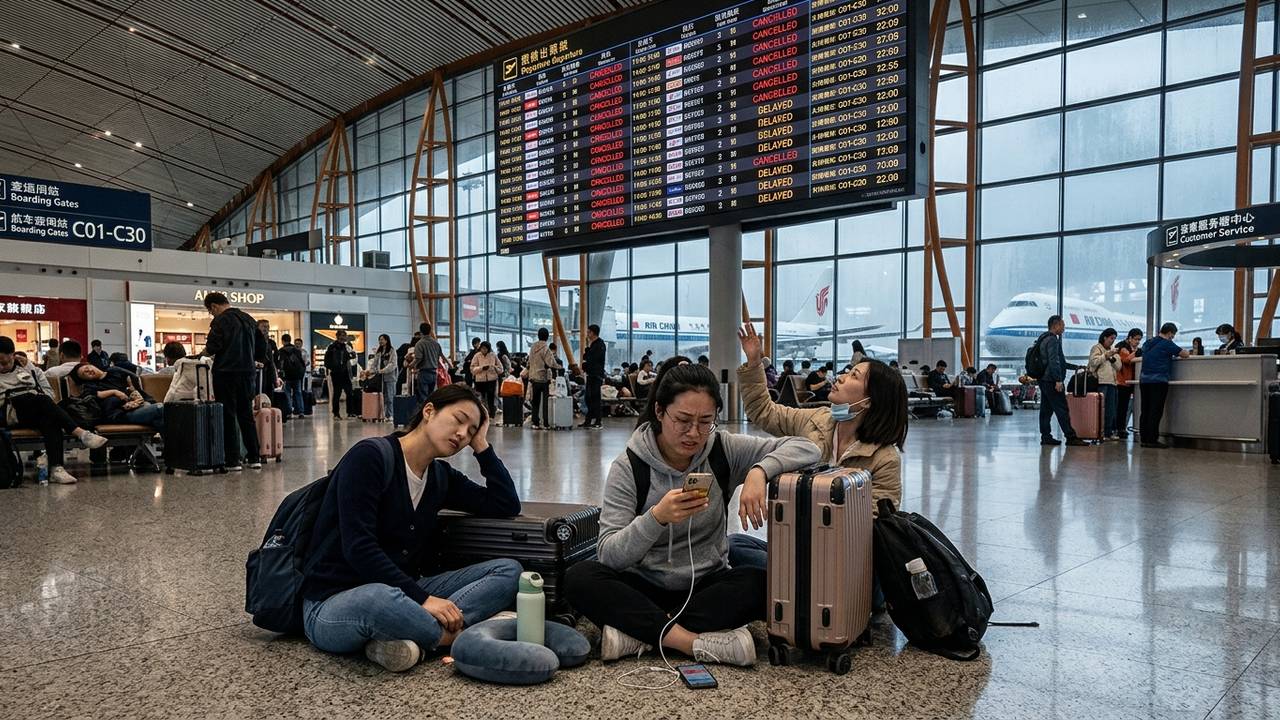
Image generated by AI
[Beijing, June 28, 2026] — A wave of severe weather systems sweeping across Asia has forced the cancellation of 150 flights and delayed 4,147 more, stranding thousands of travelers at major international airports from Tokyo to St. Petersburg. Torrential rainstorms and heavy snowfall across Japan, China, and Russia have crippled operations at dozens of hubs, directly impacting carriers including Hainan Airlines, ANA Wings, Uzbekistan Airways, IndiGo, and numerous others. Aviation authorities across China, Bangladesh, Turkey, Singapore, and Russia are scrambling to clear unprecedented backlogs as displaced aircraft remain stranded on tarmacs and ground crews work around the clock.
Severe Weather Triggers Asia-Wide Aviation Paralysis
Unpredictable weather patterns have descended on multiple regions simultaneously, creating a compounding crisis for airlines and airport operators. Rainstorms lashed Japan while snowfall blanketed parts of China and Russia, creating hazardous conditions for both arrivals and departures. The sheer scale of the disruption has overwhelmed standard contingency protocols at several major gateways.
Aggregated data from primary aviation hubs confirms 150 total cancellations and 4,147 total delays across airport operations. Carrier-specific figures paint an equally grim picture, with 113 cancellations and 3,116 delays recorded directly against prominent airlines. The gap between airport-level and airline-level figures reflects the cascading nature of the crisis — a single cancelled flight at one hub triggers delays across multiple downstream connections.
Industry sources indicate that the operational paralysis is intensifying by the hour as backlogs accumulate. Ground crews are stretched thin, and displaced planes are occupying gates and tarmac space needed for incoming flights. Airlines are urging passengers to check departure statuses digitally before traveling to airports, as customer service counters face overwhelming demand.
Tokyo and Japanese Airports Bear Heaviest Delay Burden
Japan has absorbed the most severe scheduling damage of any single country. Tokyo Haneda (HND) recorded 529 delays alongside 11 cancellations — the highest delay count at any individual airport in the dataset. The disruption extends well beyond the capital, however.
Osaka Itami (ITM) logged 4 cancellations and 94 delays, while Fukuoka (FUK) reported 2 cancellations and 65 delays. These figures confirm that the weather system's impact is distributed across the entire Japanese archipelago rather than concentrated in one metropolitan zone. Japanese carriers are working to reposition aircraft and crew, but the widespread nature of the disruption limits the availability of backup resources.
Beijing and Chinese Megacities Face Cancellations and Triple-Digit Delays
China's aviation network has been hit across an extraordinary number of cities, reflecting the geographic breadth of the weather event. Beijing's two primary gateways both reported significant strain: Beijing Capital (PEK) suffered 14 cancellations — the highest individual cancellation rate at any airport — along with 218 delays. Beijing Daxing (PKX) managed a lighter load but still logged 2 cancellations and 115 delays.
Xi'an Xianyang (XIY) experienced 8 cancellations and a massive 278 delays, making it one of the most congested non-capital hubs. Shenzhen Bao'an (SZX) saw 2 cancellations paired with 268 delays. Shanghai's dual-gateway system was equally pressured, with Shanghai Pudong (PVG) recording 3 cancellations and 264 delays, and Shanghai Hongqiao (SHA) handling 2 cancellations and 110 delays.
Chengdu's two airports created a severe bottleneck in Southwestern China collectively: Chengdu Tianfu (TFU) reported 4 cancellations and 222 delays, while Chengdu Shuangliu (CTU) added 2 cancellations and 48 delays. Several regional centers posted triple-digit delay counts, including Nanjing Lukou (NKG) with 2 cancellations and 139 delays, Wuhan Tianhe (WUH) with 4 cancellations and 125 delays, and Lanzhou Zhongchuan (LHW) with 4 cancellations and 118 delays.
Chongqing Jiangbei (CKG) recorded 2 cancellations and 92 delays. Coastal and leisure gateways were not spared: Haikou Meilan (HAK) reported 8 cancellations and 79 delays, Tianjin Binhai (TSN) noted 8 cancellations and 65 delays, and Zhuhai (ZUH) dealt with 6 cancellations and 66 delayed flights.
Southeast and South Asian Hubs Report Growing Backlogs
Beyond East Asia, the disruption has rippled into Southeast and South Asian operations. Kuala Lumpur (KUL), Malaysia's principal gateway, registered 5 cancellations and 184 delays. Dhaka's Shahjalal International (DAC) in Bangladesh logged 2 cancellations and 23 delays. Bengaluru (BLR) in India handled 2 cancellations and 55 delays, reflecting friction at one of the country's busiest tech-corridor airports.
These figures suggest that the weather-driven disruption in East Asia is propagating through connecting flight networks across the broader continent, as delayed or cancelled inbound aircraft cause downstream scheduling failures at hubs that are themselves operating under clear skies.
Middle East, Turkey, and Russian Gateways Absorb Transcontinental Strain
The transcontinental network stretching west from Asia has experienced significant disruption as well. Dubai (DXB) in the United Arab Emirates recorded 6 cancellations and 101 delays. Antalya (AYT), Turkey's major holiday gateway, noted 8 cancellations and 162 delays — a sharp figure that underscores the vulnerability of leisure-focused routes to schedule instability.
Russia's capital region was strained across two airports: Sheremetyevo (SVO) reported 2 cancellations and 38 delays, while Vnukovo (VKO) logged 7 cancellations and 32 delays. St. Petersburg's Pulkovo (LED) saw 8 cancellations and 75 delays, confirming that the weather system's reach extends deep into Russian airspace.
Carrier-by-Carrier Breakdown: China Eastern Leads Delays, Air China Tops Cancellations
When examining the specific airlines absorbing these operational shocks, the data reveals stark contrasts. China Eastern recorded 741 delays — the highest of any carrier in the dataset — alongside 11 cancellations. Air China bore the highest volume of outright cancellations at 23, while accumulating 282 delays. Hainan Airlines followed with 17 cancellations and 181 delays.
Japan's major carriers were heavily impacted. Japan Airlines logged 6 cancellations and 266 delays. All Nippon Airways (ANA) recorded 1 cancellation and 180 delays. ANA Wings faced 1 cancellation and 97 delays. Budget and regional operators across China also absorbed compounding schedule failures: Spring Airlines reported 6 cancellations and 173 delays, China Express Airlines marked 1 cancellation and 143 delays, and Juneyao Airlines reported 1 cancellation and 107 delays.
Additional Chinese carriers dealing with disrupted operations included Shanghai Airlines (1 cancellation, 70 delays), Tianjin Airlines (1 cancellation, 54 delays), Tibet Airlines (1 cancellation, 54 delays), Lucky Air (1 cancellation, 44 delays), and Dalian Airlines (1 cancellation, 12 delays).
Southeast Asian operators stuttered as well. AirAsia logged 5 cancellations and 89 delays. Lion Air posted 1 cancellation and 69 delays. Batik Air faced 1 cancellation and 34 delays. Scoot, operating from Singapore, dealt with 1 cancellation and 34 delays.
In South Asia, IndiGo absorbed 177 delays alongside 2 cancellations. US-Bangla Airlines experienced 5 cancellations and 15 delays. Bangkok Airways handled 2 cancellations and 26 delays. Pakistan International Airlines managed 1 cancellation and 13 delays.
Middle Eastern and Central Asian carriers reported their own disruptions. FlyDubai (UAE) split its issues with 4 cancellations and 23 delays, while Emirates (UAE) kept cancellations to 1 but recorded 53 delays. Flynas (Saudi Arabia) tracked 1 cancellation and 37 delays. Air Arabia reported 1 cancellation and 18 delays. Uzbekistan Airways recorded 1 cancellation and 10 delays.
Russian operators Rossiya Airlines faced 9 cancellations and 42 delays, while UTair dealt with 2 cancellations and 25 delays.
Airport Disruption Data Table
| Airport (IATA) | City | Country | Cancellations | Delays |
|---|---|---|---|---|
| Haneda (HND) | Tokyo | Japan | 11 | 529 |
| Itami (ITM) | Osaka | Japan | 4 | 94 |
| Fukuoka (FUK) | Fukuoka | Japan | 2 | 65 |
| Beijing Capital (PEK) | Beijing | China | 14 | 218 |
| Beijing Daxing (PKX) | Beijing | China | 2 | 115 |
| Xi'an Xianyang (XIY) | Xi'an | China | 8 | 278 |
| Shenzhen Bao'an (SZX) | Shenzhen | China | 2 | 268 |
| Shanghai Pudong (PVG) | Shanghai | China | 3 | 264 |
| Shanghai Hongqiao (SHA) | Shanghai | China | 2 | 110 |
| Chengdu Tianfu (TFU) | Chengdu | China | 4 | 222 |
| Chengdu Shuangliu (CTU) | Chengdu | China | 2 | 48 |
| Nanjing Lukou (NKG) | Nanjing | China | 2 | 139 |
| Wuhan Tianhe (WUH) | Wuhan | China | 4 | 125 |
| Lanzhou Zhongchuan (LHW) | Lanzhou | China | 4 | 118 |
| Chongqing Jiangbei (CKG) | Chongqing | China | 2 | 92 |
| Haikou Meilan (HAK) | Haikou | China | 8 | 79 |
| Tianjin Binhai (TSN) | Tianjin | China | 8 | 65 |
| Zhuhai (ZUH) | Zhuhai | China | 6 | 66 |
| Kuala Lumpur (KUL) | Kuala Lumpur | Malaysia | 5 | 184 |
| Shahjalal Int'l (DAC) | Dhaka | Bangladesh | 2 | 23 |
| Bengaluru (BLR) | Bengaluru | India | 2 | 55 |
| Dubai (DXB) | Dubai | UAE | 6 | 101 |
| Antalya (AYT) | Antalya | Turkey | 8 | 162 |
| Sheremetyevo (SVO) | Moscow | Russia | 2 | 38 |
| Vnukovo (VKO) | Moscow | Russia | 7 | 32 |
| Pulkovo (LED) | St. Petersburg | Russia | 8 | 75 |
Airline Disruption Data Table
| Airline | Cancellations | Delays |
|---|---|---|
| China Eastern | 11 | 741 |
| Air China | 23 | 282 |
| Hainan Airlines | 17 | 181 |
| Japan Airlines | 6 | 266 |
| All Nippon Airways (ANA) | 1 | 180 |
| ANA Wings | 1 | 97 |
| Spring Airlines | 6 | 173 |
| China Express Airlines | 1 | 143 |
| Juneyao Airlines | 1 | 107 |
| Shanghai Airlines | 1 | 70 |
| Tianjin Airlines | 1 | 54 |
| Tibet Airlines | 1 | 54 |
| Lucky Air | 1 | 44 |
| Dalian Airlines | 1 | 12 |
| AirAsia | 5 | 89 |
| Lion Air | 1 | 69 |
| Batik Air | 1 | 34 |
| Scoot | 1 | 34 |
| IndiGo | 2 | 177 |
| US-Bangla Airlines | 5 | 15 |
| Bangkok Airways | 2 | 26 |
| Pakistan International Airlines | 1 | 13 |
| FlyDubai | 4 | 23 |
| Emirates | 1 | 53 |
| Flynas | 1 | 37 |
| Air Arabia | 1 | 18 |
| Uzbekistan Airways | 1 | 10 |
| Rossiya Airlines | 9 | 42 |
| UTair | 2 | 25 |
What Affected Passengers Should Do Now
Travelers caught in this disruption face extended wait times and uncertain schedules. Several practical steps can help mitigate the impact.
Use mobile apps for rebooking. Rather than standing in long queues at airport service desks, passengers should log into their airline's mobile application immediately. Carriers such as China Eastern, Air China, and Japan Airlines frequently push instant rebooking options directly to digital profiles during mass delay events. Digital channels are operating faster than in-person counters under current conditions.
Explore alternative routing. With major gateways like Tokyo Haneda, Beijing Capital, and Shenzhen Bao'an heavily backlogged, passengers should ask agents to search for flights through less-impacted nearby regional airports. In multi-hub cities like Shanghai, switching between Pudong (PVG) and Hongqiao (SHA) may yield available seats if one gateway is more congested than the other.
Request official delay documentation. Passengers experiencing extended delays — especially those flying carriers with triple-digit delay counts like IndiGo, Spring Airlines, or China Express — should request an official delay certificate from gate agents. This document is essential for filing travel insurance claims and seeking compensation under applicable consumer protection regulations.
Retain all receipts. Travelers should keep detailed, itemized receipts for any out-of-pocket expenses incurred during unexpected layovers, including meals, ground transportation, and hotel accommodations. Many international consumer protection frameworks require airlines to reimburse these costs when the disruption falls within the carrier's operational control.
Impact Analysis: Cascading Failures Across an Interconnected Network
The data reveals a crisis that extends far beyond the regions where weather is actively severe. The 150 cancellations and 4,147 delays documented across this event illustrate how tightly interconnected the Asian aviation network has become. A weather system centered on Japan, China, and Russia has produced measurable disruptions in Bangladesh, Malaysia, India, Turkey, the UAE, and Singapore — countries where skies are largely clear.
This propagation occurs because aircraft and crew do not reset between regions. A plane delayed departing Tokyo will arrive late at its next destination, which may be Kuala Lumpur or Dubai. That late arrival then delays the next departure from that hub, creating a chain reaction that can persist for 24 to 48 hours after the original weather event clears.
The carrier data underscores the scale of this problem. China Eastern's 741 delays alone represent a fleet-wide operational crisis that will take days to unwind. Air China's 23 cancellations mean 23 aircraft and their assigned crews are out of position, creating downstream gaps in the schedule. When these figures are combined across all affected carriers, the recovery timeline stretches well beyond the weather event itself.
Why This Matters: The Vulnerability of Dense Aviation Networks
This event exposes a structural weakness in modern aviation. The concentration of traffic through a small number of mega-hubs — Tokyo Haneda, Beijing Capital, Shanghai Pudong, Dubai — means that disruption at any single node can cascade across an entire continental network. When multiple hubs are hit simultaneously, as happened here, the system loses its ability to reroute passengers through unaffected alternatives.
The data also highlights the disproportionate impact on budget carriers. Spring Airlines, AirAsia, Lion Air, and Scoot all posted significant delay and cancellation counts. These airlines operate with tighter turnarounds and thinner schedule buffers than legacy carriers, making them more vulnerable to weather-driven disruptions. Passengers on budget carriers may face longer recovery times because these airlines have fewer spare aircraft and crew available to absorb schedule shocks.
For the broader travel industry, this event serves as a stress test. Hotels, ground transportation providers, and travel insurance companies in affected cities are all dealing with surging demand from stranded passengers. The economic cost of a single day of disruption at this scale — measured in passenger compensation, lost revenue, and operational recovery expenses — runs into the tens of millions of dollars.
The event also raises questions about climate resilience in aviation infrastructure. As severe weather events become more frequent and less predictable, airports and airlines may need to invest in more robust contingency planning, larger schedule buffers, and improved passenger communication systems to prevent the kind of system-wide paralysis documented in this data.
Related Travel Guides
Disclaimer
This article is for informational and educational purposes only. It does not constitute legal, financial, or professional advice. While we strive to provide accurate and up-to-date information, travel policies, regulations, and conditions change rapidly. Always verify information with official sources before making travel decisions. Nomad Lawyer makes no representations about the accuracy, reliability, completeness, or suitability of the information provided. Readers should consult qualified professionals for advice specific to their circumstances. The views expressed in this article are those of the author and do not necessarily reflect the views of Nomad Lawyer.
Raushan Kumar
Founder & Lead Developer
Full-stack developer with 11+ years of experience and a passionate traveller. Raushan built Nomad Lawyer from the ground up with a vision to create the best travel and law experience on the web.
Learn more about our team →