UAE Elevates Aviation Safety as Serco Secures First GCAA Aerodrome Training Certification

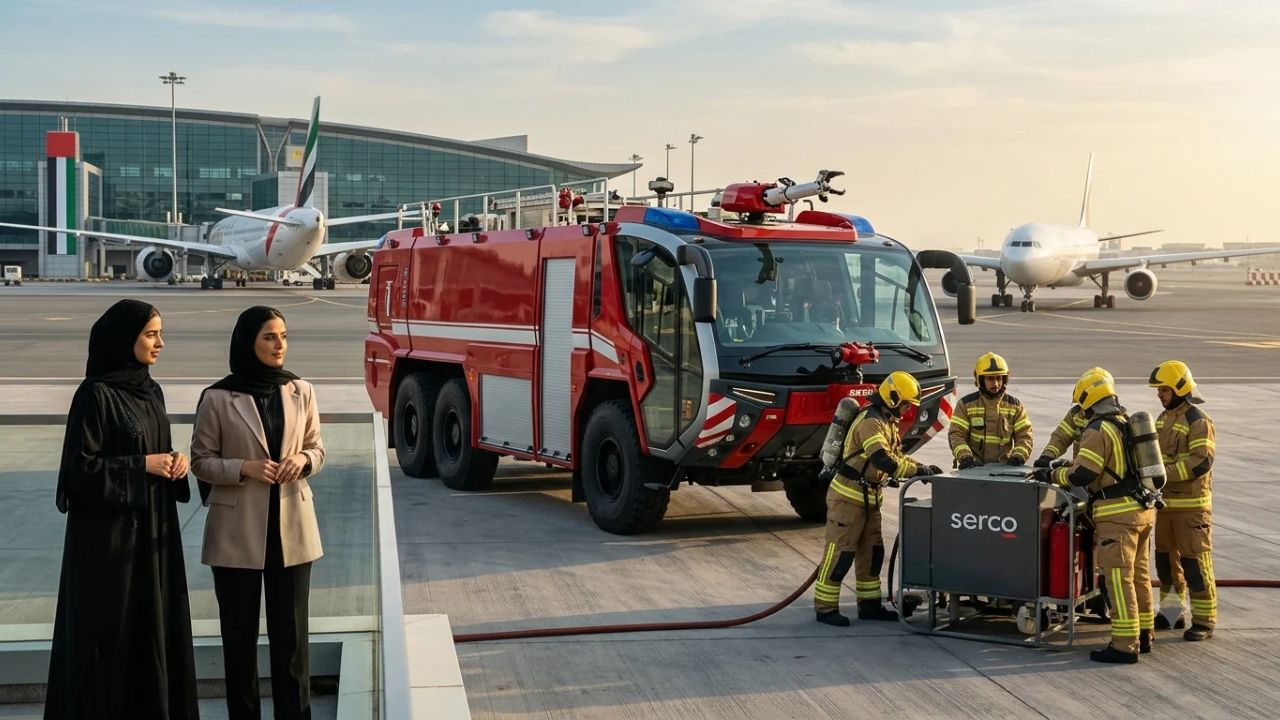
The UAE General Civil Aviation Authority has certified Serco as the first accredited aerodrome training provider under its new national safety framework.
ABU DHABI, November 2, 2026 — The United Arab Emirates has established a major regulatory precedent in international civil aviation safety, with the General Civil Aviation Authority (GCAA) officially accrediting Serco as the nation's first certified aerodrome training provider under an updated national framework. The landmark certification authorizes Serco to conduct specialized instruction and competency-based evaluations for Aerodrome Rescue and Firefighting Services (ARFFS) personnel across operational, supervisory, and managerial roles, creating a unified standard of emergency preparedness across the country's rapidly expanding airport network.
[!NOTE] The GCAA's newly enacted regulatory structure mandates standardized, competency-based qualifications for all airport emergency response personnel across the UAE. The accreditation ensures that frontline emergency teams at mega-hubs including Dubai International (DXB), Zayed International (AUH), and Al Maktoum International (DWC) comply with the highest international safety thresholds established by the International Civil Aviation Organization (ICAO).
GCAA AERODROME RESCUE & FIREFIGHTING (ARFFS) TRAINING ARCHITECTURE
| Column 1 |
|---|
| Operational Level Supervisory Level Managerial / Command Level |
| * Structural Aircraft Fire * Tactical Crew Leadership * Incident Command System |
| * Rapid Intervention * Multi-Vehicle Deployment * Crisis Management Protocol |
| * Hazardous Material Ops * Airfield Dynamic Triage * Inter-Agency Coordination |
| * Evacuation Management * Resource Logistics Control * Regulatory Compliance Audit |
| Accreditation Authority: UAE General Civil Aviation Authority (GCAA) |
| Certified Provider: Serco Middle East (First Authorized Entity Under New Framework) |
National Aviation Safety Architecture: The GCAA's Strategic Regulatory Shift
The formal certification of Serco represents a pivotal transition in how the United Arab Emirates governs emergency response preparedness across its commercial and military airfields. Historically, aerodrome rescue and firefighting training across the Gulf region relied on a mixture of internal airport operator drills, third-party overseas academies, and vendor-specific operational certifications. While these disparate mechanisms maintained operational readiness, the accelerating pace of aviation infrastructure expansion across the UAE necessitated a centralized, nationally accredited framework governed directly by federal civil aviation regulators.
Under the new regulatory structure, the GCAA has replaced fragmented qualification mechanisms with an integrated, competency-based qualification framework. This framework defines explicit learning objectives, psychomotor skill evaluations, and tactical leadership benchmarks that every emergency responder must satisfy before assuming operational responsibilities on an active aerodrome. By establishing standardized curricula, the GCAA ensures that an emergency specialist qualified at a regional airfield in Ras Al Khaimah possesses identical tactical competencies, procedural discipline, and command familiarity as a responder stationed at Dubai International.
This regulatory evolution aligns directly with the UAE's broader ambition to maintain its standing as the world's preeminent intercontinental aviation crossroads. With commercial air traffic across UAE airspace climbing toward record levels and international transit passengers exceeding 100 million annually, aerodrome safety serves as the foundational bedrock underpinning consumer confidence, airline flight frequency commitments, and sovereign aviation prestige.
The regulatory standard established by the GCAA directly reinforces the UAE's stellar performance under the International Civil Aviation Organization's Universal Safety Oversight Audit Programme (USOAP). In successive multilateral audits, the Emirates has achieved among the highest safety implementation scores globally, frequently exceeding 98% compliance across critical elements of civil aviation oversight. By integrating ARFFS training into the National Aviation Safety Plan (NASP) and the federal State Safety Programme (SSP), aviation authorities have established continuous regulatory feedback loops that systematically identify operational vulnerabilities and mandate immediate curriculum revisions across all certified training centers.
This comprehensive oversight encompasses not only primary international gateways but also vital secondary and specialized aerodromes distributed across the seven emirates. Facilities including Ras Al Khaimah International Airport (RKT), Al Ain International Airport (AAN), and Fujairah International Airport (FJR)—alongside specialized executive facilities such as Al Bateen Executive Airport in Abu Dhabi—must maintain strict emergency response readiness tailored to their specific aircraft traffic mixes. Whether handling regional low-cost commercial carriers, heavy cargo charters, sovereign VIP flights, or flight training academies, each certified airfield benefits from standard operating procedures developed under this unified national framework.
Serco's Historic Accreditation: Scope Across Operational, Supervisory, and Management Tiers
Securing the inaugural accreditation under this stringent framework reinforces Serco's long-standing position as an elite public service provider and specialized aviation contractor in the Middle East. Under the terms of the GCAA certification, Serco is licensed to design, administer, and formally examine personnel across the entire hierarchy of airport rescue operations.
At the operational tier, the training curricula focus on the physical, technical, and psychological rigors of aviation firefighting. Trainees undergo intensive instruction in high-pressure foam application, aircraft fuselage breach tactics, hazardous material containment, and the tactical deployment of ultra-high-pressure water piercing systems. Operational firefighters are trained to navigate dense smoke environments within widebody aircraft cabins, execute rapid passenger extractions, and mitigate hydrocarbon pool fires fueled by volatile Jet A-1 aviation kerosene.
At the supervisory and managerial levels, the educational focus transitions to tactical dynamic risk assessment, multi-vehicle airside coordination, and strategic incident command. Supervisors master the art of staging major foam tenders (MFTs), rapid intervention vehicles (RIVs), and medical evacuation teams during complex airfield emergencies. Managers are trained to integrate airport fire response plans with municipal civil defense units, national emergency crisis and disaster management authorities (NCEMA), and international airline emergency response centers, ensuring absolute cohesion during large-scale crisis scenarios.
A defining characteristic of Serco's accredited curriculum is its integration of state-of-the-art simulation technology with demanding live-fire training modules. Training facilities incorporate computer-controlled propane-fired aircraft mockups that replicate full-scale structural fires across various aircraft configurations, including narrow-body fuselages, double-decker superjumbos, and widebody cargo transports. These specialized fire simulators allow instructors to generate realistic engine nacelle fires, landing gear brake fires, interior cabin flashovers, and complex cargo bay blazes in a controlled, repeatable environment without releasing carcinogenic pollutants into the surrounding atmosphere.
Specifically adapted for the Gulf region, the instructional programs place immense emphasis on human physiological resilience and heat stress management. Airport firefighters in the UAE regularly perform rigorous physical duties in ambient summer temperatures exceeding 45 degrees Celsius, compounded by high coastal humidity and radiant heat from burning jet fuel. Trainees must demonstrate mastery of air consumption protocols using positive-pressure Self-Contained Breathing Apparatus (SCBA), maintain situational awareness inside low-visibility thermal environments, and execute patient drag extractions while wearing heavy multi-layered structural firefighting turnout gear.
| Qualification Tier | Target Professional Cohort | Core Competency Focus Areas | Regulatory Assessment Methodology |
|---|---|---|---|
| Operational Tier | Frontline Firefighters, Rescue Specialists, Apparatus Drivers | Aircraft structural egress, Jet A-1 pool fire suppression, SCBA endurance, composite material hazards | Practical live-fire burn simulations, physical fitness benchmarks, written examinations |
| Supervisory Tier | Watch Commanders, Crew Chiefs, Sector Supervisors | Tactical resource allocation, airfield sectoring, communications discipline, dynamic risk assessment | Scenario-based tactical simulations, incident triage evaluations, operational drills |
| Managerial Tier | Fire Chiefs, Aerodrome Safety Directors, Operations Heads | Unified Incident Command (ICS), inter-agency disaster logistics, regulatory audit compliance, media protocol | Tabletop crisis exercises, comprehensive policy defenses, multi-agency coordination audits |
Aerodrome Rescue and Firefighting Services: Technical Standards and Modern Fleet Demands
Aerodrome Rescue and Firefighting Services occupy a unique operational niche within the global emergency services sector. Unlike conventional municipal structural firefighting, which contends primarily with burning timber, masonry, and residential synthetic materials, airport rescue teams operate in an environment characterized by extreme chemical volatility, immense fuel volumes, and tight temporal response constraints.
International aviation standards established under ICAO Annex 14 dictate that airport rescue services must achieve an emergency response time of two minutes—and not exceeding three minutes—to any point of each operational runway under optimal visibility and surface conditions. Achieving this rapid response standard requires high-performance, specialized apparatus. Modern ARFFS fleets across the UAE utilize multi-axle all-wheel-drive crash tenders capable of accelerating from zero to 80 kilometers per hour in under 25 seconds while carrying up to 12,000 liters of water, 1,500 liters of aqueous film-forming foam (AFFF), and hundreds of kilograms of dry chemical powder.
Operating these sophisticated vehicles requires specialized training that blends precision high-speed vehicle dynamics with advanced turret operations. Serco's accredited programs incorporate specialized driving simulators and live-vehicle handling courses designed to train drivers to maneuver 40-tonne tenders across active taxiways, runway safety areas (RSAs), and unpaved arresting beds without compromising vehicle stability or infringing upon non-incident aircraft flight paths.
Beyond vehicle dynamics, the modern emergency response curriculum reflects an industry-wide transition toward ecologically responsible fire suppression chemicals. Historically, aviation firefighting relied heavily on Aqueous Film-Forming Foam (AFFF) formulations containing persistent per- and polyfluoroalkyl substances (PFAS and PFOS). In alignment with international environmental agreements and UAE national sustainability mandates, airport operators are aggressively transitioning their apparatus to next-generation Fluorine-Free Foams (F3). These innovative chemical agents achieve rapid hydrocarbon fuel vapor suppression and cooling without causing persistent bioaccumulative contamination in surrounding soil and groundwater tables.
Mastering the tactical deployment of Fluorine-Free Foams requires revised instructional paradigms, as F3 formulations possess distinct viscosity, drainage rates, and foam blanket expansion characteristics compared to fluorinated legacy foams. Firefighters are trained in specialized indirect application techniques, gentle foam blanket rolling tactics, and precise High-Reach Extendable Turret (HRET) manipulation. Modern crash tenders equipped with penetrating boom nozzles enable operators to puncture aircraft fuselage skins and window assemblies from an elevated distance, delivering direct water mist and foam streams into passenger decks or cargo holds to knock down flashover fires before ground personnel initiate physical entry.
| Airport Facility | ICAO Aerodrome Category | Primary Fleet Capabilities | Critical Operational Demands |
|---|---|---|---|
| Dubai International (DXB) | Category 10 | Ultra-heavy multi-axle foam tenders, High-Reach Extendable Turrets (HRET) | High-density continuous operations, dual-runway simultaneous movements |
| Al Maktoum Int'l (DWC) | Category 10 | Rapid intervention fleets, dedicated cargo terminal emergency assets | Expansive geographic airfield footprint, massive freighter traffic |
| Zayed International (AUH) | Category 10 | State-of-the-art crash tenders, multi-station distributed airfield coverage | Advanced Terminal A operations, long-haul widebody turnaround coverage |
| Sharjah International (SHJ) | Category 9 | High-acceleration foam units, dedicated rapid rescue transports | Regional low-cost carrier density, high-turnaround apron movements |
Leadership Perspectives: Analysis of GCAA and Serco Middle East Declarations
The formal announcement of Serco's accreditation was accompanied by definitive policy statements from senior aviation leaders, highlighting the strategic importance of standardized safety qualifications within the nation's economic framework.
Eng. Aqeel Al Zarouni, Assistant Director General for Aviation Safety Affairs at the GCAA, articulated the regulatory philosophy guiding the initiative:
"The certification of the first training provider under the new regulatory framework marks an important milestone in strengthening the competency and readiness of Aerodrome Rescue and Firefighting Services personnel across the UAE through a training and qualification system founded on clear regulatory requirements and advanced professional and operational standards. The framework further strengthens the integration between regulatory oversight, specialised training and operational readiness, contributing to the highest levels of safety and response effectiveness while supporting the sustainability of national competencies capable of keeping pace with the continued evolution of the aviation sector and its future requirements."
Al Zarouni's commentary underscores a fundamental regulatory objective: creating structural synergy between statutory civil aviation oversight and frontline operational performance. By certifying private and semi-autonomous training entities against rigorous federal criteria, the GCAA establishes an enforceable quality assurance loop. Training programs are no longer static, episodic events; they are continuously audited against evolving operational metrics, incident debriefings, and international regulatory adjustments.
Hana Abu Kharmeh, General Manager of Serco Middle East, framed the achievement within the context of regional public safety and collaborative governance:
"This certification is an important milestone for Serco and reflects the GCAA's continued leadership in strengthening aviation safety and raising standards across the UAE. We are proud to be the first training provider certified under this new regulatory framework and to bring Serco's extensive fire and rescue training expertise to support its implementation. Highly skilled fire and rescue teams play a critical role in keeping airports, passengers and communities safe. We look forward to continuing to work closely with the GCAA and our partners to develop these vital capabilities and support the continued advancement of the UAE's aviation sector."
Abu Kharmeh's remarks emphasize Serco's intention to leverage its extensive international expertise—gained through managing emergency operations and specialized aviation contracts in the United Kingdom, Europe, and the Middle East—to build sustainable local talent pipelines within the Emirates.
The Infrastructure Scale: Supporting Al Maktoum, Dubai International, and Zayed International
To fully appreciate the significance of standardized ARFFS certification, one must examine the staggering scale of the UAE's commercial aviation ecosystem. The country is home to several of the most commercially vital airport complexes on earth, each operating at or near maximum operational capacity.
Dubai International Airport (DXB) operates as the primary global hub for Emirates Airline and flydubai, handling tens of millions of passengers annually across two closely spaced parallel runways. The aerodrome handles an extraordinarily high proportion of widebody aircraft, including the world's largest operating fleet of Airbus A380 double-decker aircraft and Boeing 777-300ER airframes. Protecting these immense aircraft requires Category 10 aerodrome safety capabilities, where emergency teams must be prepared to evacuate up to 615 passengers from an A380 within 90 seconds while applying thousands of liters of fire-suppressing foam per minute.
Simultaneously, the development of Al Maktoum International Airport (DWC) at Dubai South represents the single largest airport construction undertaking in history. With an authorized capital expenditure exceeding $35 billion, the future mega-hub is engineered to accommodate 260 million passengers and 12 million tonnes of cargo annually across five parallel runways and 400 aircraft gates. The physical expanse of DWC—spanning dozens of square kilometers—demands decentralized emergency response stations, advanced command architectures, and hundreds of certified ARFFS professionals capable of deploying across vast runway distances within regulatory time limits.
In the federal capital, the recent opening and rapid expansion of Terminal A at Zayed International Airport (AUH) has solidified Abu Dhabi's status as a premium aviation gateway, hosting Etihad Airways' expanding fleet. Supporting this modern infrastructure requires a deep reservoir of highly qualified firefighting personnel who possess certified mastery of complex airport terminal fire engineering, sub-surface baggage handling suppression systems, and fuel hydrant emergency shutoff mechanisms.
A critical operational challenge confronting airport rescue teams at UAE hubs is the management of hazardous air cargo. As primary global logistics crossroads linking manufacturing hubs in Asia with consumer markets in Europe, Africa, and the Americas, Dubai International, Al Maktoum International, and Sharjah International process colossal volumes of specialized air freight daily. These shipments frequently include dangerous goods shipments, commercial lithium-ion battery consignments, industrial radioactive materials, volatile chemicals, and temperature-sensitive biological agents.
Managing an airfield emergency involving an all-cargo freighter or a passenger airliner carrying belly-hold dangerous goods demands advanced chemical hazard recognition and containment protocols. Serco's training courses instruct incident commanders in the rapid interpretation of IATA Dangerous Goods Regulations, emergency response guidebooks, and computerized cargo manifest systems. Firefighters learn how to establish isolated hot zones, deploy specialized dry chemical and clean-agent extinguishing systems, coordinate with airport environmental health teams, and contain potentially contaminated runoff water to safeguard the surrounding airport ecosystem.
Modern Aviation Hazards: Managing Composite Airframes and Lithium Battery Emergencies
The technical complexity of modern aviation firefighting has escalated dramatically over the past decade, driven by radical innovations in aircraft design, composite materials, and onboard consumer electronics. Standardized GCAA-certified training is indispensable because conventional firefighting doctrines are insufficient to manage twenty-first-century airframe emergencies.
Modern commercial aircraft—exemplified by the Boeing 787 Dreamliner, Airbus A350 XWB, and the latest generation of regional jets—utilize carbon-fiber-reinforced polymer (CFRP) composites across their wings, fuselages, and control surfaces. While composites deliver superior fuel efficiency and structural strength, their behavior during high-temperature aviation fuel fires presents unprecedented hazards to emergency responders:
- Microscopic Particulate Hazards: When composite resins ignite and burn, they release microscopic carbon fibers into the surrounding atmosphere. These fibers can penetrate standard turnout gear, causing severe respiratory trauma and skin irritation for firefighters who lack specialized hazardous material filtration gear.
- Structural Integrity Masking: Unlike aluminum airframes, which melt at approximately 660 degrees Celsius and provide visual indicators of internal cabin fire burn-through, composite materials can maintain their geometric shape while smoldering internally, concealing catastrophic structural failure and trapping toxic gases inside the passenger cabin.
- High-Energy Battery Thermal Runaways: The proliferation of lithium-ion batteries—both in massive aircraft avionics systems and in passenger electronic devices carried in overhead baggage bins—introduces the constant hazard of thermal runaway. Extinguishing a self-sustaining lithium battery fire demands specialized immersion techniques, infrared thermal scanning, and prolonged cooling regimens to prevent reignition.
Serco's GCAA-certified curriculum integrates advanced thermal imaging diagnostics, specialized breathing apparatus protocols, and composite cutting procedures into its core training syllabus, preparing UAE firefighters to neutralize modern airframe fires safely and effectively.
| Modern Aviation Hazard | Traditional Airframe Baseline | Modern Technological Manifestation | Specialized ARFFS Tactical Countermeasure |
|---|---|---|---|
| Fuselage Structural Fires | Aluminum alloy skin (melts at ~660°C, providing heat venting) | Carbon-Fiber Reinforced Polymers (CFRP) sustain internal burn | Piercing nozzle water injection, infrared structural imaging |
| Toxic Atmospheric Emissions | Hydrocarbon smoke, burning cabin synthetic textiles | Airborne microscopic carbon fibers, hydrogen cyanide, carbon monoxide | Hazmat positive-pressure SCBA, restricted perimeter hot zones |
| Battery Thermal Runaways | Lead-acid / nickel-cadmium auxiliary starting batteries | High-density lithium-ion main avionics banks and personal devices | Continuous deluge cooling, specialized thermal containment vessels |
| Aviation Fuel Volatility | Standard Jet A-1 kerosene fuel cell containment | High-capacity wing fuel tanks with integrated composite skin | Compressed Air Foam Systems (CAFS), fluorosurfactant alternatives |
Multi-Agency Incident Command: Harmonizing Civil Defense and Aerodrome Response Teams
A critical element of the new GCAA regulatory framework is the institutionalization of unified Incident Command System (ICS) protocols linking on-airport emergency teams with external municipal authorities. An aircraft accident or major airfield emergency inevitably exceeds the organic capacity of airport fire stations alone, requiring swift reinforcement from municipal Civil Defense teams, police forces, emergency medical services, and military air wings.
In the past, jurisdictional ambiguity or differing radio communication frequencies could introduce tactical delays during the initial minutes of an emergency response. Under the accredited managerial training programs designed by Serco, aerodrome commanders are trained to establish an integrated Incident Command Post (ICP) within moments of an alert. This command structure ensures that municipal civil defense water tankers, ambulance convoys, and specialized rescue teams integrate smoothly into the airfield perimeter through designated crash gates without impeding ongoing flight operations or compromising airside security.
The curriculum places heavy emphasis on realistic, multi-agency mass casualty incident (MCI) simulations. These drills test the capacity of supervisory personnel to establish triage sectors, manage primary and secondary patient decontamination, coordinate with trauma hospitals across the Emirates, and preserve evidentiary integrity for official accident investigators from the GCAA Air Accident Investigation Sector (AAIS).
National Talent Development: Emiratisation and Long-Term Human Capital in Aviation Safety
Beyond immediate operational readiness, the GCAA-Serco partnership serves as a powerful catalyst for long-term national talent development. The UAE government has placed economic diversification and human capital cultivation at the center of its national vision, with aggressive Emiratisation mandates across high-skill, strategic industries.
Aviation safety and aerodrome management represent high-value specialized fields where cultivating domestic expertise is essential for national security and sovereign self-reliance. Historically, specialized aviation firefighting roles—particularly at managerial and technical inspection levels—depended heavily on expatriate specialists recruited from established overseas aviation markets.
By anchoring world-class, competency-based training within the country, the GCAA framework provides a clear, structured professional pathway for young Emirati men and women seeking careers in aviation safety engineering, emergency services command, and aerodrome management. Serco's training programs incorporate structured apprenticeship models, foundational physics and chemistry coursework, and leadership development modules tailored to advance high-performing national candidates into supervisory and fire chief positions across the nation's airfields.
Strategic Implications: Why Standardized ARFFS Certification Matters for Airlines and Passengers
For the global traveler and international commercial airlines, the regulatory accreditation of Serco as the UAE's premier aerodrome training provider delivers substantial practical and commercial benefits that extend far beyond administrative compliance.
For commercial airlines—including international carriers operating hundreds of flights weekly into the UAE—operating into airports with certified, world-class ARFFS personnel directly influences risk underwriting and insurance premiums. Hull and liability insurance underwriters evaluate aerodrome emergency response capabilities as a primary risk factor when calculating operational premiums. Certified compliance with the GCAA's rigorous framework provides global insurers with audited proof that emergency crews possess verified, state-of-the-art rescue capabilities, mitigating financial exposure in the event of an incident.
For passengers, the framework ensures that an invisible yet comprehensive safety shield protects every takeoff, landing, and taxiing maneuver across the country. In the extremely rare event of an airframe incident, landing gear malfunction, or engine failure, travelers can be confident that the crews racing toward their aircraft are trained to the highest technical benchmarks certified by national aviation authorities.
As the United Arab Emirates continues to redefine global aviation excellence through bold airport expansions and visionary airline strategies, the establishment of this new national aerodrome training framework proves that operational safety remains the foundational cornerstone of the nation's aerospace success.
Related Travel Guides
This article is for informational purposes. Flight routes, passenger regulations, visa rules, and transit advisories are subject to change by airlines and aviation authorities. Readers are advised to verify schedules and travel documentation with relevant carriers and border agencies before departure.
Related Stories
Flydubai Flight FZ1549 Emergency: Inside the High-Alert Squawk 7500 Sequence at Tel Aviv

Iraq Negotiates U.S. Sanctions Waivers to Restore Iranian Airline Flights for Humanitarian and Pilgrimage Travel