
Ronald Reagan Washington National Airport Records 22 Flight Cancellations and 11 Delays Affecting American and Delta Capital Services
Ronald Reagan Washington National Airport (DCA) reported 22 flight cancellations and 11 delays affecting American, Delta, United, and Southwest routes.

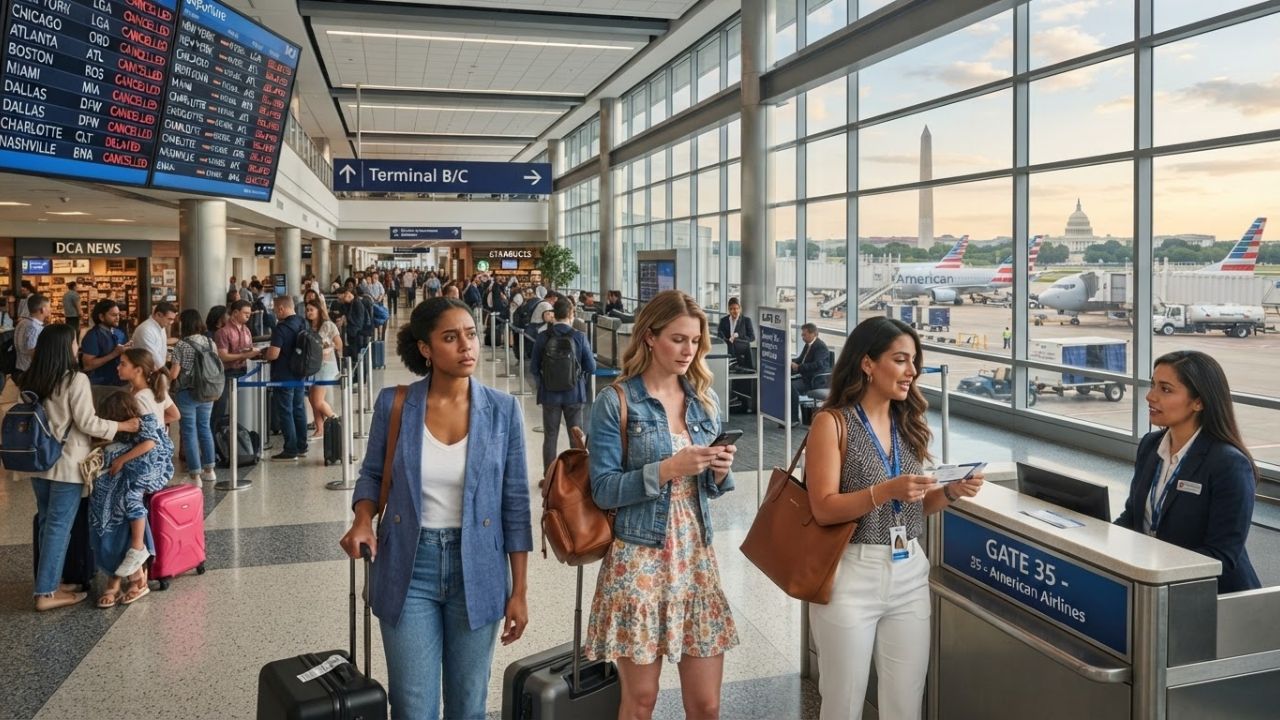
Image generated by AI
Moderate travel disruptions at Ronald Reagan Washington National Airport have delayed capital itineraries. The airport reported 22 cancellations and 11 delays as slot constraints and airspace congestion impacted carrier schedules.
Slot Constraints and Airspace Congestion Pressure Capital Corridors
According to reports, high passenger volumes are placing significant pressure on the Washington capital transit nodes.
Operational alerts issued by Ronald Reagan Washington National Airport (DCA) show that cancellations exceeded delays during the morning peak window.
Airspace guidelines enforced by the Federal Aviation Administration (FAA) confirm that weather and route constraints along the Northeast corridor required safety adjustments.
Because DCA operates under strict runway slot rules, a delay at another East Coast hub can quickly lead to a cancellation.
The table below details the scope of the flight disruptions and the primary carriers and cities affected.
Flight Disruptions at Ronald Reagan Washington National Airport
| Disruption Type | Quantity | Key Affected Carriers | Primary Routes Affected |
|---|---|---|---|
| Canceled Flights | 22 | American Airlines, Delta Air Lines, United Airlines, Southwest | New York, Chicago, Atlanta, Boston, Miami, Dallas |
| Delayed Flights | 11 | American Airlines, Delta, United, Southwest, JetBlue | Northeast shuttle routes and midwestern connections |
Interconnected Flight Rotations Spread Downstream Route Delays
Aviation industry analysts note that commercial carriers schedule aircraft for multiple daily flights to maintain profitability.
When an inbound plane is delayed due to weather in New York or Boston, its next departure from Washington is pushed back.
If the delay exceeds a specific time window, airlines often cancel the flight to avoid crew timeout limits.
- Airspace Congestion: High traffic density in the Washington-New York corridor limits runway access.
- Slot Restrictions: DCA operates under strict hourly limits on takeoffs and landings.
- Crew Duty Limits: Federal safety rules cap the consecutive hours pilots and flight attendants can work.
- Aircraft Maintenance: Unscheduled inspections require keeping planes on the ground.
- Downstream Propagation: Delays at feeder airports cause late arrivals at the capital gateway.
To minimize the impact, American and Delta are using larger aircraft on select shuttle runs to accommodate stranded travelers.
Travel Recommendations for Navigating Reagan National Disruptions
Aviation consultants recommend several steps to help travelers manage schedule changes at DCA:
- Leverage Shuttle Alternatives: Consider booking flights from Washington Dulles (IAD) or Baltimore-Washington (BWI) if cancellations affect DCA.
- Track Inbound Aircraft: Use flight-tracking websites to monitor the status of the incoming plane before leaving for the terminal.
- Check Gate Status Frequently: Gate changes are common during schedule recoveries as ground crews reposition planes.
- Verify Rebooking Policies: Understand airline rules regarding ticket transfers and hotel accommodations during carrier-caused delays.
Why This Matters
Our analysis of the flight data indicates that DCA's location and layout make it vulnerable to Northeast corridor congestion. The airport's proximity to central Washington makes it popular with business travelers, meaning delays have high economic impacts.
Unlike larger hubs with multiple runways, DCA relies on a single main runway for the majority of its jet traffic.
This layout leaves no margin for error when thunderstorms or convective wind activity sweep through the Potomac valley.
Additionally, because many government travelers use DCA, delays can disrupt official schedules and corporate travel plans.
Ultimately, these cancellations demonstrate that slot-controlled airports must prioritize schedule resilience over peak capacity.
Forward Outlook
Market trends suggest that airlines will continue to consolidate flights on Northeast shuttle routes to manage slot limits. Regional transit authorities are planning upgrades to terminal gates to handle larger single-aisle jets.
Expect flight schedules at Reagan National to stabilize as weather conditions clear along the East Coast. The regional business travel market is projected to see steady demand through the summer quarter.
Disclaimer
This article is for informational and educational purposes only. It does not constitute legal, financial, or professional advice. While we strive to provide accurate and up-to-date information, travel policies, regulations, and conditions change rapidly. Always verify information with official sources before making travel decisions. Nomad Lawyer makes no representations about the accuracy, reliability, completeness, or suitability of the information provided. Readers should consult qualified professionals for advice specific to their circumstances. The views expressed in this article are those of the author and do not necessarily reflect the views of Nomad Lawyer.
Kunal K Choudhary
Co-Founder & Contributor
A passionate traveller and tech enthusiast. Kunal contributes to the vision and growth of Nomad Lawyer, bringing fresh perspectives and driving the community forward.
Learn more about our team →