
Thousands of Travellers Stranded In Middle East As Bahrain, Kuwait, Iraq And Others Delay 367 And Cancelled 725 Flights Impacting Qatar Airways, Gulf Air, Saudia And Others In Dubai, Beirut And More
Qatar Airways has cancelled 261 flights and delayed 14 following the closure of Qatari airspace amid escalating regional hostilities that began February 28, 2026, stranding an estimated 30,000+ passengers across Saudi Arabia, UAE, Iran, Iraq, Kuwait, Lebanon, and Turkey.

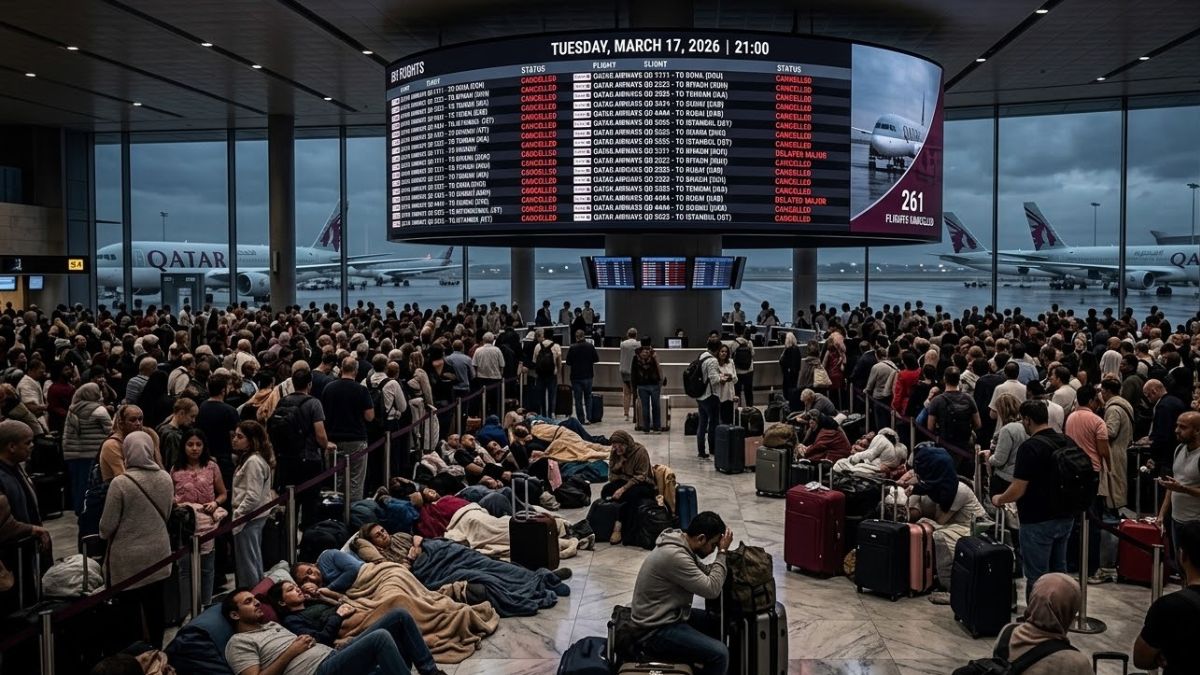
Image for illustrative purposes
Quick Summary
- Qatar Airways has confirmed 261 flight cancellations and 14 delays as of March 17, 2026, following the closure of Qatari airspace amid escalating regional hostilities that began February 28, 2026
- An estimated 30,000+ passengers are stranded across Saudi Arabia, UAE, Iran, Iraq, Kuwait, Lebanon, and Turkey — one of the largest single-carrier disruption events in modern Middle East aviation
- The airline has shifted to a Revised Limited Schedule through March 28, operating only authorised "safe corridor" flights — passengers are warned NOT to proceed to the airport without a confirmed booking on these specific services
- Qatar Airways has activated a flexible travel policy: two free rebookings for travel through April 30, 2026, and full refunds for passengers whose plans have been permanently derailed
Qatar Airways, the Doha-based flag carrier and one of the world's largest long-haul airlines, has officially confirmed the cancellation of 261 scheduled flights and the delay of a further 14 services — a crippling operational halt that has effectively severed the major aviation arteries connecting the Middle East to the rest of the world. As of March 17, 2026, an estimated 30,000+ passengers are stranded across a vast geographic corridor spanning Saudi Arabia, Iran, the United Arab Emirates, Iraq, Kuwait, Lebanon, and Turkey, as regional hostilities that escalated on February 28, 2026 forced the Qatar Civil Aviation Authority (QCAA) to close Qatari airspace as an "exceptional precautionary measure."
What Triggered the Crisis: Airspace Closure and Regional Hostilities
The chain of events began on February 28, 2026, when escalating regional hostilities prompted the QCAA's initial airspace restrictions. By March 17, the situation had intensified across the wider Gulf, with the General Civil Aviation Authority (GCAA) of the UAE citing "rapidly evolving regional security developments" — including reported drone and missile threats near Dubai International Airport (DXB) and Abu Dhabi — as the basis for temporary grounding orders affecting all carriers operating in UAE airspace.
The combined effect of multiple national airspace closures transformed what began as a Qatar-centred disruption into a region-wide aviation emergency. Airlines including Oman Air and Turkish Airlines have joined Qatar Airways in suspending or curtailing Gulf services, citing a security environment that makes regular commercial operations a logistical and safety impossibility.
Consolidated Cancellation and Delay Metrics (March 17, 2026)
| Metric | Total | Date of Report | Status |
|---|---|---|---|
| Cancelled Flights | 261 | March 17, 2026 | Confirmed |
| Delayed Flights | 14 | March 17, 2026 | Reported |
| Stranded Passengers | ~30,000+ | Cumulative | Estimated across Gulf network |
| Flexible rebooking window | Free rebooking ×2 | Through April 30, 2026 | Active |
| Limited Schedule end date | — | March 28, 2026 | Announced |
Qatar Airways Regional Flight Status (March 17, 2026)
| Region | Primary Cities | Current Status | Key Impact |
|---|---|---|---|
| Qatar | Doha (DOH) | Limited Schedule Only | Airspace closed to regular traffic; safe corridor flights only |
| UAE | Dubai (DXB), Abu Dhabi (AUH) | Significant Disruptions | Drone/missile activity triggered grounding; phased recovery underway |
| Saudi Arabia | Riyadh (RUH), Jeddah (JED), Medina (MED) | Severe Cancellations | Most flights cancelled; relief corridors for stranded pilgrims |
| Iran | Tehran (IKA), Shiraz (SYZ) | Suspended | ~100% of commercial operations halted |
| Iraq | Baghdad (BGW), Basra (BSR), Erbil (EBL) | Suspended | All Qatar Airways services grounded; airspace avoided for rerouting |
| Turkey | Istanbul (IST) | Intermittent | Primary re-entry point; significant congestion and fare spikes |
| Kuwait & Lebanon | Kuwait City (KWI), Beirut (BEY) | Halted | No Qatar Airways commercial arrivals or departures |
Country-by-Country Breakdown
Qatar — Doha (DOH): The Epicentre
Hamad International Airport (DOH) in Doha remains the focal point of the crisis. The QCAA has maintained a total closure of Qatari airspace to regular commercial traffic, compelling Qatar Airways to abandon its standard global network entirely. The airline is operating a "Limited Operating Schedule" using tightly restricted safe air corridors — a small number of relief flights to cities including London, Paris, and Mumbai are operating, but thousands of passengers remain in Doha awaiting confirmed seats on the few authorised departures.
Saudi Arabia — Riyadh (RUH), Jeddah (JED), Medina (MED)
Travel within and through Saudi Arabia is severely paralysed. The Saudi General Authority of Civil Aviation (GACA) has implemented strict rerouting protocols, cancelling nearly all Qatar Airways services connecting to the Kingdom. The disruption is particularly acute for religious pilgrims using Jeddah and Medina as gateways — a small number of lifeline flights coordinated between Saudia and Qatar Airways are facilitating repatriations, while the broader regional airspace remains a restricted no-fly zone.
United Arab Emirates — Dubai (DXB), Abu Dhabi (AUH)
The UAE has experienced some of the most dramatic individual disruption events. Drone and missile interceptions near Dubai on March 17 prompted the GCAA to briefly suspend all operations at Dubai International — triggering a cascade of cancellations across both Emirates and Qatar Airways. UAE-based carriers have begun a phased recovery, but Qatar Airways flights to the Emirates remain largely off the schedule, with transit passengers seeking alternative routing via Oman or Turkey.
Iran — Tehran (IKA), Shiraz (SYZ)
Iran has effectively been isolated from the global aviation network. Tehran Imam Khomeini International (IKA) and Shiraz (SYZ) are seeing close to 100% international commercial flight cancellations. Qatar Airways and other Gulf carriers have indefinitely suspended all services to Iranian territory following the February 28 escalation. Previously planned repatriation flights have been subject to last-minute groundings, leaving thousands of travelers without a clear departure timeline.
Iraq — Baghdad (BGW), Basra (BSR), Erbil (EBL)
Iraq's airspace has been classified as a high-risk zone, with all Qatar Airways services from Baghdad, Basra, and Erbil pulled entirely. Civil aviation authorities have issued NOTAMs (Notices to Airmen) directing commercial aircraft to avoid the southern Iraq corridor — forcing international long-haul operators to undertake costly, time-consuming reroutes that add hours and significant fuel burn to intercontinental flights.
Turkey — Istanbul (IST): The Region's Escape Valve
Istanbul Airport (IST) has emerged as the primary re-entry point for stranded travelers fleeing the wider Gulf disruption. Turkish Airlines and Pegasus have attempted to absorb overflow passengers, but the volume of redirected Gulf travelers has overwhelmed Istanbul's hub capacity — generating massive terminal congestion and sharp fare spikes for available seats on onward connections.
Kuwait and Lebanon — KWI and BEY: Total Halt
Kuwait City (KWI) and Beirut (BEY) have seen all Qatar Airways commercial operations suspended. Kuwait remains caught in the broader Gulf airspace closure, while Beirut's situation is compounded by the volatile security environment in the Levant. Lebanese civil aviation has seen a mass exit of international carriers. Travelers in both countries currently have almost no commercial Qatar Airways connectivity, forcing reliance on land routes or limited services from local carriers.
Qatar Airways' Response: Revised Limited Schedule and Flexible Policy
Acting under QCAA guidance, Qatar Airways has announced a Revised Limited Schedule running through March 28, 2026, focused on reopening restricted "operating corridors" to facilitate the return of stranded travelers to their home countries. According to Qatar News Agency (QNA) reporting, this is explicitly not a return to normal commercial operations — it is a humanitarian-adjacent effort to clear the passenger backlog.
Qatar Airways' official passenger advisory: Do not travel to the airport unless you hold a confirmed, valid booking on one of the specifically authorised Revised Limited Schedule flights.
Flexible Travel Policy — Key Options for Affected Passengers
For all bookings between February 28 and March 28, 2026, Qatar Airways has activated the following protections:
- Date Changes: Two complimentary rebookings, with revised travel dates available through April 30, 2026
- Full Refunds: Complete return of the unused ticket value for passengers whose travel plans are permanently cancelled
- Passengers should manage changes via qatarairways.com/managebooking or contact Qatar Airways customer service directly
The Saudi GACA has been coordinating separately with regional carriers to manage displaced travelers in Jeddah and Medina, with specific attention to religious pilgrimage passengers requiring priority repatriation support.
What This Means for the Region's Tourism Economy
The disruption's economic impact is already significant. Qatar's "Stopover Tourism" programme — a cornerstone of the country's national tourism strategy that funnels transit passengers through Doha for short-stay experiences — has reached a virtual standstill, draining foot traffic from airport retail and Doha's hospitality sector.
The World Tourism Organization (UN Tourism) and regional tourism ministries are monitoring the situation closely. Aviation analysts tracking Gulf hub economics estimate the cumulative revenue impact across the grounded Qatar Airways network — at 261 flights per report date — is already running into hundreds of millions of dollars.
Regional civil aviation bodies are targeting a resumption of up to 48 flights per hour once security conditions stabilise, though no confirmed timeline has been announced as of March 17, 2026.
What Stranded Travelers Should Do
- Do not go to the airport unless you have a confirmed booking on the Qatar Airways Revised Limited Schedule — check your booking status at qatarairways.com
- Rebook or claim a full refund via Qatar Airways' manage-booking portal — two free date changes are available for travel through April 30, 2026
- Know your rights: Passengers on cancelled flights are entitled to a full cash refund under their country's applicable civil aviation consumer protection rules — UAE passengers should refer to the GCAA, Saudi passengers to GACA
- Check your government's travel advisory — the UK Foreign Office, US State Department, and equivalent national authorities are issuing real-time advisories for all affected countries
- Consider rerouting via Istanbul — Turkish Airlines is the primary alternative hub carrier for the region, though fares are elevated and availability is constrained
- Purchase or claim on travel insurance — if you have a policy covering travel disruption due to security incidents, file your claim immediately with full documentation of cancellation notifications
Key Facts at a Glance
| Detail | Data |
|---|---|
| Airline | Qatar Airways |
| Flights cancelled | 261 (as of March 17, 2026) |
| Flights delayed | 14 |
| Estimated stranded passengers | ~30,000+ |
| Crisis start date | February 28, 2026 |
| Revised Limited Schedule end | March 28, 2026 |
| Authorities involved | QCAA (Qatar), GCAA (UAE), GACA (Saudi Arabia) |
| Most-affected airports | DOH, DXB, AUH, RUH, JED, IKA, BGW, KWI, BEY, IST |
| Rebooking flexibility | 2 free changes through April 30, 2026 |
| Refund policy | Full refund on unused ticket value |
| Istanbul hub role | Primary alternative re-entry point for stranded Gulf passengers |
Frequently Asked Questions
How do I rebook or get a refund for my cancelled Qatar Airways flight? Log in to qatarairways.com/managebooking with your booking reference. For travel between February 28 and March 28, 2026, Qatar Airways is offering two complimentary rebookings with revised travel dates available through April 30, 2026, or a full cash refund of your unused ticket value. Passengers are advised to manage changes digitally rather than at the airport during the current disruption.
Is Dubai International Airport still open and accepting flights? Dubai International (DXB) experienced a temporary grounding on March 17, 2026 following drone and missile interceptions near the airport. Emirates and other UAE-based carriers have begun a phased recovery. However, Qatar Airways flights to and from the UAE remain largely suspended. Check real-time status at Dubai Airports or FlightAware before travelling to DXB.
Which countries are currently most affected by the Qatar Airways cancellations? The countries with the most severe impact as of March 17, 2026 are Iran (near-total suspension), Iraq (all Qatar Airways services grounded), Kuwait and Lebanon (all Qatar Airways commercial operations halted), and Saudi Arabia (severe cancellations, pilgrim-priority relief corridors only). The UAE is in a phased recovery, while Turkey is experiencing congestion as the primary alternative transit hub.
When will Qatar Airways resume normal operations? No confirmed resumption timeline has been announced by Qatar Airways or the QCAA as of March 17, 2026. The Revised Limited Schedule runs through March 28. Regional civil aviation bodies are targeting a resumption of up to 48 flights per hour once security conditions allow, but the timeline remains subject to the evolving security environment. Follow Qatar News Agency (QNA) and Qatar Airways News for official updates.
Related Travel Guides
Winter Storm Grounds Hundreds — Chicago, Denver, NYC Hit Hardest
Reagan National Airport Chaos: 80+ Flights Cancelled — Is Yours Next?
Middle East Crisis: UAE, Saudi, Qatar & Gulf States Waive Visa Fines for Stranded Travelers
Disclaimer
This article is for informational and educational purposes only. It does not constitute legal, financial, or professional advice. While we strive to provide accurate and up-to-date information, travel policies, regulations, and conditions change rapidly. Always verify information with official sources before making travel decisions. Nomad Lawyer makes no representations about the accuracy, reliability, completeness, or suitability of the information provided. Readers should consult qualified professionals for advice specific to their circumstances. The views expressed in this article are those of the author and do not necessarily reflect the views of Nomad Lawyer.
Kunal K Choudhary
Co-Founder & Contributor
A passionate traveller and tech enthusiast. Kunal contributes to the vision and growth of Nomad Lawyer, bringing fresh perspectives and driving the community forward.
Learn more about our team →