
Travel Chaos at Dubai International Airport: Seven Flights Grounded, Hundreds Stranded Amid Disruptions to Tbilisi, Manchester, Budapest, and More
Dubai International Airport faces chaos as Flydubai and Emirates ground seven flights, impacting routes to Tbilisi, Manchester, and more, leaving travelers stranded.

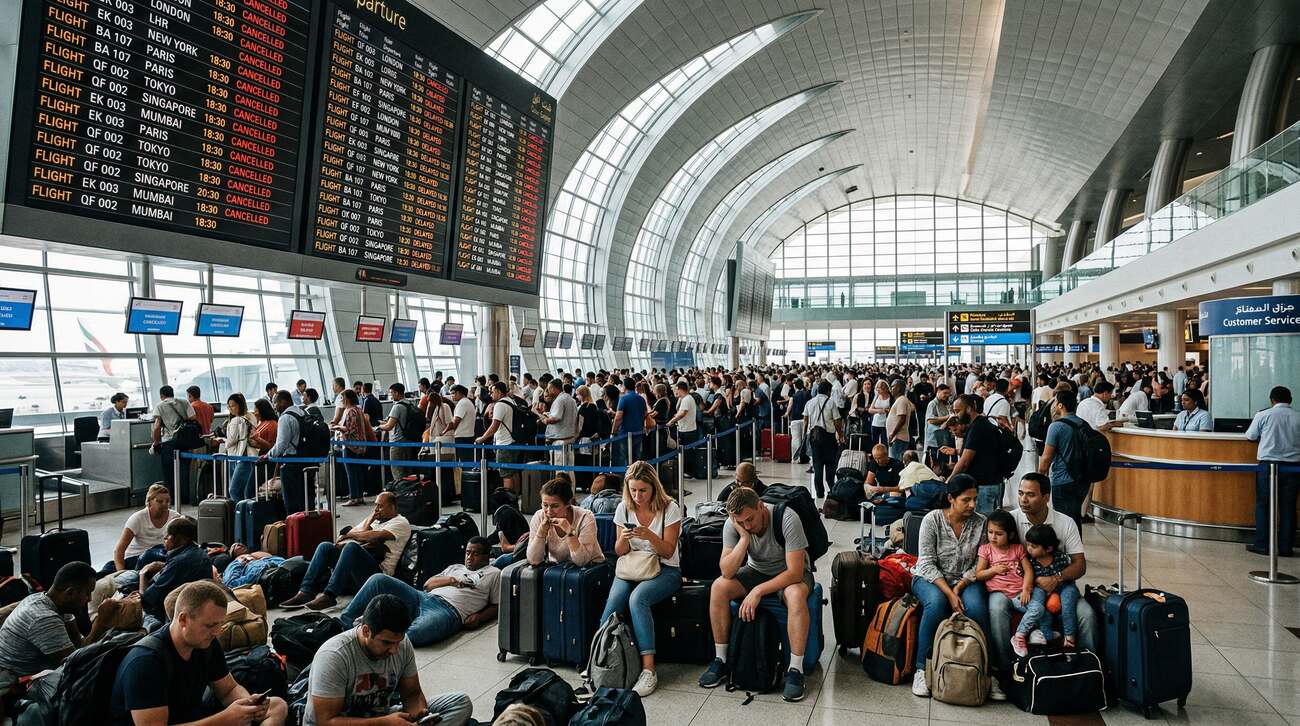
Image generated by AI
In a dramatic turn of events, Dubai International Airport is witnessing significant travel chaos as Flydubai and Emirates have grounded seven flights, causing widespread disruption. Key routes to cities like Tbilisi, Manchester, Budapest, Kabul, and Birmingham are severely affected, leaving travelers stranded and uncertain about their travel plans.
🚨 Critical Highlights
- 7 flights grounded by Flydubai and Emirates
- 49 additional flights delayed, impacting European, Asian, and African routes
- Root cause: Regional airspace closures linked to the Iran War (since late February 2026)
- Capacity collapse: Dubai's scheduled departures dropped from 600 to 250 in just one month
- Affected routes: Manchester, Budapest, Tbilisi, Birmingham, Kabul, and broader European/Asian networks
- Travel advice: Avoid tight connections; book through-tickets on single airlines; expect flight cancellations without notice
The Middle East Conflict Impact on Dubai Hub Operations
The situation at Dubai International Airport is the direct result of prolonged airspace restrictions across Iran and Iraq airspace, triggered by the escalating Iran War since late February 2026. Unlike typical operational disruptions caused by weather or technical failures, this crisis stems from geopolitical volatility that has fundamentally reshaped how airlines operate through the region's busiest international hub.
The impact has been devastating. According to aviation data analysis, Dubai International Airport operated with 600 scheduled flights on March 2, yet tracked only 9 flights actually departing—a staggering 98% cancellation rate. By March 31, while the situation stabilized somewhat, scheduled flights had collapsed to 250 (down 58% from the start of the month), though tracked operations improved to 224 flights. This shifting pattern reveals airlines desperately trying to maintain ambitious schedules while operational reality forced aggressive reductions.
Why Dubai Hub is Particularly Vulnerable
Dubai International serves as a critical banking hub for flights connecting Europe, Asia, and Africa. Aircraft and crew that once turned around quickly between continents now face:
- Extended ground times due to complex alternate routings around restricted airspace
- Reduced runway and terminal capacity during the crisis
- Unpredictable flight times as routes through Iran/Iraq are unavailable
- Passenger cascades when single flight cancellations trigger missed connections across networks
This has made Dubai's traditionally efficient hub model extremely difficult to sustain.
Affected Routes and Destinations Hardest Hit
The primary impact has fallen on secondary and regional routes rather than long-haul trunk services:
European Routes Under Pressure:
- Manchester (limited frequencies, longer layovers for UK-bound passengers)
- Budapest (reduced capacity to Central Europe)
- Birmingham (alternative routing via EU hubs becoming necessary)
Regional Routes in Crisis:
- Tbilisi (Caucasus access severely curtailed)
- Kabul (exceptionally complex due to security considerations + airspace issues)
Secondary Impact:
- Passengers routing Asia-to-Africa connections increasingly diverted via Istanbul, Doha, or EU hubs
- Migrant workers and visiting families facing visa complications from missed connections
- Backup flights unable to clear multi-day passenger backlogs
The Domino Effect: Passenger Experience Deteriorates
Travelers caught in this disruption describe a chaotic airport experience:
✘ Long waits at gates with minimal communication ✘ Missed onward connections due to upstream delays on mixed itineraries ✘ Overnight stays when rebooking options are exhausted ✘ Overwhelmed call centers with 8+ hour wait times ✘ Inconsistent flight status information (flights show as scheduled until near-departure, then are pulled from departure boards) ✘ Scarce rebooking options particularly on frequencies to Manchester, Budapest, and other secondary cities
The situation remains particularly acute for passengers on mixed itineraries combining Flydubai and Emirates sectors—if one leg is canceled, the entire connection collapses with limited alternatives available.
Dubai International's Fight for Recovery: From Collapse to Adaptation
What's remarkable in the data is how quickly Dubai adapted. The month-long operational journey reveals a system learning to function under constraint:
| Date | Scheduled Departures | Tracked Departures | Reflection |
|---|---|---|---|
| Mar 2 | 600 | 9 | Initial shock—airlines still filing pre-conflict schedules |
| Mar 4 | 538 | 98 | Cascading cancellations as reality hits |
| Mar 9 | 561 | 226 | System stabilizing; adaptive rerouting begins |
| Mar 14 | 401 | 235 | Peak adaptation—aircraft/crew reallocated efficiently |
| Mar 16 | 390 | 95 | Temporary spike (possible military activity) |
| Mar 31 | 250 | 224 | New normal—aggressive but reliable schedules |
By month's end, the narrowing gap between scheduled and tracked flights shows airlines have aligned operations with reality: what's planned now closely matches what actually departs. However, this represents operating at less than half normal capacity.
FAQ: Essential Information for Travelers
Q1: Should I cancel my trip through Dubai right now?
A: It depends on flexibility and destination. If you have non-essential travel plans and tight connections:
- Consider rebooking via alternative hubs (Istanbul, Doha, or direct European connections where possible)
- Many carriers are offering flexible change and refund policies during this period
- Business and essential travel should proceed with extended buffer time between connections
For non-essential trips, especially those with connections under 3 hours at Dubai, voluntary cancellation/rescheduling is advisable.
Q2: What's the rule for booking through Dubai right now?
A: Book through-tickets on single airlines rather than multi-airline itineraries. If Flydubai (A) → Dubai → Emirates (B) fails, you're scrambling; if Emirates (A) → Dubai → Emirates (B), automatic rebooking is far more likely.
Q3: How long will these disruptions last?
A: Aviation analysts expect volatility to continue for weeks to months depending on geopolitical developments. The data shows the system is adapting, but regional airspace remains constrained. Plan for continued reduced frequencies and potential cancellations rather than resolution in days.
Q4: What compensation am I entitled to if my flight is canceled?
A: Under EU261 regulations (if applicable):
- €250 for flights up to 1,500 km
- €400 for EU-internal and longer flights (1,500-3,500 km)
- €600 for flights over 3,500 km
However, you may not qualify if the airline invokes "extraordinary circumstances" (which Middle East airspace restrictions may qualify as). Claim immediately; disputes can be resolved through airline ombudsmen or travel courts.
Q5: If my flight is canceled, what are my options?
A: Airlines must offer:
- ✓ Rebooking on the next available flight (or alternative date)
- ✓ Full refund (including connecting segments if canceled)
- ✓ Meal vouchers, accommodation, and communication costs (for canceled flights)
- ✓ Hotel for overnight stay if rebooking can't depart until next day
Claim in writing to preserve your rights; don't just accept the first verbal offer at the airport.
Q6: What's the safest connection time at Dubai right now?
A: Experts recommend minimum 4-5 hours instead of the typical 2-3 hours. This accounts for:
- Potential upstream delays on your inbound flight
- Slower-than-usual baggage handling and security during reduced operations
- Possibility of rebooking onto later flights if your connection is missed
For international-to-international connections, 6 hours is prudent.
Q7: Are hotels near Dubai airport offering flexible terms?
A: Many yes, but verify before booking. Hotels recognize the operational situation and many are offering:
- Free cancellations up to 24 hours before
- Flexible rebooking if flight status is confirmed
- Extended check-out times for overnight connections
Always ask explicitly about layover packages if you might need an unexpected overnight stay.
Q8: Should I purchase travel insurance?
A: Absolutely. Standard multi-trip policies may not cover "extraordinary circumstances," but comprehensive travel insurance with geopolitical event coverage provides:
- Trip cancellation reimbursement
- Emergency accommodation and meal costs
- Missed connection rebooking assistance
- Medical evacuation
This is non-negotiable for any Dubai-connection travel in the current environment.
Q9: Which airlines are most reliable for Dubai connections right now?
A: Single-airline itineraries are more reliable than connections:
- Emirates (through-ticketed segments within Emirates network)
- Flydubai (for regional routes it still operates)
- Avoid multi-airline combinations at all costs
Actual reliability is secondary to booking structure during this crisis.
Q10: Where should I reroute if I want to avoid Dubai?
A: Viable alternatives by origin/destination:
- Asia → Europe: Istanbul (Turkish Airlines), Doha (Qatar Airways), or direct flights from major Asian hubs
- Asia → Africa/Middle East: Doha has reliable capacity; Doha-to-Addis (Ethiopian Airlines) remains stable
- Europe → Asia: Consider direct flights from London, Frankfurt, or Amsterdam if available
- Australia/NZ → Europe: Longer single flights via SE Asia or Middle East alternatives
- US → Middle East/Asia: Consider Europe as intermediate hub rather than Gulf route
Airlines are actively promoting alternative routings, so call your preferred carrier for rebooking suggestions.
The situation at Dubai International Airport reflects a broader fragility in global aviation: when a major hub encounters prolonged operational constraints due to geopolitical events, the entire interconnected system feels the shockwaves within hours. But the data also shows resilience—Dubai operators and airlines adapted, reoptimized, and are maintaining meaningful operations even under duress. For travelers, this means vigilance, flexibility, and pre-planning are essential.
Related Travel Guides
- Qantas Integrates Wing Seong Fatty’s Heritage Dishes into Singapore Changi Airport Lounges in 2026
- Bypassing Layover Travel Chaos: Air Astana Launches Massive Direct Airbus A321LR Flights to Cyprus to Shield Tourists from European Airport Disruptions
- Real-Time Flight Tracking Technology Tested Mid-Flight: What Passengers Can Now Monitor From 40,000 Feet
Disclaimer:** Flight schedules, routes, and regional airspace restrictions are subject to immediate change based on geopolitical and operational conditions. Verify with your airline directly and monitor official FAA/EASA/GCAA announcements before traveling. This article reflects conditions as of April 5, 2026, and may be outdated. Airlines' policies on refunds, rebooking, and compensation vary by carrier and applicable law; consult your airline's website or contact customer service for your specific situation.
Disclaimer
This article is for informational and educational purposes only. It does not constitute legal, financial, or professional advice. While we strive to provide accurate and up-to-date information, travel policies, regulations, and conditions change rapidly. Always verify information with official sources before making travel decisions. Nomad Lawyer makes no representations about the accuracy, reliability, completeness, or suitability of the information provided. Readers should consult qualified professionals for advice specific to their circumstances. The views expressed in this article are those of the author and do not necessarily reflect the views of Nomad Lawyer.
Raushan Kumar
Founder & Lead Developer
Full-stack developer with 11+ years of experience and a passionate traveller. Raushan built Nomad Lawyer from the ground up with a vision to create the best travel and law experience on the web.
Learn more about our team →