
Qantas A380 Charles Ulm Stuns London Gatwick With Shock Charter Landing After 21-Hour Sydney-Singapore odyssey as Global Energy Crisis Forces Airlines to Rethink Long-Haul Fleet Deployment
The Qantas A380 'Charles Ulm' (VH-OQG) made a rare and dramatic appearance at London Gatwick — a port rarely seen by superjumbos — completing a Sydney-Singapore-London charter run in over 21 hours as oil price shocks and rerouted global demand reshape how airlines deploy their flagship widebody aircraft.

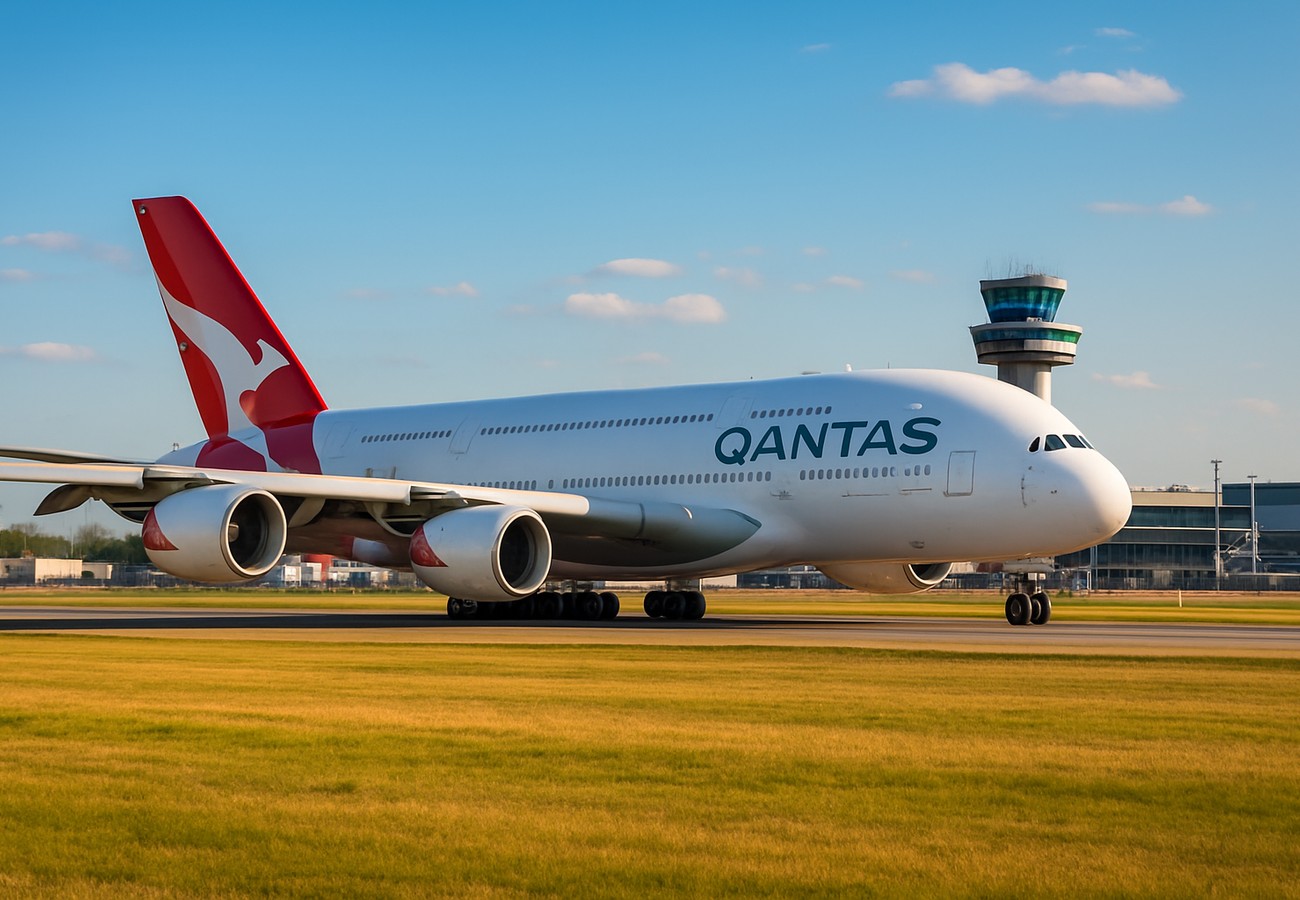
Image generated by AI
Qantas A380 Charles Ulm Stuns London Gatwick With Shock Charter Landing After 21-Hour Sydney-Singapore Odyssey as Global Energy Crisis Forces Airlines to Rethink Long-Haul Fleet Deployment
Rare Widebody Appearance at Secondary UK Hub Signals Deepening Shift in Global Aviation Economics: How the Strait of Hormuz Conflict Is Reshaping Charter Demand and Airport Utilisation
LONDON, UK — It was the kind of arrival that stops aviation spotters and industry analysts in their tracks. The Qantas Airbus A380 registered VH-OQG — named "Charles Ulm" after the legendary Australian aviator — made a strikingly rare landing at London Gatwick Airport, an event that has generated immediate and significant attention across the global aviation community. The aircraft, which had completed a 21-hour journey from Sydney, Australia, via Singapore, dropped into Gatwick instead of its customary home of London Heathrow, breaking a deeply established operational pattern and signalling something far more significant than a routine schedule change. In the context of a global aviation sector being rapidly restructured by oil price shocks, Gulf tensions, and the downstream economic effects of the Strait of Hormuz standoff, this charter deployment is a crystalline example of how airlines are being forced to rewrite the rules of long-haul fleet economics.
EXPANDED OVERVIEW: An Aircraft, a Name, and a 21-Hour Mission
The mechanics of the journey are themselves impressive. The Qantas A380 "Charles Ulm" (VH-OQG) departed Sydney on the first sector of a structured multi-leg itinerary, routing through Singapore Changi Airport — the airline's primary Asian transit hub and a critical node for long-haul connectivity between Australia, Asia, and Europe.
Following a turnaround in Singapore, the aircraft launched on a direct long-haul segment to London, clocking over 13 hours in the air on the second sector alone. The total elapsed journey time of more than 21 hours demonstrates the remarkable endurance capability of the Airbus A380 platform, which remains one of the most capable ultra-long-haul aircraft in commercial service.
The landing at Gatwick — where A380 superjumbos are an extreme rarity — immediately triggered industry interest. The aircraft remained on the ground for just over three hours before departing as flight QF336, reportedly routing back towards Singapore in a tight, pre-planned charter cycle.
GEOPOLITICAL CONTEXT: How the Strait of Hormuz Is Driving Charter Demand
To understand why Qantas is deploying its flagship A380 fleet on bespoke charter missions to secondary UK airports, one must look at the broader economic environment reshaping aviation in 2026.
The ongoing US-Iran conflict and the effective disruption of tanker traffic through the Strait of Hormuz have imposed two compounding pressures on global aviation. First, jet fuel procurement costs have surged dramatically, forcing airlines to abandon marginal routes where yield cannot offset the elevated cost base. Second, the disruption of traditional Gulf hub-and-spoke transit networks — centered on UAE, Qatar, and Saudi Arabia — has created significant demand volatility among high-spending corporate and group travelers who previously relied on Middle Eastern super-connectors.
This vacuum has directly inflated the premium charter market. Corporations, government delegations, and high-value group movements that once routed through Dubai or Doha are now commissioning dedicated widebody aircraft for point-to-point long-haul missions — exactly the kind of high-margin operation that makes deploying the Qantas A380 on a Gatwick charter financially compelling.
GLOBAL ENERGY IMPACT: Oil Price Volatility and the Charter Premium
The global energy crisis has created a paradox for the aviation sector. While soaring oil prices are crippling the economics of high-frequency scheduled flying on thin-margin routes, they are simultaneously making high-yield charter operations increasingly attractive for airlines with large, fuel-efficient widebody assets.
The Airbus A380 — with its massive passenger capacity and highly fuel-efficient engine technology on a per-seat basis — becomes an instrument of economic resilience during fuel price spikes when loaded with charter passengers paying premium rates. A fully utilised A380 on a charter mission can generate per-flight revenue that makes the fuel cost viable in ways that a half-empty scheduled service cannot.
This logic is driving a quiet but significant industry shift: airlines like Qantas are actively monetising their flagship superjumbo fleet through bespoke charter missions precisely because the global energy crisis has made conventional scheduled deployment on secondary routes economically untenable.
SHIPPING & TRADE IMPACT: Aviation Filling the Logistics Vacuum
With maritime shipping disruption in the Gulf forcing urgent cargo onto commercial aircraft belly holds, the economic calculation for long-haul charter operations has shifted further. A Qantas A380 flying a charter mission between Sydney, Singapore, and London carries not just passengers but also belly cargo — and the rates for that cargo have surged as maritime alternatives have become unreliable.
Insurance costs for Gulf-adjacent maritime routes have become prohibitive, pushing logistics operators toward airfreight. This demand is flowing directly into the aircraft bellies of widebody charter operations, adding a revenue dimension to missions like the Gatwick deployment that makes them even more financially calculated than they appear on the surface.
REGIONAL IMPACT (GULF STATES): The Hub Bypass Phenomenon
The Gatwick charter underscores a growing strategic shift in long-haul aviation routing. By connecting Sydney to London via Singapore rather than through traditional Gulf hubs in Saudi Arabia, the UAE, or Qatar, Qantas is benefiting from — and reinforcing — a trend of Gulf hub bypass that is gathering momentum across the industry.
For Kuwait, Oman, and Bahrain, whose aviation economies depend on transit traffic, this circumvention represents a structural threat. As more airlines deploy direct or Southeast Asia-transiting services to Europe, the traditional Middle Eastern super-connector model faces intensifying pressure from exactly the kind of nimble, demand-driven fleet deployment demonstrated by the Gatwick landing.
INDUSTRY / EXPERT ANALYSIS: Gatwick's Growing Role as a Flexible Hub
The significance of the Gatwick landing extends beyond Qantas itself. Gatwick's slot flexibility and infrastructure adaptability make it an increasingly attractive option for charter and bespoke widebody operations that cannot be accommodated within Heathrow's heavily congested and commercially driven slot framework.
"Secondary airports like Gatwick are quietly becoming the preferred venue for premium charter operations precisely because they can offer operational agility that Heathrow's constrained slot environment simply cannot," observes one senior European aviation operations analyst. "The fact that an A380 is turning around in three hours at Gatwick for a pre-planned charter circuit tells you everything about how the industry is optimising asset deployment under the current economic pressure."
The three-hour ground time at Gatwick — covering passenger disembarkation, refuelling, and operational checks — demonstrated the airport's genuine widebody handling capability, potentially opening the door to more such operations as charter demand continues its upward trajectory.
WHAT HAPPENS NEXT: More Charters, More Flexibility
As the Gulf tensions continue to redirect long-haul demand away from traditional Middle Eastern hubs and toward Southeast Asian transit alternatives, the charter market for premium long-haul widebody operations will likely continue growing. Airlines with A380 and Boeing 777 fleets capable of ultra-long-haul endurance are in the strongest position to monetise this shift.
For Qantas, the Sydney-Singapore-London charter arc demonstrates exactly the kind of operational versatility that gives the airline a competitive edge during a period of profound global aviation instability. Expect more such deployments as the winter 2026 charter season approaches.
CONCLUSION: A Landing That Signals a New Aviation Reality
The arrival of the Qantas A380 "Charles Ulm" at London Gatwick was not an operational accident or a weather diversion. It was a precisely planned, commercially driven deployment reflecting the new economic realities of global aviation in the age of oil price shocks and Gulf tensions. A 21-hour journey, a three-hour turnaround, a departure as QF336 — every minute of this mission was calculated. And in its careful precision, it reveals an industry in the process of a profound, quiet transformation.
KEY TAKEAWAYS
- The Qantas A380 VH-OQG "Charles Ulm" made a rare landing at London Gatwick — not Heathrow — on a dedicated charter mission, not a scheduled service.
- The aircraft completed a 21-hour journey from Sydney via Singapore to London, with the Singapore-London sector alone exceeding 13 hours.
- The Gatwick appearance is linked to surging premium charter demand created partly by the disruption of traditional Gulf hub routing due to the Strait of Hormuz standoff.
- The aircraft departed as flight QF336 after a tight three-hour turnaround, reflecting a highly optimised charter operation.
- The event highlights a broader industry trend: airlines are leveraging large widebody fleets (A380, B777) for bespoke charter missions as oil price shocks make marginal scheduled routes unprofitable.
- London Gatwick is emerging as a viable alternative hub for flexible, charter-driven widebody operations as Heathrow's slot constraints limit operational agility.
Disclaimer
This article is for informational and educational purposes only. It does not constitute legal, financial, or professional advice. While we strive to provide accurate and up-to-date information, travel policies, regulations, and conditions change rapidly. Always verify information with official sources before making travel decisions. Nomad Lawyer makes no representations about the accuracy, reliability, completeness, or suitability of the information provided. Readers should consult qualified professionals for advice specific to their circumstances. The views expressed in this article are those of the author and do not necessarily reflect the views of Nomad Lawyer.
Raushan Kumar
Founder & Lead Developer
Full-stack developer with 11+ years of experience and a passionate traveller. Raushan built Nomad Lawyer from the ground up with a vision to create the best travel and law experience on the web.
Learn more about our team →