
Puerto Rico Air Connectivity Expands in 2026: American, JetBlue, and Southwest Add Direct Routes to San Juan, Aguadilla, and Ponce
As American Airlines increases Miami-San Juan flights to eight daily, JetBlue and Southwest introduce direct mainland links to San Juan, Aguadilla, and Ponce ahead of winter 2026.

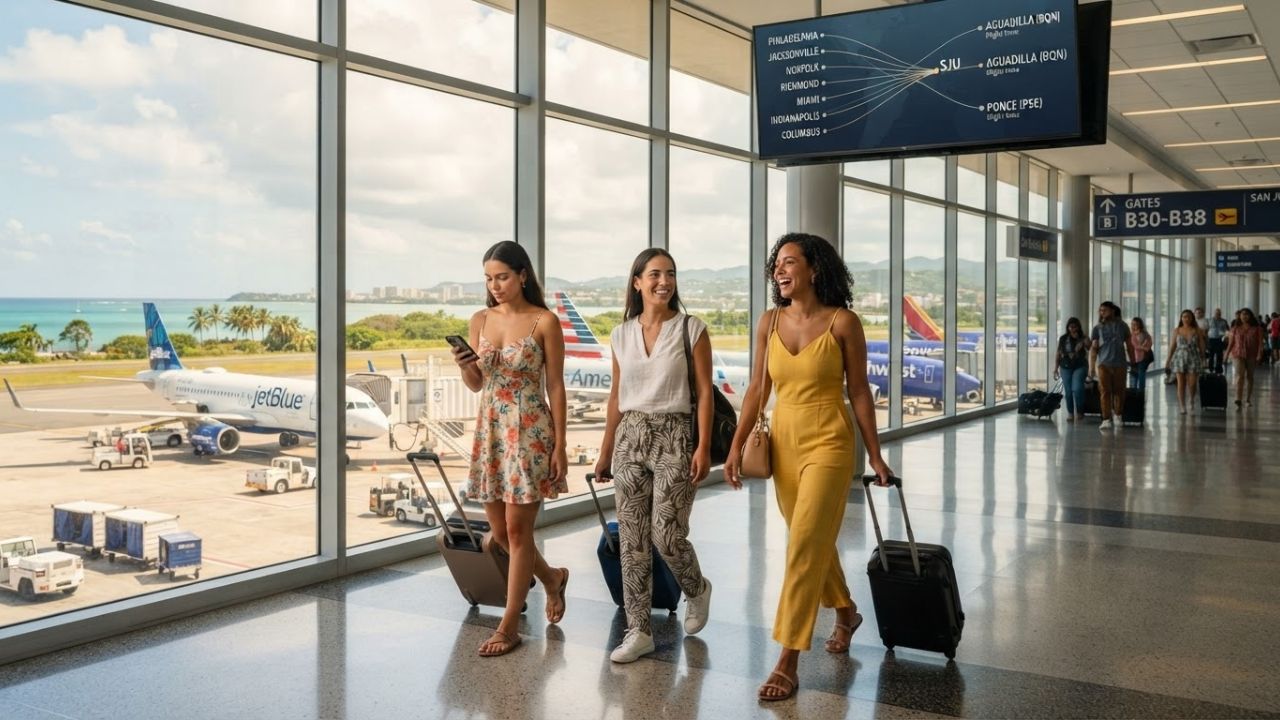
Image generated by AI
While over 85 percent of travelers visiting Puerto Rico historically touch down exclusively through the northern metropolitan gates of San Juan, an ambitious 2026 airline expansion is systematically dismantling that geographic bottleneck. As American Airlines ramps up its vital Miami corridor to as many as eight daily flights into San Juan Luis Muñoz Marín International Airport, JetBlue and Southwest Airlines are opening direct routes from diverse mainland hubs—including Philadelphia, Jacksonville, Norfolk, Richmond, Buffalo, Indianapolis, and Columbus, Ohio. Crucially, the expansion stretches beyond the capital city walls, funneling nonstop flights directly into the western surf breaks of Aguadilla and the southern neoclassical plazas of Ponce, fundamentally transforming how independent cultural travelers experience the island.
The 2026 Air Corridor Expansion: Connecting the Mainland and Regional Gateways
The coordinated network additions across American Airlines, JetBlue, and Southwest reflect a strategic realignment of Caribbean capacity ahead of the high-demand winter travel season. American Airlines has reinforced South Florida’s connection to Puerto Rico by scaling operations between Miami International Airport (MIA) and San Juan Luis Muñoz Marín International Airport (SJU) up to eight flights every day. This high-frequency schedule not only serves local Florida demand, but provides seamless, multi-wave flight connections for long-haul passengers transferring from across North America, Europe, and Latin America.
Simultaneously, JetBlue has broadened direct east coast connectivity into San Juan with new nonstop services originating in Philadelphia, Jacksonville, Norfolk, Richmond, and Buffalo. By bypassing crowded southern transfer hubs, these point-to-point flights eliminate layovers for travelers originating in mid-Atlantic and northeastern states. Even more impactful for regional distribution, JetBlue is deploying additional nonstop services connecting Fort Lauderdale directly to Rafael Hernández Airport in Aguadilla and Mercedita Airport in Ponce.
Further west, Southwest Airlines is tapping unserved heartland demand by introducing brand-new direct flights from Indianapolis alongside a dedicated route from Columbus, Ohio. These Midwestern links connect industrial and commercial population centers straight to the Caribbean without tedious southern layovers. Promoted internationally by Discover Puerto Rico, this distributed network structure represents more than added seat capacity; it decentralizes tourism footfall, empowering travelers to design regional itineraries around specific regional passions rather than defaulting to capital-centric packaged vacations.
What Makes Puerto Rico Different: From Fortified Sentry Boxes to Surf and Coffee Valleys
What sets Puerto Rico apart from neighboring Caribbean destinations is the striking cultural and ecological diversity packed into an island measuring roughly one hundred by thirty-five miles. In the historic heart of Old San Juan, five centuries of Spanish colonial heritage rise dramatically above the Atlantic swell. The massive ramparts of Castillo San Felipe del Morro and Castillo San Cristóbal, preserved globally on the UNESCO World Heritage Centre register and protected by the National Park Service, guard a maze of blue cobblestone streets (adoquines) cast from molten iron furnace slag.
Yet landing in Aguadilla transports travelers into an entirely different realm. Situated along Puerto Rico’s western coast, Aguadilla serves as the gateway to the Atlantic surf capital of Rincón and the dramatic cliffs of Isabela. At Crash Boat Beach, turquoise waters lap against a vibrant, graffiti-adorned historic military pier where local pelicans dive alongside recreational snorkelers. The atmosphere here is unhurried, driven by coastal seafood shacks, oceanfront reggae sessions, and winter swells that attract watermen from across the globe.
To the south, arriving at Mercedita Airport in Ponce unlocks the aristocratic grandeur of "La Perla del Sur" (The Pearl of the South). Ponce is celebrated for its distinctive nineteenth-century Ponce Creole architecture, characterized by intricate wooden balconies, neoclassical facades, and interior courtyards. In the historic Plaza Las Delicias, the striking red-and-black wooden Victorian firehouse, Parque de Bombas, stands as a civic icon, while nearby mountain roads climb into the Cordillera Central, where century-old coffee haciendas produce rich, shade-grown Arabica beans beneath mist-shrouded peaks.
Visitor Insider Tips: Navigating Puerto Rico Like a Local Traveler
To maximize your journey while exploring beyond predictable tourist corridors, incorporate these practical recommendations into your travel planning:
- Select Your Airport by Itinerary: If your holiday centers on surfing, western beach hopping, or whale watching, book your arrival directly into Aguadilla (BQN) aboard JetBlue rather than landing in San Juan and navigating a two-and-a-half-hour cross-island highway drive. If you plan to tour southern dry forests, coffee plantations, or the bioluminescent bay in La Parguera, fly into Ponce (PSE).
- Car Rental and Electronic Tolls: While ride-hailing services operate efficiently within metropolitan San Juan, public transportation outside the capital is virtually nonexistent. Renting a vehicle is essential for independent regional travel. Ensure your rental contract includes an automated AutoExpreso toll transponder, as all major toll highways (such as the PR-22 westward and PR-52 southward) are completely electronic and cashless.
- Time Your Fortress and Old City Walks: Old San Juan’s stone ramparts and plazas absorb intense tropical heat during midday. Tour the open courtyards and sentry boxes (garitas) of El Morro between 09:00 and 10:30, or visit after 16:30 when afternoon breezes cool the battlements and local families gather on the vast seaside lawn to fly colorful homemade kites (chiringas).
- Cultural Etiquette and Island Respect: Puerto Ricans are renowned for their warm, dignified hospitality. Always begin interactions in shops, bakeries, or taxis with a courteous "Buenos días" (good morning) or "Buenas tardes" (good afternoon). When dining in traditional establishments, meal service is considered an unhurried social experience; servers will not bring your check (la cuenta) until you explicitly request it.
- Savor Authentic Boricua Gastronomy: Pass by generic resort buffets to sample Puerto Rico’s authentic culinary heritage. Order mofongo—savory green plantains fried, seasoned with garlic and crispy pork cracklings (chicharrón), and mashed in a wooden pilón, crowned with fresh Caribbean shrimp in creole sauce or tender skirt steak. On weekends, embark on a scenic drive up Route 184 into the mountain town of Guavate, renowned as the "Pork Highway," where roadside open-air lechoneras roast whole suckling pigs over fragrant wood coals accompanied by live salsa and mountain views.
Cultural and Environmental Context: Regional Regeneration and Ecological Stewardship
The decentralization of flight corridors into Aguadilla and Ponce brings profound socio-economic and environmental benefits to Puerto Rico. For decades, the concentration of tourism revenues in San Juan created an economic divide, leaving coastal fishing communities and interior agricultural towns vulnerable to economic downturns. Direct air connections now channel visitor spending directly into family-operated mesones gastronómicos (certified heritage restaurants), independent dive shops, and rural coffee farm cooperatives.
Simultaneously, expanding regional tourism demands heightened environmental vigilance. Western Puerto Rico harbors delicate coral reefs, seagrass beds, and vital nesting grounds for endangered hawksbill and leatherback sea turtles. Community-led conservation initiatives in Rincón and Isabela actively engage visiting surfers and divers in dune restoration and beach cleanup campaigns.
In the south, proximity to the unique dry tropical forest of Guánica and the delicate mangrove lagoons of La Parguera requires low-impact travel practices. Tour operators in La Parguera’s bioluminescent bay have instituted strict regulations limiting motorized boat traffic to prevent disruption to glowing dinoflagellate microorganisms. By distributing arrivals across multiple gateways and encouraging visitors to patronize small-scale, environmentally conscious local operators, Puerto Rico’s aviation expansion fosters a sustainable model that preserves the island's coastal habitats and vibrant cultural legacy.
FAQ: Visiting Puerto Rico in 2026
Do US citizens require a passport to enter Puerto Rico?
No. Because Puerto Rico is a US territory, domestic American travelers do not require a passport, needing only a REAL ID-compliant driver's license or government-issued photo ID for air travel.
What is the advantage of flying into Aguadilla or Ponce instead of San Juan?
Flying directly into Aguadilla or Ponce places travelers right next to western surf beaches or southern historic districts, bypassing metropolitan San Juan traffic and reducing cross-island driving times.
What is the best time of year to visit Puerto Rico for optimal weather?
December through April provides the most pleasant conditions, featuring sunny days, low humidity, comfortable trade winds, and temperatures averaging 27°C to 29°C across coastal regions.
Can travelers explore Puerto Rico without renting a car?
While walking and ride-hailing work well within Old San Juan and Condado, exploring regional beaches, mountain rainforests, and historic towns like Ponce requires a rental car.
Touching down beyond the capital's fortified bay reveals Puerto Rico's deepest charm: an island where vibrant salsa rhythms, Atlantic surf, and mountain mist welcome you like family.
Related Travel Guides
- Anguilla Tourism Shatters Records in 2026: Stayover Surge, West End Luxury, and Caribbean Soul
- Dubai Leads the Global Aviation Comeback: Emirates Route Restorations and Insider Stopover Guide 2026
- Spain's Alicante Tourism at a Crossroads: Weak Regulation, 90,000 Holiday Rentals, and the Battle for Local Housing
Disclaimer
This article is for informational and educational purposes only. It does not constitute legal, financial, or professional advice. While we strive to provide accurate and up-to-date information, travel policies, regulations, and conditions change rapidly. Always verify information with official sources before making travel decisions. Nomad Lawyer makes no representations about the accuracy, reliability, completeness, or suitability of the information provided. Readers should consult qualified professionals for advice specific to their circumstances. The views expressed in this article are those of the author and do not necessarily reflect the views of Nomad Lawyer.
Raushan Kumar
Founder & Lead Developer
Full-stack developer with 11+ years of experience and a passionate traveller. Raushan built Nomad Lawyer from the ground up with a vision to create the best travel and law experience on the web.
Learn more about our team →