
Peru Sacred Valley Astronomy: Quechua Heritage and Stargazing Guide 2026
Sacred Valley stargazing pairs high-altitude optical astronomy with Quechua dark-cloud constellation lore and community-led luxury lodges in Peru.

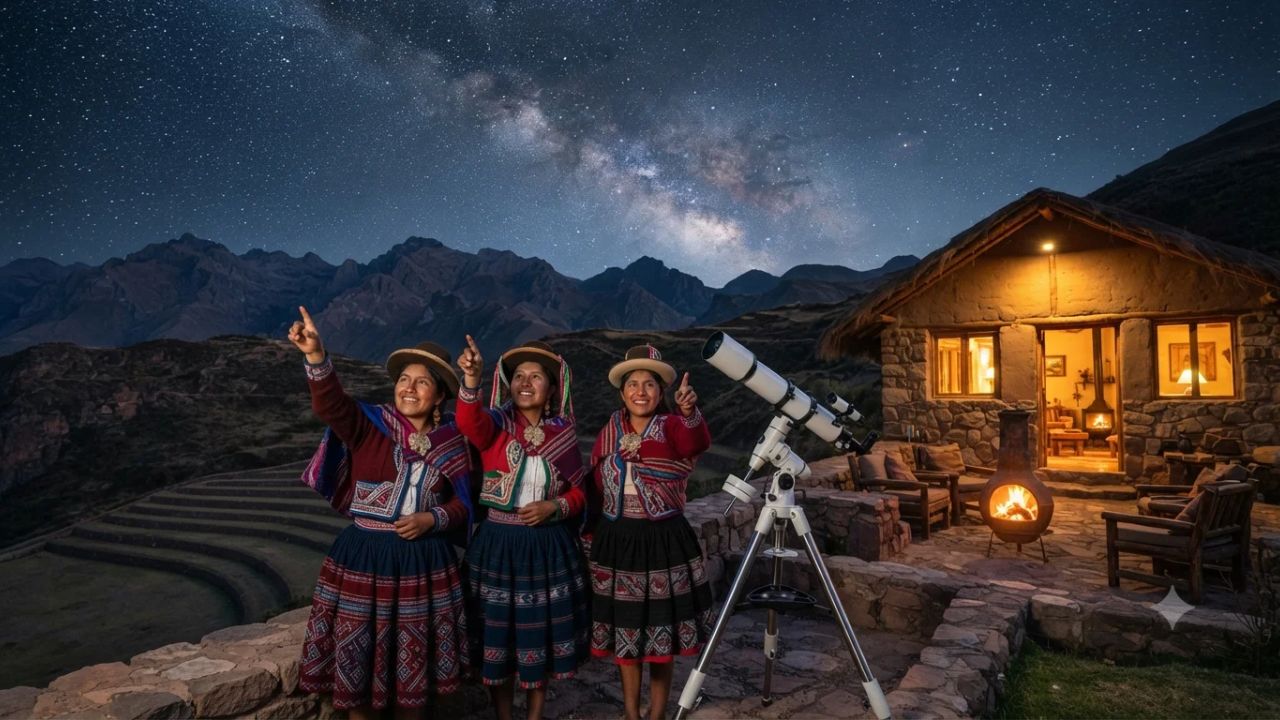
Unlike Western astronomy that maps constellations solely by connecting bright stars, ancient Quechua stargazers identified dark cloud formations (Yana Phuyu) within the luminous ribbon of the Milky Way (Mayu), tracking celestial animals like the Cosmic Llama (Yacana) to govern agricultural planting cycles. Set against the snowcapped peaks of the Vilcanota mountain range in the Peruvian Andes, the Sacred Valley of the Incas has emerged as a premier destination for high-altitude celestial observation and community-led heritage journeys. Pairing optical telescope astronomy with fireside storytelling in traditional adobe pavilions, international travelers are bypassing crowded mass tours in favor of immersive indigenous encounters.
The Sacred Valley Elevation Advantage and High-Andean Astronomy
The Sacred Valley (Valle Sagrado de los Incas), carved by the Urubamba River approximately 55 to 60 kilometers northeast of Cusco, provides critical physiological and experiential advantages for visitors to the Southern Peruvian Andes. While Cusco sits at a demanding 3,400 meters (11,152 feet) above sea level, the valley floor at Urubamba drops to 2,870 meters (9,416 feet). Descending directly to the valley upon arrival at Cusco's Alejandro Velasco Astete International Airport allows travelers to acclimatize comfortably while avoiding acute mountain sickness (soroche).
From late dry-season windows in September through October, thin high-altitude air and minimal light pollution create optimal atmospheric clarity for stargazing. Cultural initiatives such as the Raymi Ch’aska gatherings bring together optical astronomers and Quechua elders to interpret the Southern Cross, the Pleiades (Qollqa), and deep-space nebulae through high-powered optical lenses.
These evening sessions are complemented by living Quechua traditions: warming cups of hot roasted cacao infused with native quinoa and mountain mint (muña), acoustic Andean panpipe melodies (zampoñas), and discussions on how celestial alignments dictate potato seedings across terraced hillsides.
According to development frameworks led by PROMPERÚ, promoting decentralized astronomical and artisan circuits helps distribute travel spending directly into rural indigenous hamlets.
| Sacred Valley Location / Landmark | Elevation (Meters / Feet) | Cultural & Astronomical Significance | Travel & Transit Logistics |
|---|---|---|---|
| Urubamba Valley Floor | 2,870 m / 9,416 ft | Prime acclimatization base, clear dark-sky stargazing | 60-minute scenic drive from Cusco airport |
| Ollantaytambo | 2,792 m / 9,160 ft | Sun Temple alignment, living Inca street grid | Primary train departure station for Machu Picchu |
| Pisac Terraces & Market | 2,972 m / 9,750 ft | Intihuatana solar hitching post & Sunday artisan fair | 45-minute drive from Cusco via Sacred Valley loop |
| Chinchero Weaving Village | 3,762 m / 12,342 ft | Pre-Columbian backstrap weaving & natural cochineal dyes | High-plateau textile stop along the northern route |
| Cusco Historic Center | 3,400 m / 11,152 ft | Qorikancha Temple of the Sun & Sacsayhuamán fortress | UNESCO World Heritage urban gateway |
What Makes Sacred Valley Astronomy and Quechua Living Culture Different
The relationship between the land (Pachamama), sacred mountain peaks (Apus), and the night sky distinguishes Andean astronomy from conventional stargazing. The Incas viewed the Milky Way as a celestial river reflecting the sacred Urubamba River below.
During high-altitude night sessions, Quechua knowledge holders explain the seasonal movement of dark constellations: Yacana (the Celestial Llama suckling its calf), Atoq (the Fox), and Hamp'atu (the Toad). These celestial silhouettes served as astronomical clocks that alerted high-altitude farmers when to dig planting furrows before seasonal mountain rains arrived.
By day, the valley showcases extraordinary agrarian engineering. At Moray, concentric circular agricultural terraces create distinct microclimates with temperature variations of up to 5°C (9°F) between top and bottom rings, functioning as an ancient Inca crop hybridization laboratory. Nearby at Maras, over 3,000 terraced saltwater evaporation pans operated by local communal families have harvested mineral-rich pink salt (Sal de Maras) continuously since pre-Inca eras.
The textile craft preserved in high-altitude villages like Chinchero represents living mathematical and spiritual expression. Master Quechua weavers spin native alpaca and sheep wool using hand drop-spindles, dyeing yarns with wild cochineal insects, purple corn, and Andean mosses before weaving geometric patterns (pallay) on traditional backstrap looms.
Visitor Insider Tips
To experience the Sacred Valley with authentic local insight and maximum physical comfort, follow these insider recommendations:
- Acclimatization Strategy: Do not stay in Cusco on your first night. Arrange a pre-booked private driver from Cusco airport (CUZ) directly down to a boutique lodge in Urubamba or Yanahuara. Spend your first 48 hours resting, hydrating, and exploring lower valley ruins before returning to Cusco's higher elevation.
- Andean Night Stargazing Gear: Temperatures in the valley drop sharply after dusk to 4°C to 7°C (39°F to 45°F). Dress in thermal merino base layers, a windproof down jacket, a fleece-lined alpaca beanie (chullo), and lightweight gloves for late-night telescope viewings.
- Direct-from-Artisan Purchases: Support women-led weaving cooperatives directly in Chinchero rather than buying mass-produced synthetic souvenirs in tourist markets. Authentic hand-spun, naturally dyed baby alpaca textiles feature complex double-weave borders and carry the distinctive scent of lanolin and botanical dye baths.
- Early Morning Train Logistics to Machu Picchu: Board morning Inca Rail or PeruRail services from Ollantaytambo Station rather than Poroy. Ollantaytambo is located inside the valley, saving you an extra two hours of road backtracking and ensuring prompt arrival in Aguas Calientes.
- Herbal Teas for Altitude: Sip freshly brewed coca leaf or muña (Andean mint) tea upon arrival. Avoid heavy alcohol and large, greasy meals during your first two days to facilitate digestive and circulatory adaptation.
Cultural and Environmental Context
Andean society is anchored in the foundational principle of Ayni—sacred reciprocity between individuals, communities, and nature. Community-based tourism initiatives supported by the UNESCO World Heritage Centre ensure that indigenous Quechua families retain sovereignty over how their heritage and ceremonies are shared with outside travelers.
Digital directories such as the Experiencia Turística Artesanal connect conscientious travelers directly with verified rural artisan associations, cutting out exploitative intermediary tour agencies and ensuring that revenue stays within indigenous village treasuries.
Conservation frameworks managed through SERNANP monitor visitor capacity along ancient Inca trail networks and archaeological zones. Luxury lodges in the valley increasingly adhere to strict regenerative tourism standards, incorporating organic heirloom Andean agriculture, solar thermal heating, and greywater bio-filtration reed beds to safeguard the delicate Urubamba River watershed.
FAQ: Traveling the Sacred Valley and Cusco 2026
What is the best time of year for stargazing in the Sacred Valley?
May through October provides the driest weather, cloudless night skies, and optimal conditions for viewing the Milky Way and Andean dark constellations.
How do I get from Cusco Airport to Urubamba?
Hire a pre-arranged private vehicle or authorized airport taxi at Alejandro Velasco Astete Airport (CUZ) for a 60- to 75-minute scenic drive through the Chinchero plateau into Urubamba.
Is the Sacred Valley safe for independent and solo travelers?
Yes, the Sacred Valley is considered one of the safest regions in Peru, with friendly local communities, well-regulated transport, and low crime rates across rural valley towns.
Do I need to book train tickets to Machu Picchu in advance?
Yes, train seats on PeruRail and Inca Rail departing from Ollantaytambo should be reserved several weeks in advance, especially during the peak travel months of June through September.
Under the brilliant celestial canopy of the high Andes, the Sacred Valley invites travelers to look upward and reconnect with an ancient universe guided by indigenous wisdom.
Related Travel Guides
Disclaimer
This article is for informational and educational purposes only. It does not constitute legal, financial, or professional advice. While we strive to provide accurate and up-to-date information, travel policies, regulations, and conditions change rapidly. Always verify information with official sources before making travel decisions. Nomad Lawyer makes no representations about the accuracy, reliability, completeness, or suitability of the information provided. Readers should consult qualified professionals for advice specific to their circumstances. The views expressed in this article are those of the author and do not necessarily reflect the views of Nomad Lawyer.
Preeti Gunjan
Contributor & Community Manager
A passionate traveller and community builder. Preeti helps grow the Nomad Lawyer community, fostering engagement and bringing the reader experience to life.
Learn more about our team →