
Panama International Arrivals Surge 17.4% in 2026 as Six Regional Destinations Decentralize Isthmian Tourism
Panama's international arrivals rose 17.4% to 1.75 million in early 2026, redirecting travelers into six provincial hubs from El Valle to Santa Fe.

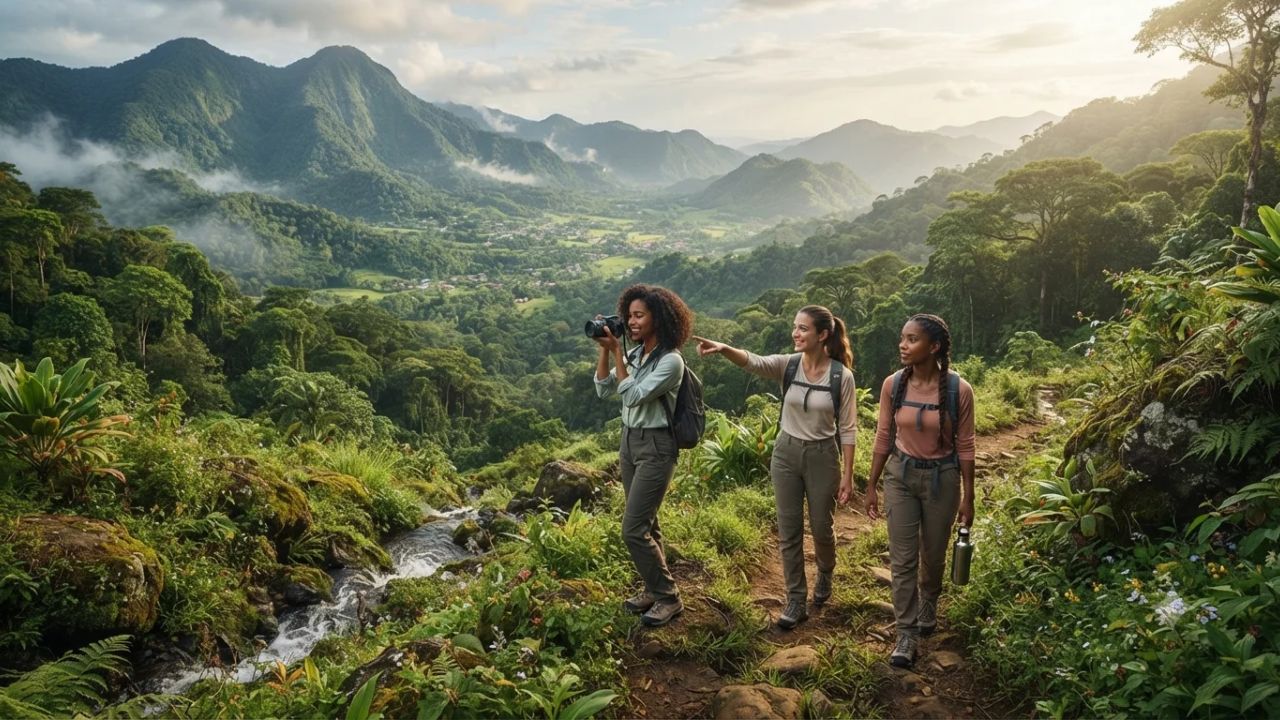
Image generated by AI
Generating B/.3,791.6 million in foreign-exchange tourism revenue on the back of 1,755,998 international visitor arrivals during the first six months of 2026—a 17.4% acceleration over the previous year—Panama is fundamentally decentralizing its visitor economy beyond the canal corridor. The official performance data, compiled jointly by the Autoridad de Turismo de Panamá (ATP) and the Instituto Nacional de Estadística y Censo (INEC), follows a landmark 2025 full-year benchmark where total arrivals topped 3,004,266 travelers, yielding B/.6,583.0 million in economic impact. Rather than concentrating this commercial expansion within Panama City's high-rise hotel districts, state development programs are channelling global travel demand into six provincial destinations: Santa Fe, Pedasí, Portobelo, El Valle de Antón, Parita, and Chitré.
The policy shift addresses a historical concentration of visitor spend. In 2025, overnight tourists accounted for 2,330,677 arrivals, with Tocumen International Airport absorbing 2,244,078 passengers, cruise operations bringing 344,408 maritime visitors, and the border station at Paso Canoas processing 106,006 overland travelers. While national hotel occupancy registered 59.3% in June 2026 and corporate meetings generated 74 international events with 113,937 participants, government initiatives like the Empreturismo program are providing targeted capital to expand rural guesthouses, agrotourism farms, and protected nature reserves across the interior provinces.
Macroeconomic Trajectory: Dissecting the Five-Year Inflow Surge
Panama's tourism expansion over the post-pandemic cycle reveals steady structural momentum. After border closures compressed arrivals to approximately 0.8 million in 2021, the market rebounded to roughly 1.9 million in 2022 before advancing 29.4% to 2,518,476 visitors in 2023. By 2024, volume reached an implied 2.78 million arrivals, paving the way for the record-setting 3,004,266 total in 2025, which marked an 8.2% annual gain.
This macroeconomic trajectory has transformed Panama's tourism infrastructure. The national accommodation register now tracks more than 20,000 hotel rooms. However, because national entry tallies reflect border checkpoints rather than town-specific headcounts, official tourism authorities emphasize distinct operational indicators—such as festival bookings, protected-area permits, and sports competitions—to measure provincial tourism density.
| Macro Tourism Indicator | Baseline Record (Full Year 2025) | Mid-Year Progress (Jan-Jun 2026) | Strategic Sector Meaning |
|---|---|---|---|
| Total International Visitors | 3,004,266 travelers (+8.2%) | 1,755,998 arrivals (+17.4%) | Sustained acceleration in global demand |
| Tourism Economic Inflow | B/.6,583.0 million | B/.3,791.6 million | Core foreign-exchange contributor |
| Overnight Tourist Stays | 2,330,677 registered stays | Expanding regional room nights | Baseline for hospitality occupancy |
| Primary Air Gateway (Tocumen) | 2,244,078 passengers | High-capacity intercontinental hub | Funnel for onward provincial transfers |
| Maritime Cruise Arrivals | 344,408 port passengers | Steady Atlantic/Pacific port calls | Seasonal coastal excursion demand |
| Overland Gateway (Paso Canoas) | 106,006 crossings | Border crossings from Costa Rica | Regional self-drive and bus itineraries |
| National Room Inventory | 20,000+ registered rooms | 59.3% occupancy (June 2026) | Capacity balance between city and interior |
Provincial Profiles: Six Micro-Destinations Reshaping the Itinerary
The government's regionalization push focuses on six geographically distinct areas that offer specialized alternatives to metropolitan sightseeing:
1. Santa Fe, Veraguas
Nestled in the highlands of Veraguas, Santa Fe centers on mountain agrotourism, cloud forest hiking, and organic cultivation. State tourism audits highlighted registered family-run properties such as Finca El Salto, where travelers encounter organic vegetables, cascades, petroglyphs, and artisanal chocolate production. Another verified estate, María y Chon, provides rural lodging integrated with coffee-processing demonstrations, river excursions, and native orchid nurseries. Further north, the district connects to the Atlantic coastal settlement of Calovébora, serving as an expedition gateway to Isla Escudo de Veraguas.
2. Pedasí and Playa Venao, Los Santos
Occupying the southeastern tip of the Azuero Peninsula, Pedasí pairs rolling pastures with Pacific surf culture and marine conservation. In 2026, Playa Venao hosted the XIX Pan American Surf Games, convening more than 280 elite athletes from 19 countries and driving local accommodation occupancy to 100%. Beyond competitive surfing, the district features Isla Iguana Wildlife Refuge, where environmental authorities have upgraded hiking trails and ecological sanitation systems to support controlled dolphin watching, snorkeling, and sport fishing.
3. Portobelo, Colón
Positioned on the Caribbean coastline, Portobelo blends colonial fortifications with coastal ecosystems within Portobelo National Park, a reserve spanning approximately 35,900 hectares, including 20% marine territory. The 17th-century fortifications of San Fernando, Santiago, and San Jerónimo—inscribed on the UNESCO World Heritage list in 1980—sit alongside a vibrant Afro-Panamanian cultural heritage celebrated through the annual Festival de Diablos y Congos. Between 2024 and 2025, the Portobelo Visitor Centre welcomed more than 4,500 organized tour groups, while provincial maritime facilities supported 91 cruise operations.
4. El Valle de Antón, Coclé
Situated within the geological caldera of an extinct volcano, El Valle de Antón functions as a temperate wellness and trekking destination. State planners have developed the Ruta de la Caldera, an integrated trail system whose initial stage establishes 30 kilometres of marked paths connecting thermal hot springs, waterfalls, and pre-Columbian petroglyphs at Piedra Pintada. Historical planning benchmarks indicate strong traveler willingness to pay premium rates for boutique mountain lodges and farm-to-table dining, cementing El Valle as a prime nature escape located two hours west of the capital.
5. Parita, Herrera
Parita preserves deep colonial and pre-Columbian roots in the Azuero plains. The community centers on the Iglesia Colonial de Parita, a mid-17th-century architectural monument declared a National Historic Monument in 1926. Outside the town perimeter lies Parque Nacional Sarigua, an 8,000-hectare arid saline territory containing archaeological evidence of ancient Indigenous settlements dating back approximately 11,000 years. During Corpus Christi, Parita hosts historic dance dramas including the Diablicos Sucios and Montezuma Pariteña, providing travelers with unvarnished folkloric traditions.
6. Chitré, Herrera
As the primary commercial crossroad of the Azuero Peninsula, Chitré provides a practical urban base equipped with conventional hotel services, museums, and restored daily commercial flights. Travelers use Chitré to access regional agrotourism farms in Monagrillo that offer fruit cultivation and livestock tours, while taking short day excursions to the colonial artisan villages of Pesé and La Villa de Los Santos.
| Destination Hub | Administrative Province | Core Travel Assets | Official Planning Indicator | Recommended Duration |
|---|---|---|---|---|
| Santa Fe | Veraguas | Agrotourism, cascades, coffee | Verified ATP agrotourism registry | 2 Nights |
| Pedasí / Venao | Los Santos | World-class surfing, Isla Iguana | 100% occupancy during Pan Am Surf | 3 Nights |
| Portobelo | Colón | UNESCO forts, Afro-Caribbean arts | 35,900-ha park; 4,500+ group visits | 2 Nights |
| El Valle de Antón | Coclé | Volcanic crater, thermal springs | 30-km Ruta de la Caldera network | 2 Nights |
| Parita | Herrera | 17th-century church, Sarigua park | 11,000-year archaeological traces | 1–2 Nights |
| Chitré | Herrera | Regional transport, farm estates | Restored daily scheduled flights | 2–3 Nights |
Environmental Governance and MiAMBIENTE Conservation Mandates
Because these six regional hubs border ecologically fragile zones, national tourism expansion is governed by rigorous conservation regulations administered by the Ministerio de Ambiente de Panamá (MiAMBIENTE). In February 2026, the ministry approved the Strategic Environmental Assessment for Pedasí, formalizing land-use zoning to prevent uncontrolled commercial sprawl from degrading coastal mangrove networks.
Similar ecological protections apply to marine and national park assets. Visitors accessing Portobelo National Park, Isla Iguana, or Santa Fe National Park must comply with mandatory online registration protocols and respect zero-trace environmental rules. At Portobelo, environmental rangers have implemented explicit regulations prohibiting tourists from feeding wild primates or disrupting marine fauna. These statutory measures ensure that rapid increases in foreign arrivals do not undermine the biodiversity that attracts international visitors in the first place.
Expert Analysis: Provincial Absorptive Capacity and Ground Transport Bottlenecks
From an aviation logistics and destination management viewpoint, Panama's tourism boom presents an acute operational divergence: world-class international access via Tocumen versus limited absorptive capacity in provincial interiors. While Tocumen functions as the premier intercontinental air bridge in Latin America, moving travelers from international arrivals to provincial trailheads involves navigating significant infrastructure bottlenecks.
For travelers booking this route, the direct consequence is that last-minute spontaneous travel through regional Panama is becoming increasingly difficult. During peak cultural festivals or major athletic events—demonstrated by the 100% occupancy recorded in Pedasí during the Pan American Surf Games—rural boutique hotels, rental 4x4 vehicles, and licensed local boat operators sell out months in advance. Travelers arriving without confirmed reservations face exorbitant premiums or find themselves displaced to roadside motels far from primary attractions.
The pricing pressure this creates means independent rural operators and family-owned agrotourism farms gain substantial pricing power, allowing them to charge rates comparable to capital-city hotels while operating on limited room inventories. To maximize travel value, visitors must approach regional Panama with structured planning: securing domestic flights to regional airstrips like Chitré where available, scheduling Inter-American Highway transits on weekdays to avoid weekend holiday congestion, and confirming guided excursions through ATP-registered operators. By distributing traveler spend across these six distinct ecosystems, visitors participate in a sustainable travel model that directly funds community conservation while experiencing the true geographical depth of the isthmus.
Key Takeaways
- Robust National Expansion: Panama recorded 1,755,998 international visitors in the first half of 2026, a 17.4% year-on-year increase that generated B/.3,791.6 million in foreign-exchange revenue.
- Historic Annual Milestone: Full-year 2025 arrivals exceeded 3.0 million for the first time, supported by 2,244,078 arrivals through Tocumen airport and 344,408 cruise passenger visits.
- Deliberate Regional Decentralization: State destination programs are diverting traveler traffic away from Panama City into six diverse interior hubs spanning volcanic craters, Pacific surf breaks, and cloud forests.
- Event-Driven Demand Surges: High-profile events like the 2026 Pan American Surf Games in Playa Venao demonstrate the power of sports tourism, generating 100% hotel occupancy across regional lodging.
- Strict Environmental Safeguards: MiAMBIENTE enforces strict protected-area regulations, including visitor quotas and wildlife protection rules, across national parks like Portobelo and Isla Iguana.
FAQ: Regional Panama Travel and Decentralized Tourism 2026
What makes El Valle de Antón geographically unique for travelers?
El Valle de Antón is situated inside the crater of an extinct volcano, offering cool mountain climates, thermal springs, and the 30-kilometre Ruta de la Caldera trail network.
Why is advance booking essential for coastal areas like Pedasí and Playa Venao?
Because regional room inventory is limited, major events like international surf competitions quickly push hotel occupancy to 100%, causing nearby lodgings and rental vehicles to sell out completely.
Can visitors access historic and marine attractions together in Portobelo?
Yes. Portobelo National Park covers 35,900 hectares of Caribbean forests and coral reefs, surrounding 17th-century UNESCO World Heritage Spanish fortifications and Afro-Panamanian cultural heritage.
Does Chitré have direct commercial air connections with Panama City?
Yes. Chitré operates scheduled domestic commercial flights from Panama City, serving as an accessible transit hub for travelers exploring the wider Azuero Peninsula and Parita.
Moving beyond the shadow of the canal, Panama's six regional frontiers prove that the country's most compelling travel narratives are written in its volcanic valleys and coastal villages.
Related Travel Guides
Disclaimer
This article is for informational and educational purposes only. It does not constitute legal, financial, or professional advice. While we strive to provide accurate and up-to-date information, travel policies, regulations, and conditions change rapidly. Always verify information with official sources before making travel decisions. Nomad Lawyer makes no representations about the accuracy, reliability, completeness, or suitability of the information provided. Readers should consult qualified professionals for advice specific to their circumstances. The views expressed in this article are those of the author and do not necessarily reflect the views of Nomad Lawyer.
Raushan Kumar
Founder & Lead Developer
Full-stack developer with 11+ years of experience and a passionate traveller. Raushan built Nomad Lawyer from the ground up with a vision to create the best travel and law experience on the web.
Learn more about our team →